SUBSCRIBE TO OUR FREE NEWSLETTER
Daily news & progressive opinion—funded by the people, not the corporations—delivered straight to your inbox.
5
#000000
#FFFFFF
To donate by check, phone, or other method, see our More Ways to Give page.
As the nation commemorates the fifty years that have passed since the height of the Civil Rights struggle that marked the 1960s as a time of historic progress in U.S. history, a diverse coalition of advocacy groups, faith-based organizations, and prominent justice and anti-poverty activists are joining forces to endorse the idea of a new broad-based movement to tackle the ills of racial discrimination, ecological degradation, and economic inequality that persist in contemporary society.
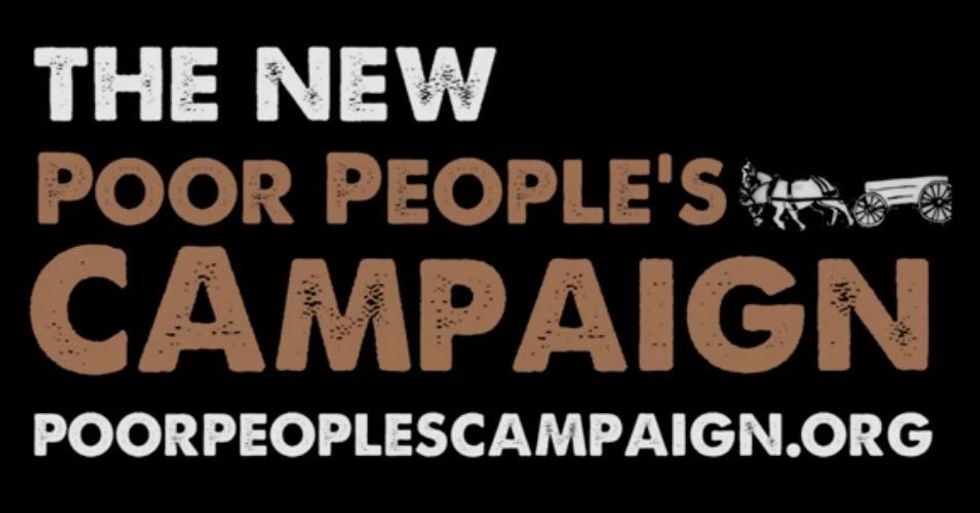
Borrowing the name of the well-known and anti-poverty and social justice campaign initiated by Dr. Martin Luther King, Jr. and the Southern Christian Leadership Conference in 1968, this new coalition is voicing support for what they call a 'New Poor People's Campaign' which will aim to fight back against a range of inter-connected societal ills -- including "an unfair police and prison system, cuts to public education, the denial of Medicaid expansion, unsafe working conditions and unfair wages, ecological devastation and the dangerous pollution of their communities, and renewed attacks on voting rights."
With the attention of the nation turned to the events that took place in Selma fifty years ago this weekend, delegates from this new coalition also converged in the Alabama city to discuss their new vision for a revitalized mass movement. The various and diverse organizations endorsing the project can be found on the campaign's website. Though most are based in the U.S., the vision for the campaign extends beyond national borders and hopes to foster allies from across the globe.
Additionally, in this statement of purpose posted to their website, the campaign organizers explain:
We live in a time of profound crisis, a time where virtually everywhere, nearly all systems and institutions fundamental to society -- political, economic, social and religious -- at best fail to meet people's needs and at worst cause widespread suffering. Poverty and economic insecurity are widespread with nearly 1/2 of the world's population--more than 3 billion people--living on less than $2.50 a day, 870 million people chronically malnourished, and millions more without health care, housing, food, education, jobs that pay adequately. Climate change is wreaking havoc all over the planet, impacting the poorest and most vulnerable the most. In recent decades, we've also seen a steady increase in war and violent conflicts which have left millions of poor people dead, displaced, and dispossessed.
In recent decades we have seen the development of a newly globalized ruling elite and power structure. The power of global capital and the institutions that serve it have meant a globalization of the political, economic, and social systems that produce poverty today. They have also meant that crises in any of those systems have devastating world-wide effects for the poor.
The profound economic crisis we are experiencing is a result of a profound crisis of leadership in the United States and in the world today. The global economic crisis has revealed the fundamental weakness in our global economic order: although we have the technical means to produce an unheard of abundance, we continue to witness a massive expansion of poverty and deepening economic inequality. There should be no poverty when there is plenty; there should be no abandonment amidst abundance. Dr. Martin Luther King Jr. argued that, "There is nothing new about poverty. What is new, however, is that we now have the resources to get rid of it... Why should there be hunger and privation in any land, in any city, at any table, when [human beings have] the resources and the scientific know-how to provide all [humankind] with the basic necessities of life?... There is no deficit in human resources, the deficit is in human will...The time has come for an all-out war against poverty."
The 'New Poor People's Campaign' is asking people to get involved by checking out their website, which offers various ways to explore their ideas and engage with the proposed agenda.
According to the project organizers, "A lesson learned from history is that a campaign on the scale called for by the current crisis cannot be launched by, or belong to, a few leaders or organizations. What is needed is a movement that reflects the needs, concerns, experiences, and demands of the diverse struggles taking place in communities large and small across the country and around the globe. To build such a campaign, we need to unite. We need to strengthen our connections and sharpen our understanding of the problems we face."
As the nation commemorates the fifty years that have passed since the height of the Civil Rights struggle that marked the 1960s as a time of historic progress in U.S. history, a diverse coalition of advocacy groups, faith-based organizations, and prominent justice and anti-poverty activists are joining forces to endorse the idea of a new broad-based movement to tackle the ills of racial discrimination, ecological degradation, and economic inequality that persist in contemporary society.
Borrowing the name of the well-known and anti-poverty and social justice campaign initiated by Dr. Martin Luther King, Jr. and the Southern Christian Leadership Conference in 1968, this new coalition is voicing support for what they call a 'New Poor People's Campaign' which will aim to fight back against a range of inter-connected societal ills -- including "an unfair police and prison system, cuts to public education, the denial of Medicaid expansion, unsafe working conditions and unfair wages, ecological devastation and the dangerous pollution of their communities, and renewed attacks on voting rights."
With the attention of the nation turned to the events that took place in Selma fifty years ago this weekend, delegates from this new coalition also converged in the Alabama city to discuss their new vision for a revitalized mass movement. The various and diverse organizations endorsing the project can be found on the campaign's website. Though most are based in the U.S., the vision for the campaign extends beyond national borders and hopes to foster allies from across the globe.
Additionally, in this statement of purpose posted to their website, the campaign organizers explain:
We live in a time of profound crisis, a time where virtually everywhere, nearly all systems and institutions fundamental to society -- political, economic, social and religious -- at best fail to meet people's needs and at worst cause widespread suffering. Poverty and economic insecurity are widespread with nearly 1/2 of the world's population--more than 3 billion people--living on less than $2.50 a day, 870 million people chronically malnourished, and millions more without health care, housing, food, education, jobs that pay adequately. Climate change is wreaking havoc all over the planet, impacting the poorest and most vulnerable the most. In recent decades, we've also seen a steady increase in war and violent conflicts which have left millions of poor people dead, displaced, and dispossessed.
In recent decades we have seen the development of a newly globalized ruling elite and power structure. The power of global capital and the institutions that serve it have meant a globalization of the political, economic, and social systems that produce poverty today. They have also meant that crises in any of those systems have devastating world-wide effects for the poor.
The profound economic crisis we are experiencing is a result of a profound crisis of leadership in the United States and in the world today. The global economic crisis has revealed the fundamental weakness in our global economic order: although we have the technical means to produce an unheard of abundance, we continue to witness a massive expansion of poverty and deepening economic inequality. There should be no poverty when there is plenty; there should be no abandonment amidst abundance. Dr. Martin Luther King Jr. argued that, "There is nothing new about poverty. What is new, however, is that we now have the resources to get rid of it... Why should there be hunger and privation in any land, in any city, at any table, when [human beings have] the resources and the scientific know-how to provide all [humankind] with the basic necessities of life?... There is no deficit in human resources, the deficit is in human will...The time has come for an all-out war against poverty."
The 'New Poor People's Campaign' is asking people to get involved by checking out their website, which offers various ways to explore their ideas and engage with the proposed agenda.
According to the project organizers, "A lesson learned from history is that a campaign on the scale called for by the current crisis cannot be launched by, or belong to, a few leaders or organizations. What is needed is a movement that reflects the needs, concerns, experiences, and demands of the diverse struggles taking place in communities large and small across the country and around the globe. To build such a campaign, we need to unite. We need to strengthen our connections and sharpen our understanding of the problems we face."
As the nation commemorates the fifty years that have passed since the height of the Civil Rights struggle that marked the 1960s as a time of historic progress in U.S. history, a diverse coalition of advocacy groups, faith-based organizations, and prominent justice and anti-poverty activists are joining forces to endorse the idea of a new broad-based movement to tackle the ills of racial discrimination, ecological degradation, and economic inequality that persist in contemporary society.
Borrowing the name of the well-known and anti-poverty and social justice campaign initiated by Dr. Martin Luther King, Jr. and the Southern Christian Leadership Conference in 1968, this new coalition is voicing support for what they call a 'New Poor People's Campaign' which will aim to fight back against a range of inter-connected societal ills -- including "an unfair police and prison system, cuts to public education, the denial of Medicaid expansion, unsafe working conditions and unfair wages, ecological devastation and the dangerous pollution of their communities, and renewed attacks on voting rights."
With the attention of the nation turned to the events that took place in Selma fifty years ago this weekend, delegates from this new coalition also converged in the Alabama city to discuss their new vision for a revitalized mass movement. The various and diverse organizations endorsing the project can be found on the campaign's website. Though most are based in the U.S., the vision for the campaign extends beyond national borders and hopes to foster allies from across the globe.
Additionally, in this statement of purpose posted to their website, the campaign organizers explain:
We live in a time of profound crisis, a time where virtually everywhere, nearly all systems and institutions fundamental to society -- political, economic, social and religious -- at best fail to meet people's needs and at worst cause widespread suffering. Poverty and economic insecurity are widespread with nearly 1/2 of the world's population--more than 3 billion people--living on less than $2.50 a day, 870 million people chronically malnourished, and millions more without health care, housing, food, education, jobs that pay adequately. Climate change is wreaking havoc all over the planet, impacting the poorest and most vulnerable the most. In recent decades, we've also seen a steady increase in war and violent conflicts which have left millions of poor people dead, displaced, and dispossessed.
In recent decades we have seen the development of a newly globalized ruling elite and power structure. The power of global capital and the institutions that serve it have meant a globalization of the political, economic, and social systems that produce poverty today. They have also meant that crises in any of those systems have devastating world-wide effects for the poor.
The profound economic crisis we are experiencing is a result of a profound crisis of leadership in the United States and in the world today. The global economic crisis has revealed the fundamental weakness in our global economic order: although we have the technical means to produce an unheard of abundance, we continue to witness a massive expansion of poverty and deepening economic inequality. There should be no poverty when there is plenty; there should be no abandonment amidst abundance. Dr. Martin Luther King Jr. argued that, "There is nothing new about poverty. What is new, however, is that we now have the resources to get rid of it... Why should there be hunger and privation in any land, in any city, at any table, when [human beings have] the resources and the scientific know-how to provide all [humankind] with the basic necessities of life?... There is no deficit in human resources, the deficit is in human will...The time has come for an all-out war against poverty."
The 'New Poor People's Campaign' is asking people to get involved by checking out their website, which offers various ways to explore their ideas and engage with the proposed agenda.
According to the project organizers, "A lesson learned from history is that a campaign on the scale called for by the current crisis cannot be launched by, or belong to, a few leaders or organizations. What is needed is a movement that reflects the needs, concerns, experiences, and demands of the diverse struggles taking place in communities large and small across the country and around the globe. To build such a campaign, we need to unite. We need to strengthen our connections and sharpen our understanding of the problems we face."