SUBSCRIBE TO OUR FREE NEWSLETTER
Daily news & progressive opinion—funded by the people, not the corporations—delivered straight to your inbox.
5
#000000
#FFFFFF
To donate by check, phone, or other method, see our More Ways to Give page.
As hundreds of protesters marched to the steps of the Ferguson police station to demand an end to police brutality and racism, activists throughout the city prepared for a series of planned demonstrations in what organizers are calling a "Moral Monday" style of civil disobedience.
Activist and academic Dr. Cornel West was among the first of the roughly 600 protesters to be arrested, those in attendance reported.
Moral Mondays, a grassroots movement which began last year in North Carolina, saw activists in that state entering legislature buildings and being peacefully arrested as part of an effort to protest discriminatory laws.
A number of clergy participating in the march on Monday approached a line of officers outside of the police department and offered to take their confessions. Others held mirrors up in front of the line of officers. Some protesters drew a chalk outline of a body outside of the station as a memorial to Michael Brown, the unarmed black teenager whose shooting death on August 9 at the hands of Officer Darren Wilson, who is white, launched months of protests against police racism and brutality.
As rain began to fall harder and harder, some activists sang hymns, while others shouted, "Fight back!" and "Shut it down!"
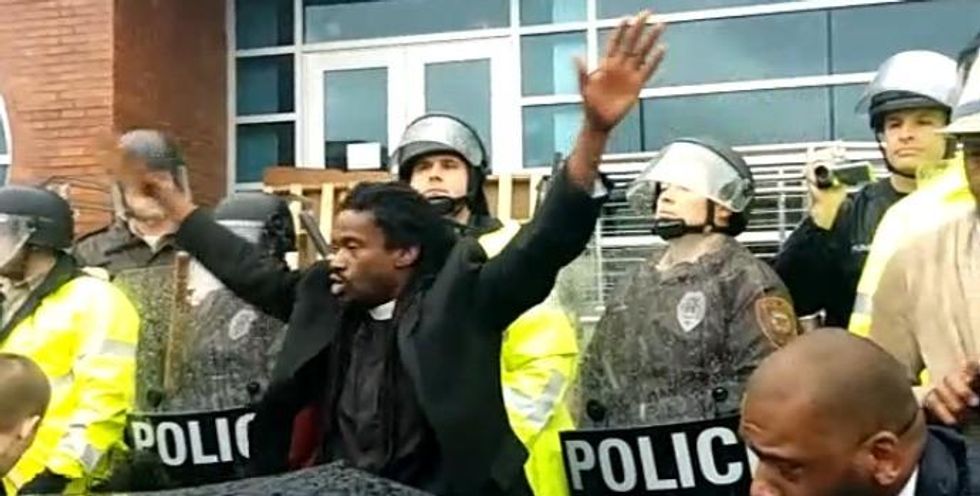
Officers barricaded the door to the police station. A protest leader gave a warning on a bullhorn that anyone who did not want to be arrested should stay behind a designated line of people holding hands.
While marching to the Ferguson police department, the protesters chanted "Hands up, don't shoot!", one of the signature slogans of the movement which culminated in the "Ferguson October" weekend of action that began last Friday.
The similar shooting death of Vonderrit Myers, a St. Louis resident who was killed last week by an off-duty officer in the Shaw neighborhood just days before the start of the weekend of action, sparked additional protests.
Police say Myers shot at the officer three times before he was killed.
Organizers kept a tight lid on details of Monday's actions earlier in the morning, but said that protests were planned in several places.
Before daybreak on Monday, more than 1,000 protesters also staged a massive, peaceful sit-in at St. Louis University, marching silently through the city until they reached the campus, where one protester announced to police barricading the entrance, "I am a student, I have my ID, and I have a lot of guests."
The weekend of action saw local organizers joined by protesters, civil rights groups, and activists from around the country--including prominent figures in the racial justice movement, like Dr. Cornel West, rapper Talib Kweli, and actor Jesse Williams. The protests are calling for an end to "the epidemic of police violence" and justice for Brown and Myers, as well as other black men and women that have been gunned down by police, security guards, and citizens, most of whom then escaped murder charges. Activists held rallies, demonstrations, and workshops over the weekend, which was mostly peaceful, although 17 arrests were reported on Saturday.
During the early-morning march, under heavy fog illuminated by street lamps, protesters also shut down an intersection by jumping rope, playing hopscotch, and throwing footballs, in a demonstration of civil disobedience that played on the protest slogan, "They think it's a game. They think it's a joke."
Myers' father, Vonderrit Myers Sr., who works at SLU, spoke to the crowd after they entered the campus. "This lets me know my son was loved," Myers said. "I'd like to thank every one of you here. God bless you."
SLU president Fred Pestello said in a statement, "I applaud the actions of everyone on campus--especially our students--for handling this situation with great grace and compassion."
Live updates can be viewed on Twitter under the hashtags #FergusonOctober and #MoralMonday:
As hundreds of protesters marched to the steps of the Ferguson police station to demand an end to police brutality and racism, activists throughout the city prepared for a series of planned demonstrations in what organizers are calling a "Moral Monday" style of civil disobedience.
Activist and academic Dr. Cornel West was among the first of the roughly 600 protesters to be arrested, those in attendance reported.
Moral Mondays, a grassroots movement which began last year in North Carolina, saw activists in that state entering legislature buildings and being peacefully arrested as part of an effort to protest discriminatory laws.
A number of clergy participating in the march on Monday approached a line of officers outside of the police department and offered to take their confessions. Others held mirrors up in front of the line of officers. Some protesters drew a chalk outline of a body outside of the station as a memorial to Michael Brown, the unarmed black teenager whose shooting death on August 9 at the hands of Officer Darren Wilson, who is white, launched months of protests against police racism and brutality.
As rain began to fall harder and harder, some activists sang hymns, while others shouted, "Fight back!" and "Shut it down!"
Officers barricaded the door to the police station. A protest leader gave a warning on a bullhorn that anyone who did not want to be arrested should stay behind a designated line of people holding hands.
While marching to the Ferguson police department, the protesters chanted "Hands up, don't shoot!", one of the signature slogans of the movement which culminated in the "Ferguson October" weekend of action that began last Friday.
The similar shooting death of Vonderrit Myers, a St. Louis resident who was killed last week by an off-duty officer in the Shaw neighborhood just days before the start of the weekend of action, sparked additional protests.
Police say Myers shot at the officer three times before he was killed.
Organizers kept a tight lid on details of Monday's actions earlier in the morning, but said that protests were planned in several places.
Before daybreak on Monday, more than 1,000 protesters also staged a massive, peaceful sit-in at St. Louis University, marching silently through the city until they reached the campus, where one protester announced to police barricading the entrance, "I am a student, I have my ID, and I have a lot of guests."
The weekend of action saw local organizers joined by protesters, civil rights groups, and activists from around the country--including prominent figures in the racial justice movement, like Dr. Cornel West, rapper Talib Kweli, and actor Jesse Williams. The protests are calling for an end to "the epidemic of police violence" and justice for Brown and Myers, as well as other black men and women that have been gunned down by police, security guards, and citizens, most of whom then escaped murder charges. Activists held rallies, demonstrations, and workshops over the weekend, which was mostly peaceful, although 17 arrests were reported on Saturday.
During the early-morning march, under heavy fog illuminated by street lamps, protesters also shut down an intersection by jumping rope, playing hopscotch, and throwing footballs, in a demonstration of civil disobedience that played on the protest slogan, "They think it's a game. They think it's a joke."
Myers' father, Vonderrit Myers Sr., who works at SLU, spoke to the crowd after they entered the campus. "This lets me know my son was loved," Myers said. "I'd like to thank every one of you here. God bless you."
SLU president Fred Pestello said in a statement, "I applaud the actions of everyone on campus--especially our students--for handling this situation with great grace and compassion."
Live updates can be viewed on Twitter under the hashtags #FergusonOctober and #MoralMonday:
As hundreds of protesters marched to the steps of the Ferguson police station to demand an end to police brutality and racism, activists throughout the city prepared for a series of planned demonstrations in what organizers are calling a "Moral Monday" style of civil disobedience.
Activist and academic Dr. Cornel West was among the first of the roughly 600 protesters to be arrested, those in attendance reported.
Moral Mondays, a grassroots movement which began last year in North Carolina, saw activists in that state entering legislature buildings and being peacefully arrested as part of an effort to protest discriminatory laws.
A number of clergy participating in the march on Monday approached a line of officers outside of the police department and offered to take their confessions. Others held mirrors up in front of the line of officers. Some protesters drew a chalk outline of a body outside of the station as a memorial to Michael Brown, the unarmed black teenager whose shooting death on August 9 at the hands of Officer Darren Wilson, who is white, launched months of protests against police racism and brutality.
As rain began to fall harder and harder, some activists sang hymns, while others shouted, "Fight back!" and "Shut it down!"
Officers barricaded the door to the police station. A protest leader gave a warning on a bullhorn that anyone who did not want to be arrested should stay behind a designated line of people holding hands.
While marching to the Ferguson police department, the protesters chanted "Hands up, don't shoot!", one of the signature slogans of the movement which culminated in the "Ferguson October" weekend of action that began last Friday.
The similar shooting death of Vonderrit Myers, a St. Louis resident who was killed last week by an off-duty officer in the Shaw neighborhood just days before the start of the weekend of action, sparked additional protests.
Police say Myers shot at the officer three times before he was killed.
Organizers kept a tight lid on details of Monday's actions earlier in the morning, but said that protests were planned in several places.
Before daybreak on Monday, more than 1,000 protesters also staged a massive, peaceful sit-in at St. Louis University, marching silently through the city until they reached the campus, where one protester announced to police barricading the entrance, "I am a student, I have my ID, and I have a lot of guests."
The weekend of action saw local organizers joined by protesters, civil rights groups, and activists from around the country--including prominent figures in the racial justice movement, like Dr. Cornel West, rapper Talib Kweli, and actor Jesse Williams. The protests are calling for an end to "the epidemic of police violence" and justice for Brown and Myers, as well as other black men and women that have been gunned down by police, security guards, and citizens, most of whom then escaped murder charges. Activists held rallies, demonstrations, and workshops over the weekend, which was mostly peaceful, although 17 arrests were reported on Saturday.
During the early-morning march, under heavy fog illuminated by street lamps, protesters also shut down an intersection by jumping rope, playing hopscotch, and throwing footballs, in a demonstration of civil disobedience that played on the protest slogan, "They think it's a game. They think it's a joke."
Myers' father, Vonderrit Myers Sr., who works at SLU, spoke to the crowd after they entered the campus. "This lets me know my son was loved," Myers said. "I'd like to thank every one of you here. God bless you."
SLU president Fred Pestello said in a statement, "I applaud the actions of everyone on campus--especially our students--for handling this situation with great grace and compassion."
Live updates can be viewed on Twitter under the hashtags #FergusonOctober and #MoralMonday: