SUBSCRIBE TO OUR FREE NEWSLETTER
Daily news & progressive opinion—funded by the people, not the corporations—delivered straight to your inbox.
5
#000000
#FFFFFF
To donate by check, phone, or other method, see our More Ways to Give page.
Daily news & progressive opinion—funded by the people, not the corporations—delivered straight to your inbox.
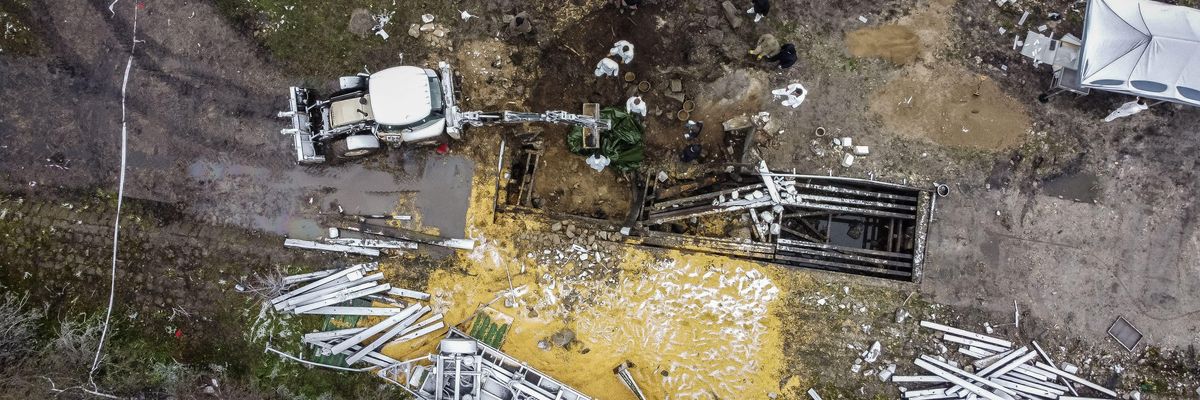
Aerial view taken on November 17, 2022 shows the site where a missile strike killed two men in the eastern Poland village of Przewodow, near the border with war-ravaged Ukraine on November 15, 2022. (Photo: Wojtek Radwanski and Damien SIMONART / AFP via Getty Images)
On November 15, two Russian-made cruise missiles crossed into Poland, landing in the village of Przewodow, a village in the southeastern corner of the country, near the border with Ukraine, killing at least two people.
The larger lesson to be learned from what happened in Poland is that dialogue is an essential requirement during moments of tension.
Preliminary investigations, as reported by NATO Secretary-General Jens Stoltenberg, indicate that the incident was caused by Ukraine's missile defense systems, which sought to intercept an incoming Russian missile. But the event immediately created a storm of speculation, coming as it did on a day when the Russian military fired some 90 cruise missiles at energy installations and other sites throughout Ukraine, continuing a weeks-long attempt to devastate the Ukrainian economy as winter approaches.
The episode, though accidental, marks the first time the fighting in Ukraine has crossed into NATO territory. That, in turn, produced a tsunami of instant analysis about whether Poland would invoke Article 5 of the 1949 Washington Treaty that created NATO. Article 5 is important because it states that an attack on one member state is an attack on all.
Everyone should have taken a deep breath. In times like these, when emotions run high and scary scenarios abound, prudence is particularly important. Invoking Article 5 is an alliance decision--and even if it were invoked, each country has the right to determine how it will respond.
Article 5 is frequently labeled the North Atlantic Treaty's most important clause--and with some justification. The collective defense commitment serves as the foundation of NATO's deterrent power. It is designed to dissuade an adversary from even thinking about launching an attack against a member state for fear of having to fight an alliance that now includes 30 countries (compared to the Cold War highpoint of 16). To the alliance's credit, the collective defense provision has worked as intended since 1949. The only time NATO has invoked the clause was after the 9/11 attacks, and that was largely as a demonstration of solidarity against a much weaker foe--a terrorist group, not a state.
Furthermore, putting NATO on a war footing isn't as simple as flipping a switch--and that's a good thing. The invocation of Article 5 doesn't actually require all NATO countries to go into autopilot mode and rush into battle. Each member of the alliance has self-agency. The decision to act, and what exactly to do, lies entirely with individual states and may differ depending on any number of circumstances--and for good reason.
NATO's commitment to collective defense was framed in a manner that would prevent events outside of its control from forcing the alliance into military action it may not wish to take. To preclude haste, the alliance's charter gives each member state the leeway to act "as it deems necessary...to restore and maintain the security of the North Atlantic area." The term "action" is left open to interpretation: it could include the use of military force but also any number of responses short of war, including severing diplomatic relations with the offending state and imposing economic sanctions. The resort to force is not ruled out, but neither is it automatic.
Moreover, no treaty, however sacrosanct in Washington policy circles, supplants the U.S. Constitution. Even had Poland requested the invocation of Article 5 and NATO determined that military force was called for, President Biden could not have short-circuited American constitutional procedures. He would still need to approach the U.S. Congress, the branch with the sole authority to declare war or authorize the use of force, and make the case that war serves the U.S. interest. Bypassing these critical procedures, even to protect an ally, would be unconstitutional.
What happened in Poland should remind us that war is inherently unpredictable and far more difficult to control than those who initiate and wage it assume. It can escalate, spread to places that were not in the fight when the guns began to fire, and produce unimaginable economic repercussions. The longer a war drags on, the more likely the law of unintended consequences will kick in.
The war in Ukraine illustrates this perfectly. It has lasted longer than anyone -- certainly Vladimir Putin -- anticipated and increased food and energy prices for countries, especially poor ones, thousands of miles away from Ukraine. There's no reason to believe a negotiated settlement to the war in Ukraine is on the horizon; but there are several reasons to believe that more surprises await us--some that may harm people with no immediate connection to the conflict. This is reason enough to have provisions and procedures, such as Article 5, in place to put a brake on impulsive reactions. To their credit, President Biden and America's NATO partners displayed this prudence by not jumping to a premature conclusion and, instead, urging patience until the facts became clear.
The larger lesson to be learned from what happened in Poland is that dialogue is an essential requirement during moments of tension. Washington and Moscow need to keep communications channels open even, or especially, during the worst of times. Putin's invasion of Ukraine has taken US-Russian relations to their lowest point in the post-Cold War era. As tempting as it may be to ostracize Russia, self-interest, even self-preservation, dictates clear and frequent communication in order to minimize misunderstandings and prevent isolated incidents from blooming into full-blown crises. It's the kind of common sense which, fortunately, infuses Article 5.
Dear Common Dreams reader, It’s been nearly 30 years since I co-founded Common Dreams with my late wife, Lina Newhouser. We had the radical notion that journalism should serve the public good, not corporate profits. It was clear to us from the outset what it would take to build such a project. No paid advertisements. No corporate sponsors. No millionaire publisher telling us what to think or do. Many people said we wouldn't last a year, but we proved those doubters wrong. Together with a tremendous team of journalists and dedicated staff, we built an independent media outlet free from the constraints of profits and corporate control. Our mission has always been simple: To inform. To inspire. To ignite change for the common good. Building Common Dreams was not easy. Our survival was never guaranteed. When you take on the most powerful forces—Wall Street greed, fossil fuel industry destruction, Big Tech lobbyists, and uber-rich oligarchs who have spent billions upon billions rigging the economy and democracy in their favor—the only bulwark you have is supporters who believe in your work. But here’s the urgent message from me today. It's never been this bad out there. And it's never been this hard to keep us going. At the very moment Common Dreams is most needed, the threats we face are intensifying. We need your support now more than ever. We don't accept corporate advertising and never will. We don't have a paywall because we don't think people should be blocked from critical news based on their ability to pay. Everything we do is funded by the donations of readers like you. When everyone does the little they can afford, we are strong. But if that support retreats or dries up, so do we. Will you donate now to make sure Common Dreams not only survives but thrives? —Craig Brown, Co-founder |
On November 15, two Russian-made cruise missiles crossed into Poland, landing in the village of Przewodow, a village in the southeastern corner of the country, near the border with Ukraine, killing at least two people.
The larger lesson to be learned from what happened in Poland is that dialogue is an essential requirement during moments of tension.
Preliminary investigations, as reported by NATO Secretary-General Jens Stoltenberg, indicate that the incident was caused by Ukraine's missile defense systems, which sought to intercept an incoming Russian missile. But the event immediately created a storm of speculation, coming as it did on a day when the Russian military fired some 90 cruise missiles at energy installations and other sites throughout Ukraine, continuing a weeks-long attempt to devastate the Ukrainian economy as winter approaches.
The episode, though accidental, marks the first time the fighting in Ukraine has crossed into NATO territory. That, in turn, produced a tsunami of instant analysis about whether Poland would invoke Article 5 of the 1949 Washington Treaty that created NATO. Article 5 is important because it states that an attack on one member state is an attack on all.
Everyone should have taken a deep breath. In times like these, when emotions run high and scary scenarios abound, prudence is particularly important. Invoking Article 5 is an alliance decision--and even if it were invoked, each country has the right to determine how it will respond.
Article 5 is frequently labeled the North Atlantic Treaty's most important clause--and with some justification. The collective defense commitment serves as the foundation of NATO's deterrent power. It is designed to dissuade an adversary from even thinking about launching an attack against a member state for fear of having to fight an alliance that now includes 30 countries (compared to the Cold War highpoint of 16). To the alliance's credit, the collective defense provision has worked as intended since 1949. The only time NATO has invoked the clause was after the 9/11 attacks, and that was largely as a demonstration of solidarity against a much weaker foe--a terrorist group, not a state.
Furthermore, putting NATO on a war footing isn't as simple as flipping a switch--and that's a good thing. The invocation of Article 5 doesn't actually require all NATO countries to go into autopilot mode and rush into battle. Each member of the alliance has self-agency. The decision to act, and what exactly to do, lies entirely with individual states and may differ depending on any number of circumstances--and for good reason.
NATO's commitment to collective defense was framed in a manner that would prevent events outside of its control from forcing the alliance into military action it may not wish to take. To preclude haste, the alliance's charter gives each member state the leeway to act "as it deems necessary...to restore and maintain the security of the North Atlantic area." The term "action" is left open to interpretation: it could include the use of military force but also any number of responses short of war, including severing diplomatic relations with the offending state and imposing economic sanctions. The resort to force is not ruled out, but neither is it automatic.
Moreover, no treaty, however sacrosanct in Washington policy circles, supplants the U.S. Constitution. Even had Poland requested the invocation of Article 5 and NATO determined that military force was called for, President Biden could not have short-circuited American constitutional procedures. He would still need to approach the U.S. Congress, the branch with the sole authority to declare war or authorize the use of force, and make the case that war serves the U.S. interest. Bypassing these critical procedures, even to protect an ally, would be unconstitutional.
What happened in Poland should remind us that war is inherently unpredictable and far more difficult to control than those who initiate and wage it assume. It can escalate, spread to places that were not in the fight when the guns began to fire, and produce unimaginable economic repercussions. The longer a war drags on, the more likely the law of unintended consequences will kick in.
The war in Ukraine illustrates this perfectly. It has lasted longer than anyone -- certainly Vladimir Putin -- anticipated and increased food and energy prices for countries, especially poor ones, thousands of miles away from Ukraine. There's no reason to believe a negotiated settlement to the war in Ukraine is on the horizon; but there are several reasons to believe that more surprises await us--some that may harm people with no immediate connection to the conflict. This is reason enough to have provisions and procedures, such as Article 5, in place to put a brake on impulsive reactions. To their credit, President Biden and America's NATO partners displayed this prudence by not jumping to a premature conclusion and, instead, urging patience until the facts became clear.
The larger lesson to be learned from what happened in Poland is that dialogue is an essential requirement during moments of tension. Washington and Moscow need to keep communications channels open even, or especially, during the worst of times. Putin's invasion of Ukraine has taken US-Russian relations to their lowest point in the post-Cold War era. As tempting as it may be to ostracize Russia, self-interest, even self-preservation, dictates clear and frequent communication in order to minimize misunderstandings and prevent isolated incidents from blooming into full-blown crises. It's the kind of common sense which, fortunately, infuses Article 5.
On November 15, two Russian-made cruise missiles crossed into Poland, landing in the village of Przewodow, a village in the southeastern corner of the country, near the border with Ukraine, killing at least two people.
The larger lesson to be learned from what happened in Poland is that dialogue is an essential requirement during moments of tension.
Preliminary investigations, as reported by NATO Secretary-General Jens Stoltenberg, indicate that the incident was caused by Ukraine's missile defense systems, which sought to intercept an incoming Russian missile. But the event immediately created a storm of speculation, coming as it did on a day when the Russian military fired some 90 cruise missiles at energy installations and other sites throughout Ukraine, continuing a weeks-long attempt to devastate the Ukrainian economy as winter approaches.
The episode, though accidental, marks the first time the fighting in Ukraine has crossed into NATO territory. That, in turn, produced a tsunami of instant analysis about whether Poland would invoke Article 5 of the 1949 Washington Treaty that created NATO. Article 5 is important because it states that an attack on one member state is an attack on all.
Everyone should have taken a deep breath. In times like these, when emotions run high and scary scenarios abound, prudence is particularly important. Invoking Article 5 is an alliance decision--and even if it were invoked, each country has the right to determine how it will respond.
Article 5 is frequently labeled the North Atlantic Treaty's most important clause--and with some justification. The collective defense commitment serves as the foundation of NATO's deterrent power. It is designed to dissuade an adversary from even thinking about launching an attack against a member state for fear of having to fight an alliance that now includes 30 countries (compared to the Cold War highpoint of 16). To the alliance's credit, the collective defense provision has worked as intended since 1949. The only time NATO has invoked the clause was after the 9/11 attacks, and that was largely as a demonstration of solidarity against a much weaker foe--a terrorist group, not a state.
Furthermore, putting NATO on a war footing isn't as simple as flipping a switch--and that's a good thing. The invocation of Article 5 doesn't actually require all NATO countries to go into autopilot mode and rush into battle. Each member of the alliance has self-agency. The decision to act, and what exactly to do, lies entirely with individual states and may differ depending on any number of circumstances--and for good reason.
NATO's commitment to collective defense was framed in a manner that would prevent events outside of its control from forcing the alliance into military action it may not wish to take. To preclude haste, the alliance's charter gives each member state the leeway to act "as it deems necessary...to restore and maintain the security of the North Atlantic area." The term "action" is left open to interpretation: it could include the use of military force but also any number of responses short of war, including severing diplomatic relations with the offending state and imposing economic sanctions. The resort to force is not ruled out, but neither is it automatic.
Moreover, no treaty, however sacrosanct in Washington policy circles, supplants the U.S. Constitution. Even had Poland requested the invocation of Article 5 and NATO determined that military force was called for, President Biden could not have short-circuited American constitutional procedures. He would still need to approach the U.S. Congress, the branch with the sole authority to declare war or authorize the use of force, and make the case that war serves the U.S. interest. Bypassing these critical procedures, even to protect an ally, would be unconstitutional.
What happened in Poland should remind us that war is inherently unpredictable and far more difficult to control than those who initiate and wage it assume. It can escalate, spread to places that were not in the fight when the guns began to fire, and produce unimaginable economic repercussions. The longer a war drags on, the more likely the law of unintended consequences will kick in.
The war in Ukraine illustrates this perfectly. It has lasted longer than anyone -- certainly Vladimir Putin -- anticipated and increased food and energy prices for countries, especially poor ones, thousands of miles away from Ukraine. There's no reason to believe a negotiated settlement to the war in Ukraine is on the horizon; but there are several reasons to believe that more surprises await us--some that may harm people with no immediate connection to the conflict. This is reason enough to have provisions and procedures, such as Article 5, in place to put a brake on impulsive reactions. To their credit, President Biden and America's NATO partners displayed this prudence by not jumping to a premature conclusion and, instead, urging patience until the facts became clear.
The larger lesson to be learned from what happened in Poland is that dialogue is an essential requirement during moments of tension. Washington and Moscow need to keep communications channels open even, or especially, during the worst of times. Putin's invasion of Ukraine has taken US-Russian relations to their lowest point in the post-Cold War era. As tempting as it may be to ostracize Russia, self-interest, even self-preservation, dictates clear and frequent communication in order to minimize misunderstandings and prevent isolated incidents from blooming into full-blown crises. It's the kind of common sense which, fortunately, infuses Article 5.