SUBSCRIBE TO OUR FREE NEWSLETTER
Daily news & progressive opinion—funded by the people, not the corporations—delivered straight to your inbox.
5
#000000
#FFFFFF
To donate by check, phone, or other method, see our More Ways to Give page.
Daily news & progressive opinion—funded by the people, not the corporations—delivered straight to your inbox.
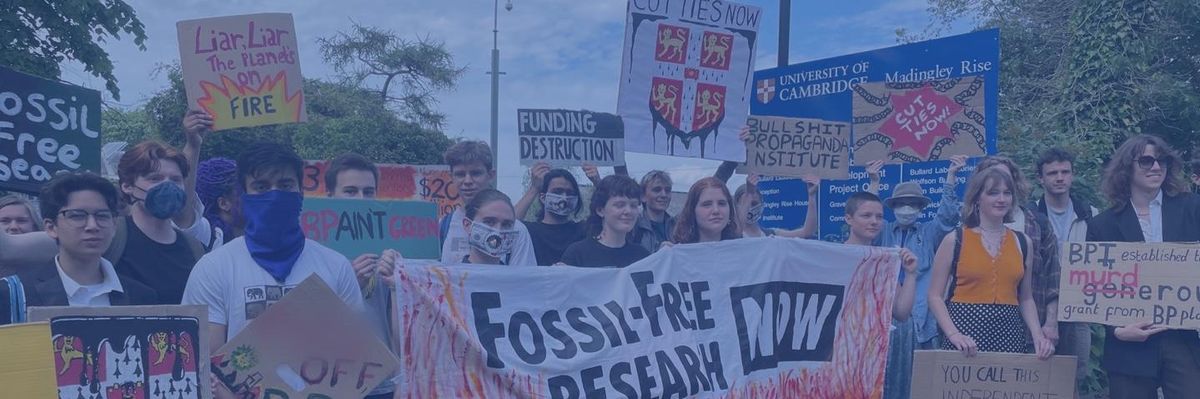
"Universities should not be engaged in concealing the influence of the powerful over scholarship," writes the authors. "Rather, they should protect the integrity of researchers who make courageous claims grounded in evidence and careful research." (Photo: Terry Macalister / via Fossil Free Research)
After a summer of record-breaking heat waves sweeping the northern hemisphere from Europe to China to California and while environmental justice advocates debate the merits of climate provisions of the landmark Inflation Reduction Act passed by the U.S. Congress, there's another critical, if less well known, front opening in the struggle to support climate action.
American research universities like Harvard and Stanford are on the front lines of this debate. Each institution has announced new climate programs--funded by massive donations of $200 million and $1.7 billion, respectively. And each announcement has been met with calls from students, alumni, faculty, and staff to ban fossil fuel funding for these programs. At Stanford, the inaugural dean insisted the new Doerr School of Sustainability would be "open to" donations from and work with the fossil fuel industry. As the school launches officially this week, oil and gas prospecting are prominently advertised among the school's "industrial affiliates program." If the industry succeeds in consolidating its influence at these centers, the consequences will echo for decades.
As Harvard and Stanford alumni whose careers focus on environmental justice, we urge our alma maters to refuse oil and gas industry money. Over 740 academics and hundreds of alumni from both schools agree with us. At Cambridge University, momentum has been building this summer around such a ban. Yet neither Harvard nor Stanford has committed to refusing fossil fuel industry research funding.
Instead of corporate interest, climate research should be accountable to frontline communities disproportionately impacted by the climate crisis already.
Funding sources have a major impact on research outcomes. As demonstrated repeatedly by scholars, industry funding can lead to unconscious bias among researchers, significantly skewing the framing and findings of scholarship toward outcomes that favor the funders. Precedents for banning funding from specific industries already exist, such as the Harvard T. H. Chan School of Public Health's policy refusing grants and other support from tobacco-related companies.
Proponents of corporate funding will argue that a diversity of funding sources can bolster the quality of research when paired with good intentions and appropriate guardrails. However, the American Association of University Professors warns that corporate funding can constrain, not strengthen, "the independence of researchers...no matter how elaborate the safeguards." Other experts mapping the extent of industry influence within universities have noted the chilling effect of fossil fuel funding on academic research, reporting that academics fear losing their funding if they take positions that aren't friendly to the industry.
Universities should not be engaged in concealing the influence of the powerful over scholarship. Rather, they should protect the integrity of researchers who make courageous claims grounded in evidence and careful research.
Little in the fossil fuel industry's track record suggests it can be trusted as a good faith partner. Fossil fuel executives have engaged in an explicit strategy to muddy debates in media, policymaking, and international negotiations. The industry's work to influence research agendas, promote scholarship they have funded, and attempt to buy the silence of scientists is just another facet of this strategy.
Even as the industry claims to be contributing to a clean energy transition, analysts have exposed its claims as greenwashing. Meanwhile, oil and gas companies continue to invest heavily in new fossil fuel projects.
Research universities should prioritize bold action to address the magnitude of the crisis, rather than working to strengthen the fossil industry's bottom line. Every research dollar, lab hour, and project report that is beholden to or biased by fossil fuel industry influence is a missed opportunity to address the climate crisis, let alone the pressing justice challenges associated with it.
To help address the climate crisis effectively, research at universities like Harvard and Stanford must be grounded in climate justice values. This means directing their vast institutional resources toward research agendas guided by the needs of the planet's most vulnerable. Universities have a vital role to play in this work: bridging disciplinary silos to make sure responses to climate change are equitable. Globally, we have the technologies and technical know-how to rapidly and equitably decarbonize our energy infrastructure while safeguarding biodiversity. Yet, vast challenges remain in the lopsided distribution of resources to scale up these capacities globally and make connections across fields of knowledge.
Instead of corporate interest, climate research should be accountable to frontline communities disproportionately impacted by the climate crisis already. Preexisting inequalities, including racial injustice, gender inequality, and legacies of slavery and colonialism, work to compound droughts, floods, fires, and other climate-fueled catastrophes. As BIPOC- and youth-led movements have emphasized with prophetic power, we have our work cut out for us.
Universities do not need fossil fuel funding, but the fossil fuel industry needs Harvard and Stanford's prestige to keep legitimizing its business model.
To the institutional leaders of our alma maters, we call on you to refuse fossil fuel industry research funding. Embrace the path to an equitable, livable future for our planet.
Dear Common Dreams reader, It’s been nearly 30 years since I co-founded Common Dreams with my late wife, Lina Newhouser. We had the radical notion that journalism should serve the public good, not corporate profits. It was clear to us from the outset what it would take to build such a project. No paid advertisements. No corporate sponsors. No millionaire publisher telling us what to think or do. Many people said we wouldn't last a year, but we proved those doubters wrong. Together with a tremendous team of journalists and dedicated staff, we built an independent media outlet free from the constraints of profits and corporate control. Our mission has always been simple: To inform. To inspire. To ignite change for the common good. Building Common Dreams was not easy. Our survival was never guaranteed. When you take on the most powerful forces—Wall Street greed, fossil fuel industry destruction, Big Tech lobbyists, and uber-rich oligarchs who have spent billions upon billions rigging the economy and democracy in their favor—the only bulwark you have is supporters who believe in your work. But here’s the urgent message from me today. It's never been this bad out there. And it's never been this hard to keep us going. At the very moment Common Dreams is most needed, the threats we face are intensifying. We need your support now more than ever. We don't accept corporate advertising and never will. We don't have a paywall because we don't think people should be blocked from critical news based on their ability to pay. Everything we do is funded by the donations of readers like you. When everyone does the little they can afford, we are strong. But if that support retreats or dries up, so do we. Will you donate now to make sure Common Dreams not only survives but thrives? —Craig Brown, Co-founder |
After a summer of record-breaking heat waves sweeping the northern hemisphere from Europe to China to California and while environmental justice advocates debate the merits of climate provisions of the landmark Inflation Reduction Act passed by the U.S. Congress, there's another critical, if less well known, front opening in the struggle to support climate action.
American research universities like Harvard and Stanford are on the front lines of this debate. Each institution has announced new climate programs--funded by massive donations of $200 million and $1.7 billion, respectively. And each announcement has been met with calls from students, alumni, faculty, and staff to ban fossil fuel funding for these programs. At Stanford, the inaugural dean insisted the new Doerr School of Sustainability would be "open to" donations from and work with the fossil fuel industry. As the school launches officially this week, oil and gas prospecting are prominently advertised among the school's "industrial affiliates program." If the industry succeeds in consolidating its influence at these centers, the consequences will echo for decades.
As Harvard and Stanford alumni whose careers focus on environmental justice, we urge our alma maters to refuse oil and gas industry money. Over 740 academics and hundreds of alumni from both schools agree with us. At Cambridge University, momentum has been building this summer around such a ban. Yet neither Harvard nor Stanford has committed to refusing fossil fuel industry research funding.
Instead of corporate interest, climate research should be accountable to frontline communities disproportionately impacted by the climate crisis already.
Funding sources have a major impact on research outcomes. As demonstrated repeatedly by scholars, industry funding can lead to unconscious bias among researchers, significantly skewing the framing and findings of scholarship toward outcomes that favor the funders. Precedents for banning funding from specific industries already exist, such as the Harvard T. H. Chan School of Public Health's policy refusing grants and other support from tobacco-related companies.
Proponents of corporate funding will argue that a diversity of funding sources can bolster the quality of research when paired with good intentions and appropriate guardrails. However, the American Association of University Professors warns that corporate funding can constrain, not strengthen, "the independence of researchers...no matter how elaborate the safeguards." Other experts mapping the extent of industry influence within universities have noted the chilling effect of fossil fuel funding on academic research, reporting that academics fear losing their funding if they take positions that aren't friendly to the industry.
Universities should not be engaged in concealing the influence of the powerful over scholarship. Rather, they should protect the integrity of researchers who make courageous claims grounded in evidence and careful research.
Little in the fossil fuel industry's track record suggests it can be trusted as a good faith partner. Fossil fuel executives have engaged in an explicit strategy to muddy debates in media, policymaking, and international negotiations. The industry's work to influence research agendas, promote scholarship they have funded, and attempt to buy the silence of scientists is just another facet of this strategy.
Even as the industry claims to be contributing to a clean energy transition, analysts have exposed its claims as greenwashing. Meanwhile, oil and gas companies continue to invest heavily in new fossil fuel projects.
Research universities should prioritize bold action to address the magnitude of the crisis, rather than working to strengthen the fossil industry's bottom line. Every research dollar, lab hour, and project report that is beholden to or biased by fossil fuel industry influence is a missed opportunity to address the climate crisis, let alone the pressing justice challenges associated with it.
To help address the climate crisis effectively, research at universities like Harvard and Stanford must be grounded in climate justice values. This means directing their vast institutional resources toward research agendas guided by the needs of the planet's most vulnerable. Universities have a vital role to play in this work: bridging disciplinary silos to make sure responses to climate change are equitable. Globally, we have the technologies and technical know-how to rapidly and equitably decarbonize our energy infrastructure while safeguarding biodiversity. Yet, vast challenges remain in the lopsided distribution of resources to scale up these capacities globally and make connections across fields of knowledge.
Instead of corporate interest, climate research should be accountable to frontline communities disproportionately impacted by the climate crisis already. Preexisting inequalities, including racial injustice, gender inequality, and legacies of slavery and colonialism, work to compound droughts, floods, fires, and other climate-fueled catastrophes. As BIPOC- and youth-led movements have emphasized with prophetic power, we have our work cut out for us.
Universities do not need fossil fuel funding, but the fossil fuel industry needs Harvard and Stanford's prestige to keep legitimizing its business model.
To the institutional leaders of our alma maters, we call on you to refuse fossil fuel industry research funding. Embrace the path to an equitable, livable future for our planet.
After a summer of record-breaking heat waves sweeping the northern hemisphere from Europe to China to California and while environmental justice advocates debate the merits of climate provisions of the landmark Inflation Reduction Act passed by the U.S. Congress, there's another critical, if less well known, front opening in the struggle to support climate action.
American research universities like Harvard and Stanford are on the front lines of this debate. Each institution has announced new climate programs--funded by massive donations of $200 million and $1.7 billion, respectively. And each announcement has been met with calls from students, alumni, faculty, and staff to ban fossil fuel funding for these programs. At Stanford, the inaugural dean insisted the new Doerr School of Sustainability would be "open to" donations from and work with the fossil fuel industry. As the school launches officially this week, oil and gas prospecting are prominently advertised among the school's "industrial affiliates program." If the industry succeeds in consolidating its influence at these centers, the consequences will echo for decades.
As Harvard and Stanford alumni whose careers focus on environmental justice, we urge our alma maters to refuse oil and gas industry money. Over 740 academics and hundreds of alumni from both schools agree with us. At Cambridge University, momentum has been building this summer around such a ban. Yet neither Harvard nor Stanford has committed to refusing fossil fuel industry research funding.
Instead of corporate interest, climate research should be accountable to frontline communities disproportionately impacted by the climate crisis already.
Funding sources have a major impact on research outcomes. As demonstrated repeatedly by scholars, industry funding can lead to unconscious bias among researchers, significantly skewing the framing and findings of scholarship toward outcomes that favor the funders. Precedents for banning funding from specific industries already exist, such as the Harvard T. H. Chan School of Public Health's policy refusing grants and other support from tobacco-related companies.
Proponents of corporate funding will argue that a diversity of funding sources can bolster the quality of research when paired with good intentions and appropriate guardrails. However, the American Association of University Professors warns that corporate funding can constrain, not strengthen, "the independence of researchers...no matter how elaborate the safeguards." Other experts mapping the extent of industry influence within universities have noted the chilling effect of fossil fuel funding on academic research, reporting that academics fear losing their funding if they take positions that aren't friendly to the industry.
Universities should not be engaged in concealing the influence of the powerful over scholarship. Rather, they should protect the integrity of researchers who make courageous claims grounded in evidence and careful research.
Little in the fossil fuel industry's track record suggests it can be trusted as a good faith partner. Fossil fuel executives have engaged in an explicit strategy to muddy debates in media, policymaking, and international negotiations. The industry's work to influence research agendas, promote scholarship they have funded, and attempt to buy the silence of scientists is just another facet of this strategy.
Even as the industry claims to be contributing to a clean energy transition, analysts have exposed its claims as greenwashing. Meanwhile, oil and gas companies continue to invest heavily in new fossil fuel projects.
Research universities should prioritize bold action to address the magnitude of the crisis, rather than working to strengthen the fossil industry's bottom line. Every research dollar, lab hour, and project report that is beholden to or biased by fossil fuel industry influence is a missed opportunity to address the climate crisis, let alone the pressing justice challenges associated with it.
To help address the climate crisis effectively, research at universities like Harvard and Stanford must be grounded in climate justice values. This means directing their vast institutional resources toward research agendas guided by the needs of the planet's most vulnerable. Universities have a vital role to play in this work: bridging disciplinary silos to make sure responses to climate change are equitable. Globally, we have the technologies and technical know-how to rapidly and equitably decarbonize our energy infrastructure while safeguarding biodiversity. Yet, vast challenges remain in the lopsided distribution of resources to scale up these capacities globally and make connections across fields of knowledge.
Instead of corporate interest, climate research should be accountable to frontline communities disproportionately impacted by the climate crisis already. Preexisting inequalities, including racial injustice, gender inequality, and legacies of slavery and colonialism, work to compound droughts, floods, fires, and other climate-fueled catastrophes. As BIPOC- and youth-led movements have emphasized with prophetic power, we have our work cut out for us.
Universities do not need fossil fuel funding, but the fossil fuel industry needs Harvard and Stanford's prestige to keep legitimizing its business model.
To the institutional leaders of our alma maters, we call on you to refuse fossil fuel industry research funding. Embrace the path to an equitable, livable future for our planet.