SUBSCRIBE TO OUR FREE NEWSLETTER
Daily news & progressive opinion—funded by the people, not the corporations—delivered straight to your inbox.
5
#000000
#FFFFFF
To donate by check, phone, or other method, see our More Ways to Give page.
Daily news & progressive opinion—funded by the people, not the corporations—delivered straight to your inbox.
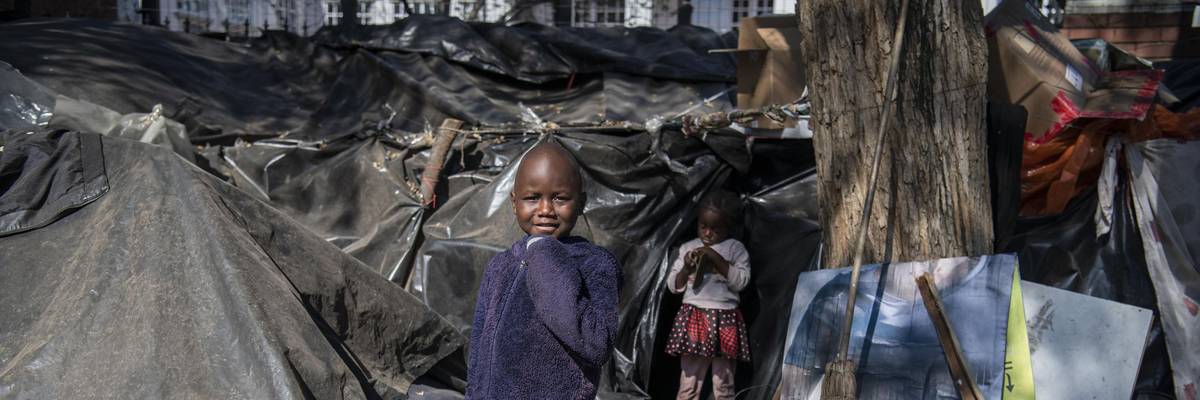
Congolese refugees, who fled the conflict in the Democratic Republic of Congo and took shelter in here, are seen as they continue to live in makeshift tents, set up by their efforts, that they set up in front of the UNHCR (United Nations Refugee Agency) building in Pretoria, South Africa on June 20, 2022. (Photo: Ihsaan Haffejee/Anadolu Agency via Getty Images)
Most refugees do not want to leave their homes.
In my family's case, a volcano erupted just 8km (5 miles) away from the only house they ever knew. Black smoke rolled above Lake Kivu, filling our streets, choking us. Conflict from the civil war forced my family to flee again. We then sought safety in Uganda.
According to a recent United Nations report, the number of people forced to flee conflict, violence and persecution has now crossed a staggering milestone--more than 100 million. Of these refugees, nearly half are children.
My father described the Ugandan refugee camp as a boundless desert, with scant supplies and little water. Our family remained there for two and a half years on the brink of starvation. Yet, we persisted. We survived and by some miracle, were granted asylum in the United States.
To this day, the smell of rotisserie chicken draws me back to my first meal in the United States. I remember the plastic container, the warmth of the chicken creating condensation on the lid, juices seeping out of the moist meat, and the pattern of the hotel bedspread upon which my family of 10 sat in Salt Lake City, Utah--a world away from our beloved home in Africa.
This modest meal exemplified joy and possibility after such strife. Sitting together, enjoying this bounty, we did not have much other than the clothes on our backs, but we felt like the richest people in the world. Our wealth was not measured in monetary value. We were rich within our hearts because we were no longer afraid. We were no longer hungry. We were safe.
My family and I are the lucky ones. According to a recent United Nations report, the number of people forced to flee conflict, violence and persecution has now crossed a staggering milestone--more than 100 million. Of these refugees, nearly half are children.
Millions are exploited. Their journeys are often deadly and when they do arrive at a place of safety, they are denied access to basic rights such as education and healthcare.
The conflict in Ukraine has brought unfathomable heartbreak. But I would argue that it has also shown humanity at its best. More than 7.6 million people have fled Ukraine. People opened their homes and offered warm meals. Neighbouring countries have opened schools for Ukrainian children and are providing healthcare to families fleeing violence. The European Union offered temporary protection to migrants. Organisations like the Red Cross and Red Crescent have offered mental health support to help heal the invisible wounds of war. The response has been nothing short of incredible.
While Ukraine has dominated the headlines, I implore you to make this the moment where you open your hearts to the plight of refugees from around the world. My message to people, governments and world leaders is simple: please keep this spirit of generosity alive. Violence and conflict continue around the globe. Migrants from all over the world need your compassion.
Today, I am a sophomore at the University of Utah. I plan to go to law school and am committed to helping others. Migrant voices like mine need to be at the heart of the policy process in this country and on the global stage.
Last month, I visited the UN, where global leaders gathered to propose solutions to the complex problems of migration. While there, I had the opportunity to meet with Francesco Rocca, president of the International Federation of Red Cross and Red Crescent Societies (IFRC). He said, "Ethnicity and nationality should not become deciding factors in saving lives." I agree. Protecting people forced to flee their homes, no matter where they are from, is our shared responsibility.
I firmly believe that if you have the knowledge, it is within your power to help change the world. The solutions to the challenges of global migration are complex and varied but our response to the conflict in Ukraine demonstrates that we can work together to find tangible solutions at the local, regional and global levels to help those who need it most. We have more work to do to help migrants around the world but I know we can do it together. There are families still waiting to share their first meal together in a safe place. Let us help them do so.
Dear Common Dreams reader, It’s been nearly 30 years since I co-founded Common Dreams with my late wife, Lina Newhouser. We had the radical notion that journalism should serve the public good, not corporate profits. It was clear to us from the outset what it would take to build such a project. No paid advertisements. No corporate sponsors. No millionaire publisher telling us what to think or do. Many people said we wouldn't last a year, but we proved those doubters wrong. Together with a tremendous team of journalists and dedicated staff, we built an independent media outlet free from the constraints of profits and corporate control. Our mission has always been simple: To inform. To inspire. To ignite change for the common good. Building Common Dreams was not easy. Our survival was never guaranteed. When you take on the most powerful forces—Wall Street greed, fossil fuel industry destruction, Big Tech lobbyists, and uber-rich oligarchs who have spent billions upon billions rigging the economy and democracy in their favor—the only bulwark you have is supporters who believe in your work. But here’s the urgent message from me today. It's never been this bad out there. And it's never been this hard to keep us going. At the very moment Common Dreams is most needed, the threats we face are intensifying. We need your support now more than ever. We don't accept corporate advertising and never will. We don't have a paywall because we don't think people should be blocked from critical news based on their ability to pay. Everything we do is funded by the donations of readers like you. When everyone does the little they can afford, we are strong. But if that support retreats or dries up, so do we. Will you donate now to make sure Common Dreams not only survives but thrives? —Craig Brown, Co-founder |
Most refugees do not want to leave their homes.
In my family's case, a volcano erupted just 8km (5 miles) away from the only house they ever knew. Black smoke rolled above Lake Kivu, filling our streets, choking us. Conflict from the civil war forced my family to flee again. We then sought safety in Uganda.
According to a recent United Nations report, the number of people forced to flee conflict, violence and persecution has now crossed a staggering milestone--more than 100 million. Of these refugees, nearly half are children.
My father described the Ugandan refugee camp as a boundless desert, with scant supplies and little water. Our family remained there for two and a half years on the brink of starvation. Yet, we persisted. We survived and by some miracle, were granted asylum in the United States.
To this day, the smell of rotisserie chicken draws me back to my first meal in the United States. I remember the plastic container, the warmth of the chicken creating condensation on the lid, juices seeping out of the moist meat, and the pattern of the hotel bedspread upon which my family of 10 sat in Salt Lake City, Utah--a world away from our beloved home in Africa.
This modest meal exemplified joy and possibility after such strife. Sitting together, enjoying this bounty, we did not have much other than the clothes on our backs, but we felt like the richest people in the world. Our wealth was not measured in monetary value. We were rich within our hearts because we were no longer afraid. We were no longer hungry. We were safe.
My family and I are the lucky ones. According to a recent United Nations report, the number of people forced to flee conflict, violence and persecution has now crossed a staggering milestone--more than 100 million. Of these refugees, nearly half are children.
Millions are exploited. Their journeys are often deadly and when they do arrive at a place of safety, they are denied access to basic rights such as education and healthcare.
The conflict in Ukraine has brought unfathomable heartbreak. But I would argue that it has also shown humanity at its best. More than 7.6 million people have fled Ukraine. People opened their homes and offered warm meals. Neighbouring countries have opened schools for Ukrainian children and are providing healthcare to families fleeing violence. The European Union offered temporary protection to migrants. Organisations like the Red Cross and Red Crescent have offered mental health support to help heal the invisible wounds of war. The response has been nothing short of incredible.
While Ukraine has dominated the headlines, I implore you to make this the moment where you open your hearts to the plight of refugees from around the world. My message to people, governments and world leaders is simple: please keep this spirit of generosity alive. Violence and conflict continue around the globe. Migrants from all over the world need your compassion.
Today, I am a sophomore at the University of Utah. I plan to go to law school and am committed to helping others. Migrant voices like mine need to be at the heart of the policy process in this country and on the global stage.
Last month, I visited the UN, where global leaders gathered to propose solutions to the complex problems of migration. While there, I had the opportunity to meet with Francesco Rocca, president of the International Federation of Red Cross and Red Crescent Societies (IFRC). He said, "Ethnicity and nationality should not become deciding factors in saving lives." I agree. Protecting people forced to flee their homes, no matter where they are from, is our shared responsibility.
I firmly believe that if you have the knowledge, it is within your power to help change the world. The solutions to the challenges of global migration are complex and varied but our response to the conflict in Ukraine demonstrates that we can work together to find tangible solutions at the local, regional and global levels to help those who need it most. We have more work to do to help migrants around the world but I know we can do it together. There are families still waiting to share their first meal together in a safe place. Let us help them do so.
Most refugees do not want to leave their homes.
In my family's case, a volcano erupted just 8km (5 miles) away from the only house they ever knew. Black smoke rolled above Lake Kivu, filling our streets, choking us. Conflict from the civil war forced my family to flee again. We then sought safety in Uganda.
According to a recent United Nations report, the number of people forced to flee conflict, violence and persecution has now crossed a staggering milestone--more than 100 million. Of these refugees, nearly half are children.
My father described the Ugandan refugee camp as a boundless desert, with scant supplies and little water. Our family remained there for two and a half years on the brink of starvation. Yet, we persisted. We survived and by some miracle, were granted asylum in the United States.
To this day, the smell of rotisserie chicken draws me back to my first meal in the United States. I remember the plastic container, the warmth of the chicken creating condensation on the lid, juices seeping out of the moist meat, and the pattern of the hotel bedspread upon which my family of 10 sat in Salt Lake City, Utah--a world away from our beloved home in Africa.
This modest meal exemplified joy and possibility after such strife. Sitting together, enjoying this bounty, we did not have much other than the clothes on our backs, but we felt like the richest people in the world. Our wealth was not measured in monetary value. We were rich within our hearts because we were no longer afraid. We were no longer hungry. We were safe.
My family and I are the lucky ones. According to a recent United Nations report, the number of people forced to flee conflict, violence and persecution has now crossed a staggering milestone--more than 100 million. Of these refugees, nearly half are children.
Millions are exploited. Their journeys are often deadly and when they do arrive at a place of safety, they are denied access to basic rights such as education and healthcare.
The conflict in Ukraine has brought unfathomable heartbreak. But I would argue that it has also shown humanity at its best. More than 7.6 million people have fled Ukraine. People opened their homes and offered warm meals. Neighbouring countries have opened schools for Ukrainian children and are providing healthcare to families fleeing violence. The European Union offered temporary protection to migrants. Organisations like the Red Cross and Red Crescent have offered mental health support to help heal the invisible wounds of war. The response has been nothing short of incredible.
While Ukraine has dominated the headlines, I implore you to make this the moment where you open your hearts to the plight of refugees from around the world. My message to people, governments and world leaders is simple: please keep this spirit of generosity alive. Violence and conflict continue around the globe. Migrants from all over the world need your compassion.
Today, I am a sophomore at the University of Utah. I plan to go to law school and am committed to helping others. Migrant voices like mine need to be at the heart of the policy process in this country and on the global stage.
Last month, I visited the UN, where global leaders gathered to propose solutions to the complex problems of migration. While there, I had the opportunity to meet with Francesco Rocca, president of the International Federation of Red Cross and Red Crescent Societies (IFRC). He said, "Ethnicity and nationality should not become deciding factors in saving lives." I agree. Protecting people forced to flee their homes, no matter where they are from, is our shared responsibility.
I firmly believe that if you have the knowledge, it is within your power to help change the world. The solutions to the challenges of global migration are complex and varied but our response to the conflict in Ukraine demonstrates that we can work together to find tangible solutions at the local, regional and global levels to help those who need it most. We have more work to do to help migrants around the world but I know we can do it together. There are families still waiting to share their first meal together in a safe place. Let us help them do so.