
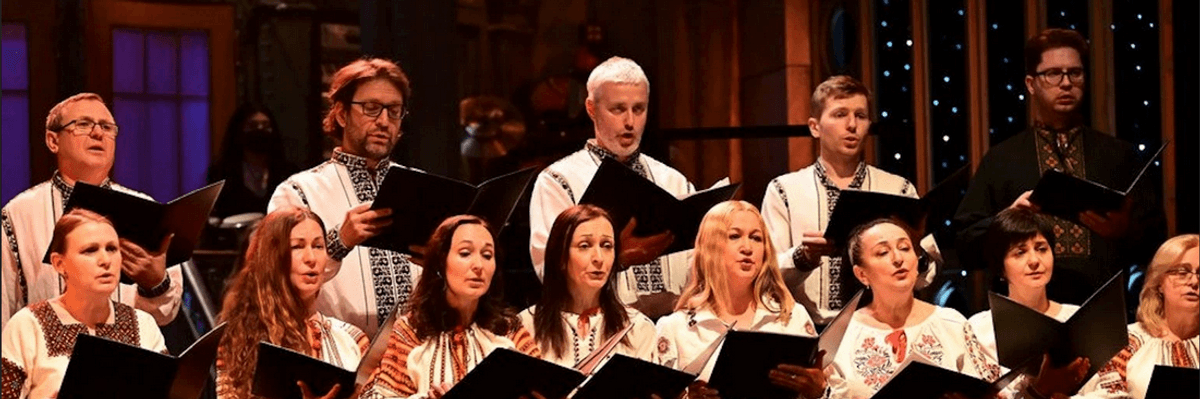
Ukrainian Chorus Dumka of New York performs "Prayer for Ukraine" during "Saturday Night Live" on February 26, 2022. (Photo:Will Heath/NBC)
Cold Open: Ukraine and the Conscience of the Left
The best way to help the people of Ukraine is to ignore the war promoters and choose the path of negotiation—for their sake and, with nuclear missiles on both sides of the Atlantic, for ours.
Saturday Night Live responded to Russia's invasion of Ukraine by devoting its "cold open," which typically involves a comedy routine based on current events, to a solemn performance by a New-York based Ukrainian chorus. It was a moving moment. It's impossible not to be moved by Ukraine's suffering, and was glad to see their courage being honored.
Sometimes, however, something else is revealed in the onrush of emotion. A columnist in Great Britain's Daily Telegraph wrote of the Ukrainians, "They seem so like us. That's what makes it shocking."
So like us.
That columnist was a conservative, but a great many liberals seem equally selective in their compassion. It takes nothing away from the cause of the Ukrainian people to ask: Why hasn't the American left shown the same solidarity with the victims of its own country's military adventures? A performative "standing up for Ukraine" requires no courage, no conscience, no sacrifice. American leftists can't do much to influence Vladimir Putin's actions, but a sustained antiwar movement in the US could undercut support for our own military adventures. That's where the US left's words and deeds could make a difference.
In the absence of courage, expressions of solidarity for the enemies of our country's enemies seem like cheap grace.
As these words are written, our country's actions are causing a mass casualty event in Afghanistan. We are underwriting an apartheid regime in Palestine. When have you seen an Afghan choir or Palestinian balladeer on network television? Why is the liberal-dominated media covering this attack on white people so differently?
In the absence of courage, expressions of solidarity for the enemies of our country's enemies seem like cheap grace. They give us a way to reassure ourselves that our compassion is alive and finely-tuned without paying a price for its expression. Support for the war-torn Palestinians or Afghans could cost public figures speaking engagements, performance gigs, invitations to the right seminars in Aspen and Davos. Not so with expressions of support for the Ukrainians.
The selectivity reveals itself in actions, as well as words. Liberal institutions that have rejected calls to boycott Israeli institutions or settlement products have rushed to ban Russian performers and closed their doors to Russian banks and corporations.
Former Secretary of State and presidential candidate Hillary Clinton said, "We have to make sure that within our own country, we are calling out people giving aid and comfort to Putin and siding with autocrats against the global cause of democracy." The comment was chilling in its implication for civil liberties. And it was a different story when she was responsible for US foreign policy.
"As the Russians gradually assumed control of Uranium One in three separate transactions from 2009 to 2013," wrote the New York Times, "Canadian records show a flow of cash made its way to the Clinton Foundation." That from an article headlined, "Cash Flowed to Clinton Foundation Amid Russian Uranium Deal."
American liberals love to call the Senate Minority Leader "Moscow Mitch," while ignoring the fact that Bill Clinton received a $500,000 "speaking fee" from a Russian investment bank. One of the Saturday Night Live cast members who introduced that chorus said she admires Hillary Clinton "so much."
But then, she's so like us.
Why? Why the hypocrisy, from people who undoubtedly think of themselves as good and decent? Studies have shown that empathetic people often display more hostility to those who are not in their in-group or don't share their political beliefs. They see "outsiders" as a threat to those they care about, not as fellow humans who deserve their empathy. White American liberals, despite their anti-racist protestations, are not exempt from anti-outsider--sometimes racist--impulses. Sure, sometimes they express concern for nonwhite victims of American or American-backed aggression. But there is often a palpable difference in tone when they do. Call it the difference between solidarity and altruism.
Yes, there are American groups working against war. But their voices are too few, too far between.
None of us are immune toward misplaced empathy or hostility toward outsiders. Bigotry, like other human traits, is... well, it's so like us. Now, however, it's more than a moral failing. It's an existential threat to humanity.
Some people, like whistleblower Dan Ellsberg, have been consistent voices against the threat of nuclear war. Now, more than ever, they need to be heard. The best way to help the people of Ukraine is to ignore the war promoters and choose the path of negotiation--for their sake and, with nuclear missiles on both sides of the Atlantic, for ours.
Yes, there are American groups working against war. But their voices are too few, too far between. They risk being shouted down by a chorus of voices calling for bloodshed. If it isn't stopped, that chorus will sing us into the coldest open of all.
We are at a crossroads
This country and this world are at a monumental crossroads. In a few short weeks, US voters will have an opportunity to beat back the forces of fascism and confront the billionaires who are rigging the economy, our media system, and our democracy, making it increasingly impossible for ordinary people to get by. We’re not just talking about the election. We’re talking about what must be done once these fascist elements are vanquished from power. We need a bolder set of solutions than what either major party has so far been willing to offer and a working-class movement ready to fight like hell for it. Trump didn't emerge from nowhere. The conditions that fueled MAGA authoritarianism were created by decades of radical neoliberal economic policies and a corrupt political system dominated by corporate interests. They slashed taxes on the super-rich, promising that the benefits would trickle down. They said giveaways to the corporate titans would make life more affordable for the rest of us. It was all bullshit. And when a bitter, betrayed populace searches for someone to blame, right-wing demagogues have little trouble finding scapegoats. People know when they're being lied to, but you won't hear any of this from the corporate media. Only independent journalism—powered and funded by people who believe in building a better world—can deliver truly trustworthy daily news. Our Fall Campaign is underway, and we need your help. To power our newsroom through the rest of the year, we need to raise $125,000 by midnight on October 31. So if you share our vision, please contribute whatever you can to sustain our work. |
Richard (RJ) Eskow is a journalist who has written for a number of major publications. His weekly program, The Zero Hour, can be found on cable television, radio, Spotify, and podcast media.
Saturday Night Live responded to Russia's invasion of Ukraine by devoting its "cold open," which typically involves a comedy routine based on current events, to a solemn performance by a New-York based Ukrainian chorus. It was a moving moment. It's impossible not to be moved by Ukraine's suffering, and was glad to see their courage being honored.
Sometimes, however, something else is revealed in the onrush of emotion. A columnist in Great Britain's Daily Telegraph wrote of the Ukrainians, "They seem so like us. That's what makes it shocking."
So like us.
That columnist was a conservative, but a great many liberals seem equally selective in their compassion. It takes nothing away from the cause of the Ukrainian people to ask: Why hasn't the American left shown the same solidarity with the victims of its own country's military adventures? A performative "standing up for Ukraine" requires no courage, no conscience, no sacrifice. American leftists can't do much to influence Vladimir Putin's actions, but a sustained antiwar movement in the US could undercut support for our own military adventures. That's where the US left's words and deeds could make a difference.
In the absence of courage, expressions of solidarity for the enemies of our country's enemies seem like cheap grace.
As these words are written, our country's actions are causing a mass casualty event in Afghanistan. We are underwriting an apartheid regime in Palestine. When have you seen an Afghan choir or Palestinian balladeer on network television? Why is the liberal-dominated media covering this attack on white people so differently?
In the absence of courage, expressions of solidarity for the enemies of our country's enemies seem like cheap grace. They give us a way to reassure ourselves that our compassion is alive and finely-tuned without paying a price for its expression. Support for the war-torn Palestinians or Afghans could cost public figures speaking engagements, performance gigs, invitations to the right seminars in Aspen and Davos. Not so with expressions of support for the Ukrainians.
The selectivity reveals itself in actions, as well as words. Liberal institutions that have rejected calls to boycott Israeli institutions or settlement products have rushed to ban Russian performers and closed their doors to Russian banks and corporations.
Former Secretary of State and presidential candidate Hillary Clinton said, "We have to make sure that within our own country, we are calling out people giving aid and comfort to Putin and siding with autocrats against the global cause of democracy." The comment was chilling in its implication for civil liberties. And it was a different story when she was responsible for US foreign policy.
"As the Russians gradually assumed control of Uranium One in three separate transactions from 2009 to 2013," wrote the New York Times, "Canadian records show a flow of cash made its way to the Clinton Foundation." That from an article headlined, "Cash Flowed to Clinton Foundation Amid Russian Uranium Deal."
American liberals love to call the Senate Minority Leader "Moscow Mitch," while ignoring the fact that Bill Clinton received a $500,000 "speaking fee" from a Russian investment bank. One of the Saturday Night Live cast members who introduced that chorus said she admires Hillary Clinton "so much."
But then, she's so like us.
Why? Why the hypocrisy, from people who undoubtedly think of themselves as good and decent? Studies have shown that empathetic people often display more hostility to those who are not in their in-group or don't share their political beliefs. They see "outsiders" as a threat to those they care about, not as fellow humans who deserve their empathy. White American liberals, despite their anti-racist protestations, are not exempt from anti-outsider--sometimes racist--impulses. Sure, sometimes they express concern for nonwhite victims of American or American-backed aggression. But there is often a palpable difference in tone when they do. Call it the difference between solidarity and altruism.
Yes, there are American groups working against war. But their voices are too few, too far between.
None of us are immune toward misplaced empathy or hostility toward outsiders. Bigotry, like other human traits, is... well, it's so like us. Now, however, it's more than a moral failing. It's an existential threat to humanity.
Some people, like whistleblower Dan Ellsberg, have been consistent voices against the threat of nuclear war. Now, more than ever, they need to be heard. The best way to help the people of Ukraine is to ignore the war promoters and choose the path of negotiation--for their sake and, with nuclear missiles on both sides of the Atlantic, for ours.
Yes, there are American groups working against war. But their voices are too few, too far between. They risk being shouted down by a chorus of voices calling for bloodshed. If it isn't stopped, that chorus will sing us into the coldest open of all.
Richard (RJ) Eskow is a journalist who has written for a number of major publications. His weekly program, The Zero Hour, can be found on cable television, radio, Spotify, and podcast media.
Saturday Night Live responded to Russia's invasion of Ukraine by devoting its "cold open," which typically involves a comedy routine based on current events, to a solemn performance by a New-York based Ukrainian chorus. It was a moving moment. It's impossible not to be moved by Ukraine's suffering, and was glad to see their courage being honored.
Sometimes, however, something else is revealed in the onrush of emotion. A columnist in Great Britain's Daily Telegraph wrote of the Ukrainians, "They seem so like us. That's what makes it shocking."
So like us.
That columnist was a conservative, but a great many liberals seem equally selective in their compassion. It takes nothing away from the cause of the Ukrainian people to ask: Why hasn't the American left shown the same solidarity with the victims of its own country's military adventures? A performative "standing up for Ukraine" requires no courage, no conscience, no sacrifice. American leftists can't do much to influence Vladimir Putin's actions, but a sustained antiwar movement in the US could undercut support for our own military adventures. That's where the US left's words and deeds could make a difference.
In the absence of courage, expressions of solidarity for the enemies of our country's enemies seem like cheap grace.
As these words are written, our country's actions are causing a mass casualty event in Afghanistan. We are underwriting an apartheid regime in Palestine. When have you seen an Afghan choir or Palestinian balladeer on network television? Why is the liberal-dominated media covering this attack on white people so differently?
In the absence of courage, expressions of solidarity for the enemies of our country's enemies seem like cheap grace. They give us a way to reassure ourselves that our compassion is alive and finely-tuned without paying a price for its expression. Support for the war-torn Palestinians or Afghans could cost public figures speaking engagements, performance gigs, invitations to the right seminars in Aspen and Davos. Not so with expressions of support for the Ukrainians.
The selectivity reveals itself in actions, as well as words. Liberal institutions that have rejected calls to boycott Israeli institutions or settlement products have rushed to ban Russian performers and closed their doors to Russian banks and corporations.
Former Secretary of State and presidential candidate Hillary Clinton said, "We have to make sure that within our own country, we are calling out people giving aid and comfort to Putin and siding with autocrats against the global cause of democracy." The comment was chilling in its implication for civil liberties. And it was a different story when she was responsible for US foreign policy.
"As the Russians gradually assumed control of Uranium One in three separate transactions from 2009 to 2013," wrote the New York Times, "Canadian records show a flow of cash made its way to the Clinton Foundation." That from an article headlined, "Cash Flowed to Clinton Foundation Amid Russian Uranium Deal."
American liberals love to call the Senate Minority Leader "Moscow Mitch," while ignoring the fact that Bill Clinton received a $500,000 "speaking fee" from a Russian investment bank. One of the Saturday Night Live cast members who introduced that chorus said she admires Hillary Clinton "so much."
But then, she's so like us.
Why? Why the hypocrisy, from people who undoubtedly think of themselves as good and decent? Studies have shown that empathetic people often display more hostility to those who are not in their in-group or don't share their political beliefs. They see "outsiders" as a threat to those they care about, not as fellow humans who deserve their empathy. White American liberals, despite their anti-racist protestations, are not exempt from anti-outsider--sometimes racist--impulses. Sure, sometimes they express concern for nonwhite victims of American or American-backed aggression. But there is often a palpable difference in tone when they do. Call it the difference between solidarity and altruism.
Yes, there are American groups working against war. But their voices are too few, too far between.
None of us are immune toward misplaced empathy or hostility toward outsiders. Bigotry, like other human traits, is... well, it's so like us. Now, however, it's more than a moral failing. It's an existential threat to humanity.
Some people, like whistleblower Dan Ellsberg, have been consistent voices against the threat of nuclear war. Now, more than ever, they need to be heard. The best way to help the people of Ukraine is to ignore the war promoters and choose the path of negotiation--for their sake and, with nuclear missiles on both sides of the Atlantic, for ours.
Yes, there are American groups working against war. But their voices are too few, too far between. They risk being shouted down by a chorus of voices calling for bloodshed. If it isn't stopped, that chorus will sing us into the coldest open of all.