SUBSCRIBE TO OUR FREE NEWSLETTER
Daily news & progressive opinion—funded by the people, not the corporations—delivered straight to your inbox.
5
#000000
#FFFFFF
To donate by check, phone, or other method, see our More Ways to Give page.
Daily news & progressive opinion—funded by the people, not the corporations—delivered straight to your inbox.
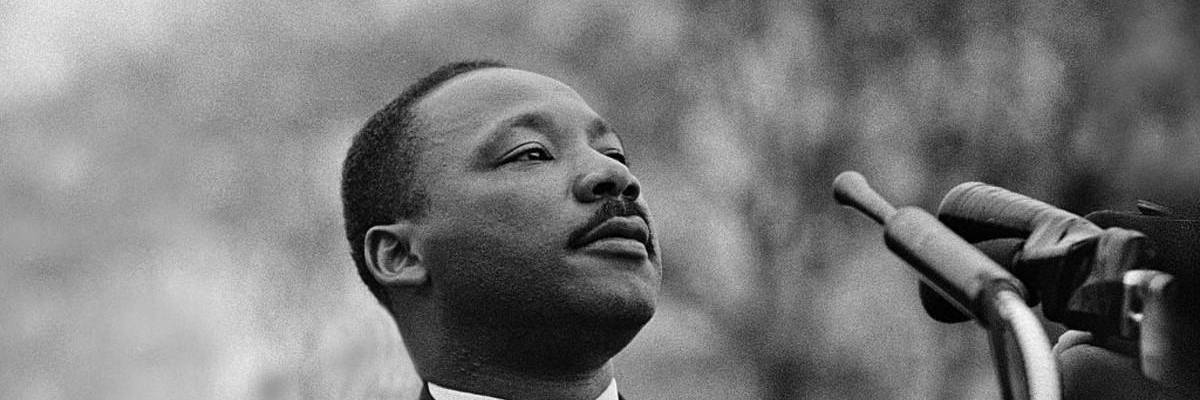
Dr. Martin Luther King, Jr. speaking before a crowd of 25,000 Selma To Montgomery, Alabama civil rights marchers, in front of the Alabama state capital building on March 25, 1965. (Photo: Stephen F. Somerstein/Getty Images)
As we mourn Martin Luther King Jr. and celebrate his life, we must remember that he was violently assassinated. His ideas were seen as radical and dangerous. He critiqued liberals and moderates and did not have the approval of most Americans. So what if we instead celebrate King as a leader who gave his life to a movement focused on Black people, on poor people, on labor activism and anti-war sentiments. What if we celebrate King as he was: a radical?
By celebrating a sanitized image of King, filled with out-of-context quotes and vague ideas about peace, we disrespect his legacy and all that he worked for.
King was a critic of the Vietnam War and a supporter of workers' rights. He was a formerly incarcerated gun-owner, stalked by the FBI, accused of communist leanings though he loudly critiqued the Communist Party, and was staunchly opposed to wealth inequality and poverty. If he lived today, he would not be celebrated for these beliefs, at least not in the mainstream. By celebrating a sanitized image of King, filled with out-of-context quotes and vague ideas about peace, we disrespect his legacy and all that he worked for. Yes, King believed in nonviolent resistance. But like all people, his ideologies and beliefs changed over time. His ideas about what constituted resistance were complex, disruptive, and often ended in violence by the opposition.
King's method of nonviolent resistance was a political tactic, designed to showcase the violence of white opposition throughout America's South. Nonviolent did not mean nondisruptive --from the march to Montgomery on the Edmund Pettus Bridge to King's support of the sanitation workers' strike in Memphis, King's ideology relied on the disruption of capitalism, of transportation and of everyday life. As conservatives co-opt King's lineage and ask 'What would King think?' after every protest of police violence, they further the myth that what King did was easy, was accepted, and did not disrupt or inconvenience the lives of white people. This couldn't be further from the truth.
Not only did King fight for civil rights, but he also argued for a Universal Basic Income and the creation of a 'nonviolent army of the poor' through his poor people's campaign, continued by his wife after his assassination. The platform of King's Poor People's Campaign involved a demand for a $30bn dollar investment in a 'real war on poverty' --a direct critique of democratic president Lyndon Johnson's Great Society programs. He also wanted a guaranteed annual wage for all Americans and the building of quality low-cost housing across the United States. To contend with King's legacy and beliefs, we have to acknowledge that many of them centered around poverty.
Ironically, some of the best evidence of King's radical ideas comes from the FBI's counterintelligence program (COINTELPRO), led by J. Edgar Hoover, which followed King for years and suspected him of communism. In a 1966 Gallup Poll, King's approval rating was at 33%. This dismantles the idea that King had universal support at the time of his activism.
By co-opting King's public image, conservatives (and liberals, too) can align themselves with historical civil rights battles while ignoring ongoing issues of labor rights, police violence, and the housing crisis in most major cities across the US. They can volunteer at 'non-political' events on Martin Luther King Day, when disruption, protest and mutual aid were central to King's ideology. Not charity. Not peace. As was the protest of unjust laws. King wrote: "there are two types of laws: just and unjust... one has a moral responsibility to disobey unjust laws." This commitment to disobedience above all, and to equitable access to housing, living wages, and justice for Black Americans in particular, is what we should celebrate when focusing on King's legacy.
Dear Common Dreams reader, It’s been nearly 30 years since I co-founded Common Dreams with my late wife, Lina Newhouser. We had the radical notion that journalism should serve the public good, not corporate profits. It was clear to us from the outset what it would take to build such a project. No paid advertisements. No corporate sponsors. No millionaire publisher telling us what to think or do. Many people said we wouldn't last a year, but we proved those doubters wrong. Together with a tremendous team of journalists and dedicated staff, we built an independent media outlet free from the constraints of profits and corporate control. Our mission has always been simple: To inform. To inspire. To ignite change for the common good. Building Common Dreams was not easy. Our survival was never guaranteed. When you take on the most powerful forces—Wall Street greed, fossil fuel industry destruction, Big Tech lobbyists, and uber-rich oligarchs who have spent billions upon billions rigging the economy and democracy in their favor—the only bulwark you have is supporters who believe in your work. But here’s the urgent message from me today. It's never been this bad out there. And it's never been this hard to keep us going. At the very moment Common Dreams is most needed, the threats we face are intensifying. We need your support now more than ever. We don't accept corporate advertising and never will. We don't have a paywall because we don't think people should be blocked from critical news based on their ability to pay. Everything we do is funded by the donations of readers like you. When everyone does the little they can afford, we are strong. But if that support retreats or dries up, so do we. Will you donate now to make sure Common Dreams not only survives but thrives? —Craig Brown, Co-founder |
As we mourn Martin Luther King Jr. and celebrate his life, we must remember that he was violently assassinated. His ideas were seen as radical and dangerous. He critiqued liberals and moderates and did not have the approval of most Americans. So what if we instead celebrate King as a leader who gave his life to a movement focused on Black people, on poor people, on labor activism and anti-war sentiments. What if we celebrate King as he was: a radical?
By celebrating a sanitized image of King, filled with out-of-context quotes and vague ideas about peace, we disrespect his legacy and all that he worked for.
King was a critic of the Vietnam War and a supporter of workers' rights. He was a formerly incarcerated gun-owner, stalked by the FBI, accused of communist leanings though he loudly critiqued the Communist Party, and was staunchly opposed to wealth inequality and poverty. If he lived today, he would not be celebrated for these beliefs, at least not in the mainstream. By celebrating a sanitized image of King, filled with out-of-context quotes and vague ideas about peace, we disrespect his legacy and all that he worked for. Yes, King believed in nonviolent resistance. But like all people, his ideologies and beliefs changed over time. His ideas about what constituted resistance were complex, disruptive, and often ended in violence by the opposition.
King's method of nonviolent resistance was a political tactic, designed to showcase the violence of white opposition throughout America's South. Nonviolent did not mean nondisruptive --from the march to Montgomery on the Edmund Pettus Bridge to King's support of the sanitation workers' strike in Memphis, King's ideology relied on the disruption of capitalism, of transportation and of everyday life. As conservatives co-opt King's lineage and ask 'What would King think?' after every protest of police violence, they further the myth that what King did was easy, was accepted, and did not disrupt or inconvenience the lives of white people. This couldn't be further from the truth.
Not only did King fight for civil rights, but he also argued for a Universal Basic Income and the creation of a 'nonviolent army of the poor' through his poor people's campaign, continued by his wife after his assassination. The platform of King's Poor People's Campaign involved a demand for a $30bn dollar investment in a 'real war on poverty' --a direct critique of democratic president Lyndon Johnson's Great Society programs. He also wanted a guaranteed annual wage for all Americans and the building of quality low-cost housing across the United States. To contend with King's legacy and beliefs, we have to acknowledge that many of them centered around poverty.
Ironically, some of the best evidence of King's radical ideas comes from the FBI's counterintelligence program (COINTELPRO), led by J. Edgar Hoover, which followed King for years and suspected him of communism. In a 1966 Gallup Poll, King's approval rating was at 33%. This dismantles the idea that King had universal support at the time of his activism.
By co-opting King's public image, conservatives (and liberals, too) can align themselves with historical civil rights battles while ignoring ongoing issues of labor rights, police violence, and the housing crisis in most major cities across the US. They can volunteer at 'non-political' events on Martin Luther King Day, when disruption, protest and mutual aid were central to King's ideology. Not charity. Not peace. As was the protest of unjust laws. King wrote: "there are two types of laws: just and unjust... one has a moral responsibility to disobey unjust laws." This commitment to disobedience above all, and to equitable access to housing, living wages, and justice for Black Americans in particular, is what we should celebrate when focusing on King's legacy.
As we mourn Martin Luther King Jr. and celebrate his life, we must remember that he was violently assassinated. His ideas were seen as radical and dangerous. He critiqued liberals and moderates and did not have the approval of most Americans. So what if we instead celebrate King as a leader who gave his life to a movement focused on Black people, on poor people, on labor activism and anti-war sentiments. What if we celebrate King as he was: a radical?
By celebrating a sanitized image of King, filled with out-of-context quotes and vague ideas about peace, we disrespect his legacy and all that he worked for.
King was a critic of the Vietnam War and a supporter of workers' rights. He was a formerly incarcerated gun-owner, stalked by the FBI, accused of communist leanings though he loudly critiqued the Communist Party, and was staunchly opposed to wealth inequality and poverty. If he lived today, he would not be celebrated for these beliefs, at least not in the mainstream. By celebrating a sanitized image of King, filled with out-of-context quotes and vague ideas about peace, we disrespect his legacy and all that he worked for. Yes, King believed in nonviolent resistance. But like all people, his ideologies and beliefs changed over time. His ideas about what constituted resistance were complex, disruptive, and often ended in violence by the opposition.
King's method of nonviolent resistance was a political tactic, designed to showcase the violence of white opposition throughout America's South. Nonviolent did not mean nondisruptive --from the march to Montgomery on the Edmund Pettus Bridge to King's support of the sanitation workers' strike in Memphis, King's ideology relied on the disruption of capitalism, of transportation and of everyday life. As conservatives co-opt King's lineage and ask 'What would King think?' after every protest of police violence, they further the myth that what King did was easy, was accepted, and did not disrupt or inconvenience the lives of white people. This couldn't be further from the truth.
Not only did King fight for civil rights, but he also argued for a Universal Basic Income and the creation of a 'nonviolent army of the poor' through his poor people's campaign, continued by his wife after his assassination. The platform of King's Poor People's Campaign involved a demand for a $30bn dollar investment in a 'real war on poverty' --a direct critique of democratic president Lyndon Johnson's Great Society programs. He also wanted a guaranteed annual wage for all Americans and the building of quality low-cost housing across the United States. To contend with King's legacy and beliefs, we have to acknowledge that many of them centered around poverty.
Ironically, some of the best evidence of King's radical ideas comes from the FBI's counterintelligence program (COINTELPRO), led by J. Edgar Hoover, which followed King for years and suspected him of communism. In a 1966 Gallup Poll, King's approval rating was at 33%. This dismantles the idea that King had universal support at the time of his activism.
By co-opting King's public image, conservatives (and liberals, too) can align themselves with historical civil rights battles while ignoring ongoing issues of labor rights, police violence, and the housing crisis in most major cities across the US. They can volunteer at 'non-political' events on Martin Luther King Day, when disruption, protest and mutual aid were central to King's ideology. Not charity. Not peace. As was the protest of unjust laws. King wrote: "there are two types of laws: just and unjust... one has a moral responsibility to disobey unjust laws." This commitment to disobedience above all, and to equitable access to housing, living wages, and justice for Black Americans in particular, is what we should celebrate when focusing on King's legacy.