

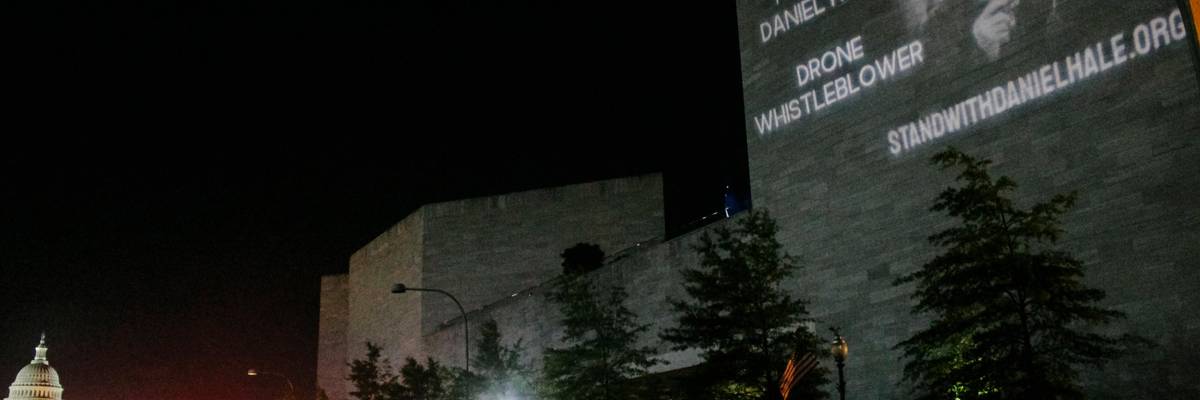
The most severe consequences have been borne by Afghanistan war veteran Daniel Hale, who was prosecuted under the draconian Espionage Act and is serving a nearly four-year prison sentence because he was the source for a ground-breaking reporting series and book on drone assassinations. (Photo: Flickr/cc/Backbone Campaign)
The Other Drone Casualties: The Whistleblowers Who Tried to Stop It
The United States continues to play prosecutor, judge, jury, and executioner of anyone on the planet. Despite a decade of air carnage, the only person in prison is the man who exposed it.
The New York Times' investigation into the Pentagon's civilian casualty files is some of the most important journalism in the War on Terror. It methodically and thoroughly picks apart the layers of lies around drone warfare and proves that the few examples of civilian casualties that have been investigated previously were not one-off mistakes. Unfortunately, this reporting comes too late for the civilians in Afghanistan, Iraq, and Syria who bore the brunt of the brutal air campaigns.
These whistleblowers have had to navigate abnormally high rates of PTSD, anxiety, depression, alcoholism, drug abuse, and suicide.
Over the years, a number of veterans have been sounding the alarm about precisely these issues, trying to blow the whistle while it could still save lives. We have represented more than a dozen such veterans who, despite being vindicated in their concerns, have suffered dire and ongoing consequences for their whistleblowing, on top of crippling moral injury from participating in a global assassination program.
They began to come forward in 2012 and 2013. Nothing. Some of them participated in the award-winning documentary 'National Bird' in 2014. Several more risked their freedom and came forward publicly in 2015. They all bore witness to what had become essentially common knowledge among drone pilots, sensor operators, and imagery analysts: civilian casualties were not an aberration and the much-touted policy safeguards and precision technology were little more than a facade in terms of actually protecting innocents. Operators or their supervisors would minimize concerns of children spotted in a strike with dehumanizing terms such as "fun-sized terrorists" or "terrorists in training,"or by simply insisting the child had been a dog. People fleeing a bombed building were referred to as "squirters."
These whistleblowers have had to navigate abnormally high rates of PTSD, anxiety, depression, alcoholism, drug abuse, and suicide. They have been berated by anti-war groups, denied veterans' benefits because they were not "boots on the ground," and subject to pretextual government investigations targeting them and their families. One former service member described to NY Times Magazine the lasting effects of moral injury, PTSD, and anxiety he suffered after leaving the drone program as well as the threats and harassment he endured after speaking out. When another client was in Germany to testify before the German Bundestag about drone warfare, Air Force officials showed up on his mother's doorstep in Missoula, Montana and told her she was being targeted by ISIS because her son was speaking out.
The most severe consequences have been borne by Afghanistan war veteran Daniel Hale, who was prosecuted under the draconian Espionage Act and is serving a nearly four-year prison sentence because he was the source for a ground-breaking reporting series and book on drone assassinations. Hale had started like other dissenters, speaking out in public forums about his experiences in the drone program after having left the military. But his conscience continued to plague him, and he had started to think of himself as a war criminal. He described his tipping point after he had unexpectedly regained access to classified drone documents at his next job as a military contractor, where his colleagues would watch "drone porn"--raw footage of drone strikes--as a form of entertainment. The documents he later gave to journalists were concrete evidence of what he and other whistleblowers had been saying (and what the Times' investigation would later confirm): the claims of accuracy touted by the military and political leaders were grossly untrue, and they knew it. The military's own studies showed that up to 90% of strike victims were not the intended target. Yet they almost never bothered to investigate the civilian deaths they claimed to work so hard to avoid. Instead, those deaths were deemed "enemies killed in action." And that inflated number of "enemy" casualties formed the basis for awards and promotions.
When Hale attempted to explain the motivation for his actions at sentencing, prosecutors protested that he had "helped ISIS," and compared him to a heroin dealer who insisted that his crimes were good for the community.
Hale spent the holidays isolated from friends and supporters by the contact restrictions and intense surveillance of a "Communications Management Unit", where he was placed by the Bureau of Prisons under the absurd rationale that he might commit another "communications-based crime" from prison, despite having had no access to classified material for almost a decade. He was unable to comment on recent news that yet again, the military absolved itself of any wrongdoing in the horrifically botched but not atypical August drone strike in Kabul--the parting shot of the American withdrawal from Afghanistan.
An Urgent Message From Our Co-Founder
Dear Common Dreams reader, It’s been nearly 30 years since I co-founded Common Dreams with my late wife, Lina Newhouser. We had the radical notion that journalism should serve the public good, not corporate profits. It was clear to us from the outset what it would take to build such a project. No paid advertisements. No corporate sponsors. No millionaire publisher telling us what to think or do. Many people said we wouldn't last a year, but we proved those doubters wrong. Together with a tremendous team of journalists and dedicated staff, we built an independent media outlet free from the constraints of profits and corporate control. Our mission has always been simple: To inform. To inspire. To ignite change for the common good. Building Common Dreams was not easy. Our survival was never guaranteed. When you take on the most powerful forces—Wall Street greed, fossil fuel industry destruction, Big Tech lobbyists, and uber-rich oligarchs who have spent billions upon billions rigging the economy and democracy in their favor—the only bulwark you have is supporters who believe in your work. But here’s the urgent message from me today. It's never been this bad out there. And it's never been this hard to keep us going. At the very moment Common Dreams is most needed, the threats we face are intensifying. We need your support now more than ever. We don't accept corporate advertising and never will. We don't have a paywall because we don't think people should be blocked from critical news based on their ability to pay. Everything we do is funded by the donations of readers like you. When everyone does the little they can afford, we are strong. But if that support retreats or dries up, so do we. Will you donate now to make sure Common Dreams not only survives but thrives? —Craig Brown, Co-founder |
The New York Times' investigation into the Pentagon's civilian casualty files is some of the most important journalism in the War on Terror. It methodically and thoroughly picks apart the layers of lies around drone warfare and proves that the few examples of civilian casualties that have been investigated previously were not one-off mistakes. Unfortunately, this reporting comes too late for the civilians in Afghanistan, Iraq, and Syria who bore the brunt of the brutal air campaigns.
These whistleblowers have had to navigate abnormally high rates of PTSD, anxiety, depression, alcoholism, drug abuse, and suicide.
Over the years, a number of veterans have been sounding the alarm about precisely these issues, trying to blow the whistle while it could still save lives. We have represented more than a dozen such veterans who, despite being vindicated in their concerns, have suffered dire and ongoing consequences for their whistleblowing, on top of crippling moral injury from participating in a global assassination program.
They began to come forward in 2012 and 2013. Nothing. Some of them participated in the award-winning documentary 'National Bird' in 2014. Several more risked their freedom and came forward publicly in 2015. They all bore witness to what had become essentially common knowledge among drone pilots, sensor operators, and imagery analysts: civilian casualties were not an aberration and the much-touted policy safeguards and precision technology were little more than a facade in terms of actually protecting innocents. Operators or their supervisors would minimize concerns of children spotted in a strike with dehumanizing terms such as "fun-sized terrorists" or "terrorists in training,"or by simply insisting the child had been a dog. People fleeing a bombed building were referred to as "squirters."
These whistleblowers have had to navigate abnormally high rates of PTSD, anxiety, depression, alcoholism, drug abuse, and suicide. They have been berated by anti-war groups, denied veterans' benefits because they were not "boots on the ground," and subject to pretextual government investigations targeting them and their families. One former service member described to NY Times Magazine the lasting effects of moral injury, PTSD, and anxiety he suffered after leaving the drone program as well as the threats and harassment he endured after speaking out. When another client was in Germany to testify before the German Bundestag about drone warfare, Air Force officials showed up on his mother's doorstep in Missoula, Montana and told her she was being targeted by ISIS because her son was speaking out.
The most severe consequences have been borne by Afghanistan war veteran Daniel Hale, who was prosecuted under the draconian Espionage Act and is serving a nearly four-year prison sentence because he was the source for a ground-breaking reporting series and book on drone assassinations. Hale had started like other dissenters, speaking out in public forums about his experiences in the drone program after having left the military. But his conscience continued to plague him, and he had started to think of himself as a war criminal. He described his tipping point after he had unexpectedly regained access to classified drone documents at his next job as a military contractor, where his colleagues would watch "drone porn"--raw footage of drone strikes--as a form of entertainment. The documents he later gave to journalists were concrete evidence of what he and other whistleblowers had been saying (and what the Times' investigation would later confirm): the claims of accuracy touted by the military and political leaders were grossly untrue, and they knew it. The military's own studies showed that up to 90% of strike victims were not the intended target. Yet they almost never bothered to investigate the civilian deaths they claimed to work so hard to avoid. Instead, those deaths were deemed "enemies killed in action." And that inflated number of "enemy" casualties formed the basis for awards and promotions.
When Hale attempted to explain the motivation for his actions at sentencing, prosecutors protested that he had "helped ISIS," and compared him to a heroin dealer who insisted that his crimes were good for the community.
Hale spent the holidays isolated from friends and supporters by the contact restrictions and intense surveillance of a "Communications Management Unit", where he was placed by the Bureau of Prisons under the absurd rationale that he might commit another "communications-based crime" from prison, despite having had no access to classified material for almost a decade. He was unable to comment on recent news that yet again, the military absolved itself of any wrongdoing in the horrifically botched but not atypical August drone strike in Kabul--the parting shot of the American withdrawal from Afghanistan.
The New York Times' investigation into the Pentagon's civilian casualty files is some of the most important journalism in the War on Terror. It methodically and thoroughly picks apart the layers of lies around drone warfare and proves that the few examples of civilian casualties that have been investigated previously were not one-off mistakes. Unfortunately, this reporting comes too late for the civilians in Afghanistan, Iraq, and Syria who bore the brunt of the brutal air campaigns.
These whistleblowers have had to navigate abnormally high rates of PTSD, anxiety, depression, alcoholism, drug abuse, and suicide.
Over the years, a number of veterans have been sounding the alarm about precisely these issues, trying to blow the whistle while it could still save lives. We have represented more than a dozen such veterans who, despite being vindicated in their concerns, have suffered dire and ongoing consequences for their whistleblowing, on top of crippling moral injury from participating in a global assassination program.
They began to come forward in 2012 and 2013. Nothing. Some of them participated in the award-winning documentary 'National Bird' in 2014. Several more risked their freedom and came forward publicly in 2015. They all bore witness to what had become essentially common knowledge among drone pilots, sensor operators, and imagery analysts: civilian casualties were not an aberration and the much-touted policy safeguards and precision technology were little more than a facade in terms of actually protecting innocents. Operators or their supervisors would minimize concerns of children spotted in a strike with dehumanizing terms such as "fun-sized terrorists" or "terrorists in training,"or by simply insisting the child had been a dog. People fleeing a bombed building were referred to as "squirters."
These whistleblowers have had to navigate abnormally high rates of PTSD, anxiety, depression, alcoholism, drug abuse, and suicide. They have been berated by anti-war groups, denied veterans' benefits because they were not "boots on the ground," and subject to pretextual government investigations targeting them and their families. One former service member described to NY Times Magazine the lasting effects of moral injury, PTSD, and anxiety he suffered after leaving the drone program as well as the threats and harassment he endured after speaking out. When another client was in Germany to testify before the German Bundestag about drone warfare, Air Force officials showed up on his mother's doorstep in Missoula, Montana and told her she was being targeted by ISIS because her son was speaking out.
The most severe consequences have been borne by Afghanistan war veteran Daniel Hale, who was prosecuted under the draconian Espionage Act and is serving a nearly four-year prison sentence because he was the source for a ground-breaking reporting series and book on drone assassinations. Hale had started like other dissenters, speaking out in public forums about his experiences in the drone program after having left the military. But his conscience continued to plague him, and he had started to think of himself as a war criminal. He described his tipping point after he had unexpectedly regained access to classified drone documents at his next job as a military contractor, where his colleagues would watch "drone porn"--raw footage of drone strikes--as a form of entertainment. The documents he later gave to journalists were concrete evidence of what he and other whistleblowers had been saying (and what the Times' investigation would later confirm): the claims of accuracy touted by the military and political leaders were grossly untrue, and they knew it. The military's own studies showed that up to 90% of strike victims were not the intended target. Yet they almost never bothered to investigate the civilian deaths they claimed to work so hard to avoid. Instead, those deaths were deemed "enemies killed in action." And that inflated number of "enemy" casualties formed the basis for awards and promotions.
When Hale attempted to explain the motivation for his actions at sentencing, prosecutors protested that he had "helped ISIS," and compared him to a heroin dealer who insisted that his crimes were good for the community.
Hale spent the holidays isolated from friends and supporters by the contact restrictions and intense surveillance of a "Communications Management Unit", where he was placed by the Bureau of Prisons under the absurd rationale that he might commit another "communications-based crime" from prison, despite having had no access to classified material for almost a decade. He was unable to comment on recent news that yet again, the military absolved itself of any wrongdoing in the horrifically botched but not atypical August drone strike in Kabul--the parting shot of the American withdrawal from Afghanistan.