SUBSCRIBE TO OUR FREE NEWSLETTER
Daily news & progressive opinion—funded by the people, not the corporations—delivered straight to your inbox.
5
#000000
#FFFFFF
To donate by check, phone, or other method, see our More Ways to Give page.
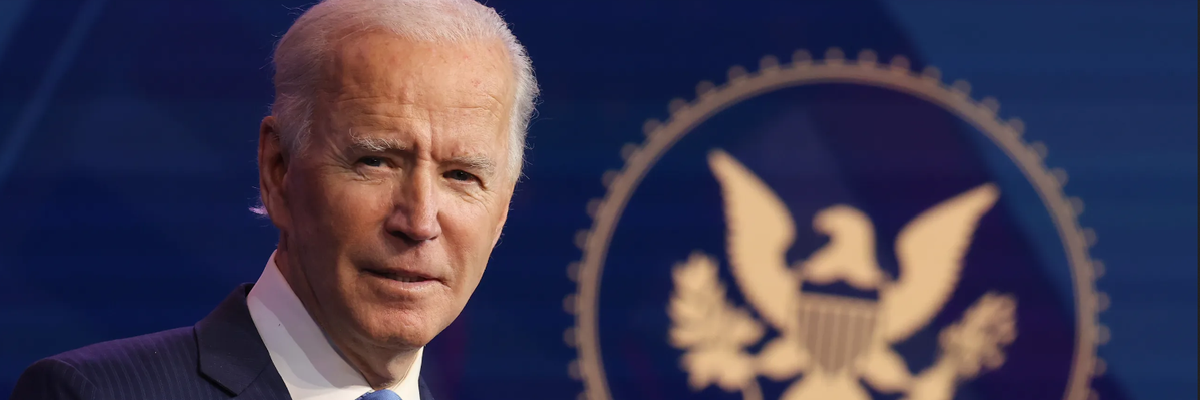
Recent polls show that President Joe Biden's approval rating has declined significantly since he took office.
A decline is not unexpected, of course, given the historical phenomenon known as a honeymoon period. But many in the media have interpreted this decline as a negative assessment specifically of Biden's too-progressive agenda (FAIR.org, 11/5/21).
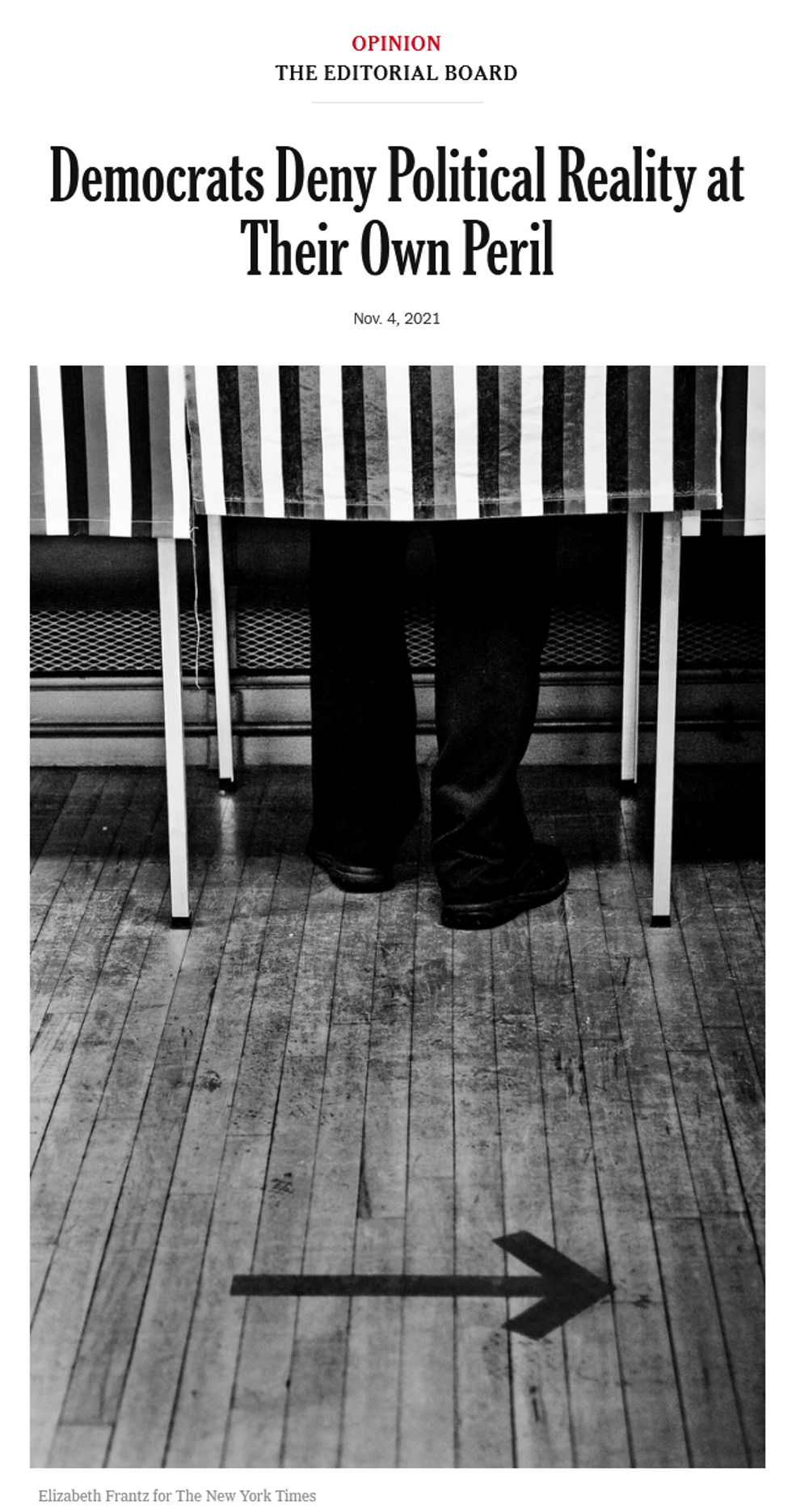
New York Times (11/4/21): "Significant parts of the electorate are feeling leery of a sharp leftward push in the party."
Numerous articles and editorials have thus argued that Biden should return to the "center" (see here, here and here), a rather vague political location these days, but one that would require him to significantly downsize many proposals in his Build Back Better legislation.
A prime example is a recent New York Times editorial (11/4/21) with the headline, "Democrats Deny Political Reality at Their Own Peril."
The alleged reality: That "significant parts of the electorate are feeling leery of a sharp leftward push in the party," and that "the concerns of more centrist Americans about a rush to spend taxpayer money, a rush to grow the government, should not be dismissed."
The solution?
What is badly needed is an honest conversation in the Democratic Party about how to return to the moderate policies and values that fueled the blue-wave victories in 2018 and won Joe Biden the presidency in 2020.
In all of these articles and editorials, the authors focus on Biden's declining approval rating as "bait"--what we should be concerned about--and then switch to talking about the president's legislative agenda. But there is no necessary connection between the two. People could disapprove of the president's performance in office for many reasons not related at all to the proposed legislation.
If Biden's approval rating has declined because of the size of his proposed legislation, then we should expect either that public approval of his proposals has been low, or that approval has declined. But neither is the case.
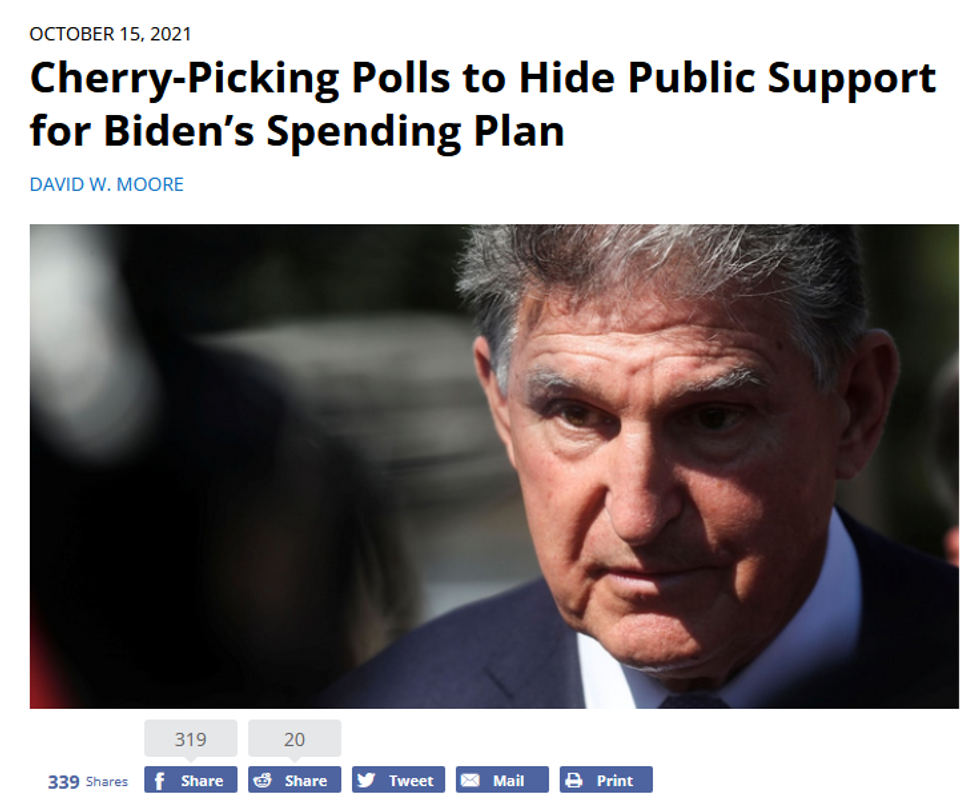
FAIR.org (10/15/21): "The margins in favor of the reconciliation package vary from a low of 12 points in the WP/ABC poll, to 24 points in the Pew poll."
In an earlier post (FAIR.org, 10/16/21), I cited several polls showing double-digit margins of support for Biden's initial plan costing $3.5 trillion. Polls since then confirm majority public support for that package, as well as the compromised package of just under $2 trillion recently passed by the House.
If the size of the legislation was a problem for the public, then we would expect to find higher support for the new compromised version than for the original bill. But the polls do not reflect such a difference.
The ABC/Washington Post poll (11/7-10/21) and the Quinnipiac poll (11/11-15/21) found almost identical results for the $2 trillion bill--58% to 37% and 58% to 38%, respectively.
And these figures were quite close to what Quinnipiac (10/1-4/21) and ABC/Washington Post (8/29/21-9/1/21) reported earlier about the $3.5 trillion package: 57% to 40% and 53% to 41%, respectively.
Biden's "gotta lead from the middle out," says pollster Joel Benenson (Washington Post, 10/23/21), whose clients include Google, Comcast, Viacom, Microsoft and Bank of America.
It would appear that many of the cited articles reflect the long-held opinions of the authors, who hold on to those views regardless of what the polls might show.
Perhaps they are persuaded by the prevailing view, as reflected in a recent Gallup poll, that most people want less, rather than more, government spending. These pundits don't seem to accept the notion, as noted in an earlier post (FAIR.org, 10/24/21), that while most Americans may express conservative beliefs, in fact large majorities generally support activist government.
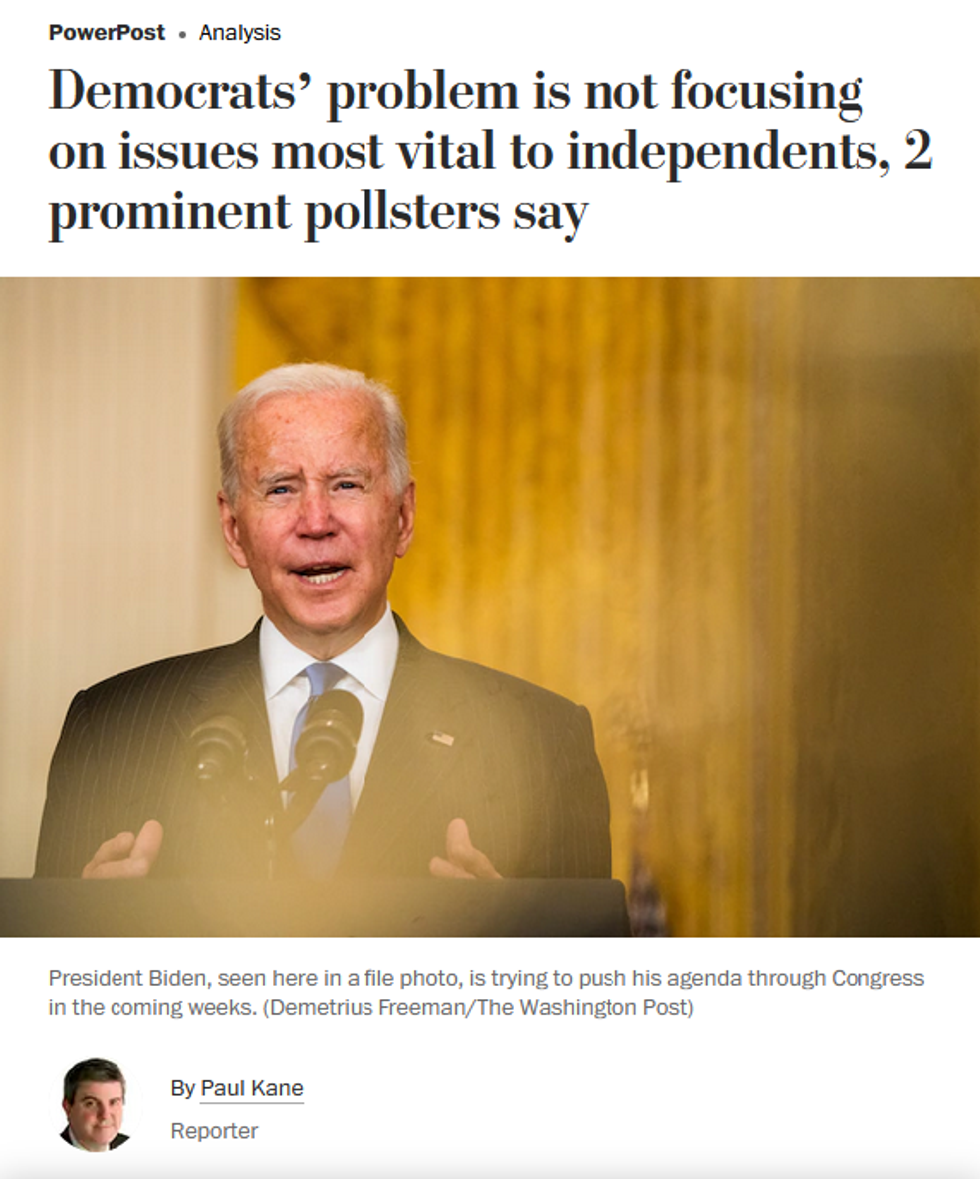
That disjuncture is reflected in an article by the Washington Post's Paul Kane (10/23/21), who apparently could not believe that Americans might support such a costly bill. He refers to an argument by two pollsters--one a Republican, the other a Democrat--who acknowledge that "individual pieces of this massive agenda are popular," but then assert that "the package is either too big for voters to comprehend, or the price is so high that it sounds scary."
That sounds like a classic case of denial. There is no polling evidence for such an assertion. In fact, polling suggests the opposite.
There are many possible explanations for Biden's low approval ratings. Pushing for his Build Back Better legislation is not one of them.
Recent polls show that President Joe Biden's approval rating has declined significantly since he took office.
A decline is not unexpected, of course, given the historical phenomenon known as a honeymoon period. But many in the media have interpreted this decline as a negative assessment specifically of Biden's too-progressive agenda (FAIR.org, 11/5/21).
New York Times (11/4/21): "Significant parts of the electorate are feeling leery of a sharp leftward push in the party."
Numerous articles and editorials have thus argued that Biden should return to the "center" (see here, here and here), a rather vague political location these days, but one that would require him to significantly downsize many proposals in his Build Back Better legislation.
A prime example is a recent New York Times editorial (11/4/21) with the headline, "Democrats Deny Political Reality at Their Own Peril."
The alleged reality: That "significant parts of the electorate are feeling leery of a sharp leftward push in the party," and that "the concerns of more centrist Americans about a rush to spend taxpayer money, a rush to grow the government, should not be dismissed."
The solution?
What is badly needed is an honest conversation in the Democratic Party about how to return to the moderate policies and values that fueled the blue-wave victories in 2018 and won Joe Biden the presidency in 2020.
In all of these articles and editorials, the authors focus on Biden's declining approval rating as "bait"--what we should be concerned about--and then switch to talking about the president's legislative agenda. But there is no necessary connection between the two. People could disapprove of the president's performance in office for many reasons not related at all to the proposed legislation.
If Biden's approval rating has declined because of the size of his proposed legislation, then we should expect either that public approval of his proposals has been low, or that approval has declined. But neither is the case.
FAIR.org (10/15/21): "The margins in favor of the reconciliation package vary from a low of 12 points in the WP/ABC poll, to 24 points in the Pew poll."
In an earlier post (FAIR.org, 10/16/21), I cited several polls showing double-digit margins of support for Biden's initial plan costing $3.5 trillion. Polls since then confirm majority public support for that package, as well as the compromised package of just under $2 trillion recently passed by the House.
If the size of the legislation was a problem for the public, then we would expect to find higher support for the new compromised version than for the original bill. But the polls do not reflect such a difference.
The ABC/Washington Post poll (11/7-10/21) and the Quinnipiac poll (11/11-15/21) found almost identical results for the $2 trillion bill--58% to 37% and 58% to 38%, respectively.
And these figures were quite close to what Quinnipiac (10/1-4/21) and ABC/Washington Post (8/29/21-9/1/21) reported earlier about the $3.5 trillion package: 57% to 40% and 53% to 41%, respectively.
Biden's "gotta lead from the middle out," says pollster Joel Benenson (Washington Post, 10/23/21), whose clients include Google, Comcast, Viacom, Microsoft and Bank of America.
It would appear that many of the cited articles reflect the long-held opinions of the authors, who hold on to those views regardless of what the polls might show.
Perhaps they are persuaded by the prevailing view, as reflected in a recent Gallup poll, that most people want less, rather than more, government spending. These pundits don't seem to accept the notion, as noted in an earlier post (FAIR.org, 10/24/21), that while most Americans may express conservative beliefs, in fact large majorities generally support activist government.
That disjuncture is reflected in an article by the Washington Post's Paul Kane (10/23/21), who apparently could not believe that Americans might support such a costly bill. He refers to an argument by two pollsters--one a Republican, the other a Democrat--who acknowledge that "individual pieces of this massive agenda are popular," but then assert that "the package is either too big for voters to comprehend, or the price is so high that it sounds scary."
That sounds like a classic case of denial. There is no polling evidence for such an assertion. In fact, polling suggests the opposite.
There are many possible explanations for Biden's low approval ratings. Pushing for his Build Back Better legislation is not one of them.
Recent polls show that President Joe Biden's approval rating has declined significantly since he took office.
A decline is not unexpected, of course, given the historical phenomenon known as a honeymoon period. But many in the media have interpreted this decline as a negative assessment specifically of Biden's too-progressive agenda (FAIR.org, 11/5/21).
New York Times (11/4/21): "Significant parts of the electorate are feeling leery of a sharp leftward push in the party."
Numerous articles and editorials have thus argued that Biden should return to the "center" (see here, here and here), a rather vague political location these days, but one that would require him to significantly downsize many proposals in his Build Back Better legislation.
A prime example is a recent New York Times editorial (11/4/21) with the headline, "Democrats Deny Political Reality at Their Own Peril."
The alleged reality: That "significant parts of the electorate are feeling leery of a sharp leftward push in the party," and that "the concerns of more centrist Americans about a rush to spend taxpayer money, a rush to grow the government, should not be dismissed."
The solution?
What is badly needed is an honest conversation in the Democratic Party about how to return to the moderate policies and values that fueled the blue-wave victories in 2018 and won Joe Biden the presidency in 2020.
In all of these articles and editorials, the authors focus on Biden's declining approval rating as "bait"--what we should be concerned about--and then switch to talking about the president's legislative agenda. But there is no necessary connection between the two. People could disapprove of the president's performance in office for many reasons not related at all to the proposed legislation.
If Biden's approval rating has declined because of the size of his proposed legislation, then we should expect either that public approval of his proposals has been low, or that approval has declined. But neither is the case.
FAIR.org (10/15/21): "The margins in favor of the reconciliation package vary from a low of 12 points in the WP/ABC poll, to 24 points in the Pew poll."
In an earlier post (FAIR.org, 10/16/21), I cited several polls showing double-digit margins of support for Biden's initial plan costing $3.5 trillion. Polls since then confirm majority public support for that package, as well as the compromised package of just under $2 trillion recently passed by the House.
If the size of the legislation was a problem for the public, then we would expect to find higher support for the new compromised version than for the original bill. But the polls do not reflect such a difference.
The ABC/Washington Post poll (11/7-10/21) and the Quinnipiac poll (11/11-15/21) found almost identical results for the $2 trillion bill--58% to 37% and 58% to 38%, respectively.
And these figures were quite close to what Quinnipiac (10/1-4/21) and ABC/Washington Post (8/29/21-9/1/21) reported earlier about the $3.5 trillion package: 57% to 40% and 53% to 41%, respectively.
Biden's "gotta lead from the middle out," says pollster Joel Benenson (Washington Post, 10/23/21), whose clients include Google, Comcast, Viacom, Microsoft and Bank of America.
It would appear that many of the cited articles reflect the long-held opinions of the authors, who hold on to those views regardless of what the polls might show.
Perhaps they are persuaded by the prevailing view, as reflected in a recent Gallup poll, that most people want less, rather than more, government spending. These pundits don't seem to accept the notion, as noted in an earlier post (FAIR.org, 10/24/21), that while most Americans may express conservative beliefs, in fact large majorities generally support activist government.
That disjuncture is reflected in an article by the Washington Post's Paul Kane (10/23/21), who apparently could not believe that Americans might support such a costly bill. He refers to an argument by two pollsters--one a Republican, the other a Democrat--who acknowledge that "individual pieces of this massive agenda are popular," but then assert that "the package is either too big for voters to comprehend, or the price is so high that it sounds scary."
That sounds like a classic case of denial. There is no polling evidence for such an assertion. In fact, polling suggests the opposite.
There are many possible explanations for Biden's low approval ratings. Pushing for his Build Back Better legislation is not one of them.