SUBSCRIBE TO OUR FREE NEWSLETTER
Daily news & progressive opinion—funded by the people, not the corporations—delivered straight to your inbox.
5
#000000
#FFFFFF
To donate by check, phone, or other method, see our More Ways to Give page.
Daily news & progressive opinion—funded by the people, not the corporations—delivered straight to your inbox.
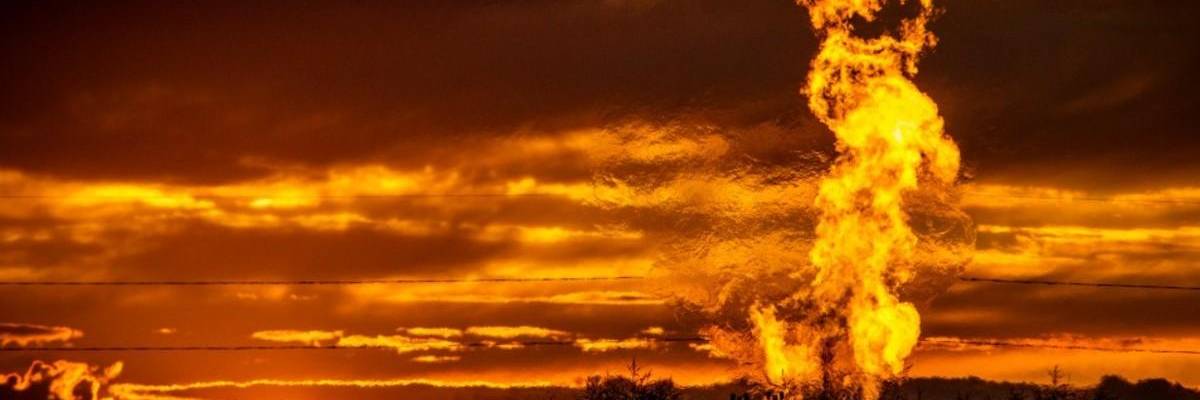
Flames are visible from a flaring pit near a well in the Bakken Oil Field. (Photo: Orjan F. Ellingvag/Corbis via Getty Images)
"Wildly here without control,
Nature reigns and rules the whole..."
Scotland's most famous poet, Robert Burns, wrote those lines in 1787. If only the delegates to COP26, the United Nations climate summit that wrapped up last Saturday in Glasgow, had heeded his words. The negotiations ended with a document dubbed the "Glasgow Climate Pact" which many climate activists called a failure. "We should call it the 'Glasgow suicide pact' for the poorest in the world," Asad Rehman of the COP26 Coaltion said on the Democracy Now! news hour. "It does not keep us below the 1.5 degree [Celsius, or 2.7 degrees Fahrenheit] guard rail. In fact, it heads us closer to 3 degrees [C, or 5.4 degrees F]...They're ramming through so many loopholes that it makes a mockery of these climate negotiations."
Poor, developing nations haven't contributed significantly to the overall climate crisis, but are suffering disproportionately.
One draft of the climate pact included an historic first, calling for "the phasing out of coal and subsidies for fossil fuels." Polluting nations and armies of fossil fuel industry lobbyists managed to dilute that down to "the phase-out of unabated coal power and of inefficient subsidies for fossil fuels." Thus, coal, the dirtiest fossil fuel, can still be burned with the promise that the resulting pollution will be "abated" with carbon capture and storage, an unproven technology. And the same fossil fuel corporations that have profited for so long while sowing disinformation about the climate will continue to enjoy lavish subsidies at taxpayer expense.
"This summit was betrayal," Mitzi Jonelle Tan, a climate justice activist from the Philippines, said on Democracy Now! "It is painful for me, knowing that the Philippines is such a vulnerable country for the climate crisis and that we know that we are hit year after year, month after month, with climate impacts." The Philippines, described as the most storm-vulnerable nation on earth, has been hard hit by a succession of especially destructive, climate change-fueled typhoons over the past decade. "All countries," she added, "should be phasing out the fossil fuel industry. That doesn't just stop at coal, but also oil and gas, which the U.S. and the U.K. conveniently took out of the text."
Indigenous land defenders from the Amazon were also in Glasgow for COP26. The world's largest rainforest is called "the lungs of the planet" for the vital role it plays in absorbing carbon dioxide from the atmosphere. "We must first change our relationship to nature, change the way we think about the world, and really put at the center of our thinking our connection to life and our commitment to future generations," Domingo Peas, an Achuar indigenous leader from the Ecuadorian Amazon, said on Democracy Now! "There are 30 indigenous nations and 30 million hectares of intact forest that are at stake. We must protect this...The forest is calling on us."
The United States and European nations built their enormous wealth by burning coal with abandon for over a century and a half, a cheap but dirty way to achieve growth. The U.S. remains the single largest historical emitter of greenhouse gases, with close to twice the total that China has emitted, based on 2017 data. China is now by far the largest emitter globally.
In recent years, the U.S., the U.K., and most European Union nations have been able to decrease their reliance on coal, shifting to oil, fracked gas, and renewable sources.
Poor, developing nations haven't contributed significantly to the overall climate crisis, but are suffering disproportionately. To recover from disasters, to adapt to the changing climate, and to build their economies responsibly toward a zero carbon future, these countries need money. COP26 was supposed to deliver on long-promised financing for these needs, but failed to do so.
At COP15 in Copenhagen in 2009, the U.S. and other developed countries pledged $100 billion per year to developing and climate-vulnerable nations from 2020 through 2025. Only a fraction of those funds have materialized, much of it as loans, not as climate aid. Meanwhile, a consortium of African nations recently estimated that the true cost for them to effectively respond to climate change would be closer to $1.3 trillion per year. Polluters should pay, and the United States should lead the way.
Robert Burns died in 1796, when the age of coal was in its infancy. The current National Poet of Scotland is Kathleen Jamie. Inspired by the River Clyde that flows through Glasgow, this week she penned "What the Clyde said, after COP26," which ends,
"sure, I'm a river,
but I can take a side.
From this day, I'd rather keep afloat,
like wee folded paper boats,
the hopes of the young folk
chanting at my bank,
fear in their spring-bright eyes
so hear this: fail them, and I will rise."
Dear Common Dreams reader, It’s been nearly 30 years since I co-founded Common Dreams with my late wife, Lina Newhouser. We had the radical notion that journalism should serve the public good, not corporate profits. It was clear to us from the outset what it would take to build such a project. No paid advertisements. No corporate sponsors. No millionaire publisher telling us what to think or do. Many people said we wouldn't last a year, but we proved those doubters wrong. Together with a tremendous team of journalists and dedicated staff, we built an independent media outlet free from the constraints of profits and corporate control. Our mission has always been simple: To inform. To inspire. To ignite change for the common good. Building Common Dreams was not easy. Our survival was never guaranteed. When you take on the most powerful forces—Wall Street greed, fossil fuel industry destruction, Big Tech lobbyists, and uber-rich oligarchs who have spent billions upon billions rigging the economy and democracy in their favor—the only bulwark you have is supporters who believe in your work. But here’s the urgent message from me today. It's never been this bad out there. And it's never been this hard to keep us going. At the very moment Common Dreams is most needed, the threats we face are intensifying. We need your support now more than ever. We don't accept corporate advertising and never will. We don't have a paywall because we don't think people should be blocked from critical news based on their ability to pay. Everything we do is funded by the donations of readers like you. When everyone does the little they can afford, we are strong. But if that support retreats or dries up, so do we. Will you donate now to make sure Common Dreams not only survives but thrives? —Craig Brown, Co-founder |
"Wildly here without control,
Nature reigns and rules the whole..."
Scotland's most famous poet, Robert Burns, wrote those lines in 1787. If only the delegates to COP26, the United Nations climate summit that wrapped up last Saturday in Glasgow, had heeded his words. The negotiations ended with a document dubbed the "Glasgow Climate Pact" which many climate activists called a failure. "We should call it the 'Glasgow suicide pact' for the poorest in the world," Asad Rehman of the COP26 Coaltion said on the Democracy Now! news hour. "It does not keep us below the 1.5 degree [Celsius, or 2.7 degrees Fahrenheit] guard rail. In fact, it heads us closer to 3 degrees [C, or 5.4 degrees F]...They're ramming through so many loopholes that it makes a mockery of these climate negotiations."
Poor, developing nations haven't contributed significantly to the overall climate crisis, but are suffering disproportionately.
One draft of the climate pact included an historic first, calling for "the phasing out of coal and subsidies for fossil fuels." Polluting nations and armies of fossil fuel industry lobbyists managed to dilute that down to "the phase-out of unabated coal power and of inefficient subsidies for fossil fuels." Thus, coal, the dirtiest fossil fuel, can still be burned with the promise that the resulting pollution will be "abated" with carbon capture and storage, an unproven technology. And the same fossil fuel corporations that have profited for so long while sowing disinformation about the climate will continue to enjoy lavish subsidies at taxpayer expense.
"This summit was betrayal," Mitzi Jonelle Tan, a climate justice activist from the Philippines, said on Democracy Now! "It is painful for me, knowing that the Philippines is such a vulnerable country for the climate crisis and that we know that we are hit year after year, month after month, with climate impacts." The Philippines, described as the most storm-vulnerable nation on earth, has been hard hit by a succession of especially destructive, climate change-fueled typhoons over the past decade. "All countries," she added, "should be phasing out the fossil fuel industry. That doesn't just stop at coal, but also oil and gas, which the U.S. and the U.K. conveniently took out of the text."
Indigenous land defenders from the Amazon were also in Glasgow for COP26. The world's largest rainforest is called "the lungs of the planet" for the vital role it plays in absorbing carbon dioxide from the atmosphere. "We must first change our relationship to nature, change the way we think about the world, and really put at the center of our thinking our connection to life and our commitment to future generations," Domingo Peas, an Achuar indigenous leader from the Ecuadorian Amazon, said on Democracy Now! "There are 30 indigenous nations and 30 million hectares of intact forest that are at stake. We must protect this...The forest is calling on us."
The United States and European nations built their enormous wealth by burning coal with abandon for over a century and a half, a cheap but dirty way to achieve growth. The U.S. remains the single largest historical emitter of greenhouse gases, with close to twice the total that China has emitted, based on 2017 data. China is now by far the largest emitter globally.
In recent years, the U.S., the U.K., and most European Union nations have been able to decrease their reliance on coal, shifting to oil, fracked gas, and renewable sources.
Poor, developing nations haven't contributed significantly to the overall climate crisis, but are suffering disproportionately. To recover from disasters, to adapt to the changing climate, and to build their economies responsibly toward a zero carbon future, these countries need money. COP26 was supposed to deliver on long-promised financing for these needs, but failed to do so.
At COP15 in Copenhagen in 2009, the U.S. and other developed countries pledged $100 billion per year to developing and climate-vulnerable nations from 2020 through 2025. Only a fraction of those funds have materialized, much of it as loans, not as climate aid. Meanwhile, a consortium of African nations recently estimated that the true cost for them to effectively respond to climate change would be closer to $1.3 trillion per year. Polluters should pay, and the United States should lead the way.
Robert Burns died in 1796, when the age of coal was in its infancy. The current National Poet of Scotland is Kathleen Jamie. Inspired by the River Clyde that flows through Glasgow, this week she penned "What the Clyde said, after COP26," which ends,
"sure, I'm a river,
but I can take a side.
From this day, I'd rather keep afloat,
like wee folded paper boats,
the hopes of the young folk
chanting at my bank,
fear in their spring-bright eyes
so hear this: fail them, and I will rise."
"Wildly here without control,
Nature reigns and rules the whole..."
Scotland's most famous poet, Robert Burns, wrote those lines in 1787. If only the delegates to COP26, the United Nations climate summit that wrapped up last Saturday in Glasgow, had heeded his words. The negotiations ended with a document dubbed the "Glasgow Climate Pact" which many climate activists called a failure. "We should call it the 'Glasgow suicide pact' for the poorest in the world," Asad Rehman of the COP26 Coaltion said on the Democracy Now! news hour. "It does not keep us below the 1.5 degree [Celsius, or 2.7 degrees Fahrenheit] guard rail. In fact, it heads us closer to 3 degrees [C, or 5.4 degrees F]...They're ramming through so many loopholes that it makes a mockery of these climate negotiations."
Poor, developing nations haven't contributed significantly to the overall climate crisis, but are suffering disproportionately.
One draft of the climate pact included an historic first, calling for "the phasing out of coal and subsidies for fossil fuels." Polluting nations and armies of fossil fuel industry lobbyists managed to dilute that down to "the phase-out of unabated coal power and of inefficient subsidies for fossil fuels." Thus, coal, the dirtiest fossil fuel, can still be burned with the promise that the resulting pollution will be "abated" with carbon capture and storage, an unproven technology. And the same fossil fuel corporations that have profited for so long while sowing disinformation about the climate will continue to enjoy lavish subsidies at taxpayer expense.
"This summit was betrayal," Mitzi Jonelle Tan, a climate justice activist from the Philippines, said on Democracy Now! "It is painful for me, knowing that the Philippines is such a vulnerable country for the climate crisis and that we know that we are hit year after year, month after month, with climate impacts." The Philippines, described as the most storm-vulnerable nation on earth, has been hard hit by a succession of especially destructive, climate change-fueled typhoons over the past decade. "All countries," she added, "should be phasing out the fossil fuel industry. That doesn't just stop at coal, but also oil and gas, which the U.S. and the U.K. conveniently took out of the text."
Indigenous land defenders from the Amazon were also in Glasgow for COP26. The world's largest rainforest is called "the lungs of the planet" for the vital role it plays in absorbing carbon dioxide from the atmosphere. "We must first change our relationship to nature, change the way we think about the world, and really put at the center of our thinking our connection to life and our commitment to future generations," Domingo Peas, an Achuar indigenous leader from the Ecuadorian Amazon, said on Democracy Now! "There are 30 indigenous nations and 30 million hectares of intact forest that are at stake. We must protect this...The forest is calling on us."
The United States and European nations built their enormous wealth by burning coal with abandon for over a century and a half, a cheap but dirty way to achieve growth. The U.S. remains the single largest historical emitter of greenhouse gases, with close to twice the total that China has emitted, based on 2017 data. China is now by far the largest emitter globally.
In recent years, the U.S., the U.K., and most European Union nations have been able to decrease their reliance on coal, shifting to oil, fracked gas, and renewable sources.
Poor, developing nations haven't contributed significantly to the overall climate crisis, but are suffering disproportionately. To recover from disasters, to adapt to the changing climate, and to build their economies responsibly toward a zero carbon future, these countries need money. COP26 was supposed to deliver on long-promised financing for these needs, but failed to do so.
At COP15 in Copenhagen in 2009, the U.S. and other developed countries pledged $100 billion per year to developing and climate-vulnerable nations from 2020 through 2025. Only a fraction of those funds have materialized, much of it as loans, not as climate aid. Meanwhile, a consortium of African nations recently estimated that the true cost for them to effectively respond to climate change would be closer to $1.3 trillion per year. Polluters should pay, and the United States should lead the way.
Robert Burns died in 1796, when the age of coal was in its infancy. The current National Poet of Scotland is Kathleen Jamie. Inspired by the River Clyde that flows through Glasgow, this week she penned "What the Clyde said, after COP26," which ends,
"sure, I'm a river,
but I can take a side.
From this day, I'd rather keep afloat,
like wee folded paper boats,
the hopes of the young folk
chanting at my bank,
fear in their spring-bright eyes
so hear this: fail them, and I will rise."