SUBSCRIBE TO OUR FREE NEWSLETTER
Daily news & progressive opinion—funded by the people, not the corporations—delivered straight to your inbox.
5
#000000
#FFFFFF
To donate by check, phone, or other method, see our More Ways to Give page.
Daily news & progressive opinion—funded by the people, not the corporations—delivered straight to your inbox.
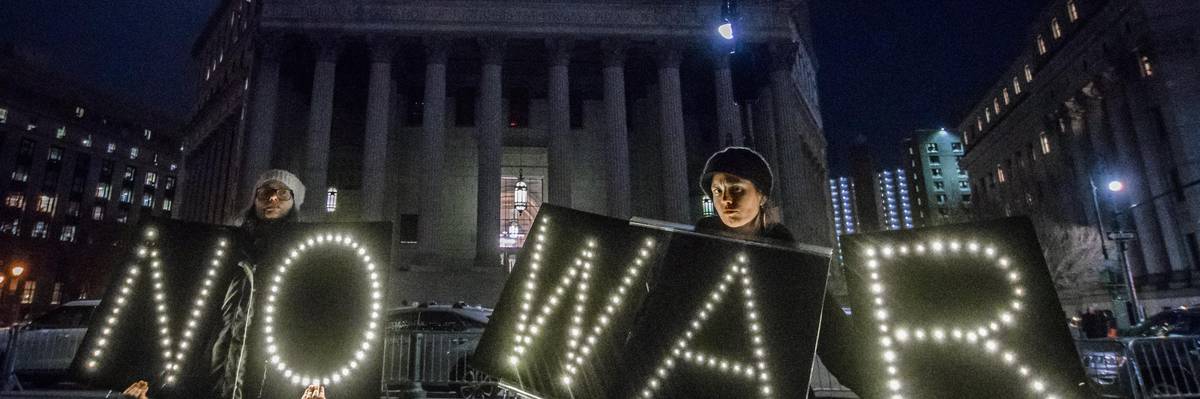
Members of the NYC Light Brigade holding an illuminated sign reading NO WAR at a rally on 01/09/2020. Hundreds of anti-war activists joined Iranian-Americans, Muslims, and communities of color in a rally at Foley Square to send a clear message: New York stand against endless wars, going to war with Iran and sanctions; demanding de-escalation and peace. (Photo: Erik McGregor/LightRocket via Getty Images)
Last weekend, U.S. corporate media continued a 20-year repetition compulsion to evade the central role of the USA in causing vast carnage and misery due to the so-called War on Terror. But millions of Americans fervently oppose the military-industrial complex and its extremely immoral nonstop warfare.
CodePink and Massachusetts Peace Action hosted a national webinar to mark the 20th anniversary of 9/11--the day before Sunday's launch of the Cut the Pentagon campaign--and the resulting video includes more than 20 speakers who directly challenged the lethal orthodoxy of the warfare state. As part of the mix, here's the gist of what I had to say:
When we hear all the media coverage and retrospectives, we rarely hear--and certainly almost never in the mass media hear--that when people are killed, whether it's intentional or predictable, those are atrocities that are being financed by U.S. taxpayers. And so we hear about the evils of Al Qaeda and 9/11, and certainly those were evils, but we're not hearing about the predictable as well as the intentional deaths: the tens of thousands of civilians killed by U.S. air strikes alone in the last two decades, and the injuries, and the terrorizing of people with drones and other U.S. weapons. We're hearing very little about that.
When we're told it's not practical on Capitol Hill to urge a cutoff of military funding and assistance to all countries that violate human rights--and when we're told that Israel is off the table--it's not our job to internalize those limits that have been internalized by almost everyone in Congress, except for the Squad and a precious few others.
Part of the role of activists is to make those realities heard, make them heard loud and clear, as forcefully and as emphatically and as powerfully as possible. Activist roles can sometimes get blurred in terms of becoming conflated with the roles of some of the best members of Congress. When progressive legislators push for peace and social justice, they deserve our praise and our support. When they succumb to the foreign-policy "Blob"--when they start to be more a representative of the establishment to the movements rather than a representative of the movements to the establishment--we've got a problem.
It's vital for progressive activists to be clear about what our goals are, and to be willing to challenge even our friends on Capitol Hill.
I'll give you a very recent example. Two leaders of anti-war forces in the House of Representatives, a couple of weeks ago, circulated a "Dear Colleague" message encouraging members of the House to sign a letter urging the chair of the House Armed Services Committee, Adam Smith, to stand firm behind President Biden's 1.6 percent increase in the Pentagon budget, over the budget that Trump had gotten the year before. The point of the letter was: Chairman Smith, we want you to defend the Biden budget's increase of 1.6 percent, against the budget that has just been approved by the Senate Armed Services Committee with a 3.3 percent increase.
That kind of a letter moves the goal posts further and further to the liking of the military-industrial complex, to the liking of war profiteers, to the liking of the warfare state. And so, when people we admire and support, in this case Rep. Mark Pocan and Rep. Barbara Lee, circulate such a Dear Colleague letter, there's a tendency for organizations to say: "Yeah, we're going to get behind you," we will respond affirmatively to the call to urge our members to urge their representatives in Congress to sign this letter. And what that creates is a jumping-off point that moves the frame of reference farther and farther into the militarism that we're trying to push back against. For that reason, my colleagues and I at RootsAction decided to decline an invitation to sign in support.
I bring up that episode because it's indicative of the pathways and the crossroads that we face to create momentum for a stronger and more effective peace and social justice movement. And it's replicated in many respects. When we're told it's not practical on Capitol Hill to urge a cutoff of military funding and assistance to all countries that violate human rights--and when we're told that Israel is off the table--it's not our job to internalize those limits that have been internalized by almost everyone in Congress, except for the Squad and a precious few others.
It's our job to speak not only truth to power but also about power. And to be clear and candid even when that means challenging some of our usual allies. And to organize.
At RootsAction, we've launched a site called Progressive Hub, as an activism tool to combine the need to know with the imperative to act.
It's not easy, to put it mildly, to go against the powerful flood of megamedia, of big money in politics, of the ways that issues are constantly framed by powerful elites. But in the long run, peace activism is essential for overcoming militarism. And organizing is what makes that possible.
Dear Common Dreams reader, It’s been nearly 30 years since I co-founded Common Dreams with my late wife, Lina Newhouser. We had the radical notion that journalism should serve the public good, not corporate profits. It was clear to us from the outset what it would take to build such a project. No paid advertisements. No corporate sponsors. No millionaire publisher telling us what to think or do. Many people said we wouldn't last a year, but we proved those doubters wrong. Together with a tremendous team of journalists and dedicated staff, we built an independent media outlet free from the constraints of profits and corporate control. Our mission has always been simple: To inform. To inspire. To ignite change for the common good. Building Common Dreams was not easy. Our survival was never guaranteed. When you take on the most powerful forces—Wall Street greed, fossil fuel industry destruction, Big Tech lobbyists, and uber-rich oligarchs who have spent billions upon billions rigging the economy and democracy in their favor—the only bulwark you have is supporters who believe in your work. But here’s the urgent message from me today. It's never been this bad out there. And it's never been this hard to keep us going. At the very moment Common Dreams is most needed, the threats we face are intensifying. We need your support now more than ever. We don't accept corporate advertising and never will. We don't have a paywall because we don't think people should be blocked from critical news based on their ability to pay. Everything we do is funded by the donations of readers like you. When everyone does the little they can afford, we are strong. But if that support retreats or dries up, so do we. Will you donate now to make sure Common Dreams not only survives but thrives? —Craig Brown, Co-founder |
Norman Solomon is the national director of RootsAction.org and executive director of the Institute for Public Accuracy. The paperback edition of his latest book, War Made Invisible: How America Hides the Human Toll of Its Military Machine, includes an afterword about the Gaza war.
Last weekend, U.S. corporate media continued a 20-year repetition compulsion to evade the central role of the USA in causing vast carnage and misery due to the so-called War on Terror. But millions of Americans fervently oppose the military-industrial complex and its extremely immoral nonstop warfare.
CodePink and Massachusetts Peace Action hosted a national webinar to mark the 20th anniversary of 9/11--the day before Sunday's launch of the Cut the Pentagon campaign--and the resulting video includes more than 20 speakers who directly challenged the lethal orthodoxy of the warfare state. As part of the mix, here's the gist of what I had to say:
When we hear all the media coverage and retrospectives, we rarely hear--and certainly almost never in the mass media hear--that when people are killed, whether it's intentional or predictable, those are atrocities that are being financed by U.S. taxpayers. And so we hear about the evils of Al Qaeda and 9/11, and certainly those were evils, but we're not hearing about the predictable as well as the intentional deaths: the tens of thousands of civilians killed by U.S. air strikes alone in the last two decades, and the injuries, and the terrorizing of people with drones and other U.S. weapons. We're hearing very little about that.
When we're told it's not practical on Capitol Hill to urge a cutoff of military funding and assistance to all countries that violate human rights--and when we're told that Israel is off the table--it's not our job to internalize those limits that have been internalized by almost everyone in Congress, except for the Squad and a precious few others.
Part of the role of activists is to make those realities heard, make them heard loud and clear, as forcefully and as emphatically and as powerfully as possible. Activist roles can sometimes get blurred in terms of becoming conflated with the roles of some of the best members of Congress. When progressive legislators push for peace and social justice, they deserve our praise and our support. When they succumb to the foreign-policy "Blob"--when they start to be more a representative of the establishment to the movements rather than a representative of the movements to the establishment--we've got a problem.
It's vital for progressive activists to be clear about what our goals are, and to be willing to challenge even our friends on Capitol Hill.
I'll give you a very recent example. Two leaders of anti-war forces in the House of Representatives, a couple of weeks ago, circulated a "Dear Colleague" message encouraging members of the House to sign a letter urging the chair of the House Armed Services Committee, Adam Smith, to stand firm behind President Biden's 1.6 percent increase in the Pentagon budget, over the budget that Trump had gotten the year before. The point of the letter was: Chairman Smith, we want you to defend the Biden budget's increase of 1.6 percent, against the budget that has just been approved by the Senate Armed Services Committee with a 3.3 percent increase.
That kind of a letter moves the goal posts further and further to the liking of the military-industrial complex, to the liking of war profiteers, to the liking of the warfare state. And so, when people we admire and support, in this case Rep. Mark Pocan and Rep. Barbara Lee, circulate such a Dear Colleague letter, there's a tendency for organizations to say: "Yeah, we're going to get behind you," we will respond affirmatively to the call to urge our members to urge their representatives in Congress to sign this letter. And what that creates is a jumping-off point that moves the frame of reference farther and farther into the militarism that we're trying to push back against. For that reason, my colleagues and I at RootsAction decided to decline an invitation to sign in support.
I bring up that episode because it's indicative of the pathways and the crossroads that we face to create momentum for a stronger and more effective peace and social justice movement. And it's replicated in many respects. When we're told it's not practical on Capitol Hill to urge a cutoff of military funding and assistance to all countries that violate human rights--and when we're told that Israel is off the table--it's not our job to internalize those limits that have been internalized by almost everyone in Congress, except for the Squad and a precious few others.
It's our job to speak not only truth to power but also about power. And to be clear and candid even when that means challenging some of our usual allies. And to organize.
At RootsAction, we've launched a site called Progressive Hub, as an activism tool to combine the need to know with the imperative to act.
It's not easy, to put it mildly, to go against the powerful flood of megamedia, of big money in politics, of the ways that issues are constantly framed by powerful elites. But in the long run, peace activism is essential for overcoming militarism. And organizing is what makes that possible.
Norman Solomon is the national director of RootsAction.org and executive director of the Institute for Public Accuracy. The paperback edition of his latest book, War Made Invisible: How America Hides the Human Toll of Its Military Machine, includes an afterword about the Gaza war.
Last weekend, U.S. corporate media continued a 20-year repetition compulsion to evade the central role of the USA in causing vast carnage and misery due to the so-called War on Terror. But millions of Americans fervently oppose the military-industrial complex and its extremely immoral nonstop warfare.
CodePink and Massachusetts Peace Action hosted a national webinar to mark the 20th anniversary of 9/11--the day before Sunday's launch of the Cut the Pentagon campaign--and the resulting video includes more than 20 speakers who directly challenged the lethal orthodoxy of the warfare state. As part of the mix, here's the gist of what I had to say:
When we hear all the media coverage and retrospectives, we rarely hear--and certainly almost never in the mass media hear--that when people are killed, whether it's intentional or predictable, those are atrocities that are being financed by U.S. taxpayers. And so we hear about the evils of Al Qaeda and 9/11, and certainly those were evils, but we're not hearing about the predictable as well as the intentional deaths: the tens of thousands of civilians killed by U.S. air strikes alone in the last two decades, and the injuries, and the terrorizing of people with drones and other U.S. weapons. We're hearing very little about that.
When we're told it's not practical on Capitol Hill to urge a cutoff of military funding and assistance to all countries that violate human rights--and when we're told that Israel is off the table--it's not our job to internalize those limits that have been internalized by almost everyone in Congress, except for the Squad and a precious few others.
Part of the role of activists is to make those realities heard, make them heard loud and clear, as forcefully and as emphatically and as powerfully as possible. Activist roles can sometimes get blurred in terms of becoming conflated with the roles of some of the best members of Congress. When progressive legislators push for peace and social justice, they deserve our praise and our support. When they succumb to the foreign-policy "Blob"--when they start to be more a representative of the establishment to the movements rather than a representative of the movements to the establishment--we've got a problem.
It's vital for progressive activists to be clear about what our goals are, and to be willing to challenge even our friends on Capitol Hill.
I'll give you a very recent example. Two leaders of anti-war forces in the House of Representatives, a couple of weeks ago, circulated a "Dear Colleague" message encouraging members of the House to sign a letter urging the chair of the House Armed Services Committee, Adam Smith, to stand firm behind President Biden's 1.6 percent increase in the Pentagon budget, over the budget that Trump had gotten the year before. The point of the letter was: Chairman Smith, we want you to defend the Biden budget's increase of 1.6 percent, against the budget that has just been approved by the Senate Armed Services Committee with a 3.3 percent increase.
That kind of a letter moves the goal posts further and further to the liking of the military-industrial complex, to the liking of war profiteers, to the liking of the warfare state. And so, when people we admire and support, in this case Rep. Mark Pocan and Rep. Barbara Lee, circulate such a Dear Colleague letter, there's a tendency for organizations to say: "Yeah, we're going to get behind you," we will respond affirmatively to the call to urge our members to urge their representatives in Congress to sign this letter. And what that creates is a jumping-off point that moves the frame of reference farther and farther into the militarism that we're trying to push back against. For that reason, my colleagues and I at RootsAction decided to decline an invitation to sign in support.
I bring up that episode because it's indicative of the pathways and the crossroads that we face to create momentum for a stronger and more effective peace and social justice movement. And it's replicated in many respects. When we're told it's not practical on Capitol Hill to urge a cutoff of military funding and assistance to all countries that violate human rights--and when we're told that Israel is off the table--it's not our job to internalize those limits that have been internalized by almost everyone in Congress, except for the Squad and a precious few others.
It's our job to speak not only truth to power but also about power. And to be clear and candid even when that means challenging some of our usual allies. And to organize.
At RootsAction, we've launched a site called Progressive Hub, as an activism tool to combine the need to know with the imperative to act.
It's not easy, to put it mildly, to go against the powerful flood of megamedia, of big money in politics, of the ways that issues are constantly framed by powerful elites. But in the long run, peace activism is essential for overcoming militarism. And organizing is what makes that possible.