SUBSCRIBE TO OUR FREE NEWSLETTER
Daily news & progressive opinion—funded by the people, not the corporations—delivered straight to your inbox.
5
#000000
#FFFFFF
To donate by check, phone, or other method, see our More Ways to Give page.
Daily news & progressive opinion—funded by the people, not the corporations—delivered straight to your inbox.
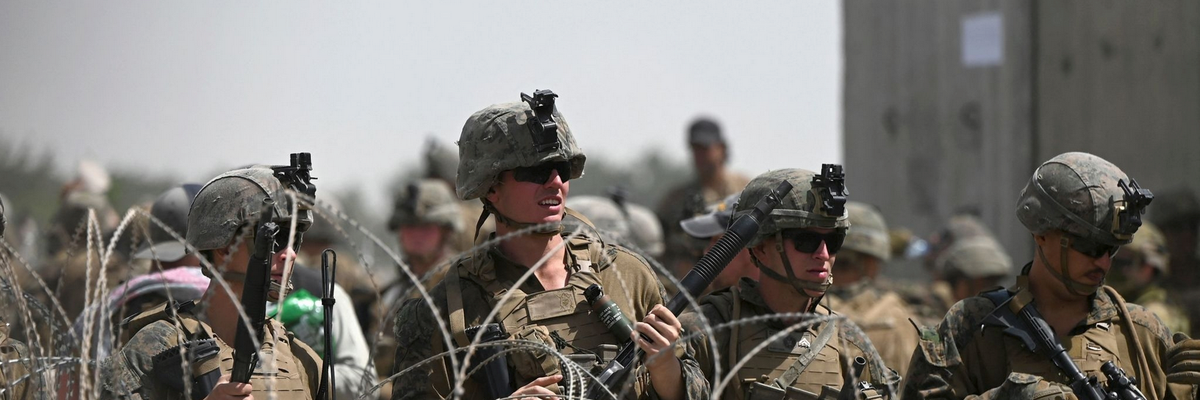
US soldiers stand guard behind barbed wire as Afghans sit on a roadside near the military part of the airport in Kabul on August 20, 2021, hoping to flee from the country after the Taliban's military takeover of Afghanistan. (Photo: Wakil Kohsar/AFP via Getty Images)
The United States emerged from its victory in World War II as the world's preeminent superpower. Its annual military budget--about three-quarters of a trillion dollars a year--exceeds the aggregate of the next ten countries in the world.
Yet despite America's apparent global military supremacy, of the approximately dozen wars the U.S. has fought since 1945 (depending on how you're counting) the U.S. has lost every real war it has fought. (Its only "victories" have been minor military incursions to overthrow unfriendly governments in Grenada, population approximately 120,000, and Panama, population approximately 4.2 million.)
After millions of deaths of Americans and foreigners and trillions of dollars lost in places like Vietnam, Afghanistan, and the Middle East, is the U.S. any safer and secure because it fought these losing wars in far-off lands? No.
Have the American people benefited from these wars? No. Hundreds of thousands of soldiers have been killed or wounded and trillions of dollars have been spent.
So if the American people don't benefit from these endless losing wars, why do we keep fighting them? The short answer is that there are powerful forces in America that get rich from endless wars: The military-industrial complex and its political and economic servants and enablers.
As CodePink tweeted last week:
President (and former General) Dwight D. Eisenhower warned in his 1961 Farewell Address to the nation, "We must never let the weight of this [the military-industrial complex] endanger our liberties or democratic processes. [...] Only an alert and knowledgeable citizenry can compel the proper meshing of the huge industrial and military machinery of defense with our peaceful methods and goals."
Drive around the wealthy suburbs around the nation's capitol and look at the multi-million dollar McMansions owned by corporate executives and lobbyists who are the real beneficiaries of America's forever wars. During the Afghanistan War, the stocks of the five largest defense contractors outperformed the S&P 500 by 58%. Fortunes end up in the pockets of corporate executives. They and their companies spend tens of millions of dollars lobbying Congress and contributing to Republican and Democratic politicians alike to buy their support for forever war and defense budgets totaling 60% of the Federal government's discretionary spending.
That's why, even as the Afghanistan War is ending, much of the corporate elite and the corporate media is ginning up a new cold war with China, to justify continued over-spending on the military.
The main danger to U.S. security is not a military invasion by a heavily armed superpower enemy. Bigger national security threats today are climate change, cybersecurity, and global pandemics. These will not be addressed by spending more on the traditional military and fighting more losing forever wars. They require popular resistance to the military industrial complex, the defeat of politicians on their payroll, and the transformation of American priorities from preparing for and fighting useless wars to addressing the climate, economic inequality, and equal justice.
As Warren Gunnels, staff director of the Senate Budget Committee, put it, "The only thing that we 'accomplished' by going into Vietnam, Iraq and Afghanistan was to put trillions of dollars into the military-industrial complex and destroy millions of lives--period, full stop. It's time to stop repeating the same mistakes over and over again."
Dear Common Dreams reader, It’s been nearly 30 years since I co-founded Common Dreams with my late wife, Lina Newhouser. We had the radical notion that journalism should serve the public good, not corporate profits. It was clear to us from the outset what it would take to build such a project. No paid advertisements. No corporate sponsors. No millionaire publisher telling us what to think or do. Many people said we wouldn't last a year, but we proved those doubters wrong. Together with a tremendous team of journalists and dedicated staff, we built an independent media outlet free from the constraints of profits and corporate control. Our mission has always been simple: To inform. To inspire. To ignite change for the common good. Building Common Dreams was not easy. Our survival was never guaranteed. When you take on the most powerful forces—Wall Street greed, fossil fuel industry destruction, Big Tech lobbyists, and uber-rich oligarchs who have spent billions upon billions rigging the economy and democracy in their favor—the only bulwark you have is supporters who believe in your work. But here’s the urgent message from me today. It's never been this bad out there. And it's never been this hard to keep us going. At the very moment Common Dreams is most needed, the threats we face are intensifying. We need your support now more than ever. We don't accept corporate advertising and never will. We don't have a paywall because we don't think people should be blocked from critical news based on their ability to pay. Everything we do is funded by the donations of readers like you. When everyone does the little they can afford, we are strong. But if that support retreats or dries up, so do we. Will you donate now to make sure Common Dreams not only survives but thrives? —Craig Brown, Co-founder |
The United States emerged from its victory in World War II as the world's preeminent superpower. Its annual military budget--about three-quarters of a trillion dollars a year--exceeds the aggregate of the next ten countries in the world.
Yet despite America's apparent global military supremacy, of the approximately dozen wars the U.S. has fought since 1945 (depending on how you're counting) the U.S. has lost every real war it has fought. (Its only "victories" have been minor military incursions to overthrow unfriendly governments in Grenada, population approximately 120,000, and Panama, population approximately 4.2 million.)
After millions of deaths of Americans and foreigners and trillions of dollars lost in places like Vietnam, Afghanistan, and the Middle East, is the U.S. any safer and secure because it fought these losing wars in far-off lands? No.
Have the American people benefited from these wars? No. Hundreds of thousands of soldiers have been killed or wounded and trillions of dollars have been spent.
So if the American people don't benefit from these endless losing wars, why do we keep fighting them? The short answer is that there are powerful forces in America that get rich from endless wars: The military-industrial complex and its political and economic servants and enablers.
As CodePink tweeted last week:
President (and former General) Dwight D. Eisenhower warned in his 1961 Farewell Address to the nation, "We must never let the weight of this [the military-industrial complex] endanger our liberties or democratic processes. [...] Only an alert and knowledgeable citizenry can compel the proper meshing of the huge industrial and military machinery of defense with our peaceful methods and goals."
Drive around the wealthy suburbs around the nation's capitol and look at the multi-million dollar McMansions owned by corporate executives and lobbyists who are the real beneficiaries of America's forever wars. During the Afghanistan War, the stocks of the five largest defense contractors outperformed the S&P 500 by 58%. Fortunes end up in the pockets of corporate executives. They and their companies spend tens of millions of dollars lobbying Congress and contributing to Republican and Democratic politicians alike to buy their support for forever war and defense budgets totaling 60% of the Federal government's discretionary spending.
That's why, even as the Afghanistan War is ending, much of the corporate elite and the corporate media is ginning up a new cold war with China, to justify continued over-spending on the military.
The main danger to U.S. security is not a military invasion by a heavily armed superpower enemy. Bigger national security threats today are climate change, cybersecurity, and global pandemics. These will not be addressed by spending more on the traditional military and fighting more losing forever wars. They require popular resistance to the military industrial complex, the defeat of politicians on their payroll, and the transformation of American priorities from preparing for and fighting useless wars to addressing the climate, economic inequality, and equal justice.
As Warren Gunnels, staff director of the Senate Budget Committee, put it, "The only thing that we 'accomplished' by going into Vietnam, Iraq and Afghanistan was to put trillions of dollars into the military-industrial complex and destroy millions of lives--period, full stop. It's time to stop repeating the same mistakes over and over again."
The United States emerged from its victory in World War II as the world's preeminent superpower. Its annual military budget--about three-quarters of a trillion dollars a year--exceeds the aggregate of the next ten countries in the world.
Yet despite America's apparent global military supremacy, of the approximately dozen wars the U.S. has fought since 1945 (depending on how you're counting) the U.S. has lost every real war it has fought. (Its only "victories" have been minor military incursions to overthrow unfriendly governments in Grenada, population approximately 120,000, and Panama, population approximately 4.2 million.)
After millions of deaths of Americans and foreigners and trillions of dollars lost in places like Vietnam, Afghanistan, and the Middle East, is the U.S. any safer and secure because it fought these losing wars in far-off lands? No.
Have the American people benefited from these wars? No. Hundreds of thousands of soldiers have been killed or wounded and trillions of dollars have been spent.
So if the American people don't benefit from these endless losing wars, why do we keep fighting them? The short answer is that there are powerful forces in America that get rich from endless wars: The military-industrial complex and its political and economic servants and enablers.
As CodePink tweeted last week:
President (and former General) Dwight D. Eisenhower warned in his 1961 Farewell Address to the nation, "We must never let the weight of this [the military-industrial complex] endanger our liberties or democratic processes. [...] Only an alert and knowledgeable citizenry can compel the proper meshing of the huge industrial and military machinery of defense with our peaceful methods and goals."
Drive around the wealthy suburbs around the nation's capitol and look at the multi-million dollar McMansions owned by corporate executives and lobbyists who are the real beneficiaries of America's forever wars. During the Afghanistan War, the stocks of the five largest defense contractors outperformed the S&P 500 by 58%. Fortunes end up in the pockets of corporate executives. They and their companies spend tens of millions of dollars lobbying Congress and contributing to Republican and Democratic politicians alike to buy their support for forever war and defense budgets totaling 60% of the Federal government's discretionary spending.
That's why, even as the Afghanistan War is ending, much of the corporate elite and the corporate media is ginning up a new cold war with China, to justify continued over-spending on the military.
The main danger to U.S. security is not a military invasion by a heavily armed superpower enemy. Bigger national security threats today are climate change, cybersecurity, and global pandemics. These will not be addressed by spending more on the traditional military and fighting more losing forever wars. They require popular resistance to the military industrial complex, the defeat of politicians on their payroll, and the transformation of American priorities from preparing for and fighting useless wars to addressing the climate, economic inequality, and equal justice.
As Warren Gunnels, staff director of the Senate Budget Committee, put it, "The only thing that we 'accomplished' by going into Vietnam, Iraq and Afghanistan was to put trillions of dollars into the military-industrial complex and destroy millions of lives--period, full stop. It's time to stop repeating the same mistakes over and over again."