SUBSCRIBE TO OUR FREE NEWSLETTER
Daily news & progressive opinion—funded by the people, not the corporations—delivered straight to your inbox.
5
#000000
#FFFFFF
To donate by check, phone, or other method, see our More Ways to Give page.
Daily news & progressive opinion—funded by the people, not the corporations—delivered straight to your inbox.
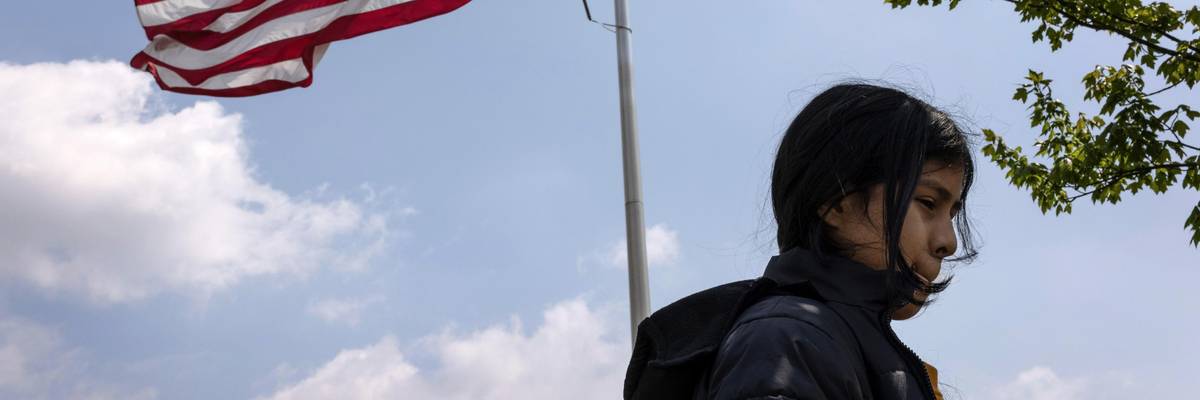
Unaccompanied minor from Honduras joins extended family in Indiana after 8 weeks in U.S. Govt Custody on April 25, 2021 in Jeffersonville, Indiana. (Photo by John Moore/Getty Images)
I grew up in a poor, undocumented family. I was lucky--we got our legal residency, I got an education, and now I have a good job. But no one should have to count on luck.
Here's my story and what I've learned.
My dad came to the U.S. to work through the Bracero program. He sent money to support us back in Mexico, but after 10 years apart, my family was desperate to reunite. So in the early 1980s, my mother took me, my sister, and brother across the border.
I was five years old, but I remember the heat, the exhaustion, the fear, and the hope. When we first reunited with my dad, he was living in a house with nine other workers. For years, living with others was the only way we could make rent.
Things like a living wage and a humane immigration policy need to be legislated according to standards of human rights and justice.
We put down roots in a conservative, majority-white town south of Dallas. At first, my parents were afraid to put us in school or even let us play outside --they feared we would be discovered and taken away. Eventually, we were enrolled in school, but the fear and trauma persisted. Neighbors called us "illegals," "wetbacks," and worse.
Money was tight. My dad worked hard at the local recycling center for less than $200 a week. As a full-time babysitter, my mom just earned $20 a week. We had beans and tortillas, a roof over our cramped living quarters, and that was it.
I remember my brother, a talented soccer player, once needed $16 socks. Afterwards, food was scarce. So we kids went to work young. We barely got by, and we lived in constant fear of deportation.
Finally, in 1986, there was a legal amnesty program for immigrants like us. My dad was afraid it was a trick to round us all up and deport us. Scams abounded where professional-looking people would try to charge immigrant families thousands of dollars to apply.
Poverty is like that sometimes. You work harder than you can imagine, and then you get fleeced. But eventually, we did become legal residents. It didn't mean we could now afford winter coats, but it did mean we weren't terrified everyday.
We worked very, very hard, but what really made a difference was luck. And that amnesty gave us just enough breathing room to get our family out of the shadows and out of poverty.
My good luck was that my school had a model Organization of American States program. It turns out I was a natural for diplomacy and ended up going to nationals in Washington, D.C.--an experience that helped me get into Georgetown.
School wasn't easy there, either--I was often treated like I wasn't good enough. But I graduated, moved back to Texas, and went to work for justice for immigrant families like mine.
I've learned a few things about poverty along the way.
First, the conditions for undocumented workers today are even worse now than when I was a child. Some things have improved with the new administration, but we still have private contractors locking up working people like my parents and kids like me. We desperately need meaningful immigration reform.
Instead of fighting the system that kept us in poverty, we were taught to fight each other.
Second, I learned how cynical politicians use racial divisions to divide and conquer us.
Alongside my poor immigrant family lived poor Black families, literally on the other side of the railroad tracks, and poor white kids in a trailer park. We were all struggling. But instead of fighting the system that kept us in poverty, we were taught to fight each other.
I was lucky, but living a dignified life shouldn't depend on luck. Things like a living wage and a humane immigration policy need to be legislated according to standards of human rights and justice.
We're all better off when we're all better off. Let's go forward together.
Dear Common Dreams reader, It’s been nearly 30 years since I co-founded Common Dreams with my late wife, Lina Newhouser. We had the radical notion that journalism should serve the public good, not corporate profits. It was clear to us from the outset what it would take to build such a project. No paid advertisements. No corporate sponsors. No millionaire publisher telling us what to think or do. Many people said we wouldn't last a year, but we proved those doubters wrong. Together with a tremendous team of journalists and dedicated staff, we built an independent media outlet free from the constraints of profits and corporate control. Our mission has always been simple: To inform. To inspire. To ignite change for the common good. Building Common Dreams was not easy. Our survival was never guaranteed. When you take on the most powerful forces—Wall Street greed, fossil fuel industry destruction, Big Tech lobbyists, and uber-rich oligarchs who have spent billions upon billions rigging the economy and democracy in their favor—the only bulwark you have is supporters who believe in your work. But here’s the urgent message from me today. It's never been this bad out there. And it's never been this hard to keep us going. At the very moment Common Dreams is most needed, the threats we face are intensifying. We need your support now more than ever. We don't accept corporate advertising and never will. We don't have a paywall because we don't think people should be blocked from critical news based on their ability to pay. Everything we do is funded by the donations of readers like you. When everyone does the little they can afford, we are strong. But if that support retreats or dries up, so do we. Will you donate now to make sure Common Dreams not only survives but thrives? —Craig Brown, Co-founder |
I grew up in a poor, undocumented family. I was lucky--we got our legal residency, I got an education, and now I have a good job. But no one should have to count on luck.
Here's my story and what I've learned.
My dad came to the U.S. to work through the Bracero program. He sent money to support us back in Mexico, but after 10 years apart, my family was desperate to reunite. So in the early 1980s, my mother took me, my sister, and brother across the border.
I was five years old, but I remember the heat, the exhaustion, the fear, and the hope. When we first reunited with my dad, he was living in a house with nine other workers. For years, living with others was the only way we could make rent.
Things like a living wage and a humane immigration policy need to be legislated according to standards of human rights and justice.
We put down roots in a conservative, majority-white town south of Dallas. At first, my parents were afraid to put us in school or even let us play outside --they feared we would be discovered and taken away. Eventually, we were enrolled in school, but the fear and trauma persisted. Neighbors called us "illegals," "wetbacks," and worse.
Money was tight. My dad worked hard at the local recycling center for less than $200 a week. As a full-time babysitter, my mom just earned $20 a week. We had beans and tortillas, a roof over our cramped living quarters, and that was it.
I remember my brother, a talented soccer player, once needed $16 socks. Afterwards, food was scarce. So we kids went to work young. We barely got by, and we lived in constant fear of deportation.
Finally, in 1986, there was a legal amnesty program for immigrants like us. My dad was afraid it was a trick to round us all up and deport us. Scams abounded where professional-looking people would try to charge immigrant families thousands of dollars to apply.
Poverty is like that sometimes. You work harder than you can imagine, and then you get fleeced. But eventually, we did become legal residents. It didn't mean we could now afford winter coats, but it did mean we weren't terrified everyday.
We worked very, very hard, but what really made a difference was luck. And that amnesty gave us just enough breathing room to get our family out of the shadows and out of poverty.
My good luck was that my school had a model Organization of American States program. It turns out I was a natural for diplomacy and ended up going to nationals in Washington, D.C.--an experience that helped me get into Georgetown.
School wasn't easy there, either--I was often treated like I wasn't good enough. But I graduated, moved back to Texas, and went to work for justice for immigrant families like mine.
I've learned a few things about poverty along the way.
First, the conditions for undocumented workers today are even worse now than when I was a child. Some things have improved with the new administration, but we still have private contractors locking up working people like my parents and kids like me. We desperately need meaningful immigration reform.
Instead of fighting the system that kept us in poverty, we were taught to fight each other.
Second, I learned how cynical politicians use racial divisions to divide and conquer us.
Alongside my poor immigrant family lived poor Black families, literally on the other side of the railroad tracks, and poor white kids in a trailer park. We were all struggling. But instead of fighting the system that kept us in poverty, we were taught to fight each other.
I was lucky, but living a dignified life shouldn't depend on luck. Things like a living wage and a humane immigration policy need to be legislated according to standards of human rights and justice.
We're all better off when we're all better off. Let's go forward together.
I grew up in a poor, undocumented family. I was lucky--we got our legal residency, I got an education, and now I have a good job. But no one should have to count on luck.
Here's my story and what I've learned.
My dad came to the U.S. to work through the Bracero program. He sent money to support us back in Mexico, but after 10 years apart, my family was desperate to reunite. So in the early 1980s, my mother took me, my sister, and brother across the border.
I was five years old, but I remember the heat, the exhaustion, the fear, and the hope. When we first reunited with my dad, he was living in a house with nine other workers. For years, living with others was the only way we could make rent.
Things like a living wage and a humane immigration policy need to be legislated according to standards of human rights and justice.
We put down roots in a conservative, majority-white town south of Dallas. At first, my parents were afraid to put us in school or even let us play outside --they feared we would be discovered and taken away. Eventually, we were enrolled in school, but the fear and trauma persisted. Neighbors called us "illegals," "wetbacks," and worse.
Money was tight. My dad worked hard at the local recycling center for less than $200 a week. As a full-time babysitter, my mom just earned $20 a week. We had beans and tortillas, a roof over our cramped living quarters, and that was it.
I remember my brother, a talented soccer player, once needed $16 socks. Afterwards, food was scarce. So we kids went to work young. We barely got by, and we lived in constant fear of deportation.
Finally, in 1986, there was a legal amnesty program for immigrants like us. My dad was afraid it was a trick to round us all up and deport us. Scams abounded where professional-looking people would try to charge immigrant families thousands of dollars to apply.
Poverty is like that sometimes. You work harder than you can imagine, and then you get fleeced. But eventually, we did become legal residents. It didn't mean we could now afford winter coats, but it did mean we weren't terrified everyday.
We worked very, very hard, but what really made a difference was luck. And that amnesty gave us just enough breathing room to get our family out of the shadows and out of poverty.
My good luck was that my school had a model Organization of American States program. It turns out I was a natural for diplomacy and ended up going to nationals in Washington, D.C.--an experience that helped me get into Georgetown.
School wasn't easy there, either--I was often treated like I wasn't good enough. But I graduated, moved back to Texas, and went to work for justice for immigrant families like mine.
I've learned a few things about poverty along the way.
First, the conditions for undocumented workers today are even worse now than when I was a child. Some things have improved with the new administration, but we still have private contractors locking up working people like my parents and kids like me. We desperately need meaningful immigration reform.
Instead of fighting the system that kept us in poverty, we were taught to fight each other.
Second, I learned how cynical politicians use racial divisions to divide and conquer us.
Alongside my poor immigrant family lived poor Black families, literally on the other side of the railroad tracks, and poor white kids in a trailer park. We were all struggling. But instead of fighting the system that kept us in poverty, we were taught to fight each other.
I was lucky, but living a dignified life shouldn't depend on luck. Things like a living wage and a humane immigration policy need to be legislated according to standards of human rights and justice.
We're all better off when we're all better off. Let's go forward together.