SUBSCRIBE TO OUR FREE NEWSLETTER
Daily news & progressive opinion—funded by the people, not the corporations—delivered straight to your inbox.
5
#000000
#FFFFFF
To donate by check, phone, or other method, see our More Ways to Give page.
Daily news & progressive opinion—funded by the people, not the corporations—delivered straight to your inbox.
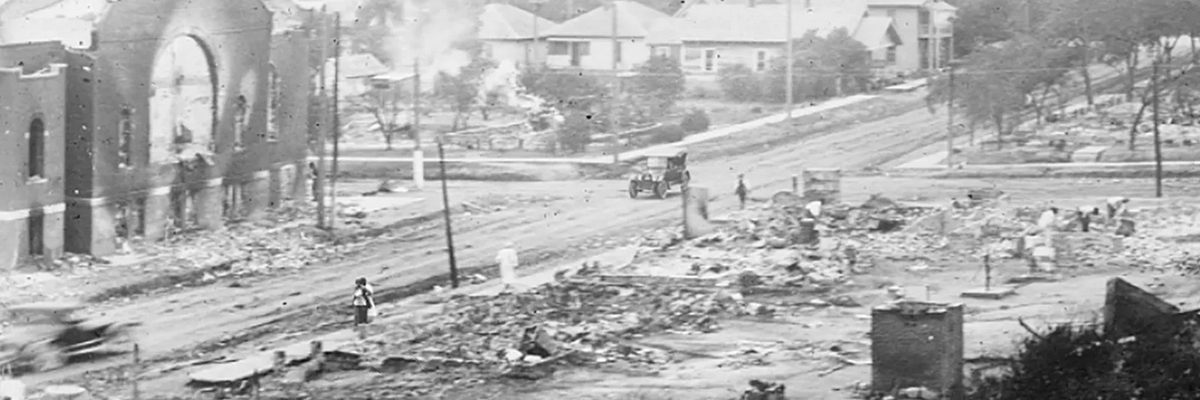
This June 1921 photo shows the aftermath of the the Tulsa Race Massacre in Tulsa, Oklahoma.
Memorial Day marks one year since the murder of George Floyd by the hands of the Minneapolis police. This week also marks the 100-year anniversary of the Tulsa Race Massacre, a brutal government-aided leveling of a prosperous African American community for which there still has been no accounting and no justice. Few even know about the massacre. It hasn't even been taught in the Tulsa public schools until this year. Although 100 years old, the massacre poses questions of justice and of decency that America cannot avoid.
After World War I, a neighborhood in Tulsa, Oklahoma, named Greenwood grew to be among the wealthiest Black communities in the country. Booker T. Washington called it the "Black Wall Street." Here were successful entrepreneurs, doctors, and lawyers who through hard work and good minds were building a prosperous Black community. The district was lined with Black-owned shops. restaurants, a 54-room grand hotel and the Dreamland Theater. It supported two newspapers and a hospital.
No one was held responsible for the deaths and injuries, or the millions in property losses.
Then on the day after Memorial Day, a white mob gathered to lynch a young Black 19-year-old who had startled a 17-year-old white girl, an elevator operator, in an elevator. Rumors inflated the incident into an alleged rape. Black veterans of World War I rushed to the jail to try to protect the young man from the mob. A shot was fired, and the enraged white mob chased blacks back into Greenwood.
Then the massacre began. The police and National Guard joined the mob rather than enforce the peace. Planes circled overhead to drop turpentine bombs on homes and businesses. As Rev. Robert Turner, pastor of the historic Vernon African Methodist Episcopal Church that was torched in the massacre, notes, "The first time in American history that airplanes were used to terrorize America was not in 9/11, was not at Pearl Harbor, it was right here in the Greenwood District."
The 2001 report of the Oklahoma Commission to Study the Race Riot of 1921, created by the state legislature, found that the city of Tulsa conspired to destroy Greenwood. According to the commission's report, the massacre destroyed some 40 square blocks. Nearly 10,000 people were left homeless as 1,256 homes were looted and burned down. So too was the thriving commercial district, including the Black hospital.
White hospitals turned away Greenwood's wounded. Many bled to death, including Greenwood's most prominent surgeon. The number of dead is estimated to be as many as 300, but went uncounted. Many were simply dumped in unmarked graves. Ten thousand African Americans were left homeless; some 6,000 were herded into internment camps for weeks. Government officials committed no public money to help Greenwood rebuild. Instead, they opposed any revival, even rejecting offers of assistance from outside of Tulsa.
No one was held responsible for the deaths and injuries, or the millions in property losses. Not one insurance company honored a claim by an African American. City and state officials covered up the crime for decades.
As Dreisen Heath, author of a Human Rights Watch report on the massacre summarized, "The Greenwood neighborhood in Tulsa was destroyed, but survivors of the massacre and their descendants are still suffering the consequences. Decades of Black prosperity and millions of dollars in hard-earned wealth were wiped out in hours, but nobody was ever held accountable, and no compensation was ever paid."
That history lives today. Tulsa is still one of the most segregated cities in the country. The current mayor acknowledges "the history of racial disparity that exists in our city. A kid that's growing up in the predominantly African American part of our city is expected to live 11 years less than a kid that's growing up in a whiter part of the city." Tulsa still suffers from discrimination, institutionalized in the police, zoning laws, housing policies and more.
One hundred years later, the African American community still seeks justice. Rev. Turner marches each week to the city council to demand repair, reparations for the damage done. The state-created commission called for reparations such as direct payments to "riot survivors and descendants," a scholarship fund and a memorial. The Human Rights Watch report on the massacre calls on the Tulsa and Oklahoma governments to provide reparations, including "direct payments to the few massacre victims still living and the descendants," efforts to recover remains from mass graves, and a "comprehensive reparations plan," including targeted investments in health, education and economic opportunities." A House subcommittee has opened an inquiry into what can be done.
The issue of reparations always meets with resistance. Why should this generation pay for the crimes of those who lived 100 years ago? Yet once the massacre is admitted, the violation done to people can't be simply ignored. And the damage incurred--erasing a prosperous Black community and enforcing racially discriminatory policies through the decades--is real.
The mark of history scars Tulsa today. There, and elsewhere in America, there needs to be a process that can officially recognize the injustice, act to repair the damages done, and bring us together, so that our society can continue to make its difficult way to an inclusive, and better America.
Dear Common Dreams reader, It’s been nearly 30 years since I co-founded Common Dreams with my late wife, Lina Newhouser. We had the radical notion that journalism should serve the public good, not corporate profits. It was clear to us from the outset what it would take to build such a project. No paid advertisements. No corporate sponsors. No millionaire publisher telling us what to think or do. Many people said we wouldn't last a year, but we proved those doubters wrong. Together with a tremendous team of journalists and dedicated staff, we built an independent media outlet free from the constraints of profits and corporate control. Our mission has always been simple: To inform. To inspire. To ignite change for the common good. Building Common Dreams was not easy. Our survival was never guaranteed. When you take on the most powerful forces—Wall Street greed, fossil fuel industry destruction, Big Tech lobbyists, and uber-rich oligarchs who have spent billions upon billions rigging the economy and democracy in their favor—the only bulwark you have is supporters who believe in your work. But here’s the urgent message from me today. It's never been this bad out there. And it's never been this hard to keep us going. At the very moment Common Dreams is most needed, the threats we face are intensifying. We need your support now more than ever. We don't accept corporate advertising and never will. We don't have a paywall because we don't think people should be blocked from critical news based on their ability to pay. Everything we do is funded by the donations of readers like you. When everyone does the little they can afford, we are strong. But if that support retreats or dries up, so do we. Will you donate now to make sure Common Dreams not only survives but thrives? —Craig Brown, Co-founder |
Memorial Day marks one year since the murder of George Floyd by the hands of the Minneapolis police. This week also marks the 100-year anniversary of the Tulsa Race Massacre, a brutal government-aided leveling of a prosperous African American community for which there still has been no accounting and no justice. Few even know about the massacre. It hasn't even been taught in the Tulsa public schools until this year. Although 100 years old, the massacre poses questions of justice and of decency that America cannot avoid.
After World War I, a neighborhood in Tulsa, Oklahoma, named Greenwood grew to be among the wealthiest Black communities in the country. Booker T. Washington called it the "Black Wall Street." Here were successful entrepreneurs, doctors, and lawyers who through hard work and good minds were building a prosperous Black community. The district was lined with Black-owned shops. restaurants, a 54-room grand hotel and the Dreamland Theater. It supported two newspapers and a hospital.
No one was held responsible for the deaths and injuries, or the millions in property losses.
Then on the day after Memorial Day, a white mob gathered to lynch a young Black 19-year-old who had startled a 17-year-old white girl, an elevator operator, in an elevator. Rumors inflated the incident into an alleged rape. Black veterans of World War I rushed to the jail to try to protect the young man from the mob. A shot was fired, and the enraged white mob chased blacks back into Greenwood.
Then the massacre began. The police and National Guard joined the mob rather than enforce the peace. Planes circled overhead to drop turpentine bombs on homes and businesses. As Rev. Robert Turner, pastor of the historic Vernon African Methodist Episcopal Church that was torched in the massacre, notes, "The first time in American history that airplanes were used to terrorize America was not in 9/11, was not at Pearl Harbor, it was right here in the Greenwood District."
The 2001 report of the Oklahoma Commission to Study the Race Riot of 1921, created by the state legislature, found that the city of Tulsa conspired to destroy Greenwood. According to the commission's report, the massacre destroyed some 40 square blocks. Nearly 10,000 people were left homeless as 1,256 homes were looted and burned down. So too was the thriving commercial district, including the Black hospital.
White hospitals turned away Greenwood's wounded. Many bled to death, including Greenwood's most prominent surgeon. The number of dead is estimated to be as many as 300, but went uncounted. Many were simply dumped in unmarked graves. Ten thousand African Americans were left homeless; some 6,000 were herded into internment camps for weeks. Government officials committed no public money to help Greenwood rebuild. Instead, they opposed any revival, even rejecting offers of assistance from outside of Tulsa.
No one was held responsible for the deaths and injuries, or the millions in property losses. Not one insurance company honored a claim by an African American. City and state officials covered up the crime for decades.
As Dreisen Heath, author of a Human Rights Watch report on the massacre summarized, "The Greenwood neighborhood in Tulsa was destroyed, but survivors of the massacre and their descendants are still suffering the consequences. Decades of Black prosperity and millions of dollars in hard-earned wealth were wiped out in hours, but nobody was ever held accountable, and no compensation was ever paid."
That history lives today. Tulsa is still one of the most segregated cities in the country. The current mayor acknowledges "the history of racial disparity that exists in our city. A kid that's growing up in the predominantly African American part of our city is expected to live 11 years less than a kid that's growing up in a whiter part of the city." Tulsa still suffers from discrimination, institutionalized in the police, zoning laws, housing policies and more.
One hundred years later, the African American community still seeks justice. Rev. Turner marches each week to the city council to demand repair, reparations for the damage done. The state-created commission called for reparations such as direct payments to "riot survivors and descendants," a scholarship fund and a memorial. The Human Rights Watch report on the massacre calls on the Tulsa and Oklahoma governments to provide reparations, including "direct payments to the few massacre victims still living and the descendants," efforts to recover remains from mass graves, and a "comprehensive reparations plan," including targeted investments in health, education and economic opportunities." A House subcommittee has opened an inquiry into what can be done.
The issue of reparations always meets with resistance. Why should this generation pay for the crimes of those who lived 100 years ago? Yet once the massacre is admitted, the violation done to people can't be simply ignored. And the damage incurred--erasing a prosperous Black community and enforcing racially discriminatory policies through the decades--is real.
The mark of history scars Tulsa today. There, and elsewhere in America, there needs to be a process that can officially recognize the injustice, act to repair the damages done, and bring us together, so that our society can continue to make its difficult way to an inclusive, and better America.
Memorial Day marks one year since the murder of George Floyd by the hands of the Minneapolis police. This week also marks the 100-year anniversary of the Tulsa Race Massacre, a brutal government-aided leveling of a prosperous African American community for which there still has been no accounting and no justice. Few even know about the massacre. It hasn't even been taught in the Tulsa public schools until this year. Although 100 years old, the massacre poses questions of justice and of decency that America cannot avoid.
After World War I, a neighborhood in Tulsa, Oklahoma, named Greenwood grew to be among the wealthiest Black communities in the country. Booker T. Washington called it the "Black Wall Street." Here were successful entrepreneurs, doctors, and lawyers who through hard work and good minds were building a prosperous Black community. The district was lined with Black-owned shops. restaurants, a 54-room grand hotel and the Dreamland Theater. It supported two newspapers and a hospital.
No one was held responsible for the deaths and injuries, or the millions in property losses.
Then on the day after Memorial Day, a white mob gathered to lynch a young Black 19-year-old who had startled a 17-year-old white girl, an elevator operator, in an elevator. Rumors inflated the incident into an alleged rape. Black veterans of World War I rushed to the jail to try to protect the young man from the mob. A shot was fired, and the enraged white mob chased blacks back into Greenwood.
Then the massacre began. The police and National Guard joined the mob rather than enforce the peace. Planes circled overhead to drop turpentine bombs on homes and businesses. As Rev. Robert Turner, pastor of the historic Vernon African Methodist Episcopal Church that was torched in the massacre, notes, "The first time in American history that airplanes were used to terrorize America was not in 9/11, was not at Pearl Harbor, it was right here in the Greenwood District."
The 2001 report of the Oklahoma Commission to Study the Race Riot of 1921, created by the state legislature, found that the city of Tulsa conspired to destroy Greenwood. According to the commission's report, the massacre destroyed some 40 square blocks. Nearly 10,000 people were left homeless as 1,256 homes were looted and burned down. So too was the thriving commercial district, including the Black hospital.
White hospitals turned away Greenwood's wounded. Many bled to death, including Greenwood's most prominent surgeon. The number of dead is estimated to be as many as 300, but went uncounted. Many were simply dumped in unmarked graves. Ten thousand African Americans were left homeless; some 6,000 were herded into internment camps for weeks. Government officials committed no public money to help Greenwood rebuild. Instead, they opposed any revival, even rejecting offers of assistance from outside of Tulsa.
No one was held responsible for the deaths and injuries, or the millions in property losses. Not one insurance company honored a claim by an African American. City and state officials covered up the crime for decades.
As Dreisen Heath, author of a Human Rights Watch report on the massacre summarized, "The Greenwood neighborhood in Tulsa was destroyed, but survivors of the massacre and their descendants are still suffering the consequences. Decades of Black prosperity and millions of dollars in hard-earned wealth were wiped out in hours, but nobody was ever held accountable, and no compensation was ever paid."
That history lives today. Tulsa is still one of the most segregated cities in the country. The current mayor acknowledges "the history of racial disparity that exists in our city. A kid that's growing up in the predominantly African American part of our city is expected to live 11 years less than a kid that's growing up in a whiter part of the city." Tulsa still suffers from discrimination, institutionalized in the police, zoning laws, housing policies and more.
One hundred years later, the African American community still seeks justice. Rev. Turner marches each week to the city council to demand repair, reparations for the damage done. The state-created commission called for reparations such as direct payments to "riot survivors and descendants," a scholarship fund and a memorial. The Human Rights Watch report on the massacre calls on the Tulsa and Oklahoma governments to provide reparations, including "direct payments to the few massacre victims still living and the descendants," efforts to recover remains from mass graves, and a "comprehensive reparations plan," including targeted investments in health, education and economic opportunities." A House subcommittee has opened an inquiry into what can be done.
The issue of reparations always meets with resistance. Why should this generation pay for the crimes of those who lived 100 years ago? Yet once the massacre is admitted, the violation done to people can't be simply ignored. And the damage incurred--erasing a prosperous Black community and enforcing racially discriminatory policies through the decades--is real.
The mark of history scars Tulsa today. There, and elsewhere in America, there needs to be a process that can officially recognize the injustice, act to repair the damages done, and bring us together, so that our society can continue to make its difficult way to an inclusive, and better America.