SUBSCRIBE TO OUR FREE NEWSLETTER
Daily news & progressive opinion—funded by the people, not the corporations—delivered straight to your inbox.
5
#000000
#FFFFFF
To donate by check, phone, or other method, see our More Ways to Give page.
Daily news & progressive opinion—funded by the people, not the corporations—delivered straight to your inbox.
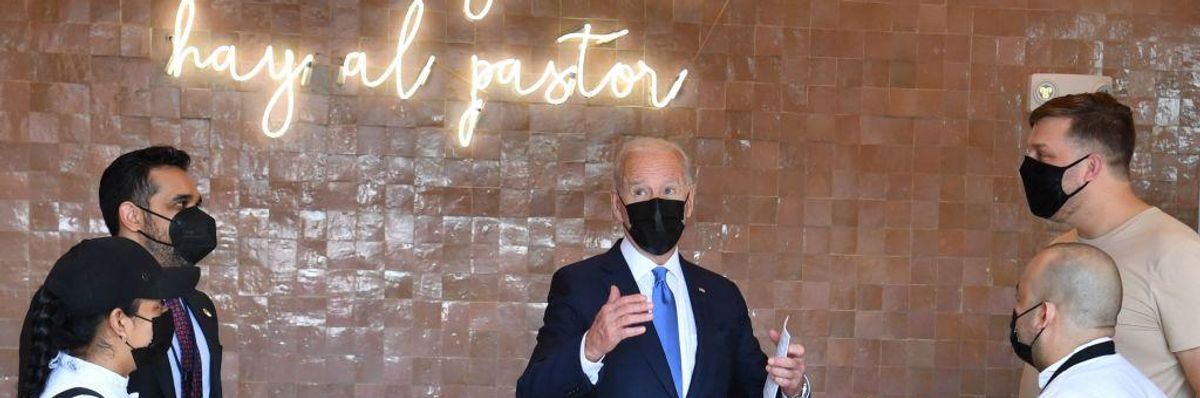
US President Joe Biden speaks with workers at Taqueria Las Gemelas (Twin Girls), a restaurant located in Northeast Washington, DC, on May 5, 2021. (Photo: Nicholas Kamm / AFP)
By almost any measure, Joe Biden's first 100 days have been hugely successful. Getting millions of Americans inoculated against COVID-19 and beginning to revive the economy are central to that success.
Two thirds of Americans support Biden's $1.9 stimulus plan, already enacted. His infrastructure and family plans, which he outlined last Wednesday night at a joint session of Congress, also have broad backing. The $6 trillion price tag for all this would make it the largest expansion of the federal government since Lyndon Johnson's Great Society. But for most Americans, it doesn't feel radical.
Rather than bet it all on a single large-scale program such as universal healthcare--which Clinton's failed to accomplish and which Obama turned into a target of Republican fearmongering--Biden has picked an array of popular initiatives, such as pre-school, public community c0llege, paid family and medical leave, home care, and infrastructure repairs, which are harder to vilify.
Economists talk about pent-up demand for private consumer goods, caused by the pandemic. Biden is responding to a pent-up demand for public goods. The demand has been there for years but the pandemic has starkly revealed it. Compared to workers in other developed nations, Americans enjoy few social benefits and safety nets. Biden is saying, in effect, it's time we caught up.
Besides, it's hard for Republicans to paint Biden as a radical. He doesn't feel scary. He's old, grandfatherly. He speaks haltingly. He's humble. When he talks about the needs of average working people, it's clear he knows them.
Biden has also been helped by the contrast to his immediate predecessor--the most divisive and authoritarian personality to occupy the Oval Office in modern memory. Had Biden been elected directly after Obama, regardless of the pandemic and economic crisis, it's unlikely he and his ambitious plans would seem so benign.
The Republican party, still captive to its Trumpian base, has no message or policies to counter Biden's proposals. Trump left it with little more than a list of baseless grievances irrelevant to the practical needs of most Americans.
In his address to a joint session of Congress Wednesday night, Biden credited others for the achievements of his first hundred days. They had been accomplished "because of you," he said, even giving a nod to Republicans. His predecessor was incapable of crediting anyone else for anything.
Meanwhile, the Republican party, still captive to its Trumpian base, has no message or policies to counter Biden's proposals. Trump left it with little more than a list of baseless grievances irrelevant to the practical needs of most Americans--that Trump would have been reelected but for fraudulent votes and a "deep state" conspiracy, that Democrats are "socialists" and that the "left" is intent on taking away American freedoms.
Biden has a razor-thin majority in Congress and must keep every Democratic senator in line if he's to get his plans enacted. But the vacuum on the right has allowed him to dominate the public conversation about his initiatives, which makes passage more likely.
Trump is aiding Biden in other ways. Trump's yawning budget deficits help normalize Biden's. When Trump sent $1,200 stimulus checks to most Americans last year regardless of whether they had a job, he cleared the way for Biden to deliver generous jobless benefits.
Trump's giant $1.9 trillion tax cut for big corporations and the wealthy, none of which "trickled down," make Biden's proposals to increase taxes on corporations and the wealthy to pay for infrastructure and education seem even more reasonable.
Trump's fierce economic nationalism has made Biden's "buy American" initiative appear innocent by comparison. Trump's angry populism has allowed Biden to criticize Wall Street and support unions without causing a ripple.
At the same time, Trumpian lawmakers' refusal to concede the election and their efforts to suppress votes has alienated much of corporate America, pushing executives toward Biden by default.
Even on the fraught issue of race, the contrast with Trump has strengthened Biden's hand. Most Americans were so repulsed by Trump's overt racism and his overtures to white supremacists, especially after the police murder of George Floyd, that Biden's initiatives to end police brutality and "root out systemic racism," as he said on Wednesday night, seem appropriate correctives.
The first 100 days of the Biden presidency were also the first 100 days of America without Trump, and the two cannot be separated.
With any luck, Biden's plans might be the antidote to Trumpism--creating enough decent-paying working class jobs, along with benefits such as childcare and free community college, as to forestall some of the right-wing dyspepsia that Trump whipped into a fury.
Dear Common Dreams reader, It’s been nearly 30 years since I co-founded Common Dreams with my late wife, Lina Newhouser. We had the radical notion that journalism should serve the public good, not corporate profits. It was clear to us from the outset what it would take to build such a project. No paid advertisements. No corporate sponsors. No millionaire publisher telling us what to think or do. Many people said we wouldn't last a year, but we proved those doubters wrong. Together with a tremendous team of journalists and dedicated staff, we built an independent media outlet free from the constraints of profits and corporate control. Our mission has always been simple: To inform. To inspire. To ignite change for the common good. Building Common Dreams was not easy. Our survival was never guaranteed. When you take on the most powerful forces—Wall Street greed, fossil fuel industry destruction, Big Tech lobbyists, and uber-rich oligarchs who have spent billions upon billions rigging the economy and democracy in their favor—the only bulwark you have is supporters who believe in your work. But here’s the urgent message from me today. It's never been this bad out there. And it's never been this hard to keep us going. At the very moment Common Dreams is most needed, the threats we face are intensifying. We need your support now more than ever. We don't accept corporate advertising and never will. We don't have a paywall because we don't think people should be blocked from critical news based on their ability to pay. Everything we do is funded by the donations of readers like you. When everyone does the little they can afford, we are strong. But if that support retreats or dries up, so do we. Will you donate now to make sure Common Dreams not only survives but thrives? —Craig Brown, Co-founder |
By almost any measure, Joe Biden's first 100 days have been hugely successful. Getting millions of Americans inoculated against COVID-19 and beginning to revive the economy are central to that success.
Two thirds of Americans support Biden's $1.9 stimulus plan, already enacted. His infrastructure and family plans, which he outlined last Wednesday night at a joint session of Congress, also have broad backing. The $6 trillion price tag for all this would make it the largest expansion of the federal government since Lyndon Johnson's Great Society. But for most Americans, it doesn't feel radical.
Rather than bet it all on a single large-scale program such as universal healthcare--which Clinton's failed to accomplish and which Obama turned into a target of Republican fearmongering--Biden has picked an array of popular initiatives, such as pre-school, public community c0llege, paid family and medical leave, home care, and infrastructure repairs, which are harder to vilify.
Economists talk about pent-up demand for private consumer goods, caused by the pandemic. Biden is responding to a pent-up demand for public goods. The demand has been there for years but the pandemic has starkly revealed it. Compared to workers in other developed nations, Americans enjoy few social benefits and safety nets. Biden is saying, in effect, it's time we caught up.
Besides, it's hard for Republicans to paint Biden as a radical. He doesn't feel scary. He's old, grandfatherly. He speaks haltingly. He's humble. When he talks about the needs of average working people, it's clear he knows them.
Biden has also been helped by the contrast to his immediate predecessor--the most divisive and authoritarian personality to occupy the Oval Office in modern memory. Had Biden been elected directly after Obama, regardless of the pandemic and economic crisis, it's unlikely he and his ambitious plans would seem so benign.
The Republican party, still captive to its Trumpian base, has no message or policies to counter Biden's proposals. Trump left it with little more than a list of baseless grievances irrelevant to the practical needs of most Americans.
In his address to a joint session of Congress Wednesday night, Biden credited others for the achievements of his first hundred days. They had been accomplished "because of you," he said, even giving a nod to Republicans. His predecessor was incapable of crediting anyone else for anything.
Meanwhile, the Republican party, still captive to its Trumpian base, has no message or policies to counter Biden's proposals. Trump left it with little more than a list of baseless grievances irrelevant to the practical needs of most Americans--that Trump would have been reelected but for fraudulent votes and a "deep state" conspiracy, that Democrats are "socialists" and that the "left" is intent on taking away American freedoms.
Biden has a razor-thin majority in Congress and must keep every Democratic senator in line if he's to get his plans enacted. But the vacuum on the right has allowed him to dominate the public conversation about his initiatives, which makes passage more likely.
Trump is aiding Biden in other ways. Trump's yawning budget deficits help normalize Biden's. When Trump sent $1,200 stimulus checks to most Americans last year regardless of whether they had a job, he cleared the way for Biden to deliver generous jobless benefits.
Trump's giant $1.9 trillion tax cut for big corporations and the wealthy, none of which "trickled down," make Biden's proposals to increase taxes on corporations and the wealthy to pay for infrastructure and education seem even more reasonable.
Trump's fierce economic nationalism has made Biden's "buy American" initiative appear innocent by comparison. Trump's angry populism has allowed Biden to criticize Wall Street and support unions without causing a ripple.
At the same time, Trumpian lawmakers' refusal to concede the election and their efforts to suppress votes has alienated much of corporate America, pushing executives toward Biden by default.
Even on the fraught issue of race, the contrast with Trump has strengthened Biden's hand. Most Americans were so repulsed by Trump's overt racism and his overtures to white supremacists, especially after the police murder of George Floyd, that Biden's initiatives to end police brutality and "root out systemic racism," as he said on Wednesday night, seem appropriate correctives.
The first 100 days of the Biden presidency were also the first 100 days of America without Trump, and the two cannot be separated.
With any luck, Biden's plans might be the antidote to Trumpism--creating enough decent-paying working class jobs, along with benefits such as childcare and free community college, as to forestall some of the right-wing dyspepsia that Trump whipped into a fury.
By almost any measure, Joe Biden's first 100 days have been hugely successful. Getting millions of Americans inoculated against COVID-19 and beginning to revive the economy are central to that success.
Two thirds of Americans support Biden's $1.9 stimulus plan, already enacted. His infrastructure and family plans, which he outlined last Wednesday night at a joint session of Congress, also have broad backing. The $6 trillion price tag for all this would make it the largest expansion of the federal government since Lyndon Johnson's Great Society. But for most Americans, it doesn't feel radical.
Rather than bet it all on a single large-scale program such as universal healthcare--which Clinton's failed to accomplish and which Obama turned into a target of Republican fearmongering--Biden has picked an array of popular initiatives, such as pre-school, public community c0llege, paid family and medical leave, home care, and infrastructure repairs, which are harder to vilify.
Economists talk about pent-up demand for private consumer goods, caused by the pandemic. Biden is responding to a pent-up demand for public goods. The demand has been there for years but the pandemic has starkly revealed it. Compared to workers in other developed nations, Americans enjoy few social benefits and safety nets. Biden is saying, in effect, it's time we caught up.
Besides, it's hard for Republicans to paint Biden as a radical. He doesn't feel scary. He's old, grandfatherly. He speaks haltingly. He's humble. When he talks about the needs of average working people, it's clear he knows them.
Biden has also been helped by the contrast to his immediate predecessor--the most divisive and authoritarian personality to occupy the Oval Office in modern memory. Had Biden been elected directly after Obama, regardless of the pandemic and economic crisis, it's unlikely he and his ambitious plans would seem so benign.
The Republican party, still captive to its Trumpian base, has no message or policies to counter Biden's proposals. Trump left it with little more than a list of baseless grievances irrelevant to the practical needs of most Americans.
In his address to a joint session of Congress Wednesday night, Biden credited others for the achievements of his first hundred days. They had been accomplished "because of you," he said, even giving a nod to Republicans. His predecessor was incapable of crediting anyone else for anything.
Meanwhile, the Republican party, still captive to its Trumpian base, has no message or policies to counter Biden's proposals. Trump left it with little more than a list of baseless grievances irrelevant to the practical needs of most Americans--that Trump would have been reelected but for fraudulent votes and a "deep state" conspiracy, that Democrats are "socialists" and that the "left" is intent on taking away American freedoms.
Biden has a razor-thin majority in Congress and must keep every Democratic senator in line if he's to get his plans enacted. But the vacuum on the right has allowed him to dominate the public conversation about his initiatives, which makes passage more likely.
Trump is aiding Biden in other ways. Trump's yawning budget deficits help normalize Biden's. When Trump sent $1,200 stimulus checks to most Americans last year regardless of whether they had a job, he cleared the way for Biden to deliver generous jobless benefits.
Trump's giant $1.9 trillion tax cut for big corporations and the wealthy, none of which "trickled down," make Biden's proposals to increase taxes on corporations and the wealthy to pay for infrastructure and education seem even more reasonable.
Trump's fierce economic nationalism has made Biden's "buy American" initiative appear innocent by comparison. Trump's angry populism has allowed Biden to criticize Wall Street and support unions without causing a ripple.
At the same time, Trumpian lawmakers' refusal to concede the election and their efforts to suppress votes has alienated much of corporate America, pushing executives toward Biden by default.
Even on the fraught issue of race, the contrast with Trump has strengthened Biden's hand. Most Americans were so repulsed by Trump's overt racism and his overtures to white supremacists, especially after the police murder of George Floyd, that Biden's initiatives to end police brutality and "root out systemic racism," as he said on Wednesday night, seem appropriate correctives.
The first 100 days of the Biden presidency were also the first 100 days of America without Trump, and the two cannot be separated.
With any luck, Biden's plans might be the antidote to Trumpism--creating enough decent-paying working class jobs, along with benefits such as childcare and free community college, as to forestall some of the right-wing dyspepsia that Trump whipped into a fury.