SUBSCRIBE TO OUR FREE NEWSLETTER
Daily news & progressive opinion—funded by the people, not the corporations—delivered straight to your inbox.
5
#000000
#FFFFFF
To donate by check, phone, or other method, see our More Ways to Give page.
Daily news & progressive opinion—funded by the people, not the corporations—delivered straight to your inbox.
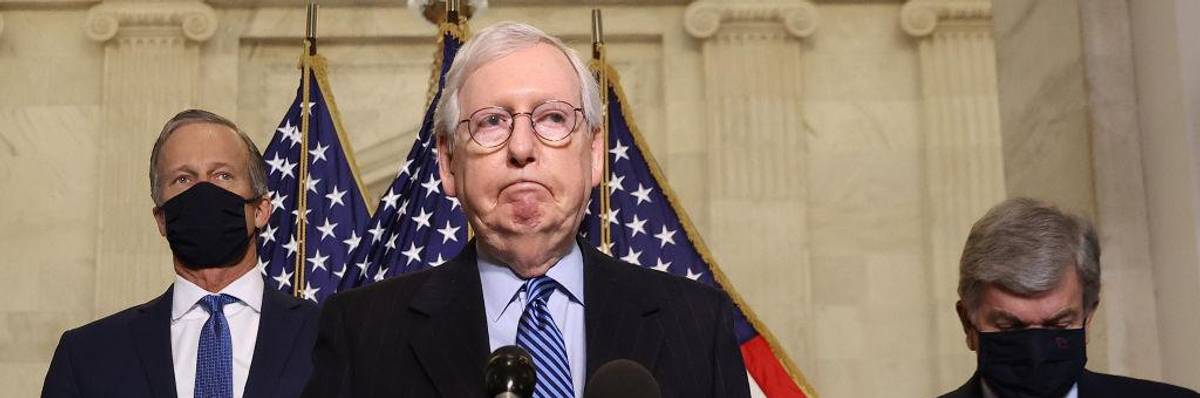
Senate Minority Leader Mitch McConnell (R-KY) talks to reporters with Sen. John Thune (R-SD) (L) and Sen. Roy Blunt (R-MO) following the weekly Senate Republican caucus luncheon in the Russell Senate Office Building on Capitol Hill March 16, 2021 in Washington, DC. (Photo: Chip Somodevilla/Getty Images)
For four decades, the basic deal between big American corporations and politicians has been simple. Corporations provide campaign funds. Politicians reciprocate by lowering corporate taxes and doing whatever else corporations need to boost profits.
The deal has proven beneficial to both sides, although not to the American public. Campaign spending has soared while corporate taxes have shriveled.
In the 1950s, corporations accounted for about 40 percent of federal revenue. Today, they contribute a meager 7 percent. Last year, more than 50 of the largest U.S. companies paid no federal income taxes at all. Many haven't paid taxes for years.
Republicans have long championed "corporate speech" when it comes in the form of campaign cash--just not as criticism.Both parties have been in on this deal although the GOP has been the bigger player. Yet since Donald Trump issued his big lie about the fraudulence of the 2020 election, corporate America has had a few qualms about its deal with the GOP.
After the storming of the Capitol, dozens of giant corporations said they would no longer donate to the 147 Republican members of Congress who objected to the certification of Biden electors on the basis of the big lie.
Then came the GOP's recent wave of restrictive state voting laws, premised on the same big lie. Georgia's are among the most egregious. The chief executive of Coca Cola, headquartered in the peach tree state, calls those laws "wrong" and "a step backward." The CEO of Delta Airlines, Georgia's largest employer, says they're "unacceptable." Major League Baseball decided to relocate its annual All-Star Game away from the home of the Atlanta Braves.
These criticisms have unleashed a rare firestorm of anti-corporate Republican indignation. The senate minority leader, Mitch McConnell, warns corporations of unspecified "serious consequences" for speaking out. Republicans are moving to revoke Major League Baseball's antitrust status. Georgia Republicans threaten to punish Delta Airlines by repealing a state tax credit for jet fuel.
"Why are we still listening to these woke corporate hypocrites on taxes, regulations & antitrust?" asks Florida Senator Marco Rubio.
Why? For the same reason Willy Sutton gave when asked why he robbed banks: That's where the money is.
McConnell told reporters that corporations should "stay out of politics" but then qualified his remark: "I'm not talking about political contributions." Of course not. Republicans have long championed "corporate speech" when it comes in the form of campaign cash--just not as criticism.
Talk about hypocrisy. McConnell was the top recipient of corporate money in the 2020 election cycle and has a long history of battling attempts to limit it. In 2010, he hailed the Supreme Court's "Citizens United" ruling, which struck down limits on corporate political donations, on the dubious grounds that corporations are "people" under the First Amendment to the Constitution.
"For too long, some in this country have been deprived of full participation in the political process," McConnell said at the time. Hint: He wasn't referring to poor Black people.
It's hypocrisy squared. The growing tsunami of corporate campaign money suppresses votes indirectly by drowning out all other voices. Republicans are in the grotesque position of calling on corporations to continue bribing politicians as long as they don't criticize Republicans for suppressing votes directly.
The hypocrisy flows in the other direction as well. The Delta's CEO criticized GOP voter suppression but the company continues to bankroll Republicans. Its PAC contributed $1,725,956 in the 2020 election, more than $1 million of which went to federal candidates, mostly to Republicans. Oh, and Delta hasn't paid federal taxes for years.
Don't let the spat fool you. The basic deal between the GOP and corporate America is still very much alive.
Which is why, despite record-low corporate taxes, congressional Republicans are feigning outrage at Joe Biden's plan to have corporations pay for his $2 trillion infrastructure proposal. Biden isn't even seeking to raise the corporate tax rate as high as it was before the Trump tax cut, yet not a single Republicans will support it.
A few Democrats, such as West Virginia's Joe Manchin, don't want to raise corporate taxes as high as Biden does, either. Yet almost two-thirds of Americans support the idea.
The basic deal between American corporations and American politicians has been a terrible deal for America. Which is why a piece of legislation entitled the "For the People Act," passed by the House and co-sponsored in the Senate by every Democratic senator except Manchin, is so important. It would both stop states from suppressing votes and also move the country toward public financing of elections, thereby reducing politicians' dependence on corporate cash.
Corporations can and should bankroll much of what America needs. But they won't as long as corporations keep bankrolling American politicians.
Dear Common Dreams reader, It’s been nearly 30 years since I co-founded Common Dreams with my late wife, Lina Newhouser. We had the radical notion that journalism should serve the public good, not corporate profits. It was clear to us from the outset what it would take to build such a project. No paid advertisements. No corporate sponsors. No millionaire publisher telling us what to think or do. Many people said we wouldn't last a year, but we proved those doubters wrong. Together with a tremendous team of journalists and dedicated staff, we built an independent media outlet free from the constraints of profits and corporate control. Our mission has always been simple: To inform. To inspire. To ignite change for the common good. Building Common Dreams was not easy. Our survival was never guaranteed. When you take on the most powerful forces—Wall Street greed, fossil fuel industry destruction, Big Tech lobbyists, and uber-rich oligarchs who have spent billions upon billions rigging the economy and democracy in their favor—the only bulwark you have is supporters who believe in your work. But here’s the urgent message from me today. It's never been this bad out there. And it's never been this hard to keep us going. At the very moment Common Dreams is most needed, the threats we face are intensifying. We need your support now more than ever. We don't accept corporate advertising and never will. We don't have a paywall because we don't think people should be blocked from critical news based on their ability to pay. Everything we do is funded by the donations of readers like you. When everyone does the little they can afford, we are strong. But if that support retreats or dries up, so do we. Will you donate now to make sure Common Dreams not only survives but thrives? —Craig Brown, Co-founder |
For four decades, the basic deal between big American corporations and politicians has been simple. Corporations provide campaign funds. Politicians reciprocate by lowering corporate taxes and doing whatever else corporations need to boost profits.
The deal has proven beneficial to both sides, although not to the American public. Campaign spending has soared while corporate taxes have shriveled.
In the 1950s, corporations accounted for about 40 percent of federal revenue. Today, they contribute a meager 7 percent. Last year, more than 50 of the largest U.S. companies paid no federal income taxes at all. Many haven't paid taxes for years.
Republicans have long championed "corporate speech" when it comes in the form of campaign cash--just not as criticism.Both parties have been in on this deal although the GOP has been the bigger player. Yet since Donald Trump issued his big lie about the fraudulence of the 2020 election, corporate America has had a few qualms about its deal with the GOP.
After the storming of the Capitol, dozens of giant corporations said they would no longer donate to the 147 Republican members of Congress who objected to the certification of Biden electors on the basis of the big lie.
Then came the GOP's recent wave of restrictive state voting laws, premised on the same big lie. Georgia's are among the most egregious. The chief executive of Coca Cola, headquartered in the peach tree state, calls those laws "wrong" and "a step backward." The CEO of Delta Airlines, Georgia's largest employer, says they're "unacceptable." Major League Baseball decided to relocate its annual All-Star Game away from the home of the Atlanta Braves.
These criticisms have unleashed a rare firestorm of anti-corporate Republican indignation. The senate minority leader, Mitch McConnell, warns corporations of unspecified "serious consequences" for speaking out. Republicans are moving to revoke Major League Baseball's antitrust status. Georgia Republicans threaten to punish Delta Airlines by repealing a state tax credit for jet fuel.
"Why are we still listening to these woke corporate hypocrites on taxes, regulations & antitrust?" asks Florida Senator Marco Rubio.
Why? For the same reason Willy Sutton gave when asked why he robbed banks: That's where the money is.
McConnell told reporters that corporations should "stay out of politics" but then qualified his remark: "I'm not talking about political contributions." Of course not. Republicans have long championed "corporate speech" when it comes in the form of campaign cash--just not as criticism.
Talk about hypocrisy. McConnell was the top recipient of corporate money in the 2020 election cycle and has a long history of battling attempts to limit it. In 2010, he hailed the Supreme Court's "Citizens United" ruling, which struck down limits on corporate political donations, on the dubious grounds that corporations are "people" under the First Amendment to the Constitution.
"For too long, some in this country have been deprived of full participation in the political process," McConnell said at the time. Hint: He wasn't referring to poor Black people.
It's hypocrisy squared. The growing tsunami of corporate campaign money suppresses votes indirectly by drowning out all other voices. Republicans are in the grotesque position of calling on corporations to continue bribing politicians as long as they don't criticize Republicans for suppressing votes directly.
The hypocrisy flows in the other direction as well. The Delta's CEO criticized GOP voter suppression but the company continues to bankroll Republicans. Its PAC contributed $1,725,956 in the 2020 election, more than $1 million of which went to federal candidates, mostly to Republicans. Oh, and Delta hasn't paid federal taxes for years.
Don't let the spat fool you. The basic deal between the GOP and corporate America is still very much alive.
Which is why, despite record-low corporate taxes, congressional Republicans are feigning outrage at Joe Biden's plan to have corporations pay for his $2 trillion infrastructure proposal. Biden isn't even seeking to raise the corporate tax rate as high as it was before the Trump tax cut, yet not a single Republicans will support it.
A few Democrats, such as West Virginia's Joe Manchin, don't want to raise corporate taxes as high as Biden does, either. Yet almost two-thirds of Americans support the idea.
The basic deal between American corporations and American politicians has been a terrible deal for America. Which is why a piece of legislation entitled the "For the People Act," passed by the House and co-sponsored in the Senate by every Democratic senator except Manchin, is so important. It would both stop states from suppressing votes and also move the country toward public financing of elections, thereby reducing politicians' dependence on corporate cash.
Corporations can and should bankroll much of what America needs. But they won't as long as corporations keep bankrolling American politicians.
For four decades, the basic deal between big American corporations and politicians has been simple. Corporations provide campaign funds. Politicians reciprocate by lowering corporate taxes and doing whatever else corporations need to boost profits.
The deal has proven beneficial to both sides, although not to the American public. Campaign spending has soared while corporate taxes have shriveled.
In the 1950s, corporations accounted for about 40 percent of federal revenue. Today, they contribute a meager 7 percent. Last year, more than 50 of the largest U.S. companies paid no federal income taxes at all. Many haven't paid taxes for years.
Republicans have long championed "corporate speech" when it comes in the form of campaign cash--just not as criticism.Both parties have been in on this deal although the GOP has been the bigger player. Yet since Donald Trump issued his big lie about the fraudulence of the 2020 election, corporate America has had a few qualms about its deal with the GOP.
After the storming of the Capitol, dozens of giant corporations said they would no longer donate to the 147 Republican members of Congress who objected to the certification of Biden electors on the basis of the big lie.
Then came the GOP's recent wave of restrictive state voting laws, premised on the same big lie. Georgia's are among the most egregious. The chief executive of Coca Cola, headquartered in the peach tree state, calls those laws "wrong" and "a step backward." The CEO of Delta Airlines, Georgia's largest employer, says they're "unacceptable." Major League Baseball decided to relocate its annual All-Star Game away from the home of the Atlanta Braves.
These criticisms have unleashed a rare firestorm of anti-corporate Republican indignation. The senate minority leader, Mitch McConnell, warns corporations of unspecified "serious consequences" for speaking out. Republicans are moving to revoke Major League Baseball's antitrust status. Georgia Republicans threaten to punish Delta Airlines by repealing a state tax credit for jet fuel.
"Why are we still listening to these woke corporate hypocrites on taxes, regulations & antitrust?" asks Florida Senator Marco Rubio.
Why? For the same reason Willy Sutton gave when asked why he robbed banks: That's where the money is.
McConnell told reporters that corporations should "stay out of politics" but then qualified his remark: "I'm not talking about political contributions." Of course not. Republicans have long championed "corporate speech" when it comes in the form of campaign cash--just not as criticism.
Talk about hypocrisy. McConnell was the top recipient of corporate money in the 2020 election cycle and has a long history of battling attempts to limit it. In 2010, he hailed the Supreme Court's "Citizens United" ruling, which struck down limits on corporate political donations, on the dubious grounds that corporations are "people" under the First Amendment to the Constitution.
"For too long, some in this country have been deprived of full participation in the political process," McConnell said at the time. Hint: He wasn't referring to poor Black people.
It's hypocrisy squared. The growing tsunami of corporate campaign money suppresses votes indirectly by drowning out all other voices. Republicans are in the grotesque position of calling on corporations to continue bribing politicians as long as they don't criticize Republicans for suppressing votes directly.
The hypocrisy flows in the other direction as well. The Delta's CEO criticized GOP voter suppression but the company continues to bankroll Republicans. Its PAC contributed $1,725,956 in the 2020 election, more than $1 million of which went to federal candidates, mostly to Republicans. Oh, and Delta hasn't paid federal taxes for years.
Don't let the spat fool you. The basic deal between the GOP and corporate America is still very much alive.
Which is why, despite record-low corporate taxes, congressional Republicans are feigning outrage at Joe Biden's plan to have corporations pay for his $2 trillion infrastructure proposal. Biden isn't even seeking to raise the corporate tax rate as high as it was before the Trump tax cut, yet not a single Republicans will support it.
A few Democrats, such as West Virginia's Joe Manchin, don't want to raise corporate taxes as high as Biden does, either. Yet almost two-thirds of Americans support the idea.
The basic deal between American corporations and American politicians has been a terrible deal for America. Which is why a piece of legislation entitled the "For the People Act," passed by the House and co-sponsored in the Senate by every Democratic senator except Manchin, is so important. It would both stop states from suppressing votes and also move the country toward public financing of elections, thereby reducing politicians' dependence on corporate cash.
Corporations can and should bankroll much of what America needs. But they won't as long as corporations keep bankrolling American politicians.