

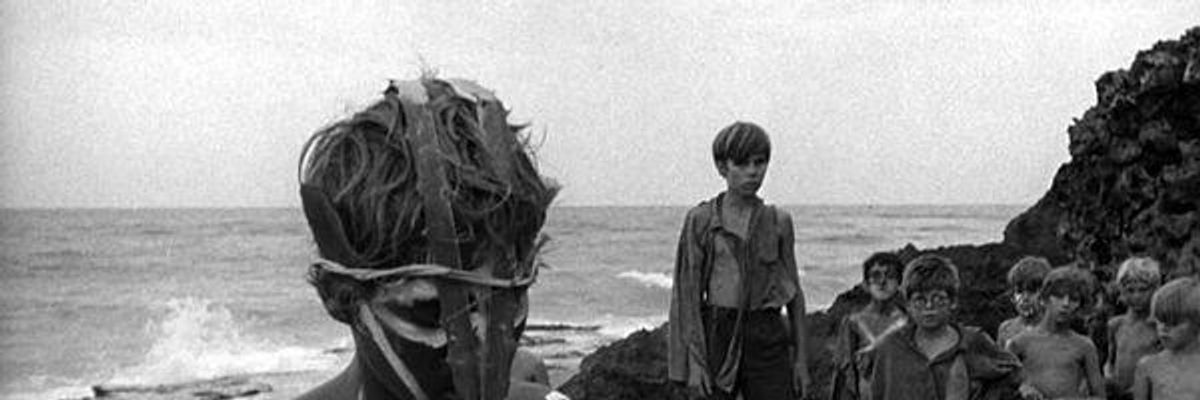
Lord of the Flies movie, 1963. (Photo: Screesnhot)
'Lord of the Flies,' Revisited
Dutch historian Rutger Bregman documents that Golding had no knowledge of behavioral science and was hardly an impartial judge of children's propensities.
Many of us read William Golding's "Lord of the Flies" in high school -- and it's still being taught. The 1954 novel depicts the gradual descent into barbaric darkness by a group of English schoolboys shipwrecked on a small, deserted island. Its portrayal of innate human depravity was hailed at the time for its unblinking "realism." Only ... it was total bulls---.
In his superb 2019 work "Humankind: A Hopeful History," Dutch historian Rutger Bregman documents that Golding had no knowledge of behavioral science and was hardly an impartial judge of children's propensities. Rather, he was an alcoholic prone to depression who beat his kids. "I have always understood the Nazis," Golding once said, "because I am of that sort by nature." So, he made up the story, and it wasn't about children's dark nature, but his own.
After learning about the man behind the tale, Bregman became curious about what would really happen if kids were left alone on an island. He kept poking into everything from scientific studies to news reports, and -- amazingly -- finally unearthed an actual incident of shipwrecked children: In 1965, six bored schoolboys from Tonga, ages 13 to 16, took a small fishing boat out on a lark, but they were caught in a sudden storm and blown far from home. Their boat's mast and rudder broke, and they drifted for days before washing up on a desolate rocky islet, where they were stranded for more than a year.
Far from devolving into barbarism, the inventive teenagers had set up a functioning democracy and communal economy.Fifty years later, the intrepid Bregman spent months tracing multiple dead ends before at last locating a few survivors and then traveling to Tonga to meet them and get the true story.
He learned that, far from devolving into barbarism, the inventive teenagers had set up a functioning democracy and communal economy. They split chores into teams of two, built sleeping huts and a kitchen, tended a garden, stored rainwater, created a gymnasium, fashioned a badminton court and got a fire going (taking turns protecting it so it never went out). One boy even constructed a rudimentary guitar to accompany their singing. Yes, they had occasional arguments, but the rule was that the quarrelers had to go to opposite ends of the island to cool down for a few hours before they were brought back to the group to apologize. "That's how we stayed friends," one former castaway told Bregman.
When rescued by a passing fishing crew after 15 months on the island, the boys were extraordinarily healthy -- physically, socially and spiritually.
There's the world we live in, and then there's the frightening world we see every hour on "the news" and in social media: Invading hordes of murderous immigrants! Black and brown rioters and looters rampaging through city streets! Organized squads of illegal voters and ballot thieves stealing elections! Lazy bums mooching on food stamps and encroaching on "our beautiful suburbs"! Fear and loathing!
In "Humankind," Bregman cites a parable about the possibility of achieving such a society:
"An old man says to his grandson: 'There's a fight going on inside me. It's a terrible fight between two wolves. One is evil -- angry, greedy, jealous, arrogant, and cowardly. The other is good -- peaceful, loving, modest, generous, honest, and trustworthy. These two wolves are also fighting within you and inside every other person, too.' After a moment, the boy asks, 'Which wolf will win?'
We are at a crossroads
This country and this world are at a monumental crossroads. In a few short weeks, US voters will have an opportunity to beat back the forces of fascism and confront the billionaires who are rigging the economy, our media system, and our democracy, making it increasingly impossible for ordinary people to get by. We’re not just talking about the election. We’re talking about what must be done once these fascist elements are vanquished from power. We need a bolder set of solutions than what either major party has so far been willing to offer and a working-class movement ready to fight like hell for it. Trump didn't emerge from nowhere. The conditions that fueled MAGA authoritarianism were created by decades of radical neoliberal economic policies and a corrupt political system dominated by corporate interests. They slashed taxes on the super-rich, promising that the benefits would trickle down. They said giveaways to the corporate titans would make life more affordable for the rest of us. It was all bullshit. And when a bitter, betrayed populace searches for someone to blame, right-wing demagogues have little trouble finding scapegoats. People know when they're being lied to, but you won't hear any of this from the corporate media. Only independent journalism—powered and funded by people who believe in building a better world—can deliver truly trustworthy daily news. Our Fall Campaign is underway, and we need your help. To power our newsroom through the rest of the year, we need to raise $125,000 by midnight on October 31. So if you share our vision, please contribute whatever you can to sustain our work. |
Many of us read William Golding's "Lord of the Flies" in high school -- and it's still being taught. The 1954 novel depicts the gradual descent into barbaric darkness by a group of English schoolboys shipwrecked on a small, deserted island. Its portrayal of innate human depravity was hailed at the time for its unblinking "realism." Only ... it was total bulls---.
In his superb 2019 work "Humankind: A Hopeful History," Dutch historian Rutger Bregman documents that Golding had no knowledge of behavioral science and was hardly an impartial judge of children's propensities. Rather, he was an alcoholic prone to depression who beat his kids. "I have always understood the Nazis," Golding once said, "because I am of that sort by nature." So, he made up the story, and it wasn't about children's dark nature, but his own.
After learning about the man behind the tale, Bregman became curious about what would really happen if kids were left alone on an island. He kept poking into everything from scientific studies to news reports, and -- amazingly -- finally unearthed an actual incident of shipwrecked children: In 1965, six bored schoolboys from Tonga, ages 13 to 16, took a small fishing boat out on a lark, but they were caught in a sudden storm and blown far from home. Their boat's mast and rudder broke, and they drifted for days before washing up on a desolate rocky islet, where they were stranded for more than a year.
Far from devolving into barbarism, the inventive teenagers had set up a functioning democracy and communal economy.Fifty years later, the intrepid Bregman spent months tracing multiple dead ends before at last locating a few survivors and then traveling to Tonga to meet them and get the true story.
He learned that, far from devolving into barbarism, the inventive teenagers had set up a functioning democracy and communal economy. They split chores into teams of two, built sleeping huts and a kitchen, tended a garden, stored rainwater, created a gymnasium, fashioned a badminton court and got a fire going (taking turns protecting it so it never went out). One boy even constructed a rudimentary guitar to accompany their singing. Yes, they had occasional arguments, but the rule was that the quarrelers had to go to opposite ends of the island to cool down for a few hours before they were brought back to the group to apologize. "That's how we stayed friends," one former castaway told Bregman.
When rescued by a passing fishing crew after 15 months on the island, the boys were extraordinarily healthy -- physically, socially and spiritually.
There's the world we live in, and then there's the frightening world we see every hour on "the news" and in social media: Invading hordes of murderous immigrants! Black and brown rioters and looters rampaging through city streets! Organized squads of illegal voters and ballot thieves stealing elections! Lazy bums mooching on food stamps and encroaching on "our beautiful suburbs"! Fear and loathing!
In "Humankind," Bregman cites a parable about the possibility of achieving such a society:
"An old man says to his grandson: 'There's a fight going on inside me. It's a terrible fight between two wolves. One is evil -- angry, greedy, jealous, arrogant, and cowardly. The other is good -- peaceful, loving, modest, generous, honest, and trustworthy. These two wolves are also fighting within you and inside every other person, too.' After a moment, the boy asks, 'Which wolf will win?'
Many of us read William Golding's "Lord of the Flies" in high school -- and it's still being taught. The 1954 novel depicts the gradual descent into barbaric darkness by a group of English schoolboys shipwrecked on a small, deserted island. Its portrayal of innate human depravity was hailed at the time for its unblinking "realism." Only ... it was total bulls---.
In his superb 2019 work "Humankind: A Hopeful History," Dutch historian Rutger Bregman documents that Golding had no knowledge of behavioral science and was hardly an impartial judge of children's propensities. Rather, he was an alcoholic prone to depression who beat his kids. "I have always understood the Nazis," Golding once said, "because I am of that sort by nature." So, he made up the story, and it wasn't about children's dark nature, but his own.
After learning about the man behind the tale, Bregman became curious about what would really happen if kids were left alone on an island. He kept poking into everything from scientific studies to news reports, and -- amazingly -- finally unearthed an actual incident of shipwrecked children: In 1965, six bored schoolboys from Tonga, ages 13 to 16, took a small fishing boat out on a lark, but they were caught in a sudden storm and blown far from home. Their boat's mast and rudder broke, and they drifted for days before washing up on a desolate rocky islet, where they were stranded for more than a year.
Far from devolving into barbarism, the inventive teenagers had set up a functioning democracy and communal economy.Fifty years later, the intrepid Bregman spent months tracing multiple dead ends before at last locating a few survivors and then traveling to Tonga to meet them and get the true story.
He learned that, far from devolving into barbarism, the inventive teenagers had set up a functioning democracy and communal economy. They split chores into teams of two, built sleeping huts and a kitchen, tended a garden, stored rainwater, created a gymnasium, fashioned a badminton court and got a fire going (taking turns protecting it so it never went out). One boy even constructed a rudimentary guitar to accompany their singing. Yes, they had occasional arguments, but the rule was that the quarrelers had to go to opposite ends of the island to cool down for a few hours before they were brought back to the group to apologize. "That's how we stayed friends," one former castaway told Bregman.
When rescued by a passing fishing crew after 15 months on the island, the boys were extraordinarily healthy -- physically, socially and spiritually.
There's the world we live in, and then there's the frightening world we see every hour on "the news" and in social media: Invading hordes of murderous immigrants! Black and brown rioters and looters rampaging through city streets! Organized squads of illegal voters and ballot thieves stealing elections! Lazy bums mooching on food stamps and encroaching on "our beautiful suburbs"! Fear and loathing!
In "Humankind," Bregman cites a parable about the possibility of achieving such a society:
"An old man says to his grandson: 'There's a fight going on inside me. It's a terrible fight between two wolves. One is evil -- angry, greedy, jealous, arrogant, and cowardly. The other is good -- peaceful, loving, modest, generous, honest, and trustworthy. These two wolves are also fighting within you and inside every other person, too.' After a moment, the boy asks, 'Which wolf will win?'