SUBSCRIBE TO OUR FREE NEWSLETTER
Daily news & progressive opinion—funded by the people, not the corporations—delivered straight to your inbox.
5
#000000
#FFFFFF
To donate by check, phone, or other method, see our More Ways to Give page.
Daily news & progressive opinion—funded by the people, not the corporations—delivered straight to your inbox.
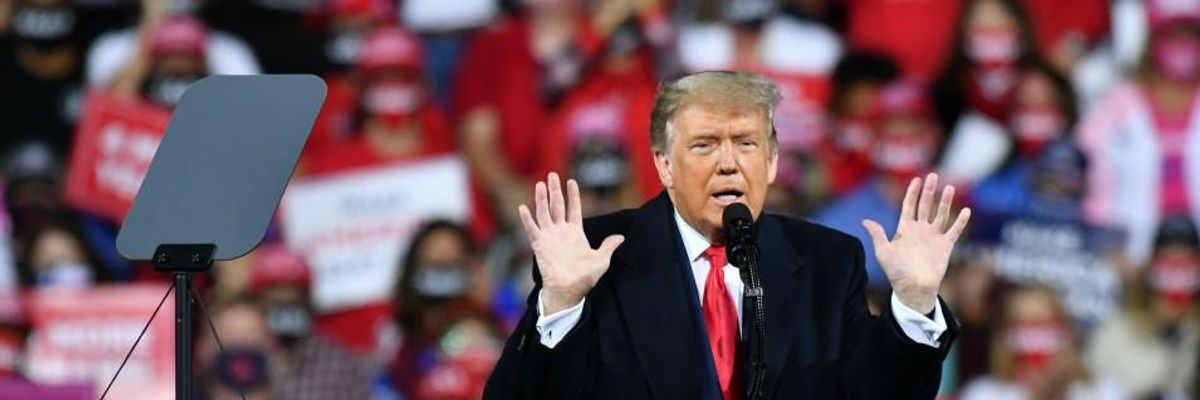
President Donald Trump speaks during a campaign rally in Fayetteville, North Carolina on September 19, 2020. (Photo: Peter Zay/Anadolu Agency via Getty Images)
Donald Trump routinely claims he "built the greatest economy in the history of the world." It is a claim rarely challenged in the mainstream media. If true, it would be at least part of a possible claim for re-election. But is it true?
There are five things we need to know to evaluate Trump's claim to economic wizardry.
The first is that rather than "building" a strong economy, Trump hitched a ride on the one that was handed to him by Barak Obama and Joe Biden. When Trump took office, the economy had already been growing for 90 straight months. It would go on to grow for another 38 months before Trump drove it into the ditch. It was the longest U.S. economic expansion since data was first collected, in 1854. But Trump didn't "build" it. He inherited it.
The second thing to know is that Trump's stewardship of the economy has been far less effective than that of many other presidents over the past 60 years. In 2018, Trump's best year for growth, the economy expanded 3.18%. That is the 29th best year for growth since JFK took office in 1961. For 2017, growth clocked in at 2.22%, 44th best in the last 59 years.
Best ever? It's not even close to being close.
What about median income? That is a reliable measure of economic well-being. According to the House Joint Economic Committee, "During the last two years of the Obama administration, annual median household income increased $4,800. This is three times more than the $1,400 increase during the first two years of the Trump administration." Best ever? Hardly.
Job growth? That, too, is a reliable indicator of a strong economy. The same Joint Economic Committee reported, "During the last 33 months of the Obama administration, nonfarm job growth averaged 224,000 per month. During the first 33 months of the Trump administration, the average was 34,000 jobs per month less." Best ever? Please.
What about unemployment? Obama drove unemployment down from 10.2% in October 2009 to 4.7% when he left office in January 2017, a decline of 5.5 percentage points. Trump inherited that 4.7% and, riding the momentum of the Obama economy, saw it decline to 3.5%, for a 1.2% reduction. That's less than one quarter the amount of the reduction Obama achieved.
Now, to be sure, 3.5% was the lowest unemployment rate in the prior 50 years. That is the main basis on which Trump hangs his claim for "building the greatest economy in the history of the world." But did that low unemployment create wide-spread prosperity and economic security? Those would be the measures of true economic well-being.
In May 2019, near the peak of the Trump expansion, the Federal Reserve Board reported that 40% of Americans could not cover an unexpected $400 expense. It also reported that three in ten American workers had had to engage in some kind of "gig" work over the prior month. Those are not the indicators of a strong economy and economic well-being. They are the signs of precariousness and desperation.
The third thing to know about Trump's economic stewardship is that what success he did have was largely bought by going into debt. Trump inherited a $20.2 trillion national debt from Obama. He enacted a $1.5 trillion tax giveaway for the rich in 2017 and the national debt now stands at $26.5 trillion.
That additional $6.3 trillion of national debt is more than 30% of all the combined debt ever borrowed over the span of 244 years, since the founding of the Republic in 1776. And it has been accomplished in less than four years under Donald Trump. This is simply stunning.
This borrowing masks profound weakness in Trump's "best economy in the history of the world." It amounts to $4.8 billion of borrowing every DAY since Trump took office. Yes, injecting almost $5 billion of borrowed money into the economy every day for almost 4 years can create the illusion of prosperity, at least for a while. But borrowing is not a sign of economic strength, but of weakness.
A truly strong economy is like a strong wage earner: it generates more money than it spends. A weak economy, like a weak wage earner, must borrow to sustain its standard of living. If your credit cards are out of control you are not in a strong position. The U.S. economy's credit cards under Trump are way, way...way...out of control.
The fourth thing to know about this "best economy ever" business is that the Trump economy entered a recession in February of 2020, before the impact of the coronavirus had hit. The first U.S. death attributable to coronavirus occurred on Feb. 6th. But the National Bureau of Economic Research--the organization that calls recessions and recoveries--determined that by February the economy had already entered a recession.
In January 2020, Reuters reported that in December 2019, "The U.S. manufacturing sector fell into its deepest slump in more than a decade," a result of Trump's failed trade war with China. Capital formation had been declining for over a year, a sign that businesses were pulling back on investments. And trade deficits had been widening.
The trade deficit is particularly noteworthy. A trade deficit occurs when imports exceed exports. The country is literally shipping more money out of the country than it is bringing in from sales abroad. It's a measure that Trump promised to eliminate when he was running in 2016. Did he?
Obama averaged $485 billion of trade deficits per year over his eight years. Trump has averaged $557 billion per year over his three. It was $64 billion in July alone, the highest in 12 years. That is a dollar-for-dollar bleed from the economy. It's no wonder it was already turning down.
The last thing to know about "the greatest economy in the history of the world"is that Trump wrecked it. That is, he wrecked the strong economy he inherited from Obama, the one that he had kept alive through the artifice of explosive debt. His bungling of the coronavirus pandemic has resulted in staggering, inconceivable destruction in the economy.
In the second quarter of this year, the economy suffered the greatest collapse ever recorded, falling 32% on an annualized basis. That is more than occurred over the entire 10-year extent of the Great Depression.
More than 56 million people have had to apply for unemployment. Tens of millions more have lost their jobs but couldn't apply because they had been working under the table. As many as 40 million people face eviction because they can't pay their rent. Hundreds of thousands, maybe millions of businesses will go bankrupt.
There is no precedent in the history of the world for the devastation these numbers represent.
Remember these five things: Trump didn't build a strong economy, he inherited one. Even then, his performance with it was substandard. What he did accomplish was bought on debt, not on growth. The economy was already heading down before the coronavirus hit. And he totally wrecked the economy with his bungled performance on the virus. And one more thing: It will take decades to recover from the damage he has inflicted.
A more proper claim for Trump would be that, "I wrecked the greatest economy in the history of the world." He might add, "And because I can't acknowledge that, I have no idea how to get it back. Vote for me."
Dear Common Dreams reader, It’s been nearly 30 years since I co-founded Common Dreams with my late wife, Lina Newhouser. We had the radical notion that journalism should serve the public good, not corporate profits. It was clear to us from the outset what it would take to build such a project. No paid advertisements. No corporate sponsors. No millionaire publisher telling us what to think or do. Many people said we wouldn't last a year, but we proved those doubters wrong. Together with a tremendous team of journalists and dedicated staff, we built an independent media outlet free from the constraints of profits and corporate control. Our mission has always been simple: To inform. To inspire. To ignite change for the common good. Building Common Dreams was not easy. Our survival was never guaranteed. When you take on the most powerful forces—Wall Street greed, fossil fuel industry destruction, Big Tech lobbyists, and uber-rich oligarchs who have spent billions upon billions rigging the economy and democracy in their favor—the only bulwark you have is supporters who believe in your work. But here’s the urgent message from me today. It's never been this bad out there. And it's never been this hard to keep us going. At the very moment Common Dreams is most needed, the threats we face are intensifying. We need your support now more than ever. We don't accept corporate advertising and never will. We don't have a paywall because we don't think people should be blocked from critical news based on their ability to pay. Everything we do is funded by the donations of readers like you. When everyone does the little they can afford, we are strong. But if that support retreats or dries up, so do we. Will you donate now to make sure Common Dreams not only survives but thrives? —Craig Brown, Co-founder |
Robert Freeman is the Founder and Executive Director of The Global Uplift Project, a leading provider of educational infrastructure for the developing world. He is the author of The Best One Hour History series whose titles include World War I, The Cold War, The Vietnam War, and many others.
Donald Trump routinely claims he "built the greatest economy in the history of the world." It is a claim rarely challenged in the mainstream media. If true, it would be at least part of a possible claim for re-election. But is it true?
There are five things we need to know to evaluate Trump's claim to economic wizardry.
The first is that rather than "building" a strong economy, Trump hitched a ride on the one that was handed to him by Barak Obama and Joe Biden. When Trump took office, the economy had already been growing for 90 straight months. It would go on to grow for another 38 months before Trump drove it into the ditch. It was the longest U.S. economic expansion since data was first collected, in 1854. But Trump didn't "build" it. He inherited it.
The second thing to know is that Trump's stewardship of the economy has been far less effective than that of many other presidents over the past 60 years. In 2018, Trump's best year for growth, the economy expanded 3.18%. That is the 29th best year for growth since JFK took office in 1961. For 2017, growth clocked in at 2.22%, 44th best in the last 59 years.
Best ever? It's not even close to being close.
What about median income? That is a reliable measure of economic well-being. According to the House Joint Economic Committee, "During the last two years of the Obama administration, annual median household income increased $4,800. This is three times more than the $1,400 increase during the first two years of the Trump administration." Best ever? Hardly.
Job growth? That, too, is a reliable indicator of a strong economy. The same Joint Economic Committee reported, "During the last 33 months of the Obama administration, nonfarm job growth averaged 224,000 per month. During the first 33 months of the Trump administration, the average was 34,000 jobs per month less." Best ever? Please.
What about unemployment? Obama drove unemployment down from 10.2% in October 2009 to 4.7% when he left office in January 2017, a decline of 5.5 percentage points. Trump inherited that 4.7% and, riding the momentum of the Obama economy, saw it decline to 3.5%, for a 1.2% reduction. That's less than one quarter the amount of the reduction Obama achieved.
Now, to be sure, 3.5% was the lowest unemployment rate in the prior 50 years. That is the main basis on which Trump hangs his claim for "building the greatest economy in the history of the world." But did that low unemployment create wide-spread prosperity and economic security? Those would be the measures of true economic well-being.
In May 2019, near the peak of the Trump expansion, the Federal Reserve Board reported that 40% of Americans could not cover an unexpected $400 expense. It also reported that three in ten American workers had had to engage in some kind of "gig" work over the prior month. Those are not the indicators of a strong economy and economic well-being. They are the signs of precariousness and desperation.
The third thing to know about Trump's economic stewardship is that what success he did have was largely bought by going into debt. Trump inherited a $20.2 trillion national debt from Obama. He enacted a $1.5 trillion tax giveaway for the rich in 2017 and the national debt now stands at $26.5 trillion.
That additional $6.3 trillion of national debt is more than 30% of all the combined debt ever borrowed over the span of 244 years, since the founding of the Republic in 1776. And it has been accomplished in less than four years under Donald Trump. This is simply stunning.
This borrowing masks profound weakness in Trump's "best economy in the history of the world." It amounts to $4.8 billion of borrowing every DAY since Trump took office. Yes, injecting almost $5 billion of borrowed money into the economy every day for almost 4 years can create the illusion of prosperity, at least for a while. But borrowing is not a sign of economic strength, but of weakness.
A truly strong economy is like a strong wage earner: it generates more money than it spends. A weak economy, like a weak wage earner, must borrow to sustain its standard of living. If your credit cards are out of control you are not in a strong position. The U.S. economy's credit cards under Trump are way, way...way...out of control.
The fourth thing to know about this "best economy ever" business is that the Trump economy entered a recession in February of 2020, before the impact of the coronavirus had hit. The first U.S. death attributable to coronavirus occurred on Feb. 6th. But the National Bureau of Economic Research--the organization that calls recessions and recoveries--determined that by February the economy had already entered a recession.
In January 2020, Reuters reported that in December 2019, "The U.S. manufacturing sector fell into its deepest slump in more than a decade," a result of Trump's failed trade war with China. Capital formation had been declining for over a year, a sign that businesses were pulling back on investments. And trade deficits had been widening.
The trade deficit is particularly noteworthy. A trade deficit occurs when imports exceed exports. The country is literally shipping more money out of the country than it is bringing in from sales abroad. It's a measure that Trump promised to eliminate when he was running in 2016. Did he?
Obama averaged $485 billion of trade deficits per year over his eight years. Trump has averaged $557 billion per year over his three. It was $64 billion in July alone, the highest in 12 years. That is a dollar-for-dollar bleed from the economy. It's no wonder it was already turning down.
The last thing to know about "the greatest economy in the history of the world"is that Trump wrecked it. That is, he wrecked the strong economy he inherited from Obama, the one that he had kept alive through the artifice of explosive debt. His bungling of the coronavirus pandemic has resulted in staggering, inconceivable destruction in the economy.
In the second quarter of this year, the economy suffered the greatest collapse ever recorded, falling 32% on an annualized basis. That is more than occurred over the entire 10-year extent of the Great Depression.
More than 56 million people have had to apply for unemployment. Tens of millions more have lost their jobs but couldn't apply because they had been working under the table. As many as 40 million people face eviction because they can't pay their rent. Hundreds of thousands, maybe millions of businesses will go bankrupt.
There is no precedent in the history of the world for the devastation these numbers represent.
Remember these five things: Trump didn't build a strong economy, he inherited one. Even then, his performance with it was substandard. What he did accomplish was bought on debt, not on growth. The economy was already heading down before the coronavirus hit. And he totally wrecked the economy with his bungled performance on the virus. And one more thing: It will take decades to recover from the damage he has inflicted.
A more proper claim for Trump would be that, "I wrecked the greatest economy in the history of the world." He might add, "And because I can't acknowledge that, I have no idea how to get it back. Vote for me."
Robert Freeman is the Founder and Executive Director of The Global Uplift Project, a leading provider of educational infrastructure for the developing world. He is the author of The Best One Hour History series whose titles include World War I, The Cold War, The Vietnam War, and many others.
Donald Trump routinely claims he "built the greatest economy in the history of the world." It is a claim rarely challenged in the mainstream media. If true, it would be at least part of a possible claim for re-election. But is it true?
There are five things we need to know to evaluate Trump's claim to economic wizardry.
The first is that rather than "building" a strong economy, Trump hitched a ride on the one that was handed to him by Barak Obama and Joe Biden. When Trump took office, the economy had already been growing for 90 straight months. It would go on to grow for another 38 months before Trump drove it into the ditch. It was the longest U.S. economic expansion since data was first collected, in 1854. But Trump didn't "build" it. He inherited it.
The second thing to know is that Trump's stewardship of the economy has been far less effective than that of many other presidents over the past 60 years. In 2018, Trump's best year for growth, the economy expanded 3.18%. That is the 29th best year for growth since JFK took office in 1961. For 2017, growth clocked in at 2.22%, 44th best in the last 59 years.
Best ever? It's not even close to being close.
What about median income? That is a reliable measure of economic well-being. According to the House Joint Economic Committee, "During the last two years of the Obama administration, annual median household income increased $4,800. This is three times more than the $1,400 increase during the first two years of the Trump administration." Best ever? Hardly.
Job growth? That, too, is a reliable indicator of a strong economy. The same Joint Economic Committee reported, "During the last 33 months of the Obama administration, nonfarm job growth averaged 224,000 per month. During the first 33 months of the Trump administration, the average was 34,000 jobs per month less." Best ever? Please.
What about unemployment? Obama drove unemployment down from 10.2% in October 2009 to 4.7% when he left office in January 2017, a decline of 5.5 percentage points. Trump inherited that 4.7% and, riding the momentum of the Obama economy, saw it decline to 3.5%, for a 1.2% reduction. That's less than one quarter the amount of the reduction Obama achieved.
Now, to be sure, 3.5% was the lowest unemployment rate in the prior 50 years. That is the main basis on which Trump hangs his claim for "building the greatest economy in the history of the world." But did that low unemployment create wide-spread prosperity and economic security? Those would be the measures of true economic well-being.
In May 2019, near the peak of the Trump expansion, the Federal Reserve Board reported that 40% of Americans could not cover an unexpected $400 expense. It also reported that three in ten American workers had had to engage in some kind of "gig" work over the prior month. Those are not the indicators of a strong economy and economic well-being. They are the signs of precariousness and desperation.
The third thing to know about Trump's economic stewardship is that what success he did have was largely bought by going into debt. Trump inherited a $20.2 trillion national debt from Obama. He enacted a $1.5 trillion tax giveaway for the rich in 2017 and the national debt now stands at $26.5 trillion.
That additional $6.3 trillion of national debt is more than 30% of all the combined debt ever borrowed over the span of 244 years, since the founding of the Republic in 1776. And it has been accomplished in less than four years under Donald Trump. This is simply stunning.
This borrowing masks profound weakness in Trump's "best economy in the history of the world." It amounts to $4.8 billion of borrowing every DAY since Trump took office. Yes, injecting almost $5 billion of borrowed money into the economy every day for almost 4 years can create the illusion of prosperity, at least for a while. But borrowing is not a sign of economic strength, but of weakness.
A truly strong economy is like a strong wage earner: it generates more money than it spends. A weak economy, like a weak wage earner, must borrow to sustain its standard of living. If your credit cards are out of control you are not in a strong position. The U.S. economy's credit cards under Trump are way, way...way...out of control.
The fourth thing to know about this "best economy ever" business is that the Trump economy entered a recession in February of 2020, before the impact of the coronavirus had hit. The first U.S. death attributable to coronavirus occurred on Feb. 6th. But the National Bureau of Economic Research--the organization that calls recessions and recoveries--determined that by February the economy had already entered a recession.
In January 2020, Reuters reported that in December 2019, "The U.S. manufacturing sector fell into its deepest slump in more than a decade," a result of Trump's failed trade war with China. Capital formation had been declining for over a year, a sign that businesses were pulling back on investments. And trade deficits had been widening.
The trade deficit is particularly noteworthy. A trade deficit occurs when imports exceed exports. The country is literally shipping more money out of the country than it is bringing in from sales abroad. It's a measure that Trump promised to eliminate when he was running in 2016. Did he?
Obama averaged $485 billion of trade deficits per year over his eight years. Trump has averaged $557 billion per year over his three. It was $64 billion in July alone, the highest in 12 years. That is a dollar-for-dollar bleed from the economy. It's no wonder it was already turning down.
The last thing to know about "the greatest economy in the history of the world"is that Trump wrecked it. That is, he wrecked the strong economy he inherited from Obama, the one that he had kept alive through the artifice of explosive debt. His bungling of the coronavirus pandemic has resulted in staggering, inconceivable destruction in the economy.
In the second quarter of this year, the economy suffered the greatest collapse ever recorded, falling 32% on an annualized basis. That is more than occurred over the entire 10-year extent of the Great Depression.
More than 56 million people have had to apply for unemployment. Tens of millions more have lost their jobs but couldn't apply because they had been working under the table. As many as 40 million people face eviction because they can't pay their rent. Hundreds of thousands, maybe millions of businesses will go bankrupt.
There is no precedent in the history of the world for the devastation these numbers represent.
Remember these five things: Trump didn't build a strong economy, he inherited one. Even then, his performance with it was substandard. What he did accomplish was bought on debt, not on growth. The economy was already heading down before the coronavirus hit. And he totally wrecked the economy with his bungled performance on the virus. And one more thing: It will take decades to recover from the damage he has inflicted.
A more proper claim for Trump would be that, "I wrecked the greatest economy in the history of the world." He might add, "And because I can't acknowledge that, I have no idea how to get it back. Vote for me."