SUBSCRIBE TO OUR FREE NEWSLETTER
Daily news & progressive opinion—funded by the people, not the corporations—delivered straight to your inbox.
5
#000000
#FFFFFF
To donate by check, phone, or other method, see our More Ways to Give page.
Daily news & progressive opinion—funded by the people, not the corporations—delivered straight to your inbox.
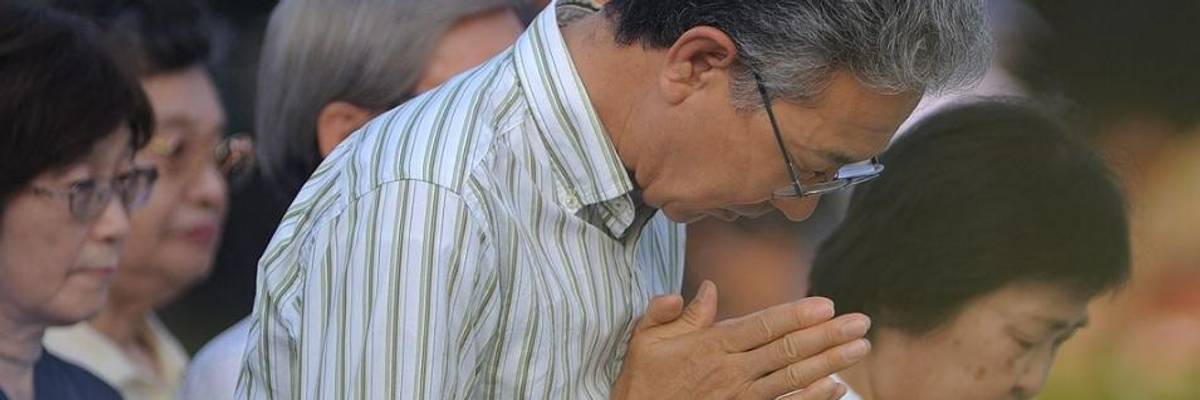
Japanese people pray in front of the Cenotaph for the Bomb Victims before the Hiroshima Peace Memorial Ceremony at the Hiroshima Peace Memorial Park on the day of the 71th anniversary of the atomic bombing of Hiroshima on August 6, 2016 in Hiroshima, Japan. Japan marks the 71th anniversary of the first atomic bomb that was dropped by the United States on Hiroshima on August 6, 1945, killing an estimated number of 70,000 people instantly with many thousands more dying over the following years from the effects of radiation. Three days later another atomic bomb was dropped on Nagasaki, ending World War II. (Photo: David Mareuil/Anadolu Agency/Getty Images)
Today marks the 75th anniversary of the first atomic bomb dropped on Hiroshima, Japan. That bomb was followed three days later by a second bomb dropped over the city of Nagasaki, Japan. The combined death toll by the end of 1945 was over 200,000 individuals, largely civilians. To this day the hibakusha, survivors of the atomic bombs, though dwindling in their numbers are still here, as are the weapons themselves. The hibakusha's steadfast plea remains that there be an end to the nuclear threat and that there be no more Hiroshima's.
The non-nuclear world is listening and heading that plea yet the leaders of the nine nuclear nations have remained oblivious to this call and the scientific knowledge demonstrating that these weapons are far more dangerous than we had previously recognized. The threat of nuclear war by intention, accident or cyberattack is now greater than at any point during the atomic age. This reality caused the Bulletin of Atomic Scientists to move their nuclear doomsday clock setting this year to 100 seconds before midnight, where midnight represents nuclear Armageddon. This is the closest it has been since its inception.
Fortunately on this anniversary there is much to celebrate as the non-nuclear nations of the world are joining forces refusing to be held hostage any longer by the nuclear nine and moving forward with ratification of the Treaty on the Prohibition of Nuclear Weapons. When placed into force the treaty will make nuclear weapons illegal to possess, produce, stockpile, transfer, develop, use or threaten to use. Also assisting, encouraging or inducing anyone to engage in any of these activities will also be prohibited. At the time of this writing, 40 nations have ratified the treaty with more nations to ratify this anniversary day. Once 50 nations have ratified, the treaty goes into effect 90 days later.
When in force, nuclear weapons will not disappear, however the nations who continue to hold them will be stigmatized and in breach of international law seriously compromising their ethical leadership in the international community with each advancing day.
The United States which along with Russia maintains greater than 92% of the world's nuclear arsenals has refused to entertain signing the treaty. This has resulted in many grassroots campaigns in the U.S. to abolish these weapons and reduce the likelihood of their use. Following on the U.N. treaty and the lead of the International Campaign to Abolish Nuclear weapons (ICAN) there is a comprehensive, all in, campaign in the United States called Back from the Brink. This campaign recognizes that what is needed is a fundamental change in U.S. nuclear policy. Simultaneously, while supporting the U.N. treaty, this campaign provides the precautionary steps necessary during the process to abolish these weapons. It calls on the United States to: renounce the option of using new weapons first; end the sole unchecked authority of any president to launch a nuclear attack; take U.S. nuclear weapons off hair trigger alert; cancel the plan to replace the entire arsenal with enhanced weapons; and actively pursue a verifiable and enforceable, time-bound agreement among nuclear arms states to eliminate their nuclear arsenals. This campaign now has 329 organizations, 45 municipalities and 6 state legislative bodies who have endorsed the campaign.
On this anniversary day there will be commemorations around the world. In the United States there will be two days of streaming events on August 6 from 11:00 am ET and August 9 from 2:00 pm ET, here under the banner #StillHere. This remarkable coalition of over 160 organizations nationwide share the common goal of ridding the world of the risk of nuclear weapons and bringing restorative justice to communities affected by nuclear weapons testing, production, and use coming together to honor survivors. As we hear the voices of the hibakusha, it is time we take definitive action to continue their fight to once and for all abolish nuclear weapons.
Dear Common Dreams reader, It’s been nearly 30 years since I co-founded Common Dreams with my late wife, Lina Newhouser. We had the radical notion that journalism should serve the public good, not corporate profits. It was clear to us from the outset what it would take to build such a project. No paid advertisements. No corporate sponsors. No millionaire publisher telling us what to think or do. Many people said we wouldn't last a year, but we proved those doubters wrong. Together with a tremendous team of journalists and dedicated staff, we built an independent media outlet free from the constraints of profits and corporate control. Our mission has always been simple: To inform. To inspire. To ignite change for the common good. Building Common Dreams was not easy. Our survival was never guaranteed. When you take on the most powerful forces—Wall Street greed, fossil fuel industry destruction, Big Tech lobbyists, and uber-rich oligarchs who have spent billions upon billions rigging the economy and democracy in their favor—the only bulwark you have is supporters who believe in your work. But here’s the urgent message from me today. It's never been this bad out there. And it's never been this hard to keep us going. At the very moment Common Dreams is most needed, the threats we face are intensifying. We need your support now more than ever. We don't accept corporate advertising and never will. We don't have a paywall because we don't think people should be blocked from critical news based on their ability to pay. Everything we do is funded by the donations of readers like you. When everyone does the little they can afford, we are strong. But if that support retreats or dries up, so do we. Will you donate now to make sure Common Dreams not only survives but thrives? —Craig Brown, Co-founder |
Today marks the 75th anniversary of the first atomic bomb dropped on Hiroshima, Japan. That bomb was followed three days later by a second bomb dropped over the city of Nagasaki, Japan. The combined death toll by the end of 1945 was over 200,000 individuals, largely civilians. To this day the hibakusha, survivors of the atomic bombs, though dwindling in their numbers are still here, as are the weapons themselves. The hibakusha's steadfast plea remains that there be an end to the nuclear threat and that there be no more Hiroshima's.
The non-nuclear world is listening and heading that plea yet the leaders of the nine nuclear nations have remained oblivious to this call and the scientific knowledge demonstrating that these weapons are far more dangerous than we had previously recognized. The threat of nuclear war by intention, accident or cyberattack is now greater than at any point during the atomic age. This reality caused the Bulletin of Atomic Scientists to move their nuclear doomsday clock setting this year to 100 seconds before midnight, where midnight represents nuclear Armageddon. This is the closest it has been since its inception.
Fortunately on this anniversary there is much to celebrate as the non-nuclear nations of the world are joining forces refusing to be held hostage any longer by the nuclear nine and moving forward with ratification of the Treaty on the Prohibition of Nuclear Weapons. When placed into force the treaty will make nuclear weapons illegal to possess, produce, stockpile, transfer, develop, use or threaten to use. Also assisting, encouraging or inducing anyone to engage in any of these activities will also be prohibited. At the time of this writing, 40 nations have ratified the treaty with more nations to ratify this anniversary day. Once 50 nations have ratified, the treaty goes into effect 90 days later.
When in force, nuclear weapons will not disappear, however the nations who continue to hold them will be stigmatized and in breach of international law seriously compromising their ethical leadership in the international community with each advancing day.
The United States which along with Russia maintains greater than 92% of the world's nuclear arsenals has refused to entertain signing the treaty. This has resulted in many grassroots campaigns in the U.S. to abolish these weapons and reduce the likelihood of their use. Following on the U.N. treaty and the lead of the International Campaign to Abolish Nuclear weapons (ICAN) there is a comprehensive, all in, campaign in the United States called Back from the Brink. This campaign recognizes that what is needed is a fundamental change in U.S. nuclear policy. Simultaneously, while supporting the U.N. treaty, this campaign provides the precautionary steps necessary during the process to abolish these weapons. It calls on the United States to: renounce the option of using new weapons first; end the sole unchecked authority of any president to launch a nuclear attack; take U.S. nuclear weapons off hair trigger alert; cancel the plan to replace the entire arsenal with enhanced weapons; and actively pursue a verifiable and enforceable, time-bound agreement among nuclear arms states to eliminate their nuclear arsenals. This campaign now has 329 organizations, 45 municipalities and 6 state legislative bodies who have endorsed the campaign.
On this anniversary day there will be commemorations around the world. In the United States there will be two days of streaming events on August 6 from 11:00 am ET and August 9 from 2:00 pm ET, here under the banner #StillHere. This remarkable coalition of over 160 organizations nationwide share the common goal of ridding the world of the risk of nuclear weapons and bringing restorative justice to communities affected by nuclear weapons testing, production, and use coming together to honor survivors. As we hear the voices of the hibakusha, it is time we take definitive action to continue their fight to once and for all abolish nuclear weapons.
Today marks the 75th anniversary of the first atomic bomb dropped on Hiroshima, Japan. That bomb was followed three days later by a second bomb dropped over the city of Nagasaki, Japan. The combined death toll by the end of 1945 was over 200,000 individuals, largely civilians. To this day the hibakusha, survivors of the atomic bombs, though dwindling in their numbers are still here, as are the weapons themselves. The hibakusha's steadfast plea remains that there be an end to the nuclear threat and that there be no more Hiroshima's.
The non-nuclear world is listening and heading that plea yet the leaders of the nine nuclear nations have remained oblivious to this call and the scientific knowledge demonstrating that these weapons are far more dangerous than we had previously recognized. The threat of nuclear war by intention, accident or cyberattack is now greater than at any point during the atomic age. This reality caused the Bulletin of Atomic Scientists to move their nuclear doomsday clock setting this year to 100 seconds before midnight, where midnight represents nuclear Armageddon. This is the closest it has been since its inception.
Fortunately on this anniversary there is much to celebrate as the non-nuclear nations of the world are joining forces refusing to be held hostage any longer by the nuclear nine and moving forward with ratification of the Treaty on the Prohibition of Nuclear Weapons. When placed into force the treaty will make nuclear weapons illegal to possess, produce, stockpile, transfer, develop, use or threaten to use. Also assisting, encouraging or inducing anyone to engage in any of these activities will also be prohibited. At the time of this writing, 40 nations have ratified the treaty with more nations to ratify this anniversary day. Once 50 nations have ratified, the treaty goes into effect 90 days later.
When in force, nuclear weapons will not disappear, however the nations who continue to hold them will be stigmatized and in breach of international law seriously compromising their ethical leadership in the international community with each advancing day.
The United States which along with Russia maintains greater than 92% of the world's nuclear arsenals has refused to entertain signing the treaty. This has resulted in many grassroots campaigns in the U.S. to abolish these weapons and reduce the likelihood of their use. Following on the U.N. treaty and the lead of the International Campaign to Abolish Nuclear weapons (ICAN) there is a comprehensive, all in, campaign in the United States called Back from the Brink. This campaign recognizes that what is needed is a fundamental change in U.S. nuclear policy. Simultaneously, while supporting the U.N. treaty, this campaign provides the precautionary steps necessary during the process to abolish these weapons. It calls on the United States to: renounce the option of using new weapons first; end the sole unchecked authority of any president to launch a nuclear attack; take U.S. nuclear weapons off hair trigger alert; cancel the plan to replace the entire arsenal with enhanced weapons; and actively pursue a verifiable and enforceable, time-bound agreement among nuclear arms states to eliminate their nuclear arsenals. This campaign now has 329 organizations, 45 municipalities and 6 state legislative bodies who have endorsed the campaign.
On this anniversary day there will be commemorations around the world. In the United States there will be two days of streaming events on August 6 from 11:00 am ET and August 9 from 2:00 pm ET, here under the banner #StillHere. This remarkable coalition of over 160 organizations nationwide share the common goal of ridding the world of the risk of nuclear weapons and bringing restorative justice to communities affected by nuclear weapons testing, production, and use coming together to honor survivors. As we hear the voices of the hibakusha, it is time we take definitive action to continue their fight to once and for all abolish nuclear weapons.