SUBSCRIBE TO OUR FREE NEWSLETTER
Daily news & progressive opinion—funded by the people, not the corporations—delivered straight to your inbox.
5
#000000
#FFFFFF
To donate by check, phone, or other method, see our More Ways to Give page.
Daily news & progressive opinion—funded by the people, not the corporations—delivered straight to your inbox.
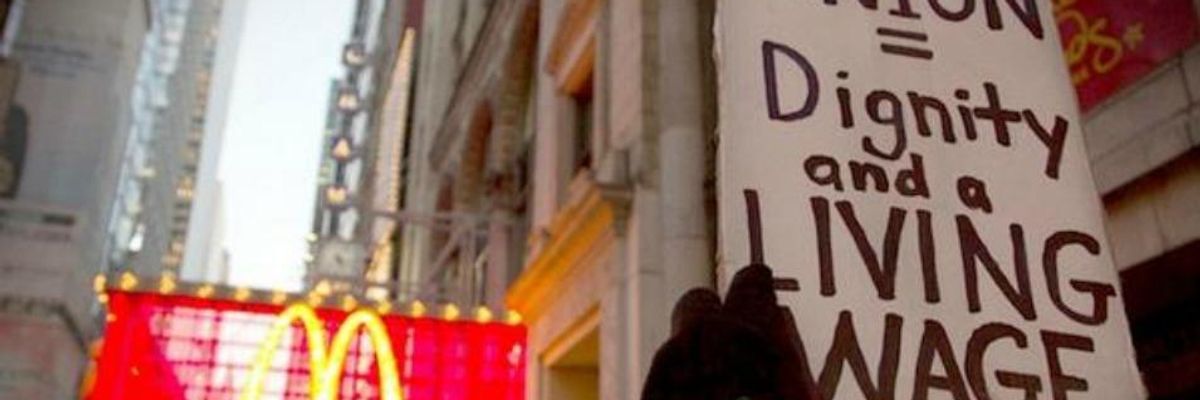
The long-term systemic reason that working people are willing to accept jobs that cannot provide enough income to cover basic needs is because they are unable to organize and demand higher wages. Unionization is clearly tied to higher and more equal wages. (Photo: SEIU via Twitter)
Members of the One Percent, such as former restaurateur Andrew Puzder, have urged Congress to not renew the $600 a week unemployment supplement Congress enacted as part of the CARES Act. They argue, in Puzder's words, that "this $600 per week bonus is discouraging work" for low-wage earners.
No one receiving unemployment benefits will make themselves rich on unemployment. The $600 is not a huge incentive to stay home. Even in the states with higher base benefits, the minimum unemployment benefits plus the supplement, leave unemployed people earning less than a living wage far below the U.S. median income.
The dignity of work is restored when employment leads to working people securing living wages and having their voices heard.
But as low as unemployment benefits are, they are higher than the U.S. paltry minimum wage of $7.25 an hour, which is tantamount to a starvation wage, leaving working families significantly food insecure. Puzder's argument makes sense: Why would anyone risk their life and health during a pandemic for lower wages than they could receive by remaining unemployed?
In the short-term, we could solve the problem Puzder raises by increasing the minimum wage to $15 an hour or more. A $15 minimum wage would provide people with, yes, $600 a week if they work a full-time job. There goes the incentive not to look for work. (Puzder, by the way, was Trump's choice for Labor Secretary before he withdrew from the running in the face of sexual harassment and labor abuse charges at his fast food restaurants)
But a minimum wage increase, while alleviating the problem in the short-run, would do nothing to fix the long-term problems in our economy exposed by the novel coronavirus. The fact that Congress passed the CARES Act on an emergency basis with almost no debate, including both hundreds of billions of dollars of bailouts for business and $176 billion for a few months of supplemental unemployment benefits shows just how broken our economy is.
The long-term systemic reason that working people are willing to accept jobs that cannot provide enough income to cover basic needs is because they are unable to organize and demand higher wages. Unionization is clearly tied to higher and more equal wages. The real disincentive working people face is that if they try to assert their right to collective bargaining, they often are quickly fired even though such firing is technically illegal.
The threat of losing your job is backed up by real consequences -- loss of income, loss of housing, loss of health insurance, and food insecurity. Unemployment benefits are so paltry, the economy cannot survive long during a period of double-digit unemployment.
But working people need more than enforced protections for union organizing, we need their voices and expertise at the center of the Coronavirus recession recovery efforts. Harvard Law School's Clean Slate for Worker Power project and the Roosevelt Institute have put forward detailed proposals on how to include worker voices during the Covid-19 recovery. With worker solutions at the table and workplace, the economic recovery will be safer, stronger, and quicker. Working people's voices need to be heard and followed daily, not just every four years during an election cycle. Democracy, particularly economic democracy, lives in the workplace.
Unfortunately, too many members of Congress have been listening more to voices like Puzder's than the voices of working people. They are letting the CARES Act unemployment benefits expire as they continue to fight over the terms of the next stimulus package.
Extending the $600 unemployment supplement would not be a threat to businesses that pay living wages and support worker voices. Not extending it is a threat to every unemployed person who is trying to survive this economic crisis.
Puzder attempts to make the argument that small-business owners hiring or trying to hire reported difficulty finding qualified applicants or any applicants and blames the unemployment supplement. What he does not take into account is the volatility of the current workplace with a cycle of re-openings and closings due to Coronavirus impacting many of the minimum wage sectors. It took many people weeks to secure unemployment benefits and they are concerned that if they return to a workplace that closes a week later they will lose this temporary stability.
Puzder argues that there is no substitute for the dignity of a job but he grossly misses the mark--forcing people to risk their lives to return to work is the opposite of dignity.
The dignity of work is restored when employment leads to working people securing living wages and having their voices heard.
Dear Common Dreams reader, It’s been nearly 30 years since I co-founded Common Dreams with my late wife, Lina Newhouser. We had the radical notion that journalism should serve the public good, not corporate profits. It was clear to us from the outset what it would take to build such a project. No paid advertisements. No corporate sponsors. No millionaire publisher telling us what to think or do. Many people said we wouldn't last a year, but we proved those doubters wrong. Together with a tremendous team of journalists and dedicated staff, we built an independent media outlet free from the constraints of profits and corporate control. Our mission has always been simple: To inform. To inspire. To ignite change for the common good. Building Common Dreams was not easy. Our survival was never guaranteed. When you take on the most powerful forces—Wall Street greed, fossil fuel industry destruction, Big Tech lobbyists, and uber-rich oligarchs who have spent billions upon billions rigging the economy and democracy in their favor—the only bulwark you have is supporters who believe in your work. But here’s the urgent message from me today. It's never been this bad out there. And it's never been this hard to keep us going. At the very moment Common Dreams is most needed, the threats we face are intensifying. We need your support now more than ever. We don't accept corporate advertising and never will. We don't have a paywall because we don't think people should be blocked from critical news based on their ability to pay. Everything we do is funded by the donations of readers like you. When everyone does the little they can afford, we are strong. But if that support retreats or dries up, so do we. Will you donate now to make sure Common Dreams not only survives but thrives? —Craig Brown, Co-founder |
Members of the One Percent, such as former restaurateur Andrew Puzder, have urged Congress to not renew the $600 a week unemployment supplement Congress enacted as part of the CARES Act. They argue, in Puzder's words, that "this $600 per week bonus is discouraging work" for low-wage earners.
No one receiving unemployment benefits will make themselves rich on unemployment. The $600 is not a huge incentive to stay home. Even in the states with higher base benefits, the minimum unemployment benefits plus the supplement, leave unemployed people earning less than a living wage far below the U.S. median income.
The dignity of work is restored when employment leads to working people securing living wages and having their voices heard.
But as low as unemployment benefits are, they are higher than the U.S. paltry minimum wage of $7.25 an hour, which is tantamount to a starvation wage, leaving working families significantly food insecure. Puzder's argument makes sense: Why would anyone risk their life and health during a pandemic for lower wages than they could receive by remaining unemployed?
In the short-term, we could solve the problem Puzder raises by increasing the minimum wage to $15 an hour or more. A $15 minimum wage would provide people with, yes, $600 a week if they work a full-time job. There goes the incentive not to look for work. (Puzder, by the way, was Trump's choice for Labor Secretary before he withdrew from the running in the face of sexual harassment and labor abuse charges at his fast food restaurants)
But a minimum wage increase, while alleviating the problem in the short-run, would do nothing to fix the long-term problems in our economy exposed by the novel coronavirus. The fact that Congress passed the CARES Act on an emergency basis with almost no debate, including both hundreds of billions of dollars of bailouts for business and $176 billion for a few months of supplemental unemployment benefits shows just how broken our economy is.
The long-term systemic reason that working people are willing to accept jobs that cannot provide enough income to cover basic needs is because they are unable to organize and demand higher wages. Unionization is clearly tied to higher and more equal wages. The real disincentive working people face is that if they try to assert their right to collective bargaining, they often are quickly fired even though such firing is technically illegal.
The threat of losing your job is backed up by real consequences -- loss of income, loss of housing, loss of health insurance, and food insecurity. Unemployment benefits are so paltry, the economy cannot survive long during a period of double-digit unemployment.
But working people need more than enforced protections for union organizing, we need their voices and expertise at the center of the Coronavirus recession recovery efforts. Harvard Law School's Clean Slate for Worker Power project and the Roosevelt Institute have put forward detailed proposals on how to include worker voices during the Covid-19 recovery. With worker solutions at the table and workplace, the economic recovery will be safer, stronger, and quicker. Working people's voices need to be heard and followed daily, not just every four years during an election cycle. Democracy, particularly economic democracy, lives in the workplace.
Unfortunately, too many members of Congress have been listening more to voices like Puzder's than the voices of working people. They are letting the CARES Act unemployment benefits expire as they continue to fight over the terms of the next stimulus package.
Extending the $600 unemployment supplement would not be a threat to businesses that pay living wages and support worker voices. Not extending it is a threat to every unemployed person who is trying to survive this economic crisis.
Puzder attempts to make the argument that small-business owners hiring or trying to hire reported difficulty finding qualified applicants or any applicants and blames the unemployment supplement. What he does not take into account is the volatility of the current workplace with a cycle of re-openings and closings due to Coronavirus impacting many of the minimum wage sectors. It took many people weeks to secure unemployment benefits and they are concerned that if they return to a workplace that closes a week later they will lose this temporary stability.
Puzder argues that there is no substitute for the dignity of a job but he grossly misses the mark--forcing people to risk their lives to return to work is the opposite of dignity.
The dignity of work is restored when employment leads to working people securing living wages and having their voices heard.
Members of the One Percent, such as former restaurateur Andrew Puzder, have urged Congress to not renew the $600 a week unemployment supplement Congress enacted as part of the CARES Act. They argue, in Puzder's words, that "this $600 per week bonus is discouraging work" for low-wage earners.
No one receiving unemployment benefits will make themselves rich on unemployment. The $600 is not a huge incentive to stay home. Even in the states with higher base benefits, the minimum unemployment benefits plus the supplement, leave unemployed people earning less than a living wage far below the U.S. median income.
The dignity of work is restored when employment leads to working people securing living wages and having their voices heard.
But as low as unemployment benefits are, they are higher than the U.S. paltry minimum wage of $7.25 an hour, which is tantamount to a starvation wage, leaving working families significantly food insecure. Puzder's argument makes sense: Why would anyone risk their life and health during a pandemic for lower wages than they could receive by remaining unemployed?
In the short-term, we could solve the problem Puzder raises by increasing the minimum wage to $15 an hour or more. A $15 minimum wage would provide people with, yes, $600 a week if they work a full-time job. There goes the incentive not to look for work. (Puzder, by the way, was Trump's choice for Labor Secretary before he withdrew from the running in the face of sexual harassment and labor abuse charges at his fast food restaurants)
But a minimum wage increase, while alleviating the problem in the short-run, would do nothing to fix the long-term problems in our economy exposed by the novel coronavirus. The fact that Congress passed the CARES Act on an emergency basis with almost no debate, including both hundreds of billions of dollars of bailouts for business and $176 billion for a few months of supplemental unemployment benefits shows just how broken our economy is.
The long-term systemic reason that working people are willing to accept jobs that cannot provide enough income to cover basic needs is because they are unable to organize and demand higher wages. Unionization is clearly tied to higher and more equal wages. The real disincentive working people face is that if they try to assert their right to collective bargaining, they often are quickly fired even though such firing is technically illegal.
The threat of losing your job is backed up by real consequences -- loss of income, loss of housing, loss of health insurance, and food insecurity. Unemployment benefits are so paltry, the economy cannot survive long during a period of double-digit unemployment.
But working people need more than enforced protections for union organizing, we need their voices and expertise at the center of the Coronavirus recession recovery efforts. Harvard Law School's Clean Slate for Worker Power project and the Roosevelt Institute have put forward detailed proposals on how to include worker voices during the Covid-19 recovery. With worker solutions at the table and workplace, the economic recovery will be safer, stronger, and quicker. Working people's voices need to be heard and followed daily, not just every four years during an election cycle. Democracy, particularly economic democracy, lives in the workplace.
Unfortunately, too many members of Congress have been listening more to voices like Puzder's than the voices of working people. They are letting the CARES Act unemployment benefits expire as they continue to fight over the terms of the next stimulus package.
Extending the $600 unemployment supplement would not be a threat to businesses that pay living wages and support worker voices. Not extending it is a threat to every unemployed person who is trying to survive this economic crisis.
Puzder attempts to make the argument that small-business owners hiring or trying to hire reported difficulty finding qualified applicants or any applicants and blames the unemployment supplement. What he does not take into account is the volatility of the current workplace with a cycle of re-openings and closings due to Coronavirus impacting many of the minimum wage sectors. It took many people weeks to secure unemployment benefits and they are concerned that if they return to a workplace that closes a week later they will lose this temporary stability.
Puzder argues that there is no substitute for the dignity of a job but he grossly misses the mark--forcing people to risk their lives to return to work is the opposite of dignity.
The dignity of work is restored when employment leads to working people securing living wages and having their voices heard.