SUBSCRIBE TO OUR FREE NEWSLETTER
Daily news & progressive opinion—funded by the people, not the corporations—delivered straight to your inbox.
5
#000000
#FFFFFF
To donate by check, phone, or other method, see our More Ways to Give page.
Daily news & progressive opinion—funded by the people, not the corporations—delivered straight to your inbox.
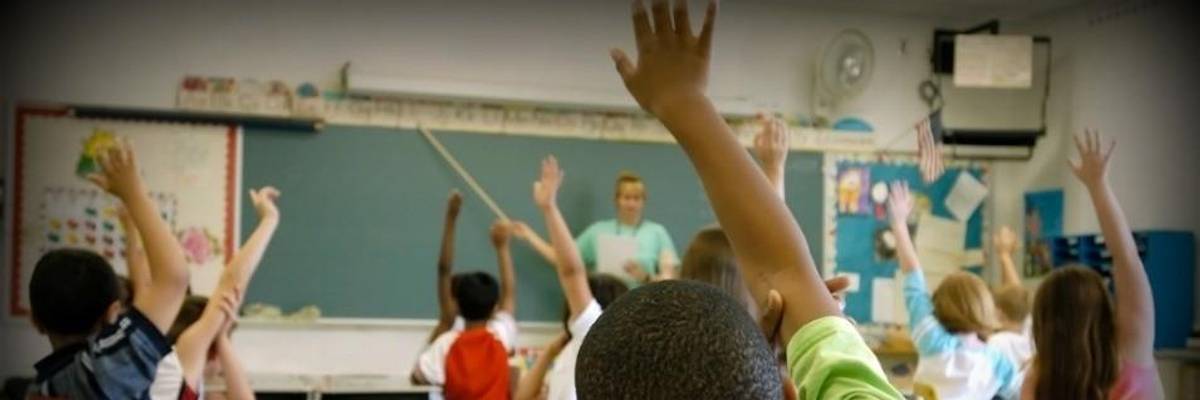
Over the past several days, governments and global policy makers have been meeting online to discuss progress towards the United Nations' sustainable development goals (SDGs). Unsurprisingly, Covid-19 is at the center of their agenda. They should also acknowledge the pandemic's impact on education.
The impact on children and young people's education has been enormous and is built on existing gaps: one in five children and youth were excluded from schools even before Covid-19 struck.
Unlike conflicts or natural disasters, the Covid-19 pandemic did not destroy schools, but it has weakened many education systems, testing their responsiveness to emergencies, including their ability to adapt without causing new forms of exclusion.
As more reports of children who did not take part in any formal education emerge from the almost 190 countries that ordered school closures in response to the pandemic, the staggering scale of how many millions of students have been affected during lockdowns in recent months is becoming clearer. But it was also wholly foreseeable.
The impact on children and young people's education has been enormous and is built on existing gaps: one in five children and youth were excluded from schools even before Covid-19 struck. The UN Special Rapporteur on Education has warned states that exclusion prior to and during the pandemic exists "against a backdrop of entrenched, recognised structural inequality." In many countries, the scrambled roll-out of online learning accompanied by a tech-heavy response has exacerbated learning inequalities, because many governments do not have the policies, resources, or infrastructure to roll it out in a fully inclusive manner.
Governments know who the out-of-school children are--solid evidence exists in most countries on which groups of children are at risk, and those who are not in school. Since the adoption of the SDGs, Human Rights Watch reporting has highlighted systematic exclusion of children with disabilities, refugees and migrant children, lesbian, gay, bisexual, and transgender (LGBT) youth, and girls in many contexts, and identified which policies and practices are causing most harm.
Addressing evident gaps highlighted by school closures and improving education systems after the pandemic will not be easy. But all governments, and agencies supporting them, should be firm in their commitments that moving forward, their focus will be on investing and adequately distributing greater resources to strengthen public inclusive education systems, swiftly removing discriminatory policies and practices, and adopting plans to redress the right to education for millions of students.
Dear Common Dreams reader, It’s been nearly 30 years since I co-founded Common Dreams with my late wife, Lina Newhouser. We had the radical notion that journalism should serve the public good, not corporate profits. It was clear to us from the outset what it would take to build such a project. No paid advertisements. No corporate sponsors. No millionaire publisher telling us what to think or do. Many people said we wouldn't last a year, but we proved those doubters wrong. Together with a tremendous team of journalists and dedicated staff, we built an independent media outlet free from the constraints of profits and corporate control. Our mission has always been simple: To inform. To inspire. To ignite change for the common good. Building Common Dreams was not easy. Our survival was never guaranteed. When you take on the most powerful forces—Wall Street greed, fossil fuel industry destruction, Big Tech lobbyists, and uber-rich oligarchs who have spent billions upon billions rigging the economy and democracy in their favor—the only bulwark you have is supporters who believe in your work. But here’s the urgent message from me today. It's never been this bad out there. And it's never been this hard to keep us going. At the very moment Common Dreams is most needed, the threats we face are intensifying. We need your support now more than ever. We don't accept corporate advertising and never will. We don't have a paywall because we don't think people should be blocked from critical news based on their ability to pay. Everything we do is funded by the donations of readers like you. When everyone does the little they can afford, we are strong. But if that support retreats or dries up, so do we. Will you donate now to make sure Common Dreams not only survives but thrives? —Craig Brown, Co-founder |
Over the past several days, governments and global policy makers have been meeting online to discuss progress towards the United Nations' sustainable development goals (SDGs). Unsurprisingly, Covid-19 is at the center of their agenda. They should also acknowledge the pandemic's impact on education.
The impact on children and young people's education has been enormous and is built on existing gaps: one in five children and youth were excluded from schools even before Covid-19 struck.
Unlike conflicts or natural disasters, the Covid-19 pandemic did not destroy schools, but it has weakened many education systems, testing their responsiveness to emergencies, including their ability to adapt without causing new forms of exclusion.
As more reports of children who did not take part in any formal education emerge from the almost 190 countries that ordered school closures in response to the pandemic, the staggering scale of how many millions of students have been affected during lockdowns in recent months is becoming clearer. But it was also wholly foreseeable.
The impact on children and young people's education has been enormous and is built on existing gaps: one in five children and youth were excluded from schools even before Covid-19 struck. The UN Special Rapporteur on Education has warned states that exclusion prior to and during the pandemic exists "against a backdrop of entrenched, recognised structural inequality." In many countries, the scrambled roll-out of online learning accompanied by a tech-heavy response has exacerbated learning inequalities, because many governments do not have the policies, resources, or infrastructure to roll it out in a fully inclusive manner.
Governments know who the out-of-school children are--solid evidence exists in most countries on which groups of children are at risk, and those who are not in school. Since the adoption of the SDGs, Human Rights Watch reporting has highlighted systematic exclusion of children with disabilities, refugees and migrant children, lesbian, gay, bisexual, and transgender (LGBT) youth, and girls in many contexts, and identified which policies and practices are causing most harm.
Addressing evident gaps highlighted by school closures and improving education systems after the pandemic will not be easy. But all governments, and agencies supporting them, should be firm in their commitments that moving forward, their focus will be on investing and adequately distributing greater resources to strengthen public inclusive education systems, swiftly removing discriminatory policies and practices, and adopting plans to redress the right to education for millions of students.
Over the past several days, governments and global policy makers have been meeting online to discuss progress towards the United Nations' sustainable development goals (SDGs). Unsurprisingly, Covid-19 is at the center of their agenda. They should also acknowledge the pandemic's impact on education.
The impact on children and young people's education has been enormous and is built on existing gaps: one in five children and youth were excluded from schools even before Covid-19 struck.
Unlike conflicts or natural disasters, the Covid-19 pandemic did not destroy schools, but it has weakened many education systems, testing their responsiveness to emergencies, including their ability to adapt without causing new forms of exclusion.
As more reports of children who did not take part in any formal education emerge from the almost 190 countries that ordered school closures in response to the pandemic, the staggering scale of how many millions of students have been affected during lockdowns in recent months is becoming clearer. But it was also wholly foreseeable.
The impact on children and young people's education has been enormous and is built on existing gaps: one in five children and youth were excluded from schools even before Covid-19 struck. The UN Special Rapporteur on Education has warned states that exclusion prior to and during the pandemic exists "against a backdrop of entrenched, recognised structural inequality." In many countries, the scrambled roll-out of online learning accompanied by a tech-heavy response has exacerbated learning inequalities, because many governments do not have the policies, resources, or infrastructure to roll it out in a fully inclusive manner.
Governments know who the out-of-school children are--solid evidence exists in most countries on which groups of children are at risk, and those who are not in school. Since the adoption of the SDGs, Human Rights Watch reporting has highlighted systematic exclusion of children with disabilities, refugees and migrant children, lesbian, gay, bisexual, and transgender (LGBT) youth, and girls in many contexts, and identified which policies and practices are causing most harm.
Addressing evident gaps highlighted by school closures and improving education systems after the pandemic will not be easy. But all governments, and agencies supporting them, should be firm in their commitments that moving forward, their focus will be on investing and adequately distributing greater resources to strengthen public inclusive education systems, swiftly removing discriminatory policies and practices, and adopting plans to redress the right to education for millions of students.