SUBSCRIBE TO OUR FREE NEWSLETTER
Daily news & progressive opinion—funded by the people, not the corporations—delivered straight to your inbox.
5
#000000
#FFFFFF
To donate by check, phone, or other method, see our More Ways to Give page.
Daily news & progressive opinion—funded by the people, not the corporations—delivered straight to your inbox.
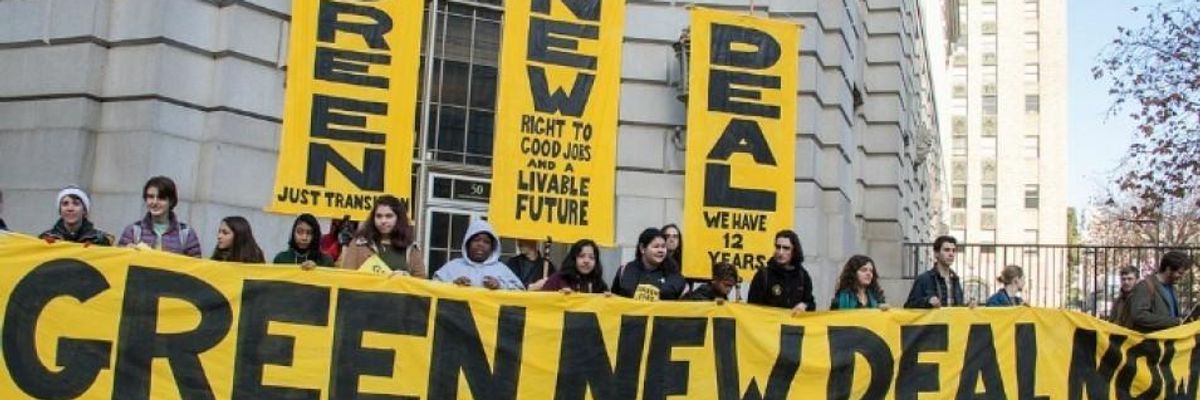
There is no alternative. To rebuild the global economy, to prepare for the next pandemic, to confront the climate crisis, we have no choice: we need a Global Green New Deal. (Photo: Peg Hunter/flickr/cc)
The global economy is collapsing. When the pandemic began, experts at the International Monetary Fund predicted that we would see the worst economic downturn since the Great Depression. This week, they announced that it will be even worse than they thought.
This disaster comes into a world already facing record inequality, desperate poverty, and a growing climate crisis. The COVID-19 pandemic has pushed a precarious world economy over the edge. This moment offers a rare opportunity to rethink the path that led us here and chart a new course out: a Global Green New Deal.
We have a tendency to treat the global economy as something natural--beyond our control.
We may understand that poverty, epidemics, and environmental destruction within the United States are not inevitable. There are certain rules in place that benefit some over others. People are not poor because they fail to lift themselves up by their bootstraps. People are poor because wages are too low, because we don't invest in public goods, because the wealthy are too powerful.
There is no alternative. To rebuild the global economy, to prepare for the next pandemic, to confront the climate crisis, we have no choice: we need a Global Green New Deal.
But when it comes to the world economy, we forget. We forget that there are rules that determine how it all works. We forget that these rules were created not by God but by man. We forget that they can be changed.
The current rules are actually rather new. Born out of the financial crisis of the 1970s, these mirrored on the global level what Ronald Reagan and Margaret Thatcher were doing at home--crushing labor unions, slashing environmental protections, and empowering corporations.
The World Bank and International Monetary Fund lent recklessly to poor countries, saddling them with debt and imposing deregulation, austerity, and labor suppression. Trade agreements like the infamous NAFTA set corporations free to search the world for profits without added protection for workers or the environment.
Nations were forced into a competitive "race to the bottom" in wages, taxes, and regulations in an attempt to lure desperately needed investment. Multinational corporations began to outsource jobs to countries where wages were lower and environmental regulations lax--and outsource profits to a shadowy network of tax havens.
The suppression of worker power deepened inequality. The decimation of environmental standards fueled the climate crisis. Decades of budget-slashing left us all unprepared to confront a pandemic. The rules that govern the world economy were not inevitable. They were intentional, and they led us to where we are today.
To escape the global recession and build a more resilient world on the other side, we need to rewrite the rules. We need a system of trade that puts workers and the environment before corporate profits. We need enforceable global floors on wages, labor laws, and environmental protections. We need global coordination to end the scourge of tax havens, debt relief for countries in crisis, and massive global redistribution.
In short, we need a Global Green New Deal.
This ambitious agenda will be hard to achieve. But if there was ever a time for big change, it is now. It was after the devastation of World War II that the United Nations was born. It was from the recessions of the 1970's that the latest world order emerged. It is out of a catastrophe as profound as COVID-19 that a new trail can be forged.
When Margaret Thatcher was setting the world on course to the present crisis, she had a slogan: "There is no alternative." For too long, we believed it.
Now, there's reason for the phrase to come back into use: There is no alternative. To rebuild the global economy, to prepare for the next pandemic, to confront the climate crisis, we have no choice: we need a Global Green New Deal.
Dear Common Dreams reader, It’s been nearly 30 years since I co-founded Common Dreams with my late wife, Lina Newhouser. We had the radical notion that journalism should serve the public good, not corporate profits. It was clear to us from the outset what it would take to build such a project. No paid advertisements. No corporate sponsors. No millionaire publisher telling us what to think or do. Many people said we wouldn't last a year, but we proved those doubters wrong. Together with a tremendous team of journalists and dedicated staff, we built an independent media outlet free from the constraints of profits and corporate control. Our mission has always been simple: To inform. To inspire. To ignite change for the common good. Building Common Dreams was not easy. Our survival was never guaranteed. When you take on the most powerful forces—Wall Street greed, fossil fuel industry destruction, Big Tech lobbyists, and uber-rich oligarchs who have spent billions upon billions rigging the economy and democracy in their favor—the only bulwark you have is supporters who believe in your work. But here’s the urgent message from me today. It's never been this bad out there. And it's never been this hard to keep us going. At the very moment Common Dreams is most needed, the threats we face are intensifying. We need your support now more than ever. We don't accept corporate advertising and never will. We don't have a paywall because we don't think people should be blocked from critical news based on their ability to pay. Everything we do is funded by the donations of readers like you. When everyone does the little they can afford, we are strong. But if that support retreats or dries up, so do we. Will you donate now to make sure Common Dreams not only survives but thrives? —Craig Brown, Co-founder |
The global economy is collapsing. When the pandemic began, experts at the International Monetary Fund predicted that we would see the worst economic downturn since the Great Depression. This week, they announced that it will be even worse than they thought.
This disaster comes into a world already facing record inequality, desperate poverty, and a growing climate crisis. The COVID-19 pandemic has pushed a precarious world economy over the edge. This moment offers a rare opportunity to rethink the path that led us here and chart a new course out: a Global Green New Deal.
We have a tendency to treat the global economy as something natural--beyond our control.
We may understand that poverty, epidemics, and environmental destruction within the United States are not inevitable. There are certain rules in place that benefit some over others. People are not poor because they fail to lift themselves up by their bootstraps. People are poor because wages are too low, because we don't invest in public goods, because the wealthy are too powerful.
There is no alternative. To rebuild the global economy, to prepare for the next pandemic, to confront the climate crisis, we have no choice: we need a Global Green New Deal.
But when it comes to the world economy, we forget. We forget that there are rules that determine how it all works. We forget that these rules were created not by God but by man. We forget that they can be changed.
The current rules are actually rather new. Born out of the financial crisis of the 1970s, these mirrored on the global level what Ronald Reagan and Margaret Thatcher were doing at home--crushing labor unions, slashing environmental protections, and empowering corporations.
The World Bank and International Monetary Fund lent recklessly to poor countries, saddling them with debt and imposing deregulation, austerity, and labor suppression. Trade agreements like the infamous NAFTA set corporations free to search the world for profits without added protection for workers or the environment.
Nations were forced into a competitive "race to the bottom" in wages, taxes, and regulations in an attempt to lure desperately needed investment. Multinational corporations began to outsource jobs to countries where wages were lower and environmental regulations lax--and outsource profits to a shadowy network of tax havens.
The suppression of worker power deepened inequality. The decimation of environmental standards fueled the climate crisis. Decades of budget-slashing left us all unprepared to confront a pandemic. The rules that govern the world economy were not inevitable. They were intentional, and they led us to where we are today.
To escape the global recession and build a more resilient world on the other side, we need to rewrite the rules. We need a system of trade that puts workers and the environment before corporate profits. We need enforceable global floors on wages, labor laws, and environmental protections. We need global coordination to end the scourge of tax havens, debt relief for countries in crisis, and massive global redistribution.
In short, we need a Global Green New Deal.
This ambitious agenda will be hard to achieve. But if there was ever a time for big change, it is now. It was after the devastation of World War II that the United Nations was born. It was from the recessions of the 1970's that the latest world order emerged. It is out of a catastrophe as profound as COVID-19 that a new trail can be forged.
When Margaret Thatcher was setting the world on course to the present crisis, she had a slogan: "There is no alternative." For too long, we believed it.
Now, there's reason for the phrase to come back into use: There is no alternative. To rebuild the global economy, to prepare for the next pandemic, to confront the climate crisis, we have no choice: we need a Global Green New Deal.
The global economy is collapsing. When the pandemic began, experts at the International Monetary Fund predicted that we would see the worst economic downturn since the Great Depression. This week, they announced that it will be even worse than they thought.
This disaster comes into a world already facing record inequality, desperate poverty, and a growing climate crisis. The COVID-19 pandemic has pushed a precarious world economy over the edge. This moment offers a rare opportunity to rethink the path that led us here and chart a new course out: a Global Green New Deal.
We have a tendency to treat the global economy as something natural--beyond our control.
We may understand that poverty, epidemics, and environmental destruction within the United States are not inevitable. There are certain rules in place that benefit some over others. People are not poor because they fail to lift themselves up by their bootstraps. People are poor because wages are too low, because we don't invest in public goods, because the wealthy are too powerful.
There is no alternative. To rebuild the global economy, to prepare for the next pandemic, to confront the climate crisis, we have no choice: we need a Global Green New Deal.
But when it comes to the world economy, we forget. We forget that there are rules that determine how it all works. We forget that these rules were created not by God but by man. We forget that they can be changed.
The current rules are actually rather new. Born out of the financial crisis of the 1970s, these mirrored on the global level what Ronald Reagan and Margaret Thatcher were doing at home--crushing labor unions, slashing environmental protections, and empowering corporations.
The World Bank and International Monetary Fund lent recklessly to poor countries, saddling them with debt and imposing deregulation, austerity, and labor suppression. Trade agreements like the infamous NAFTA set corporations free to search the world for profits without added protection for workers or the environment.
Nations were forced into a competitive "race to the bottom" in wages, taxes, and regulations in an attempt to lure desperately needed investment. Multinational corporations began to outsource jobs to countries where wages were lower and environmental regulations lax--and outsource profits to a shadowy network of tax havens.
The suppression of worker power deepened inequality. The decimation of environmental standards fueled the climate crisis. Decades of budget-slashing left us all unprepared to confront a pandemic. The rules that govern the world economy were not inevitable. They were intentional, and they led us to where we are today.
To escape the global recession and build a more resilient world on the other side, we need to rewrite the rules. We need a system of trade that puts workers and the environment before corporate profits. We need enforceable global floors on wages, labor laws, and environmental protections. We need global coordination to end the scourge of tax havens, debt relief for countries in crisis, and massive global redistribution.
In short, we need a Global Green New Deal.
This ambitious agenda will be hard to achieve. But if there was ever a time for big change, it is now. It was after the devastation of World War II that the United Nations was born. It was from the recessions of the 1970's that the latest world order emerged. It is out of a catastrophe as profound as COVID-19 that a new trail can be forged.
When Margaret Thatcher was setting the world on course to the present crisis, she had a slogan: "There is no alternative." For too long, we believed it.
Now, there's reason for the phrase to come back into use: There is no alternative. To rebuild the global economy, to prepare for the next pandemic, to confront the climate crisis, we have no choice: we need a Global Green New Deal.