
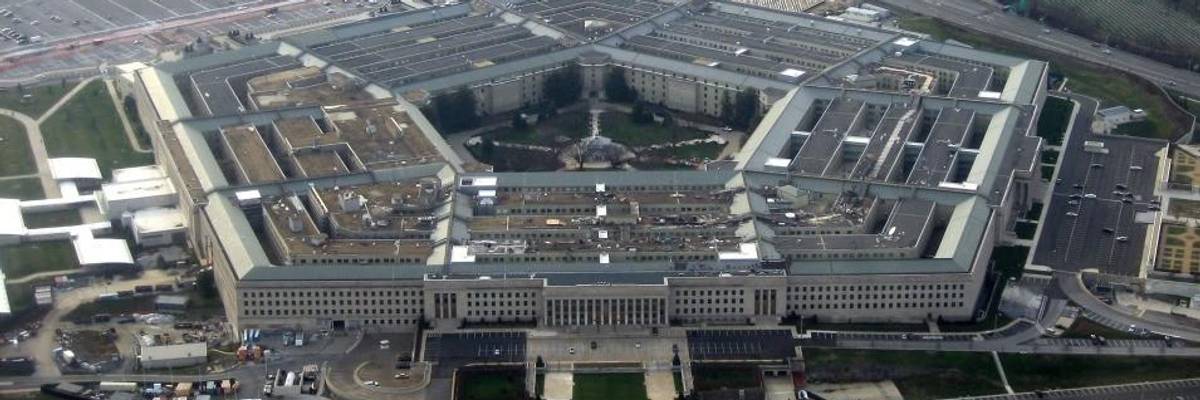
Money entrusted to the Pentagon and a vast array of military contractors must be spent to meet human needs. (Photo: David B. Gleason/Flickr/cc)
Weapons That Protect White Privilege Prevent Sustainable Community Change
Reflections on weapons and systems white people use to protect their white privilege, recalling that Dr. King likened U.S. wars to "some demonic destructive suction tube."
In her poem, "The Revolution Will Rhyme," Buffalo Black Lives Matter activist Jillian Hanesworth writes about the movement for change we now see sweeping across the world:
It will not be developed just to be displaced
Its focus will not be extracted and refocused or repurposed
And the burden of education and comfort will not be placed on the oppressed
While understanding and tolerance is gifted to the oppressor
You will not be able to binge watch the revolution
Rewinding the comfortable triumphs and fast forwarding through the hurt.
In strong, confident language, fueled by recognition of hurts and atrocities, Hanesworth calls on white people to ask themselves uncomfortable questions. How does our white privilege contribute to racism and oppression? How can we use our privilege to bring about systemic change?
I think it's important to examine the so-called security U.S. people purchase through funding the U.S. military and demand redirection of these resources.
Mindful not to repurpose or refocus Jillian's words, I think we must move forward, urgently, to tackle systemic change. We must use our white privilege to insist on and secure decent schools, health care, housing and human rights, especially for those who've been most harmed by racial disparities and economic inequalities in the United States.
Where are the resources, the funding, to do this? I think it's important to examine the so-called security U.S. people purchase through funding the U.S. military and demand redirection of these resources. Money entrusted to the Pentagon and a vast array of military contractors must be spent to meet human needs.
Maybe this series of questions could help. Could I ever imagine myself paying for materials to assemble Molotov Cocktails for use as weapons amid a conflict? Could I ever imagine myself funding a group of people known for burning residential areas? At a magnitude incalculably greater than purchasing materials for Molotov Cocktails, or burning one urban residential area, U.S. taxpayers fund weapons used to wage gruesome wars of choice in far-away places where civilians struggle with every-day hunger, thirst, and displacement.
Condemn arson? Yes, but scale up and whisper: Dresden, Tokyo, Hiroshima, Nagasaki, Baghdad.
Imagine U.S. complicity with Saudi bludgeoning of Yemen's cities, towns, and critical infrastructure and link that with construction, in Marinette, WI, of four Littoral Combat Ships which Lockheed Martin has arranged to build and sell to the Kingdom of Saudi Arabia. The Saudis use these ships to blockade Yemen's ports, causing even more starvation in a country on the brink of famine. Yes, the construction of the ships provides greatly needed jobs. But, are there other, better construction projects that privileged people could demand be given immediate priority in our war-torn world? Could Marinette's engineers, designers, welders and builders work on projects that would help rebuild communities devastated by declining infrastructure and racist neglect within the United States?
Jillian's poem says the revolution will be a complete overhaul, not just a quick fix. We should join her in settling for nothing less. White people who are among the privileged "haves" in our unjust society must look long and hard into the mirror of our privileged history. Why should people who already have so much be entitled to get more? And if we're to learn how to live together without killing one another, how can we dismantle and repurpose the vast killing machine that protects our unfair white privilege?
An Urgent Message From Our Co-Founder
Dear Common Dreams reader, It’s been nearly 30 years since I co-founded Common Dreams with my late wife, Lina Newhouser. We had the radical notion that journalism should serve the public good, not corporate profits. It was clear to us from the outset what it would take to build such a project. No paid advertisements. No corporate sponsors. No millionaire publisher telling us what to think or do. Many people said we wouldn't last a year, but we proved those doubters wrong. Together with a tremendous team of journalists and dedicated staff, we built an independent media outlet free from the constraints of profits and corporate control. Our mission has always been simple: To inform. To inspire. To ignite change for the common good. Building Common Dreams was not easy. Our survival was never guaranteed. When you take on the most powerful forces—Wall Street greed, fossil fuel industry destruction, Big Tech lobbyists, and uber-rich oligarchs who have spent billions upon billions rigging the economy and democracy in their favor—the only bulwark you have is supporters who believe in your work. But here’s the urgent message from me today. It's never been this bad out there. And it's never been this hard to keep us going. At the very moment Common Dreams is most needed, the threats we face are intensifying. We need your support now more than ever. We don't accept corporate advertising and never will. We don't have a paywall because we don't think people should be blocked from critical news based on their ability to pay. Everything we do is funded by the donations of readers like you. When everyone does the little they can afford, we are strong. But if that support retreats or dries up, so do we. Will you donate now to make sure Common Dreams not only survives but thrives? —Craig Brown, Co-founder |
In her poem, "The Revolution Will Rhyme," Buffalo Black Lives Matter activist Jillian Hanesworth writes about the movement for change we now see sweeping across the world:
It will not be developed just to be displaced
Its focus will not be extracted and refocused or repurposed
And the burden of education and comfort will not be placed on the oppressed
While understanding and tolerance is gifted to the oppressor
You will not be able to binge watch the revolution
Rewinding the comfortable triumphs and fast forwarding through the hurt.
In strong, confident language, fueled by recognition of hurts and atrocities, Hanesworth calls on white people to ask themselves uncomfortable questions. How does our white privilege contribute to racism and oppression? How can we use our privilege to bring about systemic change?
I think it's important to examine the so-called security U.S. people purchase through funding the U.S. military and demand redirection of these resources.
Mindful not to repurpose or refocus Jillian's words, I think we must move forward, urgently, to tackle systemic change. We must use our white privilege to insist on and secure decent schools, health care, housing and human rights, especially for those who've been most harmed by racial disparities and economic inequalities in the United States.
Where are the resources, the funding, to do this? I think it's important to examine the so-called security U.S. people purchase through funding the U.S. military and demand redirection of these resources. Money entrusted to the Pentagon and a vast array of military contractors must be spent to meet human needs.
Maybe this series of questions could help. Could I ever imagine myself paying for materials to assemble Molotov Cocktails for use as weapons amid a conflict? Could I ever imagine myself funding a group of people known for burning residential areas? At a magnitude incalculably greater than purchasing materials for Molotov Cocktails, or burning one urban residential area, U.S. taxpayers fund weapons used to wage gruesome wars of choice in far-away places where civilians struggle with every-day hunger, thirst, and displacement.
Condemn arson? Yes, but scale up and whisper: Dresden, Tokyo, Hiroshima, Nagasaki, Baghdad.
Imagine U.S. complicity with Saudi bludgeoning of Yemen's cities, towns, and critical infrastructure and link that with construction, in Marinette, WI, of four Littoral Combat Ships which Lockheed Martin has arranged to build and sell to the Kingdom of Saudi Arabia. The Saudis use these ships to blockade Yemen's ports, causing even more starvation in a country on the brink of famine. Yes, the construction of the ships provides greatly needed jobs. But, are there other, better construction projects that privileged people could demand be given immediate priority in our war-torn world? Could Marinette's engineers, designers, welders and builders work on projects that would help rebuild communities devastated by declining infrastructure and racist neglect within the United States?
Jillian's poem says the revolution will be a complete overhaul, not just a quick fix. We should join her in settling for nothing less. White people who are among the privileged "haves" in our unjust society must look long and hard into the mirror of our privileged history. Why should people who already have so much be entitled to get more? And if we're to learn how to live together without killing one another, how can we dismantle and repurpose the vast killing machine that protects our unfair white privilege?
In her poem, "The Revolution Will Rhyme," Buffalo Black Lives Matter activist Jillian Hanesworth writes about the movement for change we now see sweeping across the world:
It will not be developed just to be displaced
Its focus will not be extracted and refocused or repurposed
And the burden of education and comfort will not be placed on the oppressed
While understanding and tolerance is gifted to the oppressor
You will not be able to binge watch the revolution
Rewinding the comfortable triumphs and fast forwarding through the hurt.
In strong, confident language, fueled by recognition of hurts and atrocities, Hanesworth calls on white people to ask themselves uncomfortable questions. How does our white privilege contribute to racism and oppression? How can we use our privilege to bring about systemic change?
I think it's important to examine the so-called security U.S. people purchase through funding the U.S. military and demand redirection of these resources.
Mindful not to repurpose or refocus Jillian's words, I think we must move forward, urgently, to tackle systemic change. We must use our white privilege to insist on and secure decent schools, health care, housing and human rights, especially for those who've been most harmed by racial disparities and economic inequalities in the United States.
Where are the resources, the funding, to do this? I think it's important to examine the so-called security U.S. people purchase through funding the U.S. military and demand redirection of these resources. Money entrusted to the Pentagon and a vast array of military contractors must be spent to meet human needs.
Maybe this series of questions could help. Could I ever imagine myself paying for materials to assemble Molotov Cocktails for use as weapons amid a conflict? Could I ever imagine myself funding a group of people known for burning residential areas? At a magnitude incalculably greater than purchasing materials for Molotov Cocktails, or burning one urban residential area, U.S. taxpayers fund weapons used to wage gruesome wars of choice in far-away places where civilians struggle with every-day hunger, thirst, and displacement.
Condemn arson? Yes, but scale up and whisper: Dresden, Tokyo, Hiroshima, Nagasaki, Baghdad.
Imagine U.S. complicity with Saudi bludgeoning of Yemen's cities, towns, and critical infrastructure and link that with construction, in Marinette, WI, of four Littoral Combat Ships which Lockheed Martin has arranged to build and sell to the Kingdom of Saudi Arabia. The Saudis use these ships to blockade Yemen's ports, causing even more starvation in a country on the brink of famine. Yes, the construction of the ships provides greatly needed jobs. But, are there other, better construction projects that privileged people could demand be given immediate priority in our war-torn world? Could Marinette's engineers, designers, welders and builders work on projects that would help rebuild communities devastated by declining infrastructure and racist neglect within the United States?
Jillian's poem says the revolution will be a complete overhaul, not just a quick fix. We should join her in settling for nothing less. White people who are among the privileged "haves" in our unjust society must look long and hard into the mirror of our privileged history. Why should people who already have so much be entitled to get more? And if we're to learn how to live together without killing one another, how can we dismantle and repurpose the vast killing machine that protects our unfair white privilege?