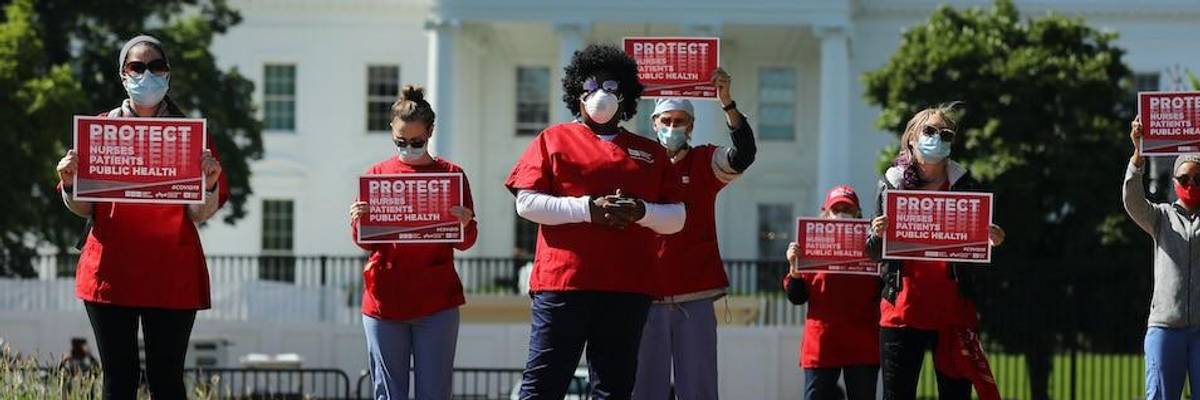
Members of National Nurses United stand in protest among empty shoes representing nurses who have died from Covid-19 in Lafayette Park across from the White House May 07, 2020. (Photo: Chip Somodevilla/Getty Images)
Let's Honor Fallen Workers on Memorial Day, Too
Covid-19 has shown us how many different kinds of workers are needed to keep us safe, housed, and fed. Many of them face danger every day, just as soldiers do.
Memorial Day, as many people know, began as a way to commemorate the 600-800,000 combatants who died fighting on both sides of the Civil War. The magnitude of that loss is hard to picture. As a percentage of the population, that's like losing 6.2 million to 8.3 million people in this country today.
Fewer people know that the event many historians consider the first Memorial Day celebration was held by freed slaves in Charleston, SC in 1865. According to contemporary accounts, the formerly enslaved men and women gathered to give a proper burial to Union soldiers who had died while imprisoned in an abandoned race track. The New York Tribune and The Charleston Courier reported that 10,000 people gathered for a memorial service, where African-American soldiers marched in formation and three thousand black schoolchildren carried flowers and sang "John Brown's Body."
"Death doesn't follow the iron laws of mathematics. For every family that has lost a loved one, the level of grief approaches infinity. That's why needless deaths are to be avoided at all costs." As with so many wars, the Civil War's losses were not shared equally among all economic classes. The Enrollment Act of 1863 established a draft for all men between the ages of 20 and 45. But it also allowed draftees to buy their way out of the war, either by paying $300 (roughly $6,100 today) or by hiring someone to join the Army in their place. Then, as now, class differences often became a matter of life and death. While not unknown, grieving families were less common in wealthier circles.
The First World War gave Americans more fallen soldiers to mourn, and turned a Civil War commemoration into a broader holiday. Sadly, there has been no shortage of wars since then. My family, like so many others, has been touched by this form of loss.
With any luck, our society will never again see the level of military death it experienced in the Civil War. Each military death is a tragedy. But then, so is every needless death. That's why it may be time to consider honoring another kind of sacrifice on this holiday, too: the workers who die each year on the job.
More than 5,000 workers (5,250) died on the job in 2018, according to US government data. That's more than 14 deaths every day, on average. These deaths are all too frequent in many lines of work, including many that have been classified as "essential" in the wake of the pandemic. The painting and construction trades are heavily represented among the deadliest jobs, as is logging (the deadliest civilian profession), fishing, air travel, refuse and sanitation, driving and other transportation work, farming and ranching, and power line maintenance.
Law enforcement officers are in the 16th-deadliest line of work. Other high-risk jobs include mining machine operators, emergency medical technicians, carpenters, and taxi drivers/chauffeurs. As with soldiers, these workers "enlist" for many reasons: to serve, to get an education, to provide for their families.
The people in these jobs show extraordinary courage every day that they show up for work. Each of them knows that this could be the day when their luck runs out. Death takes different forms for different jobs--taxi drivers are more likely to be murdered than any other worker, for example--but the courage it takes remains the same.
"It may be time to consider honoring another kind of sacrifice on this holiday, too: the workers who die each year on the job."
To be clear, military service during wartime remains deadlier than any civilian occupation. At the height of the Iraq and Afghanistan wars, the estimated annual rate for U.S. Army combat deaths was 78.8 per 100,000. Accidental deaths were also high, at 46 deaths per thousand, making the total risk greater than that of even the most high-risk civilian jobs of logging (97 deaths per 100,000) and fishing (77 deaths per 100,000).
In the end, however, death doesn't follow the iron laws of mathematics. For every family that has lost a loved one, the level of grief approaches infinity. That's why needless deaths are to be avoided at all costs. Nations should never go to war based on deception or stupidity. CEOs and their political servants should never knowingly endanger the lives of workers or others in the pursuit of profit at all costs. But, whatever the justification for the danger, those who face it bravely deserve to be recognized. Honoring one kind of sacrifice doesn't diminish the others.
Covid-19 has shown us how many different kinds of workers are needed to keep us safe, housed, and fed. Many of them face danger every day, just as soldiers do. There will be a time to discuss the rights they deserve and the political representation they have been denied. In the meantime, let's remember those among them who have died, as we remember those gave their lives in other ways.
Urgent. It's never been this bad.
Dear Common Dreams reader, It’s been nearly 30 years since I co-founded Common Dreams with my late wife, Lina Newhouser. We had the radical notion that journalism should serve the public good, not corporate profits. It was clear to us from the outset what it would take to build such a project. No paid advertisements. No corporate sponsors. No millionaire publisher telling us what to think or do. Many people said we wouldn't last a year, but we proved those doubters wrong. Together with a tremendous team of journalists and dedicated staff, we built an independent media outlet free from the constraints of profits and corporate control. Our mission from the outset was simple. To inform. To inspire. To ignite change for the common good. Building Common Dreams was not easy. Our survival was never guaranteed. When you take on the most powerful forces—Wall Street greed, fossil fuel industry destruction, Big Tech lobbyists, and uber-rich oligarchs who have spent billions upon billions rigging the economy and democracy in their favor—the only bulwark you have is supporters who believe in your work. But here’s the urgent message from me today. It’s never been this bad out there. And it’s never been this hard to keep us going. At the very moment Common Dreams is most needed and doing some of its best and most important work, the threats we face are intensifying. Right now, with just two days to go in our Spring Campaign, we're falling short of our make-or-break goal. When everyone does the little they can afford, we are strong. But if that support retreats or dries up, so do we. Can you make a gift right now to make sure Common Dreams not only survives but thrives? There is no backup plan or rainy day fund. There is only you. —Craig Brown, Co-founder |
Richard (RJ) Eskow is a journalist who has written for a number of major publications. His weekly program, The Zero Hour, can be found on cable television, radio, Spotify, and podcast media.
Memorial Day, as many people know, began as a way to commemorate the 600-800,000 combatants who died fighting on both sides of the Civil War. The magnitude of that loss is hard to picture. As a percentage of the population, that's like losing 6.2 million to 8.3 million people in this country today.
Fewer people know that the event many historians consider the first Memorial Day celebration was held by freed slaves in Charleston, SC in 1865. According to contemporary accounts, the formerly enslaved men and women gathered to give a proper burial to Union soldiers who had died while imprisoned in an abandoned race track. The New York Tribune and The Charleston Courier reported that 10,000 people gathered for a memorial service, where African-American soldiers marched in formation and three thousand black schoolchildren carried flowers and sang "John Brown's Body."
"Death doesn't follow the iron laws of mathematics. For every family that has lost a loved one, the level of grief approaches infinity. That's why needless deaths are to be avoided at all costs." As with so many wars, the Civil War's losses were not shared equally among all economic classes. The Enrollment Act of 1863 established a draft for all men between the ages of 20 and 45. But it also allowed draftees to buy their way out of the war, either by paying $300 (roughly $6,100 today) or by hiring someone to join the Army in their place. Then, as now, class differences often became a matter of life and death. While not unknown, grieving families were less common in wealthier circles.
The First World War gave Americans more fallen soldiers to mourn, and turned a Civil War commemoration into a broader holiday. Sadly, there has been no shortage of wars since then. My family, like so many others, has been touched by this form of loss.
With any luck, our society will never again see the level of military death it experienced in the Civil War. Each military death is a tragedy. But then, so is every needless death. That's why it may be time to consider honoring another kind of sacrifice on this holiday, too: the workers who die each year on the job.
More than 5,000 workers (5,250) died on the job in 2018, according to US government data. That's more than 14 deaths every day, on average. These deaths are all too frequent in many lines of work, including many that have been classified as "essential" in the wake of the pandemic. The painting and construction trades are heavily represented among the deadliest jobs, as is logging (the deadliest civilian profession), fishing, air travel, refuse and sanitation, driving and other transportation work, farming and ranching, and power line maintenance.
Law enforcement officers are in the 16th-deadliest line of work. Other high-risk jobs include mining machine operators, emergency medical technicians, carpenters, and taxi drivers/chauffeurs. As with soldiers, these workers "enlist" for many reasons: to serve, to get an education, to provide for their families.
The people in these jobs show extraordinary courage every day that they show up for work. Each of them knows that this could be the day when their luck runs out. Death takes different forms for different jobs--taxi drivers are more likely to be murdered than any other worker, for example--but the courage it takes remains the same.
"It may be time to consider honoring another kind of sacrifice on this holiday, too: the workers who die each year on the job."
To be clear, military service during wartime remains deadlier than any civilian occupation. At the height of the Iraq and Afghanistan wars, the estimated annual rate for U.S. Army combat deaths was 78.8 per 100,000. Accidental deaths were also high, at 46 deaths per thousand, making the total risk greater than that of even the most high-risk civilian jobs of logging (97 deaths per 100,000) and fishing (77 deaths per 100,000).
In the end, however, death doesn't follow the iron laws of mathematics. For every family that has lost a loved one, the level of grief approaches infinity. That's why needless deaths are to be avoided at all costs. Nations should never go to war based on deception or stupidity. CEOs and their political servants should never knowingly endanger the lives of workers or others in the pursuit of profit at all costs. But, whatever the justification for the danger, those who face it bravely deserve to be recognized. Honoring one kind of sacrifice doesn't diminish the others.
Covid-19 has shown us how many different kinds of workers are needed to keep us safe, housed, and fed. Many of them face danger every day, just as soldiers do. There will be a time to discuss the rights they deserve and the political representation they have been denied. In the meantime, let's remember those among them who have died, as we remember those gave their lives in other ways.
Richard (RJ) Eskow is a journalist who has written for a number of major publications. His weekly program, The Zero Hour, can be found on cable television, radio, Spotify, and podcast media.
Memorial Day, as many people know, began as a way to commemorate the 600-800,000 combatants who died fighting on both sides of the Civil War. The magnitude of that loss is hard to picture. As a percentage of the population, that's like losing 6.2 million to 8.3 million people in this country today.
Fewer people know that the event many historians consider the first Memorial Day celebration was held by freed slaves in Charleston, SC in 1865. According to contemporary accounts, the formerly enslaved men and women gathered to give a proper burial to Union soldiers who had died while imprisoned in an abandoned race track. The New York Tribune and The Charleston Courier reported that 10,000 people gathered for a memorial service, where African-American soldiers marched in formation and three thousand black schoolchildren carried flowers and sang "John Brown's Body."
"Death doesn't follow the iron laws of mathematics. For every family that has lost a loved one, the level of grief approaches infinity. That's why needless deaths are to be avoided at all costs." As with so many wars, the Civil War's losses were not shared equally among all economic classes. The Enrollment Act of 1863 established a draft for all men between the ages of 20 and 45. But it also allowed draftees to buy their way out of the war, either by paying $300 (roughly $6,100 today) or by hiring someone to join the Army in their place. Then, as now, class differences often became a matter of life and death. While not unknown, grieving families were less common in wealthier circles.
The First World War gave Americans more fallen soldiers to mourn, and turned a Civil War commemoration into a broader holiday. Sadly, there has been no shortage of wars since then. My family, like so many others, has been touched by this form of loss.
With any luck, our society will never again see the level of military death it experienced in the Civil War. Each military death is a tragedy. But then, so is every needless death. That's why it may be time to consider honoring another kind of sacrifice on this holiday, too: the workers who die each year on the job.
More than 5,000 workers (5,250) died on the job in 2018, according to US government data. That's more than 14 deaths every day, on average. These deaths are all too frequent in many lines of work, including many that have been classified as "essential" in the wake of the pandemic. The painting and construction trades are heavily represented among the deadliest jobs, as is logging (the deadliest civilian profession), fishing, air travel, refuse and sanitation, driving and other transportation work, farming and ranching, and power line maintenance.
Law enforcement officers are in the 16th-deadliest line of work. Other high-risk jobs include mining machine operators, emergency medical technicians, carpenters, and taxi drivers/chauffeurs. As with soldiers, these workers "enlist" for many reasons: to serve, to get an education, to provide for their families.
The people in these jobs show extraordinary courage every day that they show up for work. Each of them knows that this could be the day when their luck runs out. Death takes different forms for different jobs--taxi drivers are more likely to be murdered than any other worker, for example--but the courage it takes remains the same.
"It may be time to consider honoring another kind of sacrifice on this holiday, too: the workers who die each year on the job."
To be clear, military service during wartime remains deadlier than any civilian occupation. At the height of the Iraq and Afghanistan wars, the estimated annual rate for U.S. Army combat deaths was 78.8 per 100,000. Accidental deaths were also high, at 46 deaths per thousand, making the total risk greater than that of even the most high-risk civilian jobs of logging (97 deaths per 100,000) and fishing (77 deaths per 100,000).
In the end, however, death doesn't follow the iron laws of mathematics. For every family that has lost a loved one, the level of grief approaches infinity. That's why needless deaths are to be avoided at all costs. Nations should never go to war based on deception or stupidity. CEOs and their political servants should never knowingly endanger the lives of workers or others in the pursuit of profit at all costs. But, whatever the justification for the danger, those who face it bravely deserve to be recognized. Honoring one kind of sacrifice doesn't diminish the others.
Covid-19 has shown us how many different kinds of workers are needed to keep us safe, housed, and fed. Many of them face danger every day, just as soldiers do. There will be a time to discuss the rights they deserve and the political representation they have been denied. In the meantime, let's remember those among them who have died, as we remember those gave their lives in other ways.