SUBSCRIBE TO OUR FREE NEWSLETTER
Daily news & progressive opinion—funded by the people, not the corporations—delivered straight to your inbox.
5
#000000
#FFFFFF
To donate by check, phone, or other method, see our More Ways to Give page.
Daily news & progressive opinion—funded by the people, not the corporations—delivered straight to your inbox.
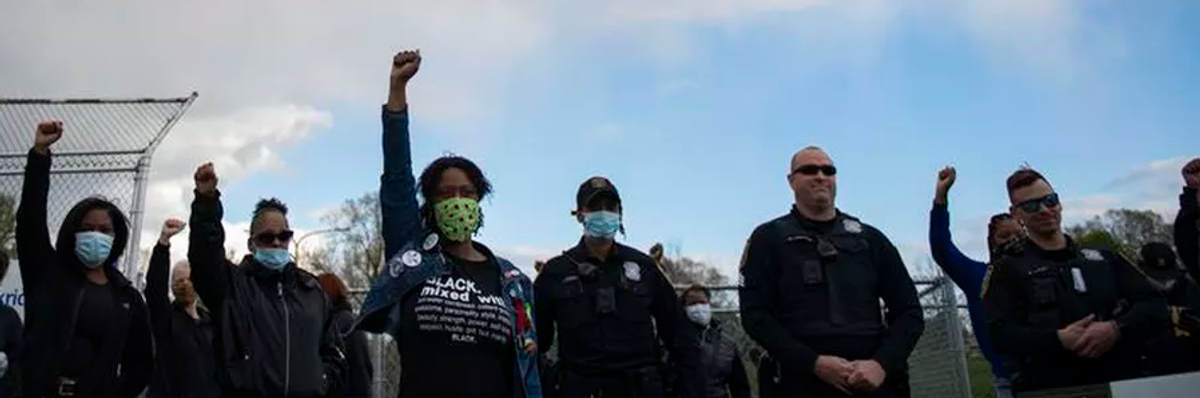
People stand six feet apart before participating in a 2.23 mile walk for Ahmaud Arbery on May 8. Arbery was shot and killed while running in Brunswick, Georgia on Feb. 23. (Photo: Nicole Hester/Mlive.com)
Today there is a national outcry about the murder of Ahmaud Arbery. The public condemnation has forced a belated response.
Those accused of his murder finally have been arrested. His murder has become a global embarrassment for whites.
For blacks, however, it is another humiliation, a continuing terror. It is the normal silence, however, that condemns thousands of African Americans to unjust deaths and millions to shattered lives. When the camera turns away, the savage injustice that embarrasses us becomes simply business as usual.
The horror of Ahmaud Arbery's murder is now well known. The 25-year-old black man went for a jog down the middle of the street in the middle of the day on Feb. 23. Two white men decided he was suspicious, hunted him down and shot him point blank in the middle of the street at 1 p.m.
Local law enforcement had video evidence of the crime. Yet no arrest was made until 74 days later, two months and two weeks after the murder. Local authorities chose not to act. Two U.S. senators said nothing. The white church--that had blessed slavery, segregation, apartheid in South Africa--was silent.
Why did the arrests finally take place? Because an intrepid reporter from the New York Times investigated the story and made it public; the murder video was leaked to the public on the 72nd day after Ahmaud's murder.
As the public outrage grew, the arrests were made. Never forget, as one commentator noted, they did not make the arrests because THEY saw the incriminating video. They made the arrests because WE saw the video. Embarrassed, faced with an aroused community and an international scandal, they finally acted.
So it goes. African Americans suffer in silence the savage injuries of institutionalized racism.
We live in northern ghettos--driven there in the early part of the last century by terrorism--most strikingly the Ku Klux Klan and their signature lynchings. The Equal Justice Initiative reports there were 4,084 lynchings of blacks in the South from 1877 to 1950. The Klan, embraced by and often made up of the white gentry of the South, often gathered at their churches to organize the public lynchings. They terrorized blacks to end the fusion multiracial coalitions that grew up in the Reconstruction, and to take back control of their states.
The lynchings and violence were greeted with silence, if not approval. White authorities, white churches, white society turned their heads, if they weren't applauding in approval.
Fleeing north, blacks were red lined into ghettos, with jobs hard to get, and discrimination closing doors. To this day, African Americans are last hired and first fired. We suffer the worst poverty, the highest unemployment, the highest childhood hunger and malnutrition, the most inadequate health care. This reality is sustained by the silence of white elites, the silence of the white church, the silence of the evangelicals, the silence of the best minded citizens.
Then, the virus hits, and its most lethal effect is on those who are vulnerable: the elderly, the sick, the hungry, those with asthma and obesity. It hits hardest among the suddenly proclaimed "essential workers" who do the work that previously was largely "invisible: the bus drivers, the grocery clerks, the nurses and medical aides. Not surprisingly, African Americans make up a disproportionate number of those killed or infected by the virus.
The racial disparities are so stark that they gain national and international attention. Pundits express shock and outrage at the reports, as if they were surprised by the results. Editorials demand reform. Politicians call for action. The informed public is embarrassed.
But little happens: the rescue packages passed by Congress send most of the money to the biggest companies and the most affluent investors. Banks are saved; the post office -- with a largely minority workforce -- is starved. Hunger spreads. Any expansion of food stamps is blocked.
Arrested for leading nonviolent protests against segregation, Dr. Martin Luther King penned his letter from the Birmingham jail expressing his grave disappointment with the "white moderate" and the "white church." He suggested that the "great stumbling block" for African Americans seeking their freedom is "not the White Citizen's Councilor or the Ku Klux Klanner, but the white moderate "who is more devoted to order than to justice." He decried a religious community "largely adjusted to the status quo, standing as a tail-light behind other community agencies rather than a headlight leading men to higher levels of justice."
The virus didn't discriminate. The society enforced the discrimination; the virus just preyed upon its victims. We have gone too long, struggled too hard to adjust to the reality that it is dangerous to be black while jogging or to be black in a pandemic.
It isn't enough to express dismay when the newspapers highlight the horrors. We need leaders and citizens of conscience who will act and not rest until justice is done.
Dear Common Dreams reader, It’s been nearly 30 years since I co-founded Common Dreams with my late wife, Lina Newhouser. We had the radical notion that journalism should serve the public good, not corporate profits. It was clear to us from the outset what it would take to build such a project. No paid advertisements. No corporate sponsors. No millionaire publisher telling us what to think or do. Many people said we wouldn't last a year, but we proved those doubters wrong. Together with a tremendous team of journalists and dedicated staff, we built an independent media outlet free from the constraints of profits and corporate control. Our mission has always been simple: To inform. To inspire. To ignite change for the common good. Building Common Dreams was not easy. Our survival was never guaranteed. When you take on the most powerful forces—Wall Street greed, fossil fuel industry destruction, Big Tech lobbyists, and uber-rich oligarchs who have spent billions upon billions rigging the economy and democracy in their favor—the only bulwark you have is supporters who believe in your work. But here’s the urgent message from me today. It's never been this bad out there. And it's never been this hard to keep us going. At the very moment Common Dreams is most needed, the threats we face are intensifying. We need your support now more than ever. We don't accept corporate advertising and never will. We don't have a paywall because we don't think people should be blocked from critical news based on their ability to pay. Everything we do is funded by the donations of readers like you. When everyone does the little they can afford, we are strong. But if that support retreats or dries up, so do we. Will you donate now to make sure Common Dreams not only survives but thrives? —Craig Brown, Co-founder |
Today there is a national outcry about the murder of Ahmaud Arbery. The public condemnation has forced a belated response.
Those accused of his murder finally have been arrested. His murder has become a global embarrassment for whites.
For blacks, however, it is another humiliation, a continuing terror. It is the normal silence, however, that condemns thousands of African Americans to unjust deaths and millions to shattered lives. When the camera turns away, the savage injustice that embarrasses us becomes simply business as usual.
The horror of Ahmaud Arbery's murder is now well known. The 25-year-old black man went for a jog down the middle of the street in the middle of the day on Feb. 23. Two white men decided he was suspicious, hunted him down and shot him point blank in the middle of the street at 1 p.m.
Local law enforcement had video evidence of the crime. Yet no arrest was made until 74 days later, two months and two weeks after the murder. Local authorities chose not to act. Two U.S. senators said nothing. The white church--that had blessed slavery, segregation, apartheid in South Africa--was silent.
Why did the arrests finally take place? Because an intrepid reporter from the New York Times investigated the story and made it public; the murder video was leaked to the public on the 72nd day after Ahmaud's murder.
As the public outrage grew, the arrests were made. Never forget, as one commentator noted, they did not make the arrests because THEY saw the incriminating video. They made the arrests because WE saw the video. Embarrassed, faced with an aroused community and an international scandal, they finally acted.
So it goes. African Americans suffer in silence the savage injuries of institutionalized racism.
We live in northern ghettos--driven there in the early part of the last century by terrorism--most strikingly the Ku Klux Klan and their signature lynchings. The Equal Justice Initiative reports there were 4,084 lynchings of blacks in the South from 1877 to 1950. The Klan, embraced by and often made up of the white gentry of the South, often gathered at their churches to organize the public lynchings. They terrorized blacks to end the fusion multiracial coalitions that grew up in the Reconstruction, and to take back control of their states.
The lynchings and violence were greeted with silence, if not approval. White authorities, white churches, white society turned their heads, if they weren't applauding in approval.
Fleeing north, blacks were red lined into ghettos, with jobs hard to get, and discrimination closing doors. To this day, African Americans are last hired and first fired. We suffer the worst poverty, the highest unemployment, the highest childhood hunger and malnutrition, the most inadequate health care. This reality is sustained by the silence of white elites, the silence of the white church, the silence of the evangelicals, the silence of the best minded citizens.
Then, the virus hits, and its most lethal effect is on those who are vulnerable: the elderly, the sick, the hungry, those with asthma and obesity. It hits hardest among the suddenly proclaimed "essential workers" who do the work that previously was largely "invisible: the bus drivers, the grocery clerks, the nurses and medical aides. Not surprisingly, African Americans make up a disproportionate number of those killed or infected by the virus.
The racial disparities are so stark that they gain national and international attention. Pundits express shock and outrage at the reports, as if they were surprised by the results. Editorials demand reform. Politicians call for action. The informed public is embarrassed.
But little happens: the rescue packages passed by Congress send most of the money to the biggest companies and the most affluent investors. Banks are saved; the post office -- with a largely minority workforce -- is starved. Hunger spreads. Any expansion of food stamps is blocked.
Arrested for leading nonviolent protests against segregation, Dr. Martin Luther King penned his letter from the Birmingham jail expressing his grave disappointment with the "white moderate" and the "white church." He suggested that the "great stumbling block" for African Americans seeking their freedom is "not the White Citizen's Councilor or the Ku Klux Klanner, but the white moderate "who is more devoted to order than to justice." He decried a religious community "largely adjusted to the status quo, standing as a tail-light behind other community agencies rather than a headlight leading men to higher levels of justice."
The virus didn't discriminate. The society enforced the discrimination; the virus just preyed upon its victims. We have gone too long, struggled too hard to adjust to the reality that it is dangerous to be black while jogging or to be black in a pandemic.
It isn't enough to express dismay when the newspapers highlight the horrors. We need leaders and citizens of conscience who will act and not rest until justice is done.
Today there is a national outcry about the murder of Ahmaud Arbery. The public condemnation has forced a belated response.
Those accused of his murder finally have been arrested. His murder has become a global embarrassment for whites.
For blacks, however, it is another humiliation, a continuing terror. It is the normal silence, however, that condemns thousands of African Americans to unjust deaths and millions to shattered lives. When the camera turns away, the savage injustice that embarrasses us becomes simply business as usual.
The horror of Ahmaud Arbery's murder is now well known. The 25-year-old black man went for a jog down the middle of the street in the middle of the day on Feb. 23. Two white men decided he was suspicious, hunted him down and shot him point blank in the middle of the street at 1 p.m.
Local law enforcement had video evidence of the crime. Yet no arrest was made until 74 days later, two months and two weeks after the murder. Local authorities chose not to act. Two U.S. senators said nothing. The white church--that had blessed slavery, segregation, apartheid in South Africa--was silent.
Why did the arrests finally take place? Because an intrepid reporter from the New York Times investigated the story and made it public; the murder video was leaked to the public on the 72nd day after Ahmaud's murder.
As the public outrage grew, the arrests were made. Never forget, as one commentator noted, they did not make the arrests because THEY saw the incriminating video. They made the arrests because WE saw the video. Embarrassed, faced with an aroused community and an international scandal, they finally acted.
So it goes. African Americans suffer in silence the savage injuries of institutionalized racism.
We live in northern ghettos--driven there in the early part of the last century by terrorism--most strikingly the Ku Klux Klan and their signature lynchings. The Equal Justice Initiative reports there were 4,084 lynchings of blacks in the South from 1877 to 1950. The Klan, embraced by and often made up of the white gentry of the South, often gathered at their churches to organize the public lynchings. They terrorized blacks to end the fusion multiracial coalitions that grew up in the Reconstruction, and to take back control of their states.
The lynchings and violence were greeted with silence, if not approval. White authorities, white churches, white society turned their heads, if they weren't applauding in approval.
Fleeing north, blacks were red lined into ghettos, with jobs hard to get, and discrimination closing doors. To this day, African Americans are last hired and first fired. We suffer the worst poverty, the highest unemployment, the highest childhood hunger and malnutrition, the most inadequate health care. This reality is sustained by the silence of white elites, the silence of the white church, the silence of the evangelicals, the silence of the best minded citizens.
Then, the virus hits, and its most lethal effect is on those who are vulnerable: the elderly, the sick, the hungry, those with asthma and obesity. It hits hardest among the suddenly proclaimed "essential workers" who do the work that previously was largely "invisible: the bus drivers, the grocery clerks, the nurses and medical aides. Not surprisingly, African Americans make up a disproportionate number of those killed or infected by the virus.
The racial disparities are so stark that they gain national and international attention. Pundits express shock and outrage at the reports, as if they were surprised by the results. Editorials demand reform. Politicians call for action. The informed public is embarrassed.
But little happens: the rescue packages passed by Congress send most of the money to the biggest companies and the most affluent investors. Banks are saved; the post office -- with a largely minority workforce -- is starved. Hunger spreads. Any expansion of food stamps is blocked.
Arrested for leading nonviolent protests against segregation, Dr. Martin Luther King penned his letter from the Birmingham jail expressing his grave disappointment with the "white moderate" and the "white church." He suggested that the "great stumbling block" for African Americans seeking their freedom is "not the White Citizen's Councilor or the Ku Klux Klanner, but the white moderate "who is more devoted to order than to justice." He decried a religious community "largely adjusted to the status quo, standing as a tail-light behind other community agencies rather than a headlight leading men to higher levels of justice."
The virus didn't discriminate. The society enforced the discrimination; the virus just preyed upon its victims. We have gone too long, struggled too hard to adjust to the reality that it is dangerous to be black while jogging or to be black in a pandemic.
It isn't enough to express dismay when the newspapers highlight the horrors. We need leaders and citizens of conscience who will act and not rest until justice is done.