SUBSCRIBE TO OUR FREE NEWSLETTER
Daily news & progressive opinion—funded by the people, not the corporations—delivered straight to your inbox.
5
#000000
#FFFFFF
To donate by check, phone, or other method, see our More Ways to Give page.
Daily news & progressive opinion—funded by the people, not the corporations—delivered straight to your inbox.
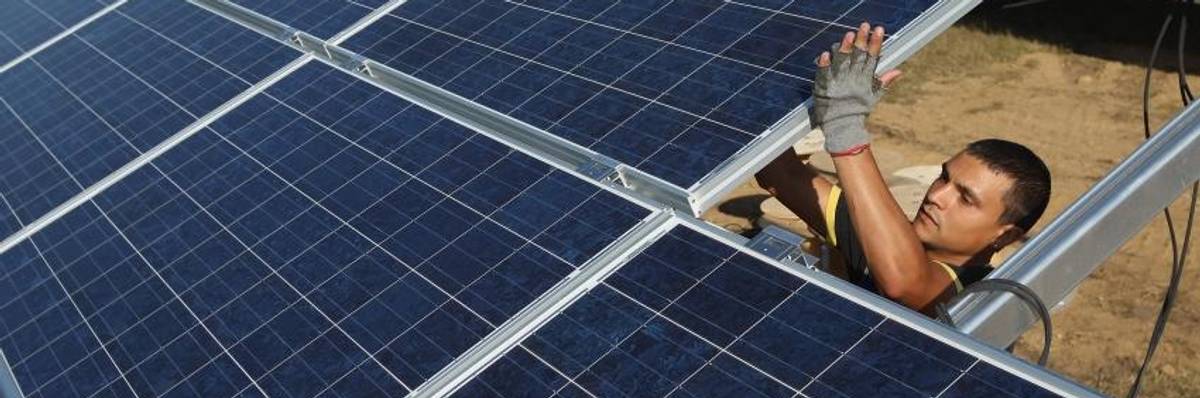
A worker installs solar panels at the Solarpark Eggersdorf solar park on September 4, 2012 near Muencheberg, Germany. (Photo by Sean Gallup/Getty Images)
Our political leaders, Republican and Democrat, are leaving tens of millions of people in free fall. Instead of a guaranteed income and universal, single-payer healthcare, we are offered paltry, one-time checks and unemployment payments (for those who qualify--and many don't, including all undocumented people). Epidemiologists tell us that people must stay home to curb the spread of the virus--yet, to do so, people need a consistent income, which most cannot achieve from home. We have been offered no road map for keeping bread lines--like the 10,000 families who showed up at a food bank in San Antonio--from growing ever longer.
To get to the other side of the Covid-19 crisis without leaving a single person behind, we need ambitious social programs like a universal income and a jobs guarantee.
Even as there are no jobs, work is piling up. For example, any plan to safely emerge from shutdown also requires contact tracing, which involves mass testing to find people who have been infected with the virus, then tracking down and monitoring anyone they have come in contact with. (Such an effort should remain firmly under the purview of public health, with checks to ensure the data is in no way subject to policing, government surveillance or private interests.) By some estimates, adequate contact tracing in the U.S. would require at least a hundred thousand tracers. As no healthcare expertise is required, it would be a perfect job for the presently unemployed.
Which is to say it has become abundantly clear that, to get to the other side of the Covid-19 crisis without leaving a single person behind, we need ambitious social programs like a universal income and a jobs guarantee. If these calls sound familiar, it might be because they are also vital to address a slower-burning but even more catastrophic emergency: climate change.
We are already experiencing some effects of climate change, but if the atmosphere warms beyond 1.5 degrees Celsius above pre-industrial levels, they will be more devastating. A universal jobs program would provide the labor for the urgent transition to renewable energy: cleaning up shuttered coal mines, building robust mass transit systems and energy-retrofitting homes. A guaranteed universal income would provide the means to survive droughts, floods and superstorms to the people most directly affected, in a country where 11.1% of people are food insecure and 40% can't afford a $400 emergency.
The Green New Deal that emerged from the longtime demands of labor and social movements, and was first championed in Congress by Rep. Alexandria Ocasio-Cortez (D-N.Y.), would create all of these programs and more.
So, why wait to start the Green New Deal? We can implement a universal basic income right now, during the pandemic, when it is desperately needed. A universal jobs program could put people to work testing, contact tracing and checking in on elders--and later be used to build the zero-carbon economy. As proponents of a "green stimulus" argue, even though social distancing creates a limit on physical labor, we can get millions of green jobs "shovel ready," and the systems in place now to save lives in the coming months and decades.
While wealth is buffering the rich from the effects of these catastrophes, the poor--disproportionately people of color--are bearing the brunt. To ensure the resilience of the working class and to remedy the long-running crisis of inequality, we need to redistribute wealth downward. Instead, thanks to the corporate bailouts in the CARES Act stimulus package, lawmakers have been orchestrating a tremendous redistribution of wealth from the poor to the rich. Republicans are the worse offenders, but Democrats deserve blame for their timidity and incrementalism.
As the circles of the vulnerable and dispossessed expand rapidly and dramatically--with 30 million more people unemployed in April than in March--we need a robust Green New Deal now to get through the current crisis, and mitigate the next one.
Dear Common Dreams reader, It’s been nearly 30 years since I co-founded Common Dreams with my late wife, Lina Newhouser. We had the radical notion that journalism should serve the public good, not corporate profits. It was clear to us from the outset what it would take to build such a project. No paid advertisements. No corporate sponsors. No millionaire publisher telling us what to think or do. Many people said we wouldn't last a year, but we proved those doubters wrong. Together with a tremendous team of journalists and dedicated staff, we built an independent media outlet free from the constraints of profits and corporate control. Our mission has always been simple: To inform. To inspire. To ignite change for the common good. Building Common Dreams was not easy. Our survival was never guaranteed. When you take on the most powerful forces—Wall Street greed, fossil fuel industry destruction, Big Tech lobbyists, and uber-rich oligarchs who have spent billions upon billions rigging the economy and democracy in their favor—the only bulwark you have is supporters who believe in your work. But here’s the urgent message from me today. It's never been this bad out there. And it's never been this hard to keep us going. At the very moment Common Dreams is most needed, the threats we face are intensifying. We need your support now more than ever. We don't accept corporate advertising and never will. We don't have a paywall because we don't think people should be blocked from critical news based on their ability to pay. Everything we do is funded by the donations of readers like you. When everyone does the little they can afford, we are strong. But if that support retreats or dries up, so do we. Will you donate now to make sure Common Dreams not only survives but thrives? —Craig Brown, Co-founder |
Our political leaders, Republican and Democrat, are leaving tens of millions of people in free fall. Instead of a guaranteed income and universal, single-payer healthcare, we are offered paltry, one-time checks and unemployment payments (for those who qualify--and many don't, including all undocumented people). Epidemiologists tell us that people must stay home to curb the spread of the virus--yet, to do so, people need a consistent income, which most cannot achieve from home. We have been offered no road map for keeping bread lines--like the 10,000 families who showed up at a food bank in San Antonio--from growing ever longer.
To get to the other side of the Covid-19 crisis without leaving a single person behind, we need ambitious social programs like a universal income and a jobs guarantee.
Even as there are no jobs, work is piling up. For example, any plan to safely emerge from shutdown also requires contact tracing, which involves mass testing to find people who have been infected with the virus, then tracking down and monitoring anyone they have come in contact with. (Such an effort should remain firmly under the purview of public health, with checks to ensure the data is in no way subject to policing, government surveillance or private interests.) By some estimates, adequate contact tracing in the U.S. would require at least a hundred thousand tracers. As no healthcare expertise is required, it would be a perfect job for the presently unemployed.
Which is to say it has become abundantly clear that, to get to the other side of the Covid-19 crisis without leaving a single person behind, we need ambitious social programs like a universal income and a jobs guarantee. If these calls sound familiar, it might be because they are also vital to address a slower-burning but even more catastrophic emergency: climate change.
We are already experiencing some effects of climate change, but if the atmosphere warms beyond 1.5 degrees Celsius above pre-industrial levels, they will be more devastating. A universal jobs program would provide the labor for the urgent transition to renewable energy: cleaning up shuttered coal mines, building robust mass transit systems and energy-retrofitting homes. A guaranteed universal income would provide the means to survive droughts, floods and superstorms to the people most directly affected, in a country where 11.1% of people are food insecure and 40% can't afford a $400 emergency.
The Green New Deal that emerged from the longtime demands of labor and social movements, and was first championed in Congress by Rep. Alexandria Ocasio-Cortez (D-N.Y.), would create all of these programs and more.
So, why wait to start the Green New Deal? We can implement a universal basic income right now, during the pandemic, when it is desperately needed. A universal jobs program could put people to work testing, contact tracing and checking in on elders--and later be used to build the zero-carbon economy. As proponents of a "green stimulus" argue, even though social distancing creates a limit on physical labor, we can get millions of green jobs "shovel ready," and the systems in place now to save lives in the coming months and decades.
While wealth is buffering the rich from the effects of these catastrophes, the poor--disproportionately people of color--are bearing the brunt. To ensure the resilience of the working class and to remedy the long-running crisis of inequality, we need to redistribute wealth downward. Instead, thanks to the corporate bailouts in the CARES Act stimulus package, lawmakers have been orchestrating a tremendous redistribution of wealth from the poor to the rich. Republicans are the worse offenders, but Democrats deserve blame for their timidity and incrementalism.
As the circles of the vulnerable and dispossessed expand rapidly and dramatically--with 30 million more people unemployed in April than in March--we need a robust Green New Deal now to get through the current crisis, and mitigate the next one.
Our political leaders, Republican and Democrat, are leaving tens of millions of people in free fall. Instead of a guaranteed income and universal, single-payer healthcare, we are offered paltry, one-time checks and unemployment payments (for those who qualify--and many don't, including all undocumented people). Epidemiologists tell us that people must stay home to curb the spread of the virus--yet, to do so, people need a consistent income, which most cannot achieve from home. We have been offered no road map for keeping bread lines--like the 10,000 families who showed up at a food bank in San Antonio--from growing ever longer.
To get to the other side of the Covid-19 crisis without leaving a single person behind, we need ambitious social programs like a universal income and a jobs guarantee.
Even as there are no jobs, work is piling up. For example, any plan to safely emerge from shutdown also requires contact tracing, which involves mass testing to find people who have been infected with the virus, then tracking down and monitoring anyone they have come in contact with. (Such an effort should remain firmly under the purview of public health, with checks to ensure the data is in no way subject to policing, government surveillance or private interests.) By some estimates, adequate contact tracing in the U.S. would require at least a hundred thousand tracers. As no healthcare expertise is required, it would be a perfect job for the presently unemployed.
Which is to say it has become abundantly clear that, to get to the other side of the Covid-19 crisis without leaving a single person behind, we need ambitious social programs like a universal income and a jobs guarantee. If these calls sound familiar, it might be because they are also vital to address a slower-burning but even more catastrophic emergency: climate change.
We are already experiencing some effects of climate change, but if the atmosphere warms beyond 1.5 degrees Celsius above pre-industrial levels, they will be more devastating. A universal jobs program would provide the labor for the urgent transition to renewable energy: cleaning up shuttered coal mines, building robust mass transit systems and energy-retrofitting homes. A guaranteed universal income would provide the means to survive droughts, floods and superstorms to the people most directly affected, in a country where 11.1% of people are food insecure and 40% can't afford a $400 emergency.
The Green New Deal that emerged from the longtime demands of labor and social movements, and was first championed in Congress by Rep. Alexandria Ocasio-Cortez (D-N.Y.), would create all of these programs and more.
So, why wait to start the Green New Deal? We can implement a universal basic income right now, during the pandemic, when it is desperately needed. A universal jobs program could put people to work testing, contact tracing and checking in on elders--and later be used to build the zero-carbon economy. As proponents of a "green stimulus" argue, even though social distancing creates a limit on physical labor, we can get millions of green jobs "shovel ready," and the systems in place now to save lives in the coming months and decades.
While wealth is buffering the rich from the effects of these catastrophes, the poor--disproportionately people of color--are bearing the brunt. To ensure the resilience of the working class and to remedy the long-running crisis of inequality, we need to redistribute wealth downward. Instead, thanks to the corporate bailouts in the CARES Act stimulus package, lawmakers have been orchestrating a tremendous redistribution of wealth from the poor to the rich. Republicans are the worse offenders, but Democrats deserve blame for their timidity and incrementalism.
As the circles of the vulnerable and dispossessed expand rapidly and dramatically--with 30 million more people unemployed in April than in March--we need a robust Green New Deal now to get through the current crisis, and mitigate the next one.