
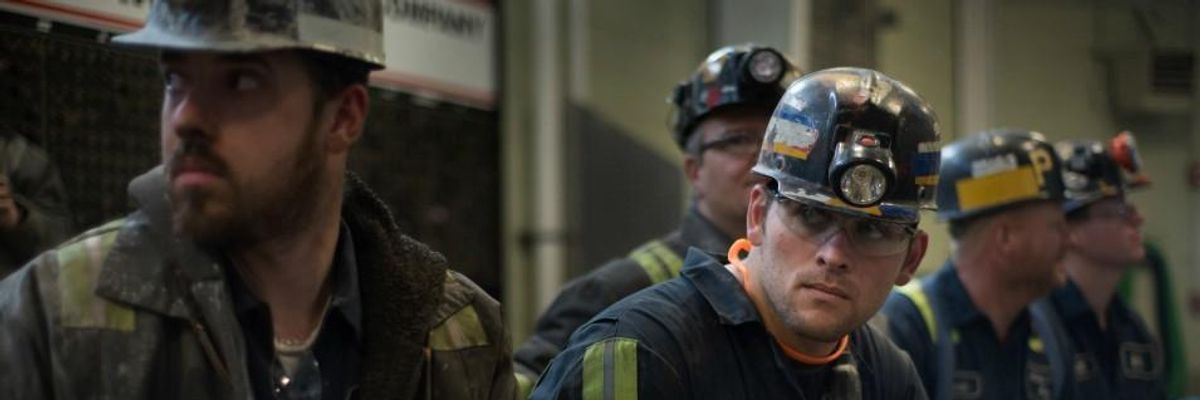
Coal miner Jaden Fredrickson of Cheat Lake, West Virginia at the Harvey Mine on April 13, 2017 in Sycamore, Pennsylvania. (Photo: Justin Merriman/Getty Images)
Reminder to Congress: The Coal Industry Trade Association Doesn't Give a Damn About Its Workers
Congress must ignore NMA's greedy request to be relieved of its collective responsibility to coal workers and the environment.
As most know by now, Congress passed the Coronavirus Aid, Relief, and Economic Security Act, or CARES Act (S.3548), delivering more than $2 trillion in aid in the wake of historic and rapidly climbing unemployment. This is the one that includes a one-time $1200 payment for some Americans and some extended unemployment benefits... as well as about $500 billion in corporate bailouts. One interesting footnote is that a request from the trade association representing the coal industry was left out of the deal.
National Mining Association shows its true colors
In the leadup to the passage of CARES, the National Mining Association (NMA) sent a letter to the president and leaders of Congress, asking for millions of dollars as part of the pandemic relief efforts. Stunningly, the NMA requested that Congress drop coal companies' legal obligation to pay per-ton taxes on coal production that support the Black Lung Disability Trust Fund (BLDTF) and the Abandoned Mine Lands fund. It's telling that the industry's trade association decided to raise concerns about its tax liability, rather than the health and safety of tens of thousands of coal miners that have been deemed essentialworkers in the current crisis. The Washington Post yesterday published a story on this topic quoting actual coal miners--read their stories.
And these two funds are critical for former workers and the environment. The BLDTF is the last option for many sick miners that worked for now-bankrupt companies. Coal companies and executives literally get rich off the blood and sweat of coal miners. Even before the recent frightening increase in black lung cases in miners, coal companies took (and still take) drastic steps to avoid paying for medical care for the workers who made them rich, often tying up cases in administrative courts for years or even decades. Sometimes the miner dies before receiving benefits owed to them.
The Black Lung Fund - which supports people who are absolutely more susceptible to COVID-19, by the way -- is on track to be over $15 billion in debt by 2050 thanks in large part to reduced industry tax rates on coal production. The AML fund supports cleanup activities on mines and still has over $10 billion in unfunded cleanup needs.
To be clear, NMA is expecting the taxpayer to pick up the tab, claiming these taxes are burdensome.
U.S. House Natural Resources Committee Chairman Raul Grijalva wrote a scathing letter in response to the coal mining industry's jaw dropping audacity, writing:
"The coal industry is taking advantage of the country's current circumstances to advocate for policies that are completely unrelated to the current crisis, policies that would in fact set back efforts to improve the health and lives of people across the country."
And no mention of workers
Meanwhile, our nation's coal miners have been deemed essential and continue to work but lack any federal protections to prevent them from contracting and spreading the virus. COVID-19 is far more dangerous than the common flu and must be taken seriously. It spreads through close contact with others, according to experts, and physical distancing combined with frequent hand washing is the primary tactic the CDC has recommended to limit the spread of the disease. But coal miners work in close quarters in tightly confined spaces while on the job (for example, crowding into elevators and coal cars that transport miners from the surface to the active mining areas), and hand washing is not exactly a priority when you're covered in coal dust. This reality led the United Mine Workers of America to demand an emergency standard from the Mine Safety and Health Administration (MSHA) for how to protect coal miners from the virus while on the job. To date, MSHA has only offered "best practices" that advise workers to remain six feet apart and use hand sanitizer frequently if soap and water are not available.
That would seem to be an anemic response that falls short of requiring employers to protect their employees. It is more than a hypothetical exercise: coal miners at a massive mine in Pennsylvania recently tested positive for the virus, leading its operator Consol to shut down the mine for two weeks, and Virginia's largest mine shut down to help avoid spreading the virus.
Congress must hold the line
You can bet that NMA will be making its case as Congress debates the details of the forthcoming economic recovery packages. Make no mistake--the trade association for the coal industry doesn't give a damn about its workers, only its profits. Congress must ignore NMA's greedy request to be relieved of its collective responsibility to coal workers and the environment.
What miners need - like all workers who must continue to work in service of society and humanity - are greater workplace protections against COVID-19.
An Urgent Message From Our Co-Founder
Dear Common Dreams reader, It’s been nearly 30 years since I co-founded Common Dreams with my late wife, Lina Newhouser. We had the radical notion that journalism should serve the public good, not corporate profits. It was clear to us from the outset what it would take to build such a project. No paid advertisements. No corporate sponsors. No millionaire publisher telling us what to think or do. Many people said we wouldn't last a year, but we proved those doubters wrong. Together with a tremendous team of journalists and dedicated staff, we built an independent media outlet free from the constraints of profits and corporate control. Our mission has always been simple: To inform. To inspire. To ignite change for the common good. Building Common Dreams was not easy. Our survival was never guaranteed. When you take on the most powerful forces—Wall Street greed, fossil fuel industry destruction, Big Tech lobbyists, and uber-rich oligarchs who have spent billions upon billions rigging the economy and democracy in their favor—the only bulwark you have is supporters who believe in your work. But here’s the urgent message from me today. It's never been this bad out there. And it's never been this hard to keep us going. At the very moment Common Dreams is most needed, the threats we face are intensifying. We need your support now more than ever. We don't accept corporate advertising and never will. We don't have a paywall because we don't think people should be blocked from critical news based on their ability to pay. Everything we do is funded by the donations of readers like you. When everyone does the little they can afford, we are strong. But if that support retreats or dries up, so do we. Will you donate now to make sure Common Dreams not only survives but thrives? —Craig Brown, Co-founder |
As most know by now, Congress passed the Coronavirus Aid, Relief, and Economic Security Act, or CARES Act (S.3548), delivering more than $2 trillion in aid in the wake of historic and rapidly climbing unemployment. This is the one that includes a one-time $1200 payment for some Americans and some extended unemployment benefits... as well as about $500 billion in corporate bailouts. One interesting footnote is that a request from the trade association representing the coal industry was left out of the deal.
National Mining Association shows its true colors
In the leadup to the passage of CARES, the National Mining Association (NMA) sent a letter to the president and leaders of Congress, asking for millions of dollars as part of the pandemic relief efforts. Stunningly, the NMA requested that Congress drop coal companies' legal obligation to pay per-ton taxes on coal production that support the Black Lung Disability Trust Fund (BLDTF) and the Abandoned Mine Lands fund. It's telling that the industry's trade association decided to raise concerns about its tax liability, rather than the health and safety of tens of thousands of coal miners that have been deemed essentialworkers in the current crisis. The Washington Post yesterday published a story on this topic quoting actual coal miners--read their stories.
And these two funds are critical for former workers and the environment. The BLDTF is the last option for many sick miners that worked for now-bankrupt companies. Coal companies and executives literally get rich off the blood and sweat of coal miners. Even before the recent frightening increase in black lung cases in miners, coal companies took (and still take) drastic steps to avoid paying for medical care for the workers who made them rich, often tying up cases in administrative courts for years or even decades. Sometimes the miner dies before receiving benefits owed to them.
The Black Lung Fund - which supports people who are absolutely more susceptible to COVID-19, by the way -- is on track to be over $15 billion in debt by 2050 thanks in large part to reduced industry tax rates on coal production. The AML fund supports cleanup activities on mines and still has over $10 billion in unfunded cleanup needs.
To be clear, NMA is expecting the taxpayer to pick up the tab, claiming these taxes are burdensome.
U.S. House Natural Resources Committee Chairman Raul Grijalva wrote a scathing letter in response to the coal mining industry's jaw dropping audacity, writing:
"The coal industry is taking advantage of the country's current circumstances to advocate for policies that are completely unrelated to the current crisis, policies that would in fact set back efforts to improve the health and lives of people across the country."
And no mention of workers
Meanwhile, our nation's coal miners have been deemed essential and continue to work but lack any federal protections to prevent them from contracting and spreading the virus. COVID-19 is far more dangerous than the common flu and must be taken seriously. It spreads through close contact with others, according to experts, and physical distancing combined with frequent hand washing is the primary tactic the CDC has recommended to limit the spread of the disease. But coal miners work in close quarters in tightly confined spaces while on the job (for example, crowding into elevators and coal cars that transport miners from the surface to the active mining areas), and hand washing is not exactly a priority when you're covered in coal dust. This reality led the United Mine Workers of America to demand an emergency standard from the Mine Safety and Health Administration (MSHA) for how to protect coal miners from the virus while on the job. To date, MSHA has only offered "best practices" that advise workers to remain six feet apart and use hand sanitizer frequently if soap and water are not available.
That would seem to be an anemic response that falls short of requiring employers to protect their employees. It is more than a hypothetical exercise: coal miners at a massive mine in Pennsylvania recently tested positive for the virus, leading its operator Consol to shut down the mine for two weeks, and Virginia's largest mine shut down to help avoid spreading the virus.
Congress must hold the line
You can bet that NMA will be making its case as Congress debates the details of the forthcoming economic recovery packages. Make no mistake--the trade association for the coal industry doesn't give a damn about its workers, only its profits. Congress must ignore NMA's greedy request to be relieved of its collective responsibility to coal workers and the environment.
What miners need - like all workers who must continue to work in service of society and humanity - are greater workplace protections against COVID-19.
As most know by now, Congress passed the Coronavirus Aid, Relief, and Economic Security Act, or CARES Act (S.3548), delivering more than $2 trillion in aid in the wake of historic and rapidly climbing unemployment. This is the one that includes a one-time $1200 payment for some Americans and some extended unemployment benefits... as well as about $500 billion in corporate bailouts. One interesting footnote is that a request from the trade association representing the coal industry was left out of the deal.
National Mining Association shows its true colors
In the leadup to the passage of CARES, the National Mining Association (NMA) sent a letter to the president and leaders of Congress, asking for millions of dollars as part of the pandemic relief efforts. Stunningly, the NMA requested that Congress drop coal companies' legal obligation to pay per-ton taxes on coal production that support the Black Lung Disability Trust Fund (BLDTF) and the Abandoned Mine Lands fund. It's telling that the industry's trade association decided to raise concerns about its tax liability, rather than the health and safety of tens of thousands of coal miners that have been deemed essentialworkers in the current crisis. The Washington Post yesterday published a story on this topic quoting actual coal miners--read their stories.
And these two funds are critical for former workers and the environment. The BLDTF is the last option for many sick miners that worked for now-bankrupt companies. Coal companies and executives literally get rich off the blood and sweat of coal miners. Even before the recent frightening increase in black lung cases in miners, coal companies took (and still take) drastic steps to avoid paying for medical care for the workers who made them rich, often tying up cases in administrative courts for years or even decades. Sometimes the miner dies before receiving benefits owed to them.
The Black Lung Fund - which supports people who are absolutely more susceptible to COVID-19, by the way -- is on track to be over $15 billion in debt by 2050 thanks in large part to reduced industry tax rates on coal production. The AML fund supports cleanup activities on mines and still has over $10 billion in unfunded cleanup needs.
To be clear, NMA is expecting the taxpayer to pick up the tab, claiming these taxes are burdensome.
U.S. House Natural Resources Committee Chairman Raul Grijalva wrote a scathing letter in response to the coal mining industry's jaw dropping audacity, writing:
"The coal industry is taking advantage of the country's current circumstances to advocate for policies that are completely unrelated to the current crisis, policies that would in fact set back efforts to improve the health and lives of people across the country."
And no mention of workers
Meanwhile, our nation's coal miners have been deemed essential and continue to work but lack any federal protections to prevent them from contracting and spreading the virus. COVID-19 is far more dangerous than the common flu and must be taken seriously. It spreads through close contact with others, according to experts, and physical distancing combined with frequent hand washing is the primary tactic the CDC has recommended to limit the spread of the disease. But coal miners work in close quarters in tightly confined spaces while on the job (for example, crowding into elevators and coal cars that transport miners from the surface to the active mining areas), and hand washing is not exactly a priority when you're covered in coal dust. This reality led the United Mine Workers of America to demand an emergency standard from the Mine Safety and Health Administration (MSHA) for how to protect coal miners from the virus while on the job. To date, MSHA has only offered "best practices" that advise workers to remain six feet apart and use hand sanitizer frequently if soap and water are not available.
That would seem to be an anemic response that falls short of requiring employers to protect their employees. It is more than a hypothetical exercise: coal miners at a massive mine in Pennsylvania recently tested positive for the virus, leading its operator Consol to shut down the mine for two weeks, and Virginia's largest mine shut down to help avoid spreading the virus.
Congress must hold the line
You can bet that NMA will be making its case as Congress debates the details of the forthcoming economic recovery packages. Make no mistake--the trade association for the coal industry doesn't give a damn about its workers, only its profits. Congress must ignore NMA's greedy request to be relieved of its collective responsibility to coal workers and the environment.
What miners need - like all workers who must continue to work in service of society and humanity - are greater workplace protections against COVID-19.