SUBSCRIBE TO OUR FREE NEWSLETTER
Daily news & progressive opinion—funded by the people, not the corporations—delivered straight to your inbox.
5
#000000
#FFFFFF
To donate by check, phone, or other method, see our More Ways to Give page.
Daily news & progressive opinion—funded by the people, not the corporations—delivered straight to your inbox.
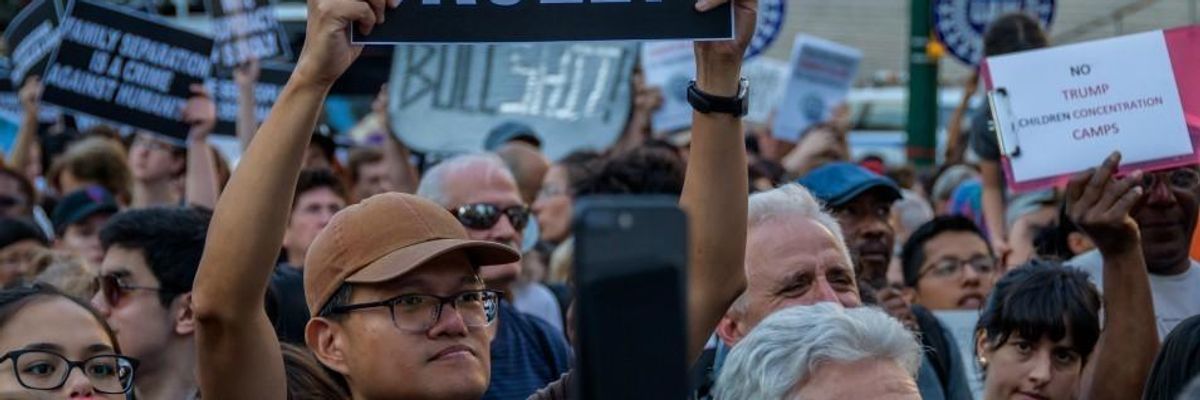
"As a trained healthcare worker, I could be helping with COVID-19 response efforts. Instead, I am fighting for my life." (Photo: Erik McGregor/Pacific Press/LightRocket via Getty Images)
I am the 40-year-old mother of a 7-year-old girl and a former nursing student. I am also trapped in immigration detention, severely immunocompromised, and terrified of dying from COVID-19, which is ravaging the state and will inevitably reach my detention facility. I suffer from Graves' disease, an autoimmune disorder in which a person's immune system attacks their thyroid, for which I have been hospitalized seven times. I have received radiation treatment and I take medication, both of which suppress my immune system, and my organs are shutting down. Endocrinologists have said my immune system readings are among the lowest they've seen in decades of practice; one was surprised I'm still alive--even without the risk of COVID-19. I also have severe asthma: I go through four inhalers a day. My health was bad before, but the lack of adequate medical care while I've been detained by ICE has caused it to further deteriorate.
"As coronavirus infections begin to ravage prisons nationwide, I fear it will turn my detention into a death sentence."
The crowded, unsanitary conditions at LaSalle ICE Processing Center in Jena, Louisiana, where I am detained, make an outbreak all but certain. In my unit, 80 women share three toilets, six showers, and eight telephones. We sleep in bunk beds just a few feet apart. There is no hand sanitizer, and the guards come in and out of the dorm without wearing masks or gloves. The dorm is at capacity, but ICE is still bringing new people in. Last week they brought in someone who was coughing.
I moved to the U.S. from Nigeria eight years ago. I've been here in ICE detention for two years because I pled to charges of conspiracy to commit fraud and mail fraud, not knowing what the immigration consequences would be to not fighting the charges. Now, as coronavirus infections begin to ravage prisons nationwide, I fear it will turn my detention into a death sentence. That's why I joined 16 others facing similar grave risks in the detention centers of Louisiana, Alabama, and Mississippi to file an emergency petition for release, brought by the Center for Constitutional Rights and the National Immigration Project of the National Lawyers Guild. A judge in New Orleans dismissed the petition last week on a jurisdictional technicality, and now we have to figure out our next steps as quickly as we can.
I feel helpless. I trained for years to be a nurse so I could be of service in times like these. Many medical workers on the front lines have underlying conditions like mine that put them at risk, but they are battling the pandemic to save others anyway. That kind of selflessness is what drew them to the profession in the first place.
I became passionate about nursing after the premature birth of my daughter. Michelle and I suffered serious complications from the birth and were hospitalized for many days. Every nurse treated me with compassion, respect, and an unwavering commitment to care. Their example inspired me to pursue a nursing degree at Gambling University.
In 2018, just two semesters shy of obtaining my nursing biology degree, I was arrested and detained in front of my daughter, who was then just five years old. She was graduating from preschool that day, and she begged the officers to let me go. Instead, they told her she would have to attend her graduation without me.
My elderly mother is now caring for Michelle, alone and overburdened by the separation. My daughter spends her school days terrified that her grandmother will also be taken away. Her ability to function, socialize, and develop relationships with her teachers and peers has been extremely difficult. Meanwhile, my time in detention has been a nightmare. Lawyers and prosecutors have threatened me with deportation and permanent separation from my daughter. In sharp contrast to the kindness and care I received when I gave birth, here in detention I have been taunted, demeaned, and physically abused by guards and medical staff.
As a trained healthcare worker, I could be helping with COVID-19 response efforts. Instead, I am fighting for my life.
No one deserves to die from COVID-19 because of government abuse and indifference. The government has a duty to adequately and humanely care for those it has taken and detained. During this pandemic, that means releasing me and others whose lives and health hang in the balance.
Dear Common Dreams reader, It’s been nearly 30 years since I co-founded Common Dreams with my late wife, Lina Newhouser. We had the radical notion that journalism should serve the public good, not corporate profits. It was clear to us from the outset what it would take to build such a project. No paid advertisements. No corporate sponsors. No millionaire publisher telling us what to think or do. Many people said we wouldn't last a year, but we proved those doubters wrong. Together with a tremendous team of journalists and dedicated staff, we built an independent media outlet free from the constraints of profits and corporate control. Our mission has always been simple: To inform. To inspire. To ignite change for the common good. Building Common Dreams was not easy. Our survival was never guaranteed. When you take on the most powerful forces—Wall Street greed, fossil fuel industry destruction, Big Tech lobbyists, and uber-rich oligarchs who have spent billions upon billions rigging the economy and democracy in their favor—the only bulwark you have is supporters who believe in your work. But here’s the urgent message from me today. It's never been this bad out there. And it's never been this hard to keep us going. At the very moment Common Dreams is most needed, the threats we face are intensifying. We need your support now more than ever. We don't accept corporate advertising and never will. We don't have a paywall because we don't think people should be blocked from critical news based on their ability to pay. Everything we do is funded by the donations of readers like you. When everyone does the little they can afford, we are strong. But if that support retreats or dries up, so do we. Will you donate now to make sure Common Dreams not only survives but thrives? —Craig Brown, Co-founder |
I am the 40-year-old mother of a 7-year-old girl and a former nursing student. I am also trapped in immigration detention, severely immunocompromised, and terrified of dying from COVID-19, which is ravaging the state and will inevitably reach my detention facility. I suffer from Graves' disease, an autoimmune disorder in which a person's immune system attacks their thyroid, for which I have been hospitalized seven times. I have received radiation treatment and I take medication, both of which suppress my immune system, and my organs are shutting down. Endocrinologists have said my immune system readings are among the lowest they've seen in decades of practice; one was surprised I'm still alive--even without the risk of COVID-19. I also have severe asthma: I go through four inhalers a day. My health was bad before, but the lack of adequate medical care while I've been detained by ICE has caused it to further deteriorate.
"As coronavirus infections begin to ravage prisons nationwide, I fear it will turn my detention into a death sentence."
The crowded, unsanitary conditions at LaSalle ICE Processing Center in Jena, Louisiana, where I am detained, make an outbreak all but certain. In my unit, 80 women share three toilets, six showers, and eight telephones. We sleep in bunk beds just a few feet apart. There is no hand sanitizer, and the guards come in and out of the dorm without wearing masks or gloves. The dorm is at capacity, but ICE is still bringing new people in. Last week they brought in someone who was coughing.
I moved to the U.S. from Nigeria eight years ago. I've been here in ICE detention for two years because I pled to charges of conspiracy to commit fraud and mail fraud, not knowing what the immigration consequences would be to not fighting the charges. Now, as coronavirus infections begin to ravage prisons nationwide, I fear it will turn my detention into a death sentence. That's why I joined 16 others facing similar grave risks in the detention centers of Louisiana, Alabama, and Mississippi to file an emergency petition for release, brought by the Center for Constitutional Rights and the National Immigration Project of the National Lawyers Guild. A judge in New Orleans dismissed the petition last week on a jurisdictional technicality, and now we have to figure out our next steps as quickly as we can.
I feel helpless. I trained for years to be a nurse so I could be of service in times like these. Many medical workers on the front lines have underlying conditions like mine that put them at risk, but they are battling the pandemic to save others anyway. That kind of selflessness is what drew them to the profession in the first place.
I became passionate about nursing after the premature birth of my daughter. Michelle and I suffered serious complications from the birth and were hospitalized for many days. Every nurse treated me with compassion, respect, and an unwavering commitment to care. Their example inspired me to pursue a nursing degree at Gambling University.
In 2018, just two semesters shy of obtaining my nursing biology degree, I was arrested and detained in front of my daughter, who was then just five years old. She was graduating from preschool that day, and she begged the officers to let me go. Instead, they told her she would have to attend her graduation without me.
My elderly mother is now caring for Michelle, alone and overburdened by the separation. My daughter spends her school days terrified that her grandmother will also be taken away. Her ability to function, socialize, and develop relationships with her teachers and peers has been extremely difficult. Meanwhile, my time in detention has been a nightmare. Lawyers and prosecutors have threatened me with deportation and permanent separation from my daughter. In sharp contrast to the kindness and care I received when I gave birth, here in detention I have been taunted, demeaned, and physically abused by guards and medical staff.
As a trained healthcare worker, I could be helping with COVID-19 response efforts. Instead, I am fighting for my life.
No one deserves to die from COVID-19 because of government abuse and indifference. The government has a duty to adequately and humanely care for those it has taken and detained. During this pandemic, that means releasing me and others whose lives and health hang in the balance.
I am the 40-year-old mother of a 7-year-old girl and a former nursing student. I am also trapped in immigration detention, severely immunocompromised, and terrified of dying from COVID-19, which is ravaging the state and will inevitably reach my detention facility. I suffer from Graves' disease, an autoimmune disorder in which a person's immune system attacks their thyroid, for which I have been hospitalized seven times. I have received radiation treatment and I take medication, both of which suppress my immune system, and my organs are shutting down. Endocrinologists have said my immune system readings are among the lowest they've seen in decades of practice; one was surprised I'm still alive--even without the risk of COVID-19. I also have severe asthma: I go through four inhalers a day. My health was bad before, but the lack of adequate medical care while I've been detained by ICE has caused it to further deteriorate.
"As coronavirus infections begin to ravage prisons nationwide, I fear it will turn my detention into a death sentence."
The crowded, unsanitary conditions at LaSalle ICE Processing Center in Jena, Louisiana, where I am detained, make an outbreak all but certain. In my unit, 80 women share three toilets, six showers, and eight telephones. We sleep in bunk beds just a few feet apart. There is no hand sanitizer, and the guards come in and out of the dorm without wearing masks or gloves. The dorm is at capacity, but ICE is still bringing new people in. Last week they brought in someone who was coughing.
I moved to the U.S. from Nigeria eight years ago. I've been here in ICE detention for two years because I pled to charges of conspiracy to commit fraud and mail fraud, not knowing what the immigration consequences would be to not fighting the charges. Now, as coronavirus infections begin to ravage prisons nationwide, I fear it will turn my detention into a death sentence. That's why I joined 16 others facing similar grave risks in the detention centers of Louisiana, Alabama, and Mississippi to file an emergency petition for release, brought by the Center for Constitutional Rights and the National Immigration Project of the National Lawyers Guild. A judge in New Orleans dismissed the petition last week on a jurisdictional technicality, and now we have to figure out our next steps as quickly as we can.
I feel helpless. I trained for years to be a nurse so I could be of service in times like these. Many medical workers on the front lines have underlying conditions like mine that put them at risk, but they are battling the pandemic to save others anyway. That kind of selflessness is what drew them to the profession in the first place.
I became passionate about nursing after the premature birth of my daughter. Michelle and I suffered serious complications from the birth and were hospitalized for many days. Every nurse treated me with compassion, respect, and an unwavering commitment to care. Their example inspired me to pursue a nursing degree at Gambling University.
In 2018, just two semesters shy of obtaining my nursing biology degree, I was arrested and detained in front of my daughter, who was then just five years old. She was graduating from preschool that day, and she begged the officers to let me go. Instead, they told her she would have to attend her graduation without me.
My elderly mother is now caring for Michelle, alone and overburdened by the separation. My daughter spends her school days terrified that her grandmother will also be taken away. Her ability to function, socialize, and develop relationships with her teachers and peers has been extremely difficult. Meanwhile, my time in detention has been a nightmare. Lawyers and prosecutors have threatened me with deportation and permanent separation from my daughter. In sharp contrast to the kindness and care I received when I gave birth, here in detention I have been taunted, demeaned, and physically abused by guards and medical staff.
As a trained healthcare worker, I could be helping with COVID-19 response efforts. Instead, I am fighting for my life.
No one deserves to die from COVID-19 because of government abuse and indifference. The government has a duty to adequately and humanely care for those it has taken and detained. During this pandemic, that means releasing me and others whose lives and health hang in the balance.