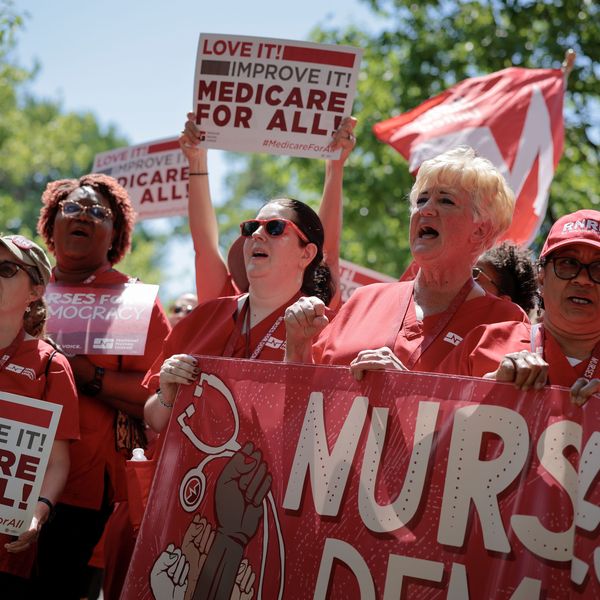


It has never been about whether the US could afford a progressive program; it has always been about whether the elite wanted to or were forced to fund it. It is an issue of political will, apparently, not economic means. (Photo: Alex Wong/Getty Images)
How Are We Going to Pay for It?
We will either have democratic socialism or we will continue to socialize suffering.
Whenever anyone proposes a policy that would benefit ordinary Americans, we are met with the repetitive chorus of "How are we going to pay for it?"
Medicare for All? Green New Deal? Universal housing? Universal childcare and preschool? Universal food? Tuition-free higher education? Student and medical debt cancellation? A jobs Guarantee? A living wage? Paid parental leave? Paid sick leave? Expanded Social Security? Universal Basic Income? High-speed rail? Free public transportation? National free wi-fi?
Socialism for the rich remains normalized, while socialism for the majority remains demonized.
"How are we going to pay for it?" It is often asserted more as an aggressive statement to shut down the idea, than as a genuine question seeking information, even though many of these policies have been enacted elsewhere. The question seems to be a fear-based, greed-based ideological hammer.
During the economic downturn and expected global recession coming with the COVID-19 pandemic, the US government and Federal Reserve Bank are considering, or already implementing: slashing interest rates; lower tax rates; tax deferrals; bank, airline, cruise, and other corporate bailouts; huge loans; equity stakes; dramatically increased financial liquidity; direct payments to Americans; forcing companies to produce certain items under the Defense Production Act; tapping the Strategic National Stockpile; activating the National Guard; a 60-day pause on foreclosures and evictions; prohibiting substantial price hikes; free testing for the coronavirus; and so on. Trillions of dollars will be spent. We also see federal, state, and local governments ordering the shutting down of travel, many businesses, schools, parks, and most other non-essential activities and events to slow the spread of COVID-19, while rolling back regulations on corporations.
Interestingly, no one is defending, let alone praising, the so-called free market, no one is championing libertarian laissez-faire ideas, no one is demanding small government, no one is attacking public health and social welfare programs, and, to be sure, no one is asking how we will pay for it. Instead, massive government involvement and intervention in the economy is steamrolling ahead at a remarkably quick pace and, seemingly, everyone wants a piece of the action.
American ideology regarding the free market, being self-made, self-reliance, self-sufficiency, and individualism has largely been mythology and hypocrisy. Crises tend to make that abundantly clear. And, for what it is worth, Horatio Alger, the original rags-to-riches success story, was fictional.
Even without a crisis, the question "How are we going to pay for it?" is typically unasked when it comes to the bloated military budget and the military-industrial complex, American imperialist wars, the drone program, the CIA, NSA, ICE, prisons and detention centers, both public and private, and other aspects of the coercive apparatus of the state. We also do not ask "How are we going to pay for it?" when it comes to the billions of corporate welfare dollars and other forms of "wealthfare" the US regularly doles out to the affluent. Likewise when the Republicans cut taxes on the wealthy, when Trump runs trillion dollar budget deficits, or when the Republicans balloon our national debt to over $23 trillion or about $70,000 in debt for each American.
It has never been about whether the US could afford a progressive program; it has always been about whether the elite wanted to or were forced to fund it. It is an issue of political will, apparently, not economic means.
And these are just the financial costs. How do we pay for what has been lost, what has been squandered, what has been ruined beyond repair, who and what has gone extinct that we will never recover? How do we pay for the unnecessary suffering, the shortened and lost lives, the productivity and creativity squandered, the shattered dreams, the tears shed? How do we pay for what could have been, but never was nor will be?
"If there is one thing history teaches us", Naomi Klein, author of The Shock Doctrine reminds us, "it's that moments of shock are profoundly volatile. We either lose a whole lot of ground, get fleeced by elites, and pay the price for decades, or we win progressive victories that seemed impossible just a few weeks earlier." Which path will we choose now?
In the meantime, socialism for the rich remains normalized, while socialism for the majority remains demonized. But here's the thing: we will either have democratic socialism or we will continue to socialize suffering. If we do not choose wisely, we will surely pay for it.
An Urgent Message From Our Co-Founder
Dear Common Dreams reader, It’s been nearly 30 years since I co-founded Common Dreams with my late wife, Lina Newhouser. We had the radical notion that journalism should serve the public good, not corporate profits. It was clear to us from the outset what it would take to build such a project. No paid advertisements. No corporate sponsors. No millionaire publisher telling us what to think or do. Many people said we wouldn't last a year, but we proved those doubters wrong. Together with a tremendous team of journalists and dedicated staff, we built an independent media outlet free from the constraints of profits and corporate control. Our mission has always been simple: To inform. To inspire. To ignite change for the common good. Building Common Dreams was not easy. Our survival was never guaranteed. When you take on the most powerful forces—Wall Street greed, fossil fuel industry destruction, Big Tech lobbyists, and uber-rich oligarchs who have spent billions upon billions rigging the economy and democracy in their favor—the only bulwark you have is supporters who believe in your work. But here’s the urgent message from me today. It's never been this bad out there. And it's never been this hard to keep us going. At the very moment Common Dreams is most needed, the threats we face are intensifying. We need your support now more than ever. We don't accept corporate advertising and never will. We don't have a paywall because we don't think people should be blocked from critical news based on their ability to pay. Everything we do is funded by the donations of readers like you. When everyone does the little they can afford, we are strong. But if that support retreats or dries up, so do we. Will you donate now to make sure Common Dreams not only survives but thrives? —Craig Brown, Co-founder |
Whenever anyone proposes a policy that would benefit ordinary Americans, we are met with the repetitive chorus of "How are we going to pay for it?"
Medicare for All? Green New Deal? Universal housing? Universal childcare and preschool? Universal food? Tuition-free higher education? Student and medical debt cancellation? A jobs Guarantee? A living wage? Paid parental leave? Paid sick leave? Expanded Social Security? Universal Basic Income? High-speed rail? Free public transportation? National free wi-fi?
Socialism for the rich remains normalized, while socialism for the majority remains demonized.
"How are we going to pay for it?" It is often asserted more as an aggressive statement to shut down the idea, than as a genuine question seeking information, even though many of these policies have been enacted elsewhere. The question seems to be a fear-based, greed-based ideological hammer.
During the economic downturn and expected global recession coming with the COVID-19 pandemic, the US government and Federal Reserve Bank are considering, or already implementing: slashing interest rates; lower tax rates; tax deferrals; bank, airline, cruise, and other corporate bailouts; huge loans; equity stakes; dramatically increased financial liquidity; direct payments to Americans; forcing companies to produce certain items under the Defense Production Act; tapping the Strategic National Stockpile; activating the National Guard; a 60-day pause on foreclosures and evictions; prohibiting substantial price hikes; free testing for the coronavirus; and so on. Trillions of dollars will be spent. We also see federal, state, and local governments ordering the shutting down of travel, many businesses, schools, parks, and most other non-essential activities and events to slow the spread of COVID-19, while rolling back regulations on corporations.
Interestingly, no one is defending, let alone praising, the so-called free market, no one is championing libertarian laissez-faire ideas, no one is demanding small government, no one is attacking public health and social welfare programs, and, to be sure, no one is asking how we will pay for it. Instead, massive government involvement and intervention in the economy is steamrolling ahead at a remarkably quick pace and, seemingly, everyone wants a piece of the action.
American ideology regarding the free market, being self-made, self-reliance, self-sufficiency, and individualism has largely been mythology and hypocrisy. Crises tend to make that abundantly clear. And, for what it is worth, Horatio Alger, the original rags-to-riches success story, was fictional.
Even without a crisis, the question "How are we going to pay for it?" is typically unasked when it comes to the bloated military budget and the military-industrial complex, American imperialist wars, the drone program, the CIA, NSA, ICE, prisons and detention centers, both public and private, and other aspects of the coercive apparatus of the state. We also do not ask "How are we going to pay for it?" when it comes to the billions of corporate welfare dollars and other forms of "wealthfare" the US regularly doles out to the affluent. Likewise when the Republicans cut taxes on the wealthy, when Trump runs trillion dollar budget deficits, or when the Republicans balloon our national debt to over $23 trillion or about $70,000 in debt for each American.
It has never been about whether the US could afford a progressive program; it has always been about whether the elite wanted to or were forced to fund it. It is an issue of political will, apparently, not economic means.
And these are just the financial costs. How do we pay for what has been lost, what has been squandered, what has been ruined beyond repair, who and what has gone extinct that we will never recover? How do we pay for the unnecessary suffering, the shortened and lost lives, the productivity and creativity squandered, the shattered dreams, the tears shed? How do we pay for what could have been, but never was nor will be?
"If there is one thing history teaches us", Naomi Klein, author of The Shock Doctrine reminds us, "it's that moments of shock are profoundly volatile. We either lose a whole lot of ground, get fleeced by elites, and pay the price for decades, or we win progressive victories that seemed impossible just a few weeks earlier." Which path will we choose now?
In the meantime, socialism for the rich remains normalized, while socialism for the majority remains demonized. But here's the thing: we will either have democratic socialism or we will continue to socialize suffering. If we do not choose wisely, we will surely pay for it.
Whenever anyone proposes a policy that would benefit ordinary Americans, we are met with the repetitive chorus of "How are we going to pay for it?"
Medicare for All? Green New Deal? Universal housing? Universal childcare and preschool? Universal food? Tuition-free higher education? Student and medical debt cancellation? A jobs Guarantee? A living wage? Paid parental leave? Paid sick leave? Expanded Social Security? Universal Basic Income? High-speed rail? Free public transportation? National free wi-fi?
Socialism for the rich remains normalized, while socialism for the majority remains demonized.
"How are we going to pay for it?" It is often asserted more as an aggressive statement to shut down the idea, than as a genuine question seeking information, even though many of these policies have been enacted elsewhere. The question seems to be a fear-based, greed-based ideological hammer.
During the economic downturn and expected global recession coming with the COVID-19 pandemic, the US government and Federal Reserve Bank are considering, or already implementing: slashing interest rates; lower tax rates; tax deferrals; bank, airline, cruise, and other corporate bailouts; huge loans; equity stakes; dramatically increased financial liquidity; direct payments to Americans; forcing companies to produce certain items under the Defense Production Act; tapping the Strategic National Stockpile; activating the National Guard; a 60-day pause on foreclosures and evictions; prohibiting substantial price hikes; free testing for the coronavirus; and so on. Trillions of dollars will be spent. We also see federal, state, and local governments ordering the shutting down of travel, many businesses, schools, parks, and most other non-essential activities and events to slow the spread of COVID-19, while rolling back regulations on corporations.
Interestingly, no one is defending, let alone praising, the so-called free market, no one is championing libertarian laissez-faire ideas, no one is demanding small government, no one is attacking public health and social welfare programs, and, to be sure, no one is asking how we will pay for it. Instead, massive government involvement and intervention in the economy is steamrolling ahead at a remarkably quick pace and, seemingly, everyone wants a piece of the action.
American ideology regarding the free market, being self-made, self-reliance, self-sufficiency, and individualism has largely been mythology and hypocrisy. Crises tend to make that abundantly clear. And, for what it is worth, Horatio Alger, the original rags-to-riches success story, was fictional.
Even without a crisis, the question "How are we going to pay for it?" is typically unasked when it comes to the bloated military budget and the military-industrial complex, American imperialist wars, the drone program, the CIA, NSA, ICE, prisons and detention centers, both public and private, and other aspects of the coercive apparatus of the state. We also do not ask "How are we going to pay for it?" when it comes to the billions of corporate welfare dollars and other forms of "wealthfare" the US regularly doles out to the affluent. Likewise when the Republicans cut taxes on the wealthy, when Trump runs trillion dollar budget deficits, or when the Republicans balloon our national debt to over $23 trillion or about $70,000 in debt for each American.
It has never been about whether the US could afford a progressive program; it has always been about whether the elite wanted to or were forced to fund it. It is an issue of political will, apparently, not economic means.
And these are just the financial costs. How do we pay for what has been lost, what has been squandered, what has been ruined beyond repair, who and what has gone extinct that we will never recover? How do we pay for the unnecessary suffering, the shortened and lost lives, the productivity and creativity squandered, the shattered dreams, the tears shed? How do we pay for what could have been, but never was nor will be?
"If there is one thing history teaches us", Naomi Klein, author of The Shock Doctrine reminds us, "it's that moments of shock are profoundly volatile. We either lose a whole lot of ground, get fleeced by elites, and pay the price for decades, or we win progressive victories that seemed impossible just a few weeks earlier." Which path will we choose now?
In the meantime, socialism for the rich remains normalized, while socialism for the majority remains demonized. But here's the thing: we will either have democratic socialism or we will continue to socialize suffering. If we do not choose wisely, we will surely pay for it.