SUBSCRIBE TO OUR FREE NEWSLETTER
Daily news & progressive opinion—funded by the people, not the corporations—delivered straight to your inbox.
5
#000000
#FFFFFF
To donate by check, phone, or other method, see our More Ways to Give page.
Daily news & progressive opinion—funded by the people, not the corporations—delivered straight to your inbox.
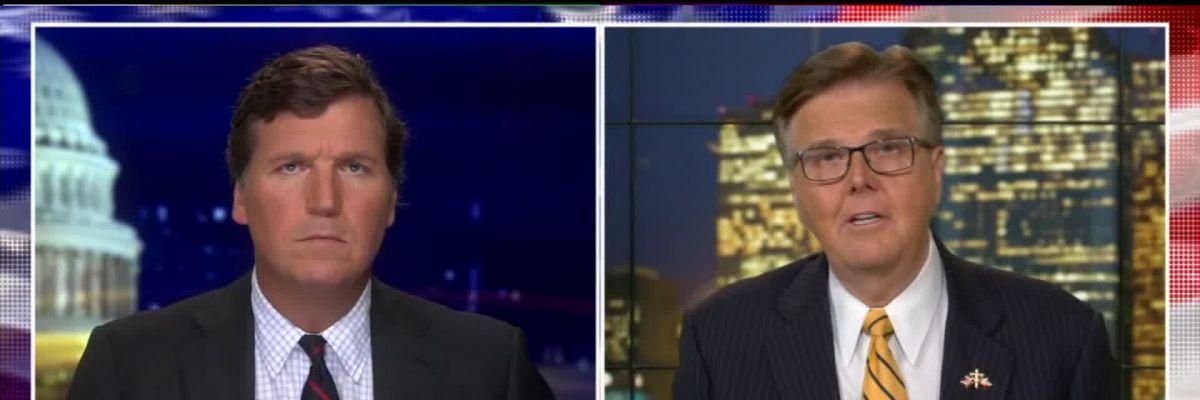
Patrick said he turns 70 next week, that he's a "small businessman," and that pandemic precautions are causing an "economic collapse." Photo: Screenshot)
Texas Lt. Governor Dan Patrick received a lot of attention Monday night when, according to many progressives, he seemed to tell Tucker Carlson that he was willing to die in order to preserve the American economy.
But this economy is damned. Merriam-Webster defines "damned" as "to bring ruin on," or "to condemn to a punishment or fate."
"I will give up a ventilator for a younger person, more than willingly, if it comes to that. But if it does come to that--if I'm forced to die for this economy--I'll curse the people who made it happen with my dying breath."
This damned economy. And we, the damned who live within it.
Here's what Patrick said:
" ... (No) one reached out to me and said, "As a senior citizen, are you willing to take a chance on your survival in exchange for keeping the America that all America loves for your children and grandchildren?"
He went on:
" .. And if that's the exchange, I'm all in. And that doesn't make me noble or brave or anything like that. I just think there are lots of grandparents out there in this country like me, I have six grandchildren, that what we all care about and what we love more than anything are those children. And I want to live smart and see through this, but I don't want the whole country to be sacrificed. And that's what I see."
Patrick said he turns 70 next week, that he's a "small businessman," and that pandemic precautions are causing an "economic collapse."
I'm a few years younger than Patrick, but I'm also likely to be at much higher risk because I have a chronic lung condition. I spoke to a pulmonologist this weekend, and when I said, "Needless to say, if I catch this thing ..."
He said, "Don't finish that sentence."
Was Patrick really saying that seniors should willingly die to preserve this economy? It looks like it, but there's some ambiguity in his wording. The truth seems to be that Patrick shares the longstanding American belief that commerce and freedom are inseparable. But, in the modern economy, commerce is dominated by corporate monopolies, which even traditional conservatism would not consider "free." That nuance gets lost, often deliberately, in today's corporate-funded politics.
Patrick went on to say:
"... my heart is lifted tonight by what I heard the president say, because we can do more than one thing at a time. We can do two things. So my message is that let's get back to work. Let's get back to living. Let's be smart about it. And those of us who are 70 plus, we'll take care of ourselves, but don't sacrifice the country. Don't do that. Don't ruin this great America."
The president's plan is considered reckless by health professionals. So, yes, at least in one sense, Patrick is saying that seniors and other vulnerable people should risk death in order to get the economy back on its feet. But whose economy? Are we being asked to sacrifice our lives for our families, our communities, and the future? Or are we being put at risk for the sake of corporations who might, just might, hire a few workers back?
Give working people money. And workplace democracy.
If I do die, it's likely to happen because we didn't plan for the longstanding possibility of a pandemic like this one. Why not? Because in this economy, the one that now asks the ultimate sacrifice of us, human life was less important than quarterly profits. That sounds like hollow rhetoric, but it is also objective reality.
Not only will I not die to save this economy, I will live to change it. At least, that's the plan.
I will give up a ventilator for a younger person, more than willingly, if it comes to that. But if it does come to that--if I'm forced to die for this economy--I'll curse the people who made it happen with my dying breath.
Carlson answers Patrick: "You're basically saying that this disease could take your life, but that's not the scariest thing to you? There's something that would be worse than dying?" And Patrick says, "Yeah."
Here's something worse than dying: knowing you've lived a life without purpose. I think most people want that. In his own way, maybe Dan Patrick wants it, too. But I'm not willing to lay down my life for the S&P500.
Changing this economy--this damned economy--now, that's what I call a purpose.
This article is part of a series called, Covid Days, a journal of the plague months from the perspective of a high-risk individual. If you have a story, please let me know. Stay safe, well, and connected.
Dear Common Dreams reader, It’s been nearly 30 years since I co-founded Common Dreams with my late wife, Lina Newhouser. We had the radical notion that journalism should serve the public good, not corporate profits. It was clear to us from the outset what it would take to build such a project. No paid advertisements. No corporate sponsors. No millionaire publisher telling us what to think or do. Many people said we wouldn't last a year, but we proved those doubters wrong. Together with a tremendous team of journalists and dedicated staff, we built an independent media outlet free from the constraints of profits and corporate control. Our mission has always been simple: To inform. To inspire. To ignite change for the common good. Building Common Dreams was not easy. Our survival was never guaranteed. When you take on the most powerful forces—Wall Street greed, fossil fuel industry destruction, Big Tech lobbyists, and uber-rich oligarchs who have spent billions upon billions rigging the economy and democracy in their favor—the only bulwark you have is supporters who believe in your work. But here’s the urgent message from me today. It's never been this bad out there. And it's never been this hard to keep us going. At the very moment Common Dreams is most needed, the threats we face are intensifying. We need your support now more than ever. We don't accept corporate advertising and never will. We don't have a paywall because we don't think people should be blocked from critical news based on their ability to pay. Everything we do is funded by the donations of readers like you. When everyone does the little they can afford, we are strong. But if that support retreats or dries up, so do we. Will you donate now to make sure Common Dreams not only survives but thrives? —Craig Brown, Co-founder |
Richard (RJ) Eskow is a journalist who has written for a number of major publications. His weekly program, The Zero Hour, can be found on cable television, radio, Spotify, and podcast media.
Texas Lt. Governor Dan Patrick received a lot of attention Monday night when, according to many progressives, he seemed to tell Tucker Carlson that he was willing to die in order to preserve the American economy.
But this economy is damned. Merriam-Webster defines "damned" as "to bring ruin on," or "to condemn to a punishment or fate."
"I will give up a ventilator for a younger person, more than willingly, if it comes to that. But if it does come to that--if I'm forced to die for this economy--I'll curse the people who made it happen with my dying breath."
This damned economy. And we, the damned who live within it.
Here's what Patrick said:
" ... (No) one reached out to me and said, "As a senior citizen, are you willing to take a chance on your survival in exchange for keeping the America that all America loves for your children and grandchildren?"
He went on:
" .. And if that's the exchange, I'm all in. And that doesn't make me noble or brave or anything like that. I just think there are lots of grandparents out there in this country like me, I have six grandchildren, that what we all care about and what we love more than anything are those children. And I want to live smart and see through this, but I don't want the whole country to be sacrificed. And that's what I see."
Patrick said he turns 70 next week, that he's a "small businessman," and that pandemic precautions are causing an "economic collapse."
I'm a few years younger than Patrick, but I'm also likely to be at much higher risk because I have a chronic lung condition. I spoke to a pulmonologist this weekend, and when I said, "Needless to say, if I catch this thing ..."
He said, "Don't finish that sentence."
Was Patrick really saying that seniors should willingly die to preserve this economy? It looks like it, but there's some ambiguity in his wording. The truth seems to be that Patrick shares the longstanding American belief that commerce and freedom are inseparable. But, in the modern economy, commerce is dominated by corporate monopolies, which even traditional conservatism would not consider "free." That nuance gets lost, often deliberately, in today's corporate-funded politics.
Patrick went on to say:
"... my heart is lifted tonight by what I heard the president say, because we can do more than one thing at a time. We can do two things. So my message is that let's get back to work. Let's get back to living. Let's be smart about it. And those of us who are 70 plus, we'll take care of ourselves, but don't sacrifice the country. Don't do that. Don't ruin this great America."
The president's plan is considered reckless by health professionals. So, yes, at least in one sense, Patrick is saying that seniors and other vulnerable people should risk death in order to get the economy back on its feet. But whose economy? Are we being asked to sacrifice our lives for our families, our communities, and the future? Or are we being put at risk for the sake of corporations who might, just might, hire a few workers back?
Give working people money. And workplace democracy.
If I do die, it's likely to happen because we didn't plan for the longstanding possibility of a pandemic like this one. Why not? Because in this economy, the one that now asks the ultimate sacrifice of us, human life was less important than quarterly profits. That sounds like hollow rhetoric, but it is also objective reality.
Not only will I not die to save this economy, I will live to change it. At least, that's the plan.
I will give up a ventilator for a younger person, more than willingly, if it comes to that. But if it does come to that--if I'm forced to die for this economy--I'll curse the people who made it happen with my dying breath.
Carlson answers Patrick: "You're basically saying that this disease could take your life, but that's not the scariest thing to you? There's something that would be worse than dying?" And Patrick says, "Yeah."
Here's something worse than dying: knowing you've lived a life without purpose. I think most people want that. In his own way, maybe Dan Patrick wants it, too. But I'm not willing to lay down my life for the S&P500.
Changing this economy--this damned economy--now, that's what I call a purpose.
This article is part of a series called, Covid Days, a journal of the plague months from the perspective of a high-risk individual. If you have a story, please let me know. Stay safe, well, and connected.
Richard (RJ) Eskow is a journalist who has written for a number of major publications. His weekly program, The Zero Hour, can be found on cable television, radio, Spotify, and podcast media.
Texas Lt. Governor Dan Patrick received a lot of attention Monday night when, according to many progressives, he seemed to tell Tucker Carlson that he was willing to die in order to preserve the American economy.
But this economy is damned. Merriam-Webster defines "damned" as "to bring ruin on," or "to condemn to a punishment or fate."
"I will give up a ventilator for a younger person, more than willingly, if it comes to that. But if it does come to that--if I'm forced to die for this economy--I'll curse the people who made it happen with my dying breath."
This damned economy. And we, the damned who live within it.
Here's what Patrick said:
" ... (No) one reached out to me and said, "As a senior citizen, are you willing to take a chance on your survival in exchange for keeping the America that all America loves for your children and grandchildren?"
He went on:
" .. And if that's the exchange, I'm all in. And that doesn't make me noble or brave or anything like that. I just think there are lots of grandparents out there in this country like me, I have six grandchildren, that what we all care about and what we love more than anything are those children. And I want to live smart and see through this, but I don't want the whole country to be sacrificed. And that's what I see."
Patrick said he turns 70 next week, that he's a "small businessman," and that pandemic precautions are causing an "economic collapse."
I'm a few years younger than Patrick, but I'm also likely to be at much higher risk because I have a chronic lung condition. I spoke to a pulmonologist this weekend, and when I said, "Needless to say, if I catch this thing ..."
He said, "Don't finish that sentence."
Was Patrick really saying that seniors should willingly die to preserve this economy? It looks like it, but there's some ambiguity in his wording. The truth seems to be that Patrick shares the longstanding American belief that commerce and freedom are inseparable. But, in the modern economy, commerce is dominated by corporate monopolies, which even traditional conservatism would not consider "free." That nuance gets lost, often deliberately, in today's corporate-funded politics.
Patrick went on to say:
"... my heart is lifted tonight by what I heard the president say, because we can do more than one thing at a time. We can do two things. So my message is that let's get back to work. Let's get back to living. Let's be smart about it. And those of us who are 70 plus, we'll take care of ourselves, but don't sacrifice the country. Don't do that. Don't ruin this great America."
The president's plan is considered reckless by health professionals. So, yes, at least in one sense, Patrick is saying that seniors and other vulnerable people should risk death in order to get the economy back on its feet. But whose economy? Are we being asked to sacrifice our lives for our families, our communities, and the future? Or are we being put at risk for the sake of corporations who might, just might, hire a few workers back?
Give working people money. And workplace democracy.
If I do die, it's likely to happen because we didn't plan for the longstanding possibility of a pandemic like this one. Why not? Because in this economy, the one that now asks the ultimate sacrifice of us, human life was less important than quarterly profits. That sounds like hollow rhetoric, but it is also objective reality.
Not only will I not die to save this economy, I will live to change it. At least, that's the plan.
I will give up a ventilator for a younger person, more than willingly, if it comes to that. But if it does come to that--if I'm forced to die for this economy--I'll curse the people who made it happen with my dying breath.
Carlson answers Patrick: "You're basically saying that this disease could take your life, but that's not the scariest thing to you? There's something that would be worse than dying?" And Patrick says, "Yeah."
Here's something worse than dying: knowing you've lived a life without purpose. I think most people want that. In his own way, maybe Dan Patrick wants it, too. But I'm not willing to lay down my life for the S&P500.
Changing this economy--this damned economy--now, that's what I call a purpose.
This article is part of a series called, Covid Days, a journal of the plague months from the perspective of a high-risk individual. If you have a story, please let me know. Stay safe, well, and connected.