SUBSCRIBE TO OUR FREE NEWSLETTER
Daily news & progressive opinion—funded by the people, not the corporations—delivered straight to your inbox.
5
#000000
#FFFFFF
To donate by check, phone, or other method, see our More Ways to Give page.
Daily news & progressive opinion—funded by the people, not the corporations—delivered straight to your inbox.

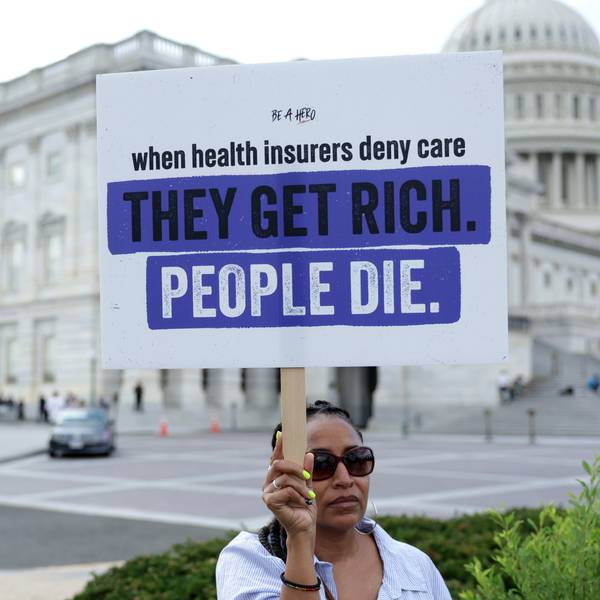
The fear and dysfunction associated with the coronavirus pandemic are unspeakably horrible, but they could spur the U.S. to once and for all eliminate the for-profit infection that sickens our health care system. (Photo: Tayfun Coskun/Anadolu Agency via Getty Images)
Last week, I listened as several Indiana workers in the hospitality industry gathered in southeastern Indiana to talk about their health. A cook in her 60s shared how she had gone months without her asthma inhalers because she couldn't afford them. During that period, she was taken to the hospital by ambulance twice. A restaurant server talked about not being able to pay for tests her doctor recommended for potentially cancerous breast tissue. Another has seven prescriptions. She tearfully described her perpetual calculation about which to fill, because she can't come close to affording them all.
Each story was greeted by sad, knowing nods. Several workers spoke about skipping doctor visits, reluctant to add to the stack of unpaid medical bills already piling up on their kitchen tables.
Beyond their inability to get the care they need, they all had another thing in common: They all had health insurance.
At least, they had what often passes for health insurance in the United States. Unique among other nations, we prioritize the interests of corporations making billions of dollars in health care profits over the goal of ensuring access to care. While 27 million Americans have no health insurance at all, four in ten working Americans have a high-deductible plan that forces them to pay thousands of dollars out of pocket before they get any benefit from the premiums taken out of their paychecks each week.
Reams of academic medical studies confirm what the workers in Indiana tell us: Price tag barriers to accessing health care deter people from seeking the care they need. As recently as last month, most Americans may have seen this as a problem solely for the worker who could not afford to see a doctor about her high blood pressure or diabetes. This month, we know it is a problem for everyone.
That same worker is unlikely to seek testing and treatment for the coronavirus, which means they may unknowingly spread it.
"The reality is, there are a lot of people that are thinking, 'I don't want a couple-thousand-dollar bill to get tested or to get treated,'" Rep. Ro Khanna (D-Calif.) told the Huffington Post. "That's going to hurt all of us."
The fears of financial catastrophe coming from treatment are well-founded. Although President Trump in a primetime television address last week claimed that health insurance companies had agreed to waive copays for coronavirus treatment, those companies quickly walked it back. They were waiving copays for testing only, not treatment. And that treatment could be enormously expensive. As the New York Times reported, a father and young daughter quarantined after coronavirus exposure already face "a pile of medical bills" adding up to $3,918.
We don't have to guess at the damage that will be caused by financial barriers to care. A Harvard Medical School study showed that 45,000 people in the U.S. die each year because of lack of health care coverage. In the case of an aggressive infectious disease like the coronavirus, where lack of testing and treatment will impact others, that total could mushroom.
Those who do seek testing will have a hard time finding it. The United States lags far behind nations like South Korea in providing access to the tests that would spur quarantines and slow the spread of the disease.
"That is a failing. Let's admit it," Dr. Anthony Fauci, director of the National Institute of Allergy and Infectious Diseases, told Congress when responding to questions about the lack of tests. At the same time, U.S. hospitals forced to prioritize revenue margins and to devote a huge amount of staff to wrangling with insurance companies, all while being hampered by a reduction in federal emergency funding, don't have adequate beds and supplies like ventilators. In rural communities in particular, budget pressures have forced many hospitals to close in recent years.
This level of unpreparedness may seem remarkable, given that we in the U.S. spend far more per capita on health care than any other nation in history. Yet, unique among nations, we waste a breathtaking $500 billion each year in health care dollars spent not on care, but on private insurance corporations' shareholder returns, executive pay as high as $83 million per year, and a massive bureaucracy devoted to contesting insurance claims and marketing. Not to mention the billions of taxpayer dollars diverted to pharmaceutical corporation profits as a result of our government refusing to negotiate the cost of medicines paid by our Medicare system, even as other nations negotiate far lower prices for the same drugs.
The problem is clear. We have allowed the profit motive to drive our U.S. health care system, and it has driven us straight into a ditch.
An Opportunity for Fundamental Reform
The surrender of our health care system to profiteering interests is so profound that the medical qualifications of our nation's top health official, Health and Human Services Secretary Alex Azar, list his work as chief lobbyist for a pharma corporation that tripled the price of insulin during his tenure.
Azar has refused to promise Congress that Americans will be able to access any coronavirus vaccine because, saying: "We would want to ensure that we work to make it affordable, but we can't control that price because we need the private sector to invest. The priority is to get vaccines and therapeutics and price controls won't get us there."
But Secretary Azar is wrong, and he knows it. Taxpayers, not the private sector, are the most important sponsors of research for new medicines, including groundbreaking research leading to effective drugs for cancer, heart disease, and infectious diseases. The coronavirus research is no exception. As a recent report by Public Citizen shows, the National Institutes of Health has shouldered the responsibility for developing new treatments and vaccines against COVID-19. Yet, the customary next step in the modern U.S. medicines system is to hand over the fruits of public drugs research to private corporations in the form of monopoly patents that last 20 years and longer, which set the stage for price-gouging. Azar seems intent on following this profiteering script with any coronavirus vaccine, too.
The same Americans who would struggle to pay for a vaccine or treatment are also likely to be among the 70 percent of low-wage workers who have no paid sick leave. Although minimal sick leave is included in emergency legislation being negotiated in response to the pandemic, there is a giant hole in the bill: It only covers about 20 percent of all workers. Additionally, there is still no long-term fix for the profound financial pressure many U.S. workers feel to show up for their shifts in nursing homes, restaurants, and grocery stores, even when they are not feeling well. Mandatory sick pay legislation that is the norm in other nations has been blocked for decades in the United States, yet another sacrifice of public health at the altar of private profit.
We can do better, and we must. Fortunately, the coronavirus scare may be opening some eyes to this reality. Even congressional and administration Republicans long opposed too government health care are willing to support some paid sick leave and government guarantees of coronavirus treatment. As the New York Times' Farhad Manjoo wrote, "Everyone is a socialist in a pandemic."
Even before the current crisis, Americans consistently cited prescription drug pricing as the number one issue they want lawmakers to address. And there is an enduring global legacy of treating essential medicines as a public good, not a commodity for extracting maximum revenue from sick people. Until corporate-pushed reforms in the late 20th century, virtually every nation on earth prohibited patenting or otherwise monopolizing access to life-essential medicines. As Jonas Salk said when asked if he considered monopolizing the polio vaccine, "Could you patent the sun?" I have written in detail about the case for removing private profiteering and monopolies from the already government-subsidized prescription medicines process.
At the same time, there is growing popular demand for a full public health care system that eliminates the barriers of copays and deductibles, and ensures coverage for all. Opinion polls show strong support for Medicare for All proposals, coupled with deep frustration with insurance companies. Democrat voters in every primary state so far expressed preference for a single-payer government health care system.
The fear and dysfunction associated with the coronavirus pandemic are unspeakably horrible, but they could spur the U.S. to once and for all eliminate the for-profit infection that sickens our health care system.
Dear Common Dreams reader, It’s been nearly 30 years since I co-founded Common Dreams with my late wife, Lina Newhouser. We had the radical notion that journalism should serve the public good, not corporate profits. It was clear to us from the outset what it would take to build such a project. No paid advertisements. No corporate sponsors. No millionaire publisher telling us what to think or do. Many people said we wouldn't last a year, but we proved those doubters wrong. Together with a tremendous team of journalists and dedicated staff, we built an independent media outlet free from the constraints of profits and corporate control. Our mission has always been simple: To inform. To inspire. To ignite change for the common good. Building Common Dreams was not easy. Our survival was never guaranteed. When you take on the most powerful forces—Wall Street greed, fossil fuel industry destruction, Big Tech lobbyists, and uber-rich oligarchs who have spent billions upon billions rigging the economy and democracy in their favor—the only bulwark you have is supporters who believe in your work. But here’s the urgent message from me today. It's never been this bad out there. And it's never been this hard to keep us going. At the very moment Common Dreams is most needed, the threats we face are intensifying. We need your support now more than ever. We don't accept corporate advertising and never will. We don't have a paywall because we don't think people should be blocked from critical news based on their ability to pay. Everything we do is funded by the donations of readers like you. When everyone does the little they can afford, we are strong. But if that support retreats or dries up, so do we. Will you donate now to make sure Common Dreams not only survives but thrives? —Craig Brown, Co-founder |
Last week, I listened as several Indiana workers in the hospitality industry gathered in southeastern Indiana to talk about their health. A cook in her 60s shared how she had gone months without her asthma inhalers because she couldn't afford them. During that period, she was taken to the hospital by ambulance twice. A restaurant server talked about not being able to pay for tests her doctor recommended for potentially cancerous breast tissue. Another has seven prescriptions. She tearfully described her perpetual calculation about which to fill, because she can't come close to affording them all.
Each story was greeted by sad, knowing nods. Several workers spoke about skipping doctor visits, reluctant to add to the stack of unpaid medical bills already piling up on their kitchen tables.
Beyond their inability to get the care they need, they all had another thing in common: They all had health insurance.
At least, they had what often passes for health insurance in the United States. Unique among other nations, we prioritize the interests of corporations making billions of dollars in health care profits over the goal of ensuring access to care. While 27 million Americans have no health insurance at all, four in ten working Americans have a high-deductible plan that forces them to pay thousands of dollars out of pocket before they get any benefit from the premiums taken out of their paychecks each week.
Reams of academic medical studies confirm what the workers in Indiana tell us: Price tag barriers to accessing health care deter people from seeking the care they need. As recently as last month, most Americans may have seen this as a problem solely for the worker who could not afford to see a doctor about her high blood pressure or diabetes. This month, we know it is a problem for everyone.
That same worker is unlikely to seek testing and treatment for the coronavirus, which means they may unknowingly spread it.
"The reality is, there are a lot of people that are thinking, 'I don't want a couple-thousand-dollar bill to get tested or to get treated,'" Rep. Ro Khanna (D-Calif.) told the Huffington Post. "That's going to hurt all of us."
The fears of financial catastrophe coming from treatment are well-founded. Although President Trump in a primetime television address last week claimed that health insurance companies had agreed to waive copays for coronavirus treatment, those companies quickly walked it back. They were waiving copays for testing only, not treatment. And that treatment could be enormously expensive. As the New York Times reported, a father and young daughter quarantined after coronavirus exposure already face "a pile of medical bills" adding up to $3,918.
We don't have to guess at the damage that will be caused by financial barriers to care. A Harvard Medical School study showed that 45,000 people in the U.S. die each year because of lack of health care coverage. In the case of an aggressive infectious disease like the coronavirus, where lack of testing and treatment will impact others, that total could mushroom.
Those who do seek testing will have a hard time finding it. The United States lags far behind nations like South Korea in providing access to the tests that would spur quarantines and slow the spread of the disease.
"That is a failing. Let's admit it," Dr. Anthony Fauci, director of the National Institute of Allergy and Infectious Diseases, told Congress when responding to questions about the lack of tests. At the same time, U.S. hospitals forced to prioritize revenue margins and to devote a huge amount of staff to wrangling with insurance companies, all while being hampered by a reduction in federal emergency funding, don't have adequate beds and supplies like ventilators. In rural communities in particular, budget pressures have forced many hospitals to close in recent years.
This level of unpreparedness may seem remarkable, given that we in the U.S. spend far more per capita on health care than any other nation in history. Yet, unique among nations, we waste a breathtaking $500 billion each year in health care dollars spent not on care, but on private insurance corporations' shareholder returns, executive pay as high as $83 million per year, and a massive bureaucracy devoted to contesting insurance claims and marketing. Not to mention the billions of taxpayer dollars diverted to pharmaceutical corporation profits as a result of our government refusing to negotiate the cost of medicines paid by our Medicare system, even as other nations negotiate far lower prices for the same drugs.
The problem is clear. We have allowed the profit motive to drive our U.S. health care system, and it has driven us straight into a ditch.
An Opportunity for Fundamental Reform
The surrender of our health care system to profiteering interests is so profound that the medical qualifications of our nation's top health official, Health and Human Services Secretary Alex Azar, list his work as chief lobbyist for a pharma corporation that tripled the price of insulin during his tenure.
Azar has refused to promise Congress that Americans will be able to access any coronavirus vaccine because, saying: "We would want to ensure that we work to make it affordable, but we can't control that price because we need the private sector to invest. The priority is to get vaccines and therapeutics and price controls won't get us there."
But Secretary Azar is wrong, and he knows it. Taxpayers, not the private sector, are the most important sponsors of research for new medicines, including groundbreaking research leading to effective drugs for cancer, heart disease, and infectious diseases. The coronavirus research is no exception. As a recent report by Public Citizen shows, the National Institutes of Health has shouldered the responsibility for developing new treatments and vaccines against COVID-19. Yet, the customary next step in the modern U.S. medicines system is to hand over the fruits of public drugs research to private corporations in the form of monopoly patents that last 20 years and longer, which set the stage for price-gouging. Azar seems intent on following this profiteering script with any coronavirus vaccine, too.
The same Americans who would struggle to pay for a vaccine or treatment are also likely to be among the 70 percent of low-wage workers who have no paid sick leave. Although minimal sick leave is included in emergency legislation being negotiated in response to the pandemic, there is a giant hole in the bill: It only covers about 20 percent of all workers. Additionally, there is still no long-term fix for the profound financial pressure many U.S. workers feel to show up for their shifts in nursing homes, restaurants, and grocery stores, even when they are not feeling well. Mandatory sick pay legislation that is the norm in other nations has been blocked for decades in the United States, yet another sacrifice of public health at the altar of private profit.
We can do better, and we must. Fortunately, the coronavirus scare may be opening some eyes to this reality. Even congressional and administration Republicans long opposed too government health care are willing to support some paid sick leave and government guarantees of coronavirus treatment. As the New York Times' Farhad Manjoo wrote, "Everyone is a socialist in a pandemic."
Even before the current crisis, Americans consistently cited prescription drug pricing as the number one issue they want lawmakers to address. And there is an enduring global legacy of treating essential medicines as a public good, not a commodity for extracting maximum revenue from sick people. Until corporate-pushed reforms in the late 20th century, virtually every nation on earth prohibited patenting or otherwise monopolizing access to life-essential medicines. As Jonas Salk said when asked if he considered monopolizing the polio vaccine, "Could you patent the sun?" I have written in detail about the case for removing private profiteering and monopolies from the already government-subsidized prescription medicines process.
At the same time, there is growing popular demand for a full public health care system that eliminates the barriers of copays and deductibles, and ensures coverage for all. Opinion polls show strong support for Medicare for All proposals, coupled with deep frustration with insurance companies. Democrat voters in every primary state so far expressed preference for a single-payer government health care system.
The fear and dysfunction associated with the coronavirus pandemic are unspeakably horrible, but they could spur the U.S. to once and for all eliminate the for-profit infection that sickens our health care system.
Last week, I listened as several Indiana workers in the hospitality industry gathered in southeastern Indiana to talk about their health. A cook in her 60s shared how she had gone months without her asthma inhalers because she couldn't afford them. During that period, she was taken to the hospital by ambulance twice. A restaurant server talked about not being able to pay for tests her doctor recommended for potentially cancerous breast tissue. Another has seven prescriptions. She tearfully described her perpetual calculation about which to fill, because she can't come close to affording them all.
Each story was greeted by sad, knowing nods. Several workers spoke about skipping doctor visits, reluctant to add to the stack of unpaid medical bills already piling up on their kitchen tables.
Beyond their inability to get the care they need, they all had another thing in common: They all had health insurance.
At least, they had what often passes for health insurance in the United States. Unique among other nations, we prioritize the interests of corporations making billions of dollars in health care profits over the goal of ensuring access to care. While 27 million Americans have no health insurance at all, four in ten working Americans have a high-deductible plan that forces them to pay thousands of dollars out of pocket before they get any benefit from the premiums taken out of their paychecks each week.
Reams of academic medical studies confirm what the workers in Indiana tell us: Price tag barriers to accessing health care deter people from seeking the care they need. As recently as last month, most Americans may have seen this as a problem solely for the worker who could not afford to see a doctor about her high blood pressure or diabetes. This month, we know it is a problem for everyone.
That same worker is unlikely to seek testing and treatment for the coronavirus, which means they may unknowingly spread it.
"The reality is, there are a lot of people that are thinking, 'I don't want a couple-thousand-dollar bill to get tested or to get treated,'" Rep. Ro Khanna (D-Calif.) told the Huffington Post. "That's going to hurt all of us."
The fears of financial catastrophe coming from treatment are well-founded. Although President Trump in a primetime television address last week claimed that health insurance companies had agreed to waive copays for coronavirus treatment, those companies quickly walked it back. They were waiving copays for testing only, not treatment. And that treatment could be enormously expensive. As the New York Times reported, a father and young daughter quarantined after coronavirus exposure already face "a pile of medical bills" adding up to $3,918.
We don't have to guess at the damage that will be caused by financial barriers to care. A Harvard Medical School study showed that 45,000 people in the U.S. die each year because of lack of health care coverage. In the case of an aggressive infectious disease like the coronavirus, where lack of testing and treatment will impact others, that total could mushroom.
Those who do seek testing will have a hard time finding it. The United States lags far behind nations like South Korea in providing access to the tests that would spur quarantines and slow the spread of the disease.
"That is a failing. Let's admit it," Dr. Anthony Fauci, director of the National Institute of Allergy and Infectious Diseases, told Congress when responding to questions about the lack of tests. At the same time, U.S. hospitals forced to prioritize revenue margins and to devote a huge amount of staff to wrangling with insurance companies, all while being hampered by a reduction in federal emergency funding, don't have adequate beds and supplies like ventilators. In rural communities in particular, budget pressures have forced many hospitals to close in recent years.
This level of unpreparedness may seem remarkable, given that we in the U.S. spend far more per capita on health care than any other nation in history. Yet, unique among nations, we waste a breathtaking $500 billion each year in health care dollars spent not on care, but on private insurance corporations' shareholder returns, executive pay as high as $83 million per year, and a massive bureaucracy devoted to contesting insurance claims and marketing. Not to mention the billions of taxpayer dollars diverted to pharmaceutical corporation profits as a result of our government refusing to negotiate the cost of medicines paid by our Medicare system, even as other nations negotiate far lower prices for the same drugs.
The problem is clear. We have allowed the profit motive to drive our U.S. health care system, and it has driven us straight into a ditch.
An Opportunity for Fundamental Reform
The surrender of our health care system to profiteering interests is so profound that the medical qualifications of our nation's top health official, Health and Human Services Secretary Alex Azar, list his work as chief lobbyist for a pharma corporation that tripled the price of insulin during his tenure.
Azar has refused to promise Congress that Americans will be able to access any coronavirus vaccine because, saying: "We would want to ensure that we work to make it affordable, but we can't control that price because we need the private sector to invest. The priority is to get vaccines and therapeutics and price controls won't get us there."
But Secretary Azar is wrong, and he knows it. Taxpayers, not the private sector, are the most important sponsors of research for new medicines, including groundbreaking research leading to effective drugs for cancer, heart disease, and infectious diseases. The coronavirus research is no exception. As a recent report by Public Citizen shows, the National Institutes of Health has shouldered the responsibility for developing new treatments and vaccines against COVID-19. Yet, the customary next step in the modern U.S. medicines system is to hand over the fruits of public drugs research to private corporations in the form of monopoly patents that last 20 years and longer, which set the stage for price-gouging. Azar seems intent on following this profiteering script with any coronavirus vaccine, too.
The same Americans who would struggle to pay for a vaccine or treatment are also likely to be among the 70 percent of low-wage workers who have no paid sick leave. Although minimal sick leave is included in emergency legislation being negotiated in response to the pandemic, there is a giant hole in the bill: It only covers about 20 percent of all workers. Additionally, there is still no long-term fix for the profound financial pressure many U.S. workers feel to show up for their shifts in nursing homes, restaurants, and grocery stores, even when they are not feeling well. Mandatory sick pay legislation that is the norm in other nations has been blocked for decades in the United States, yet another sacrifice of public health at the altar of private profit.
We can do better, and we must. Fortunately, the coronavirus scare may be opening some eyes to this reality. Even congressional and administration Republicans long opposed too government health care are willing to support some paid sick leave and government guarantees of coronavirus treatment. As the New York Times' Farhad Manjoo wrote, "Everyone is a socialist in a pandemic."
Even before the current crisis, Americans consistently cited prescription drug pricing as the number one issue they want lawmakers to address. And there is an enduring global legacy of treating essential medicines as a public good, not a commodity for extracting maximum revenue from sick people. Until corporate-pushed reforms in the late 20th century, virtually every nation on earth prohibited patenting or otherwise monopolizing access to life-essential medicines. As Jonas Salk said when asked if he considered monopolizing the polio vaccine, "Could you patent the sun?" I have written in detail about the case for removing private profiteering and monopolies from the already government-subsidized prescription medicines process.
At the same time, there is growing popular demand for a full public health care system that eliminates the barriers of copays and deductibles, and ensures coverage for all. Opinion polls show strong support for Medicare for All proposals, coupled with deep frustration with insurance companies. Democrat voters in every primary state so far expressed preference for a single-payer government health care system.
The fear and dysfunction associated with the coronavirus pandemic are unspeakably horrible, but they could spur the U.S. to once and for all eliminate the for-profit infection that sickens our health care system.