SUBSCRIBE TO OUR FREE NEWSLETTER
Daily news & progressive opinion—funded by the people, not the corporations—delivered straight to your inbox.
5
#000000
#FFFFFF
To donate by check, phone, or other method, see our More Ways to Give page.
Daily news & progressive opinion—funded by the people, not the corporations—delivered straight to your inbox.
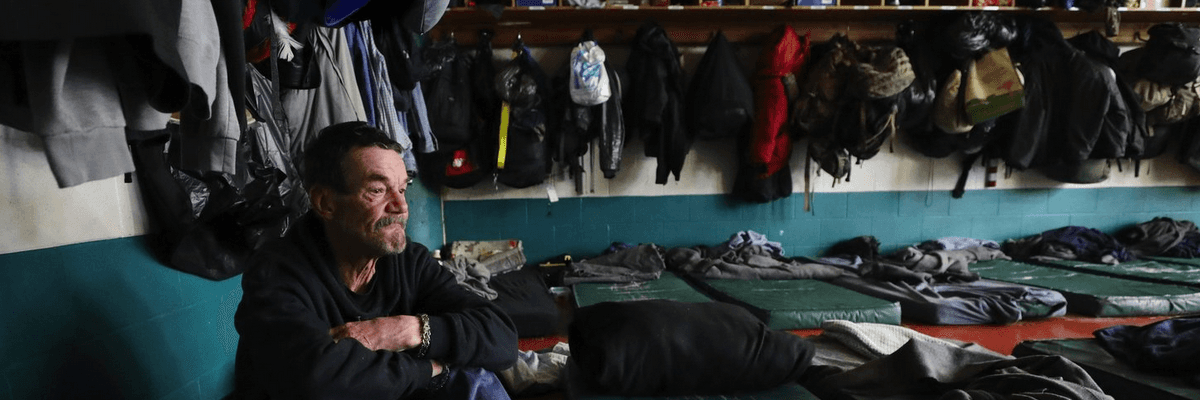
St. Martin de Porres homeless shelter client Randy Armstrong says the coronavirus "sucks." There are 212 mats at St. Martin de Porres shelter for men like Armstrong over the age of 50. He's shoved his mat against the wall for more space. (Photo: Alan Berner / The Seattle Times)
In the United States, tens of millions of people are at a much greater risk of getting sick from the coronavirus than others. The most vulnerable among us do not have the option to comply with suggestions to stay home from work or work remotely. Most low wage workers do not have any paid sick days and cannot do their work from home. The over two million people in jails and prisons each night do not have these options nor do the half a million homeless people.
One. Thirty-four million workers do not have a single day of paid sick leave. Even though most of the developed world gives its workers paid sick leave there is no federal law requiring it for workers. Thirty seven percent of private industry workers do not have paid sick leave including nearly half of the lowest paid quarter of workers. That means 34 million working people have no paid sick leave at all. As with all inequality, this group of people is disproportionately women and people of color. More than half of Latinx workers, approximately 15 million workers, are unable to earn a single sick day. Nearly 40 percent of African American workers, more than 7 million people, are in jobs where they cannot earn a single paid sick day.
Two. Low wage workers and people without a paid sick day have to continue to work to survive. Studies prove people without paid sick days are more likely to go to work sick than workers who have paid sick leave. And workers without paid sick days are much more likely to seek care from emergency rooms than those with paid sick leave.
Three. About 30 million people in the US do not have health insurance, according to the Kaiser Family Foundation. Nearly half say they cannot afford it. They are unlikely to seek medical treatment for flu like symptoms or seek screening because they cannot afford it.
Four. Staying home is not an option for the homeless. There are about 550,000 homeless people in the US, according to the National Coalition for the Homeless. Homeless people have rates of diabetes, heart disease, and HIV/AIDS at rates three to six times that of the general population, according to the National Alliance to End Homelessness. Shelters often provide close living arrangements and opportunities to clean hands and clothes and utensils are minimal for those on the street. Homeless people have higher rates of infectious, acute and chronic diseases like tuberculosis.
Five. Nearly 2.2 million people are in jails and prisons every day, the highest rate in the world. Prisoners are kept in close quarters and receive inadequate medical care. Iran released 70,000 prisoners because of coronavirus. Hand sanitizers are generally not allowed in jails because of their alcohol content. Prisoners are kept in local over 3,000 different federal, state and jails and prisons, each of which has its own procedures and practices for dealing with infectious diseases.
Six. Solutions? For sick leave, see The National Partnership for Women & Families which publishes several fact sheets about the need for paid sick days. For prisons, see Prison Policy Initiative which has five specific suggestions for jails and prisons, starting with releasing as many people as possible. New York City has developed a working paper on coronavirus for homeless shelters. And of course, the country needs economic justice and universally available health care.
Dear Common Dreams reader, It’s been nearly 30 years since I co-founded Common Dreams with my late wife, Lina Newhouser. We had the radical notion that journalism should serve the public good, not corporate profits. It was clear to us from the outset what it would take to build such a project. No paid advertisements. No corporate sponsors. No millionaire publisher telling us what to think or do. Many people said we wouldn't last a year, but we proved those doubters wrong. Together with a tremendous team of journalists and dedicated staff, we built an independent media outlet free from the constraints of profits and corporate control. Our mission has always been simple: To inform. To inspire. To ignite change for the common good. Building Common Dreams was not easy. Our survival was never guaranteed. When you take on the most powerful forces—Wall Street greed, fossil fuel industry destruction, Big Tech lobbyists, and uber-rich oligarchs who have spent billions upon billions rigging the economy and democracy in their favor—the only bulwark you have is supporters who believe in your work. But here’s the urgent message from me today. It's never been this bad out there. And it's never been this hard to keep us going. At the very moment Common Dreams is most needed, the threats we face are intensifying. We need your support now more than ever. We don't accept corporate advertising and never will. We don't have a paywall because we don't think people should be blocked from critical news based on their ability to pay. Everything we do is funded by the donations of readers like you. When everyone does the little they can afford, we are strong. But if that support retreats or dries up, so do we. Will you donate now to make sure Common Dreams not only survives but thrives? —Craig Brown, Co-founder |
In the United States, tens of millions of people are at a much greater risk of getting sick from the coronavirus than others. The most vulnerable among us do not have the option to comply with suggestions to stay home from work or work remotely. Most low wage workers do not have any paid sick days and cannot do their work from home. The over two million people in jails and prisons each night do not have these options nor do the half a million homeless people.
One. Thirty-four million workers do not have a single day of paid sick leave. Even though most of the developed world gives its workers paid sick leave there is no federal law requiring it for workers. Thirty seven percent of private industry workers do not have paid sick leave including nearly half of the lowest paid quarter of workers. That means 34 million working people have no paid sick leave at all. As with all inequality, this group of people is disproportionately women and people of color. More than half of Latinx workers, approximately 15 million workers, are unable to earn a single sick day. Nearly 40 percent of African American workers, more than 7 million people, are in jobs where they cannot earn a single paid sick day.
Two. Low wage workers and people without a paid sick day have to continue to work to survive. Studies prove people without paid sick days are more likely to go to work sick than workers who have paid sick leave. And workers without paid sick days are much more likely to seek care from emergency rooms than those with paid sick leave.
Three. About 30 million people in the US do not have health insurance, according to the Kaiser Family Foundation. Nearly half say they cannot afford it. They are unlikely to seek medical treatment for flu like symptoms or seek screening because they cannot afford it.
Four. Staying home is not an option for the homeless. There are about 550,000 homeless people in the US, according to the National Coalition for the Homeless. Homeless people have rates of diabetes, heart disease, and HIV/AIDS at rates three to six times that of the general population, according to the National Alliance to End Homelessness. Shelters often provide close living arrangements and opportunities to clean hands and clothes and utensils are minimal for those on the street. Homeless people have higher rates of infectious, acute and chronic diseases like tuberculosis.
Five. Nearly 2.2 million people are in jails and prisons every day, the highest rate in the world. Prisoners are kept in close quarters and receive inadequate medical care. Iran released 70,000 prisoners because of coronavirus. Hand sanitizers are generally not allowed in jails because of their alcohol content. Prisoners are kept in local over 3,000 different federal, state and jails and prisons, each of which has its own procedures and practices for dealing with infectious diseases.
Six. Solutions? For sick leave, see The National Partnership for Women & Families which publishes several fact sheets about the need for paid sick days. For prisons, see Prison Policy Initiative which has five specific suggestions for jails and prisons, starting with releasing as many people as possible. New York City has developed a working paper on coronavirus for homeless shelters. And of course, the country needs economic justice and universally available health care.
In the United States, tens of millions of people are at a much greater risk of getting sick from the coronavirus than others. The most vulnerable among us do not have the option to comply with suggestions to stay home from work or work remotely. Most low wage workers do not have any paid sick days and cannot do their work from home. The over two million people in jails and prisons each night do not have these options nor do the half a million homeless people.
One. Thirty-four million workers do not have a single day of paid sick leave. Even though most of the developed world gives its workers paid sick leave there is no federal law requiring it for workers. Thirty seven percent of private industry workers do not have paid sick leave including nearly half of the lowest paid quarter of workers. That means 34 million working people have no paid sick leave at all. As with all inequality, this group of people is disproportionately women and people of color. More than half of Latinx workers, approximately 15 million workers, are unable to earn a single sick day. Nearly 40 percent of African American workers, more than 7 million people, are in jobs where they cannot earn a single paid sick day.
Two. Low wage workers and people without a paid sick day have to continue to work to survive. Studies prove people without paid sick days are more likely to go to work sick than workers who have paid sick leave. And workers without paid sick days are much more likely to seek care from emergency rooms than those with paid sick leave.
Three. About 30 million people in the US do not have health insurance, according to the Kaiser Family Foundation. Nearly half say they cannot afford it. They are unlikely to seek medical treatment for flu like symptoms or seek screening because they cannot afford it.
Four. Staying home is not an option for the homeless. There are about 550,000 homeless people in the US, according to the National Coalition for the Homeless. Homeless people have rates of diabetes, heart disease, and HIV/AIDS at rates three to six times that of the general population, according to the National Alliance to End Homelessness. Shelters often provide close living arrangements and opportunities to clean hands and clothes and utensils are minimal for those on the street. Homeless people have higher rates of infectious, acute and chronic diseases like tuberculosis.
Five. Nearly 2.2 million people are in jails and prisons every day, the highest rate in the world. Prisoners are kept in close quarters and receive inadequate medical care. Iran released 70,000 prisoners because of coronavirus. Hand sanitizers are generally not allowed in jails because of their alcohol content. Prisoners are kept in local over 3,000 different federal, state and jails and prisons, each of which has its own procedures and practices for dealing with infectious diseases.
Six. Solutions? For sick leave, see The National Partnership for Women & Families which publishes several fact sheets about the need for paid sick days. For prisons, see Prison Policy Initiative which has five specific suggestions for jails and prisons, starting with releasing as many people as possible. New York City has developed a working paper on coronavirus for homeless shelters. And of course, the country needs economic justice and universally available health care.