SUBSCRIBE TO OUR FREE NEWSLETTER
Daily news & progressive opinion—funded by the people, not the corporations—delivered straight to your inbox.
5
#000000
#FFFFFF
To donate by check, phone, or other method, see our More Ways to Give page.
Daily news & progressive opinion—funded by the people, not the corporations—delivered straight to your inbox.
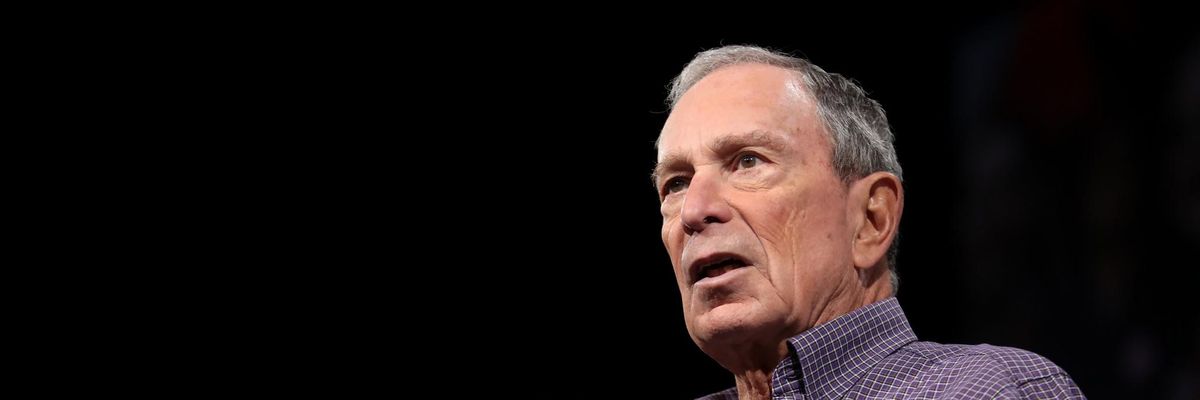
Arguments for Bloomberg's candidacy stress his wealth as a plus, a kind of monetary insulation against outside influence, and his self-made billionaire status as a key weapon against Trump. (Photo: Gage Skidmore / Flickr)
Michael Bloomberg is not afraid to use his $60 billion fortune to get a leg up in the presidential race. He pays entry level organizers $72,000 annually. In addition to the salary, he lures them with perks like free iPhones. As The Intercept reported last week, the perks are working so well that Bloomberg is enticing staff away from state and local campaigns. He has poured $400 million of his own money into campaign advertisements featuring platitudes about why his mayoral tenure and his experience building a corporate empire make him the best candidate to beat Donald Trump. Other ads tout his record on climate change and gun control.
"If these two billionaires end up battling it out for the presidency, I am not sure it matters who wins in November. Democracy will have lost."
The spending did exactly what it was supposed to: It raised the national profile of the billionaire former New York City mayor, who has qualified for the next Democratic debate after earning 19% support from Democrats and Democratic-leaning voters in a NPR/PBS NewsHour/Marist poll.
Democrats, terrified of the prospect of another four years of Trump have claimed they'll "vote blue no matter who." Ryan Cooper of The Week was among that group, that is, until Bloomberg entered the race. First of all, Cooper writes, "it is not at all obvious that Bloomberg would even be a better president than Trump."
Per Cooper:
He locked up thousands of protesters during the 2004 Republican National Convention (where he gave a speech warmly endorsing George W. Bush, and thanked him for starting the war in Iraq), and a judge held the city in contempt for violating due process law. He created what amounted to a police state for New York Muslims, subjecting the entire community to dragnet surveillance and harassment, and filling mosques with spies and agent provocateurs. The city had to pay millions in settlements for violating Muslims' civil rights. (All this did precisely nothing to prevent terrorism, by the way.)
Arguments for Bloomberg's candidacy stress his wealth as a plus, a kind of monetary insulation against outside influence, and his self-made billionaire status as a key weapon against Trump. They also reference Bloomberg's work on fighting for gun control and against climate change.
As Josh Barro writes in New York Magazine, Bloomberg is "17 times wealthier than President Trump." Plus, Barro adds, "unlike Trump, he's a self-made billionaire." In Vox, Emily Stewart argues that the former New York City Mayor and current Democratic candidate for president "has all the resources he needs to combat the Trump machine, and he doesn't have to spend time and energy courting donors and then returning favors to them if and when he's in the White House."
Cooper concedes that while "Bloomberg does have a legitimate history of supporting gun control and climate policy," including his work with Everytown for Gun Safety, "it is exceedingly unlikely that he will be able to get past a Senate filibuster on gun control, especially given his sneering know-it-all approach."
Money also can't prevent journalists from looking closely at Bloomberg's record. The New York Times observed this past week that the campaign has been "on the defensive over past recordings that showed him linking the financial crisis to the end of discriminatory "redlining" practices in mortgage lending, and defending physically aggressive policing tactics as a deterrent against crime."
Bloomberg claimed during a campaign stop in Chattanooga, Tennessee, last week that being elected mayor of New York City three times means "the public seems to like what I do." He neglected to mention, as Politico points out, that the then mayor "orchestrated a change in municipal law so he could run for that third term, vastly outspent his opponent and won the race by fewer than 5 points."
The ability to buy your way into power is not proof that people like what you do -- for Bloomberg or for Trump. As Arwa Mahdavi writes in The Guardian, "If these two billionaires end up battling it out for the presidency, I am not sure it matters who wins in November. Democracy will have lost."
Dear Common Dreams reader, It’s been nearly 30 years since I co-founded Common Dreams with my late wife, Lina Newhouser. We had the radical notion that journalism should serve the public good, not corporate profits. It was clear to us from the outset what it would take to build such a project. No paid advertisements. No corporate sponsors. No millionaire publisher telling us what to think or do. Many people said we wouldn't last a year, but we proved those doubters wrong. Together with a tremendous team of journalists and dedicated staff, we built an independent media outlet free from the constraints of profits and corporate control. Our mission has always been simple: To inform. To inspire. To ignite change for the common good. Building Common Dreams was not easy. Our survival was never guaranteed. When you take on the most powerful forces—Wall Street greed, fossil fuel industry destruction, Big Tech lobbyists, and uber-rich oligarchs who have spent billions upon billions rigging the economy and democracy in their favor—the only bulwark you have is supporters who believe in your work. But here’s the urgent message from me today. It's never been this bad out there. And it's never been this hard to keep us going. At the very moment Common Dreams is most needed, the threats we face are intensifying. We need your support now more than ever. We don't accept corporate advertising and never will. We don't have a paywall because we don't think people should be blocked from critical news based on their ability to pay. Everything we do is funded by the donations of readers like you. When everyone does the little they can afford, we are strong. But if that support retreats or dries up, so do we. Will you donate now to make sure Common Dreams not only survives but thrives? —Craig Brown, Co-founder |
Michael Bloomberg is not afraid to use his $60 billion fortune to get a leg up in the presidential race. He pays entry level organizers $72,000 annually. In addition to the salary, he lures them with perks like free iPhones. As The Intercept reported last week, the perks are working so well that Bloomberg is enticing staff away from state and local campaigns. He has poured $400 million of his own money into campaign advertisements featuring platitudes about why his mayoral tenure and his experience building a corporate empire make him the best candidate to beat Donald Trump. Other ads tout his record on climate change and gun control.
"If these two billionaires end up battling it out for the presidency, I am not sure it matters who wins in November. Democracy will have lost."
The spending did exactly what it was supposed to: It raised the national profile of the billionaire former New York City mayor, who has qualified for the next Democratic debate after earning 19% support from Democrats and Democratic-leaning voters in a NPR/PBS NewsHour/Marist poll.
Democrats, terrified of the prospect of another four years of Trump have claimed they'll "vote blue no matter who." Ryan Cooper of The Week was among that group, that is, until Bloomberg entered the race. First of all, Cooper writes, "it is not at all obvious that Bloomberg would even be a better president than Trump."
Per Cooper:
He locked up thousands of protesters during the 2004 Republican National Convention (where he gave a speech warmly endorsing George W. Bush, and thanked him for starting the war in Iraq), and a judge held the city in contempt for violating due process law. He created what amounted to a police state for New York Muslims, subjecting the entire community to dragnet surveillance and harassment, and filling mosques with spies and agent provocateurs. The city had to pay millions in settlements for violating Muslims' civil rights. (All this did precisely nothing to prevent terrorism, by the way.)
Arguments for Bloomberg's candidacy stress his wealth as a plus, a kind of monetary insulation against outside influence, and his self-made billionaire status as a key weapon against Trump. They also reference Bloomberg's work on fighting for gun control and against climate change.
As Josh Barro writes in New York Magazine, Bloomberg is "17 times wealthier than President Trump." Plus, Barro adds, "unlike Trump, he's a self-made billionaire." In Vox, Emily Stewart argues that the former New York City Mayor and current Democratic candidate for president "has all the resources he needs to combat the Trump machine, and he doesn't have to spend time and energy courting donors and then returning favors to them if and when he's in the White House."
Cooper concedes that while "Bloomberg does have a legitimate history of supporting gun control and climate policy," including his work with Everytown for Gun Safety, "it is exceedingly unlikely that he will be able to get past a Senate filibuster on gun control, especially given his sneering know-it-all approach."
Money also can't prevent journalists from looking closely at Bloomberg's record. The New York Times observed this past week that the campaign has been "on the defensive over past recordings that showed him linking the financial crisis to the end of discriminatory "redlining" practices in mortgage lending, and defending physically aggressive policing tactics as a deterrent against crime."
Bloomberg claimed during a campaign stop in Chattanooga, Tennessee, last week that being elected mayor of New York City three times means "the public seems to like what I do." He neglected to mention, as Politico points out, that the then mayor "orchestrated a change in municipal law so he could run for that third term, vastly outspent his opponent and won the race by fewer than 5 points."
The ability to buy your way into power is not proof that people like what you do -- for Bloomberg or for Trump. As Arwa Mahdavi writes in The Guardian, "If these two billionaires end up battling it out for the presidency, I am not sure it matters who wins in November. Democracy will have lost."
Michael Bloomberg is not afraid to use his $60 billion fortune to get a leg up in the presidential race. He pays entry level organizers $72,000 annually. In addition to the salary, he lures them with perks like free iPhones. As The Intercept reported last week, the perks are working so well that Bloomberg is enticing staff away from state and local campaigns. He has poured $400 million of his own money into campaign advertisements featuring platitudes about why his mayoral tenure and his experience building a corporate empire make him the best candidate to beat Donald Trump. Other ads tout his record on climate change and gun control.
"If these two billionaires end up battling it out for the presidency, I am not sure it matters who wins in November. Democracy will have lost."
The spending did exactly what it was supposed to: It raised the national profile of the billionaire former New York City mayor, who has qualified for the next Democratic debate after earning 19% support from Democrats and Democratic-leaning voters in a NPR/PBS NewsHour/Marist poll.
Democrats, terrified of the prospect of another four years of Trump have claimed they'll "vote blue no matter who." Ryan Cooper of The Week was among that group, that is, until Bloomberg entered the race. First of all, Cooper writes, "it is not at all obvious that Bloomberg would even be a better president than Trump."
Per Cooper:
He locked up thousands of protesters during the 2004 Republican National Convention (where he gave a speech warmly endorsing George W. Bush, and thanked him for starting the war in Iraq), and a judge held the city in contempt for violating due process law. He created what amounted to a police state for New York Muslims, subjecting the entire community to dragnet surveillance and harassment, and filling mosques with spies and agent provocateurs. The city had to pay millions in settlements for violating Muslims' civil rights. (All this did precisely nothing to prevent terrorism, by the way.)
Arguments for Bloomberg's candidacy stress his wealth as a plus, a kind of monetary insulation against outside influence, and his self-made billionaire status as a key weapon against Trump. They also reference Bloomberg's work on fighting for gun control and against climate change.
As Josh Barro writes in New York Magazine, Bloomberg is "17 times wealthier than President Trump." Plus, Barro adds, "unlike Trump, he's a self-made billionaire." In Vox, Emily Stewart argues that the former New York City Mayor and current Democratic candidate for president "has all the resources he needs to combat the Trump machine, and he doesn't have to spend time and energy courting donors and then returning favors to them if and when he's in the White House."
Cooper concedes that while "Bloomberg does have a legitimate history of supporting gun control and climate policy," including his work with Everytown for Gun Safety, "it is exceedingly unlikely that he will be able to get past a Senate filibuster on gun control, especially given his sneering know-it-all approach."
Money also can't prevent journalists from looking closely at Bloomberg's record. The New York Times observed this past week that the campaign has been "on the defensive over past recordings that showed him linking the financial crisis to the end of discriminatory "redlining" practices in mortgage lending, and defending physically aggressive policing tactics as a deterrent against crime."
Bloomberg claimed during a campaign stop in Chattanooga, Tennessee, last week that being elected mayor of New York City three times means "the public seems to like what I do." He neglected to mention, as Politico points out, that the then mayor "orchestrated a change in municipal law so he could run for that third term, vastly outspent his opponent and won the race by fewer than 5 points."
The ability to buy your way into power is not proof that people like what you do -- for Bloomberg or for Trump. As Arwa Mahdavi writes in The Guardian, "If these two billionaires end up battling it out for the presidency, I am not sure it matters who wins in November. Democracy will have lost."