SUBSCRIBE TO OUR FREE NEWSLETTER
Daily news & progressive opinion—funded by the people, not the corporations—delivered straight to your inbox.
5
#000000
#FFFFFF
To donate by check, phone, or other method, see our More Ways to Give page.
Daily news & progressive opinion—funded by the people, not the corporations—delivered straight to your inbox.
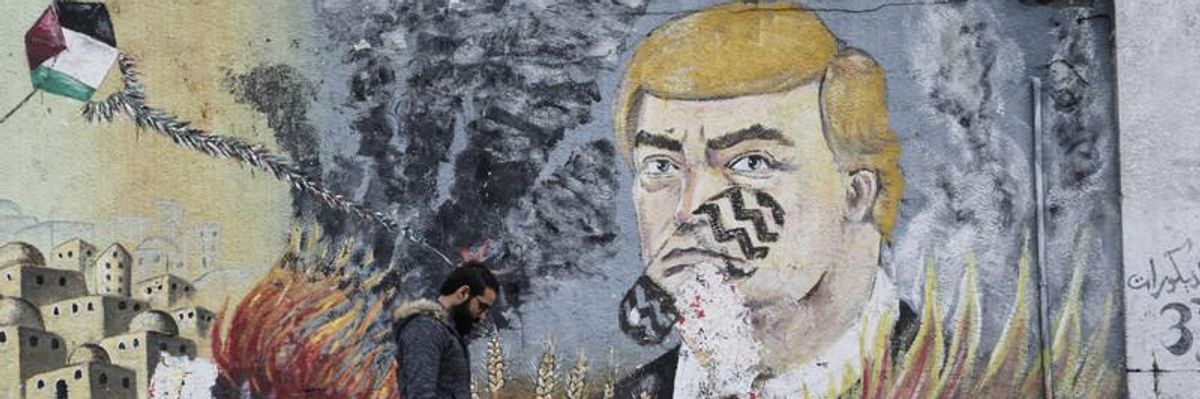
Graffiti in Gaza shows what Palestinians have come to think of US President Donald Trump's peacemaking.(Photo: Mahmoud Issa SIPA USA)
After much anticipation and with great ceremony, on Tuesday US President Donald Trump presented his plan for Middle East peace.
It's "a great plan," Trump had already said a few days ago, though he may just have been humoring his son-in-law Jared Kushner, its chief architect.
On Tuesday, he called the plan "win-win," though to whom the second win goes is hard to say.
The first is undoubtedly Israel's, of whom the only thing that is being asked is a four-year settlement freeze while Palestinian statehood is negotiated.
Here is the eye-opening fact that eludes those who seem to think that power is all that matters: This is all over only when Palestinians say it is. Not a minute before.
Outside this exhausting demand to do less, Israel gets: all (or near enough) its settlements, all of Jerusalem, control over borders, uncontested military control over the whole area of historic Palestine, some one-third of the West Bank and the removal of any possibility that Palestinians who were expelled in 1948 could ever claim a right of return or even compensation for the lands and homes and years that were stolen from them.
It is little wonder that a beaming Benjamin Netanyahu, the incumbent Israeli prime minister who stood next to Trump as he presented the plan, looked more smug than ever.
"For too long," Netanyahu said in his remarks after Trump had delivered (boy, did he deliver), "the very heart of the land of Israel, where our patriarchs prayed, our prophets preached and our kings ruled has been outrageously branded as illegally occupied territory. Well today, Mr. President, you are puncturing this big lie."
Indeed. No one could sum up better than Netanyahu how much is wrong with the plan. It has precisely nothing to do with the Palestinians, who have been reduced to the kind of bit players their status--in the eyes of those who came up with and support this plan--as second-class people restricts them to.
Palestinians don't go entirely empty-handed. Their overlords have granted them "statehood." Over more than twice as much land as they currently control.
That at least is the breathless reporting that infected initial reports on the plan's announcement, though no one stopped to ask the obvious: two times nothing is?
According to the plan, the issue of territory was worked out "in the spirit of UN [Security Council Resolution] 242." But that would suggest some kind of adherence to 1967 boundaries. Judging by the "conceptual maps" of the plan's appendix, it is hard to see that the 1967 boundaries were even considered.
Indeed, the priority, as the plan makes clear, is Israel's security. Hence Palestinians get no control over borders in and out of the West Bank.
Nor do the maps indicate in what sense Jerusalem becomes both the unified capital of Israel while also becoming Palestine's capital of "Al-Quds [including] areas of East Jerusalem."
In lieu of compensation, a "Trump Economic Plan" will benefit refugees already present and those who are absorbed into the "State of Palestine" or the "Palestine Empire" or "Greater Palestine" or whatever the Palestinians want to call it, a series of non-contiguous areas that would be connected by bridges, tunnels and roads.
We get roads! This must be what Jared Kushner meant about economic advancement.
The Palestinians also might look forward to a resort area on the northern Dead Sea.
With details like these, it is easy to see how the Trump plan runs to 180 pages.
The plan, of course, is unworkable. It is a non-starter as the Palestinians have said all along.
It violates every red line the Palestinian Authority has stipulated, every principle the Palestine Liberation Organization signed onto in 1993 and every resolution of international law.
It cements a situation in which one set of people retains control over another without being responsible for upholding their rights.
No Palestinian leader could accept it. No Palestinian leader will accept it. Any Arab leader who is seen to support it will be tainted.
It's worse than a joke. It's an insult.
Palestinian Authority officials--Mahmoud Abbas, the PA leader, called it the "slap of the century"--and Hamas spokespeople predictably rejected the plan out of hand.
Others, too, were scathing.
B'Tselem, an Israeli human rights group, said the plan changed nothing.
"What the Palestinians are being 'offered' right now is not rights or a state, but a permanent state of apartheid."
Matt Duss, foreign policy advisor for US presidential hopeful Bernie Sanders, tweeted out his word of the day: "Bantustan," and cautioned journalists to talk to "actual Palestinians."
Much of the presentation of the plan sounded like a threat against Palestinians.
Thus, the "difficulty" in creating a contiguous Palestinian state, given the spread of settlements, was used by an administration official as the reason for Palestinians to accept it.
"... [I]f we don't do this freeze now I think that their chance to ever have a state basically goes away."
What this official doesn't seem to have stopped to consider is this: So what?
So what if that chance goes away. Israel still has to live with six million Palestinians.
Here is the eye-opening fact that eludes those who seem to think that power is all that matters: This is all over only when Palestinians say it is. Not a minute before.
Dear Common Dreams reader, It’s been nearly 30 years since I co-founded Common Dreams with my late wife, Lina Newhouser. We had the radical notion that journalism should serve the public good, not corporate profits. It was clear to us from the outset what it would take to build such a project. No paid advertisements. No corporate sponsors. No millionaire publisher telling us what to think or do. Many people said we wouldn't last a year, but we proved those doubters wrong. Together with a tremendous team of journalists and dedicated staff, we built an independent media outlet free from the constraints of profits and corporate control. Our mission has always been simple: To inform. To inspire. To ignite change for the common good. Building Common Dreams was not easy. Our survival was never guaranteed. When you take on the most powerful forces—Wall Street greed, fossil fuel industry destruction, Big Tech lobbyists, and uber-rich oligarchs who have spent billions upon billions rigging the economy and democracy in their favor—the only bulwark you have is supporters who believe in your work. But here’s the urgent message from me today. It's never been this bad out there. And it's never been this hard to keep us going. At the very moment Common Dreams is most needed, the threats we face are intensifying. We need your support now more than ever. We don't accept corporate advertising and never will. We don't have a paywall because we don't think people should be blocked from critical news based on their ability to pay. Everything we do is funded by the donations of readers like you. When everyone does the little they can afford, we are strong. But if that support retreats or dries up, so do we. Will you donate now to make sure Common Dreams not only survives but thrives? —Craig Brown, Co-founder |
After much anticipation and with great ceremony, on Tuesday US President Donald Trump presented his plan for Middle East peace.
It's "a great plan," Trump had already said a few days ago, though he may just have been humoring his son-in-law Jared Kushner, its chief architect.
On Tuesday, he called the plan "win-win," though to whom the second win goes is hard to say.
The first is undoubtedly Israel's, of whom the only thing that is being asked is a four-year settlement freeze while Palestinian statehood is negotiated.
Here is the eye-opening fact that eludes those who seem to think that power is all that matters: This is all over only when Palestinians say it is. Not a minute before.
Outside this exhausting demand to do less, Israel gets: all (or near enough) its settlements, all of Jerusalem, control over borders, uncontested military control over the whole area of historic Palestine, some one-third of the West Bank and the removal of any possibility that Palestinians who were expelled in 1948 could ever claim a right of return or even compensation for the lands and homes and years that were stolen from them.
It is little wonder that a beaming Benjamin Netanyahu, the incumbent Israeli prime minister who stood next to Trump as he presented the plan, looked more smug than ever.
"For too long," Netanyahu said in his remarks after Trump had delivered (boy, did he deliver), "the very heart of the land of Israel, where our patriarchs prayed, our prophets preached and our kings ruled has been outrageously branded as illegally occupied territory. Well today, Mr. President, you are puncturing this big lie."
Indeed. No one could sum up better than Netanyahu how much is wrong with the plan. It has precisely nothing to do with the Palestinians, who have been reduced to the kind of bit players their status--in the eyes of those who came up with and support this plan--as second-class people restricts them to.
Palestinians don't go entirely empty-handed. Their overlords have granted them "statehood." Over more than twice as much land as they currently control.
That at least is the breathless reporting that infected initial reports on the plan's announcement, though no one stopped to ask the obvious: two times nothing is?
According to the plan, the issue of territory was worked out "in the spirit of UN [Security Council Resolution] 242." But that would suggest some kind of adherence to 1967 boundaries. Judging by the "conceptual maps" of the plan's appendix, it is hard to see that the 1967 boundaries were even considered.
Indeed, the priority, as the plan makes clear, is Israel's security. Hence Palestinians get no control over borders in and out of the West Bank.
Nor do the maps indicate in what sense Jerusalem becomes both the unified capital of Israel while also becoming Palestine's capital of "Al-Quds [including] areas of East Jerusalem."
In lieu of compensation, a "Trump Economic Plan" will benefit refugees already present and those who are absorbed into the "State of Palestine" or the "Palestine Empire" or "Greater Palestine" or whatever the Palestinians want to call it, a series of non-contiguous areas that would be connected by bridges, tunnels and roads.
We get roads! This must be what Jared Kushner meant about economic advancement.
The Palestinians also might look forward to a resort area on the northern Dead Sea.
With details like these, it is easy to see how the Trump plan runs to 180 pages.
The plan, of course, is unworkable. It is a non-starter as the Palestinians have said all along.
It violates every red line the Palestinian Authority has stipulated, every principle the Palestine Liberation Organization signed onto in 1993 and every resolution of international law.
It cements a situation in which one set of people retains control over another without being responsible for upholding their rights.
No Palestinian leader could accept it. No Palestinian leader will accept it. Any Arab leader who is seen to support it will be tainted.
It's worse than a joke. It's an insult.
Palestinian Authority officials--Mahmoud Abbas, the PA leader, called it the "slap of the century"--and Hamas spokespeople predictably rejected the plan out of hand.
Others, too, were scathing.
B'Tselem, an Israeli human rights group, said the plan changed nothing.
"What the Palestinians are being 'offered' right now is not rights or a state, but a permanent state of apartheid."
Matt Duss, foreign policy advisor for US presidential hopeful Bernie Sanders, tweeted out his word of the day: "Bantustan," and cautioned journalists to talk to "actual Palestinians."
Much of the presentation of the plan sounded like a threat against Palestinians.
Thus, the "difficulty" in creating a contiguous Palestinian state, given the spread of settlements, was used by an administration official as the reason for Palestinians to accept it.
"... [I]f we don't do this freeze now I think that their chance to ever have a state basically goes away."
What this official doesn't seem to have stopped to consider is this: So what?
So what if that chance goes away. Israel still has to live with six million Palestinians.
Here is the eye-opening fact that eludes those who seem to think that power is all that matters: This is all over only when Palestinians say it is. Not a minute before.
After much anticipation and with great ceremony, on Tuesday US President Donald Trump presented his plan for Middle East peace.
It's "a great plan," Trump had already said a few days ago, though he may just have been humoring his son-in-law Jared Kushner, its chief architect.
On Tuesday, he called the plan "win-win," though to whom the second win goes is hard to say.
The first is undoubtedly Israel's, of whom the only thing that is being asked is a four-year settlement freeze while Palestinian statehood is negotiated.
Here is the eye-opening fact that eludes those who seem to think that power is all that matters: This is all over only when Palestinians say it is. Not a minute before.
Outside this exhausting demand to do less, Israel gets: all (or near enough) its settlements, all of Jerusalem, control over borders, uncontested military control over the whole area of historic Palestine, some one-third of the West Bank and the removal of any possibility that Palestinians who were expelled in 1948 could ever claim a right of return or even compensation for the lands and homes and years that were stolen from them.
It is little wonder that a beaming Benjamin Netanyahu, the incumbent Israeli prime minister who stood next to Trump as he presented the plan, looked more smug than ever.
"For too long," Netanyahu said in his remarks after Trump had delivered (boy, did he deliver), "the very heart of the land of Israel, where our patriarchs prayed, our prophets preached and our kings ruled has been outrageously branded as illegally occupied territory. Well today, Mr. President, you are puncturing this big lie."
Indeed. No one could sum up better than Netanyahu how much is wrong with the plan. It has precisely nothing to do with the Palestinians, who have been reduced to the kind of bit players their status--in the eyes of those who came up with and support this plan--as second-class people restricts them to.
Palestinians don't go entirely empty-handed. Their overlords have granted them "statehood." Over more than twice as much land as they currently control.
That at least is the breathless reporting that infected initial reports on the plan's announcement, though no one stopped to ask the obvious: two times nothing is?
According to the plan, the issue of territory was worked out "in the spirit of UN [Security Council Resolution] 242." But that would suggest some kind of adherence to 1967 boundaries. Judging by the "conceptual maps" of the plan's appendix, it is hard to see that the 1967 boundaries were even considered.
Indeed, the priority, as the plan makes clear, is Israel's security. Hence Palestinians get no control over borders in and out of the West Bank.
Nor do the maps indicate in what sense Jerusalem becomes both the unified capital of Israel while also becoming Palestine's capital of "Al-Quds [including] areas of East Jerusalem."
In lieu of compensation, a "Trump Economic Plan" will benefit refugees already present and those who are absorbed into the "State of Palestine" or the "Palestine Empire" or "Greater Palestine" or whatever the Palestinians want to call it, a series of non-contiguous areas that would be connected by bridges, tunnels and roads.
We get roads! This must be what Jared Kushner meant about economic advancement.
The Palestinians also might look forward to a resort area on the northern Dead Sea.
With details like these, it is easy to see how the Trump plan runs to 180 pages.
The plan, of course, is unworkable. It is a non-starter as the Palestinians have said all along.
It violates every red line the Palestinian Authority has stipulated, every principle the Palestine Liberation Organization signed onto in 1993 and every resolution of international law.
It cements a situation in which one set of people retains control over another without being responsible for upholding their rights.
No Palestinian leader could accept it. No Palestinian leader will accept it. Any Arab leader who is seen to support it will be tainted.
It's worse than a joke. It's an insult.
Palestinian Authority officials--Mahmoud Abbas, the PA leader, called it the "slap of the century"--and Hamas spokespeople predictably rejected the plan out of hand.
Others, too, were scathing.
B'Tselem, an Israeli human rights group, said the plan changed nothing.
"What the Palestinians are being 'offered' right now is not rights or a state, but a permanent state of apartheid."
Matt Duss, foreign policy advisor for US presidential hopeful Bernie Sanders, tweeted out his word of the day: "Bantustan," and cautioned journalists to talk to "actual Palestinians."
Much of the presentation of the plan sounded like a threat against Palestinians.
Thus, the "difficulty" in creating a contiguous Palestinian state, given the spread of settlements, was used by an administration official as the reason for Palestinians to accept it.
"... [I]f we don't do this freeze now I think that their chance to ever have a state basically goes away."
What this official doesn't seem to have stopped to consider is this: So what?
So what if that chance goes away. Israel still has to live with six million Palestinians.
Here is the eye-opening fact that eludes those who seem to think that power is all that matters: This is all over only when Palestinians say it is. Not a minute before.