SUBSCRIBE TO OUR FREE NEWSLETTER
Daily news & progressive opinion—funded by the people, not the corporations—delivered straight to your inbox.
5
#000000
#FFFFFF
To donate by check, phone, or other method, see our More Ways to Give page.
Daily news & progressive opinion—funded by the people, not the corporations—delivered straight to your inbox.
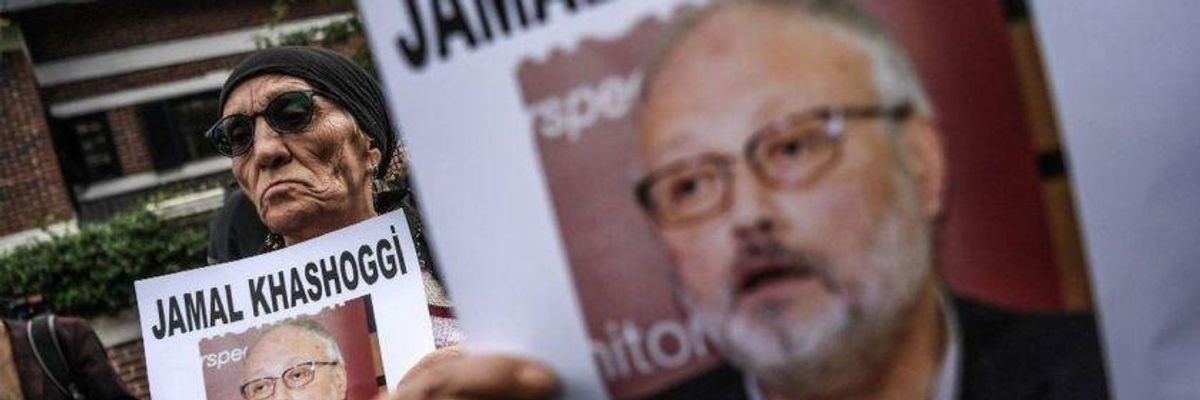
Following the brutal killing of Saudi dissident and Washington Post contributor Jamal Khashoggi at Saudi Arabia's consulate in Istanbul, Turkey, one year ago, the Saudi government became something of a toxic commodity in American politics. Several high-profile lobbying and public relations firms dropped the Saudis as a client. Think tanks, including the Brookings Institution, severed ties with the Saudi government. Businesses pulled out of a major conference in Riyadh shortly after Khashoggi's death.
As the U.S. intelligence community, and the United Nations, were determining that Saudi Arabia was culpable in the killing, members of Congress demanded accountability. Democrats led the charge on a series of bills that would have halted U.S. arms sales to the kingdom and ended U.S. support for the Saudi-led coalition's disastrous war in Yemen. Republicans were outraged too. Sen. Lindsey Graham (R-S.C.), who claimed on "Fox & Friends" to have once been Saudi Arabia's "biggest defender on the floor of the United States Senate," announced shortly after Khashoggi's death that Saudi Arabia's de facto ruler, Crown Prince Mohammed bin Salman, "has got to go." The crown prince denies a role in Khashoggi's death; the U.N. sees credible evidence warranting further investigation.
Despite the backlash directed at the kingdom, the Saudis haven't faced serious consequences for the slaying of Khashoggi or its slaughter of civilians in Yemen. That is thanks in large part to one man -- President Trump. He has loudly and emphatically defended Saudi Arabia at every opportunity. According to a July House Oversight committee report, he recently considered giving Riyadh nuclear technology without appropriate safeguards to prevent nuclear proliferation, in part at the behest of the chair of his inaugural committee, Thomas J. Barrack Jr. He has also tweeted at least a fleeting willingness to go to war with Iran on Saudi Arabia's behalf following the attacks on Saudi oil fields, something the American public overwhelmingly doesn't support.
Trump's principal argument for siding with the Saudis has to do with the alleged economic benefits of U.S. arms sales to the kingdom. It all began during his May 2017 trip to Saudi Arabia, when he touted a purported $110-billion arms deal that would mean "jobs, jobs, jobs" for Americans. The deal itself, according to the Washington Post "Fact Checker," was considerably smaller than the administration claimed, with much of it composed of sales already approved under the Obama administration or speculative offers that would happen years from now, if ever. And a report from our organization, the Center for International Policy, found the president's claims of U.S. jobs tied to Saudi arms deals were greatly exaggerated--10 to 20 times the actual number.
While Trump appears to be the commander-in-chief of Saudi Arabia's public relations efforts in the U.S., he's far from alone. Even with several firms abandoning the influence machine the Saudi's had assembled before Khashoggi's killing, the Saudi lobby is still represented in the U.S. by more than 20 "K Street" firms, according to the Department of Justice . This includes influential operators such as Squire Patton Boggs and Brownstein Hyatt Farber Schreck--whom the Saudis paid over $1 million on Oct. 4, 2018, just two days after Khashoggi was killed at the Saudi consulate--and the McKeon Group, whose namesake, former Rep. Howard "Buck" McKeon (R-Santa Clarita), was once the chairman of the House Armed Services Committee.
Saudi Arabia has also dramatically increased funding to many of the lobbying and public relations firms that stayed with them post-Khashoggi. In fact, one firm--Qorvis Communications, the Saudis' longtime public relations gurus in America--received nearly $18 million from the kingdom in just the first three months after Khashoggi's death, more than most countries spend on all of their lobbying activities for an entire year. Washington lobbyists acting as agents of Saudi Arabia have also continued to give lavishly to House and Senate campaigns, in some cases on the same day they met with members of Congress or their staffs to discuss the kingdom.
All of this has served a critical function for the Saudi regime: maintaining enough support in Congress to ensure Trump's vetoes aren't overridden, which keeps the U.S. government from punishing the Saudis for Khashoggi's death.
President Trump's protection of Saudi Arabia is at best a temporary shield. Veterans, peace and human rights groups, and other interest groups have been pushing Congress to block U.S. military support for the kingdom by invoking provisions of the War Powers Resolution and making amendments to the National Defense Authorization Act. Human rights organizations also have pushed beneficiaries of Mohammed bin Salman's private charity -- among them the New York Public Library and the United Nations--to abandon their connection to the foundation, which the crown prince uses as a propaganda platform.
Yet, one year after Khashoggi's killing, and 4 1/2 years into the brutal Saudi-led intervention in Yemen, Congress and the president have yet to hold Saudi Arabia accountable. That cannot be allowed to stand. On the anniversary of Khashoggi's murder, we owe it to him to stand up to the Saudi lobby and the president, and once and for all punish the Saudi government for what it has done.
Dear Common Dreams reader, It’s been nearly 30 years since I co-founded Common Dreams with my late wife, Lina Newhouser. We had the radical notion that journalism should serve the public good, not corporate profits. It was clear to us from the outset what it would take to build such a project. No paid advertisements. No corporate sponsors. No millionaire publisher telling us what to think or do. Many people said we wouldn't last a year, but we proved those doubters wrong. Together with a tremendous team of journalists and dedicated staff, we built an independent media outlet free from the constraints of profits and corporate control. Our mission has always been simple: To inform. To inspire. To ignite change for the common good. Building Common Dreams was not easy. Our survival was never guaranteed. When you take on the most powerful forces—Wall Street greed, fossil fuel industry destruction, Big Tech lobbyists, and uber-rich oligarchs who have spent billions upon billions rigging the economy and democracy in their favor—the only bulwark you have is supporters who believe in your work. But here’s the urgent message from me today. It's never been this bad out there. And it's never been this hard to keep us going. At the very moment Common Dreams is most needed, the threats we face are intensifying. We need your support now more than ever. We don't accept corporate advertising and never will. We don't have a paywall because we don't think people should be blocked from critical news based on their ability to pay. Everything we do is funded by the donations of readers like you. When everyone does the little they can afford, we are strong. But if that support retreats or dries up, so do we. Will you donate now to make sure Common Dreams not only survives but thrives? —Craig Brown, Co-founder |
Following the brutal killing of Saudi dissident and Washington Post contributor Jamal Khashoggi at Saudi Arabia's consulate in Istanbul, Turkey, one year ago, the Saudi government became something of a toxic commodity in American politics. Several high-profile lobbying and public relations firms dropped the Saudis as a client. Think tanks, including the Brookings Institution, severed ties with the Saudi government. Businesses pulled out of a major conference in Riyadh shortly after Khashoggi's death.
As the U.S. intelligence community, and the United Nations, were determining that Saudi Arabia was culpable in the killing, members of Congress demanded accountability. Democrats led the charge on a series of bills that would have halted U.S. arms sales to the kingdom and ended U.S. support for the Saudi-led coalition's disastrous war in Yemen. Republicans were outraged too. Sen. Lindsey Graham (R-S.C.), who claimed on "Fox & Friends" to have once been Saudi Arabia's "biggest defender on the floor of the United States Senate," announced shortly after Khashoggi's death that Saudi Arabia's de facto ruler, Crown Prince Mohammed bin Salman, "has got to go." The crown prince denies a role in Khashoggi's death; the U.N. sees credible evidence warranting further investigation.
Despite the backlash directed at the kingdom, the Saudis haven't faced serious consequences for the slaying of Khashoggi or its slaughter of civilians in Yemen. That is thanks in large part to one man -- President Trump. He has loudly and emphatically defended Saudi Arabia at every opportunity. According to a July House Oversight committee report, he recently considered giving Riyadh nuclear technology without appropriate safeguards to prevent nuclear proliferation, in part at the behest of the chair of his inaugural committee, Thomas J. Barrack Jr. He has also tweeted at least a fleeting willingness to go to war with Iran on Saudi Arabia's behalf following the attacks on Saudi oil fields, something the American public overwhelmingly doesn't support.
Trump's principal argument for siding with the Saudis has to do with the alleged economic benefits of U.S. arms sales to the kingdom. It all began during his May 2017 trip to Saudi Arabia, when he touted a purported $110-billion arms deal that would mean "jobs, jobs, jobs" for Americans. The deal itself, according to the Washington Post "Fact Checker," was considerably smaller than the administration claimed, with much of it composed of sales already approved under the Obama administration or speculative offers that would happen years from now, if ever. And a report from our organization, the Center for International Policy, found the president's claims of U.S. jobs tied to Saudi arms deals were greatly exaggerated--10 to 20 times the actual number.
While Trump appears to be the commander-in-chief of Saudi Arabia's public relations efforts in the U.S., he's far from alone. Even with several firms abandoning the influence machine the Saudi's had assembled before Khashoggi's killing, the Saudi lobby is still represented in the U.S. by more than 20 "K Street" firms, according to the Department of Justice . This includes influential operators such as Squire Patton Boggs and Brownstein Hyatt Farber Schreck--whom the Saudis paid over $1 million on Oct. 4, 2018, just two days after Khashoggi was killed at the Saudi consulate--and the McKeon Group, whose namesake, former Rep. Howard "Buck" McKeon (R-Santa Clarita), was once the chairman of the House Armed Services Committee.
Saudi Arabia has also dramatically increased funding to many of the lobbying and public relations firms that stayed with them post-Khashoggi. In fact, one firm--Qorvis Communications, the Saudis' longtime public relations gurus in America--received nearly $18 million from the kingdom in just the first three months after Khashoggi's death, more than most countries spend on all of their lobbying activities for an entire year. Washington lobbyists acting as agents of Saudi Arabia have also continued to give lavishly to House and Senate campaigns, in some cases on the same day they met with members of Congress or their staffs to discuss the kingdom.
All of this has served a critical function for the Saudi regime: maintaining enough support in Congress to ensure Trump's vetoes aren't overridden, which keeps the U.S. government from punishing the Saudis for Khashoggi's death.
President Trump's protection of Saudi Arabia is at best a temporary shield. Veterans, peace and human rights groups, and other interest groups have been pushing Congress to block U.S. military support for the kingdom by invoking provisions of the War Powers Resolution and making amendments to the National Defense Authorization Act. Human rights organizations also have pushed beneficiaries of Mohammed bin Salman's private charity -- among them the New York Public Library and the United Nations--to abandon their connection to the foundation, which the crown prince uses as a propaganda platform.
Yet, one year after Khashoggi's killing, and 4 1/2 years into the brutal Saudi-led intervention in Yemen, Congress and the president have yet to hold Saudi Arabia accountable. That cannot be allowed to stand. On the anniversary of Khashoggi's murder, we owe it to him to stand up to the Saudi lobby and the president, and once and for all punish the Saudi government for what it has done.
Following the brutal killing of Saudi dissident and Washington Post contributor Jamal Khashoggi at Saudi Arabia's consulate in Istanbul, Turkey, one year ago, the Saudi government became something of a toxic commodity in American politics. Several high-profile lobbying and public relations firms dropped the Saudis as a client. Think tanks, including the Brookings Institution, severed ties with the Saudi government. Businesses pulled out of a major conference in Riyadh shortly after Khashoggi's death.
As the U.S. intelligence community, and the United Nations, were determining that Saudi Arabia was culpable in the killing, members of Congress demanded accountability. Democrats led the charge on a series of bills that would have halted U.S. arms sales to the kingdom and ended U.S. support for the Saudi-led coalition's disastrous war in Yemen. Republicans were outraged too. Sen. Lindsey Graham (R-S.C.), who claimed on "Fox & Friends" to have once been Saudi Arabia's "biggest defender on the floor of the United States Senate," announced shortly after Khashoggi's death that Saudi Arabia's de facto ruler, Crown Prince Mohammed bin Salman, "has got to go." The crown prince denies a role in Khashoggi's death; the U.N. sees credible evidence warranting further investigation.
Despite the backlash directed at the kingdom, the Saudis haven't faced serious consequences for the slaying of Khashoggi or its slaughter of civilians in Yemen. That is thanks in large part to one man -- President Trump. He has loudly and emphatically defended Saudi Arabia at every opportunity. According to a July House Oversight committee report, he recently considered giving Riyadh nuclear technology without appropriate safeguards to prevent nuclear proliferation, in part at the behest of the chair of his inaugural committee, Thomas J. Barrack Jr. He has also tweeted at least a fleeting willingness to go to war with Iran on Saudi Arabia's behalf following the attacks on Saudi oil fields, something the American public overwhelmingly doesn't support.
Trump's principal argument for siding with the Saudis has to do with the alleged economic benefits of U.S. arms sales to the kingdom. It all began during his May 2017 trip to Saudi Arabia, when he touted a purported $110-billion arms deal that would mean "jobs, jobs, jobs" for Americans. The deal itself, according to the Washington Post "Fact Checker," was considerably smaller than the administration claimed, with much of it composed of sales already approved under the Obama administration or speculative offers that would happen years from now, if ever. And a report from our organization, the Center for International Policy, found the president's claims of U.S. jobs tied to Saudi arms deals were greatly exaggerated--10 to 20 times the actual number.
While Trump appears to be the commander-in-chief of Saudi Arabia's public relations efforts in the U.S., he's far from alone. Even with several firms abandoning the influence machine the Saudi's had assembled before Khashoggi's killing, the Saudi lobby is still represented in the U.S. by more than 20 "K Street" firms, according to the Department of Justice . This includes influential operators such as Squire Patton Boggs and Brownstein Hyatt Farber Schreck--whom the Saudis paid over $1 million on Oct. 4, 2018, just two days after Khashoggi was killed at the Saudi consulate--and the McKeon Group, whose namesake, former Rep. Howard "Buck" McKeon (R-Santa Clarita), was once the chairman of the House Armed Services Committee.
Saudi Arabia has also dramatically increased funding to many of the lobbying and public relations firms that stayed with them post-Khashoggi. In fact, one firm--Qorvis Communications, the Saudis' longtime public relations gurus in America--received nearly $18 million from the kingdom in just the first three months after Khashoggi's death, more than most countries spend on all of their lobbying activities for an entire year. Washington lobbyists acting as agents of Saudi Arabia have also continued to give lavishly to House and Senate campaigns, in some cases on the same day they met with members of Congress or their staffs to discuss the kingdom.
All of this has served a critical function for the Saudi regime: maintaining enough support in Congress to ensure Trump's vetoes aren't overridden, which keeps the U.S. government from punishing the Saudis for Khashoggi's death.
President Trump's protection of Saudi Arabia is at best a temporary shield. Veterans, peace and human rights groups, and other interest groups have been pushing Congress to block U.S. military support for the kingdom by invoking provisions of the War Powers Resolution and making amendments to the National Defense Authorization Act. Human rights organizations also have pushed beneficiaries of Mohammed bin Salman's private charity -- among them the New York Public Library and the United Nations--to abandon their connection to the foundation, which the crown prince uses as a propaganda platform.
Yet, one year after Khashoggi's killing, and 4 1/2 years into the brutal Saudi-led intervention in Yemen, Congress and the president have yet to hold Saudi Arabia accountable. That cannot be allowed to stand. On the anniversary of Khashoggi's murder, we owe it to him to stand up to the Saudi lobby and the president, and once and for all punish the Saudi government for what it has done.