
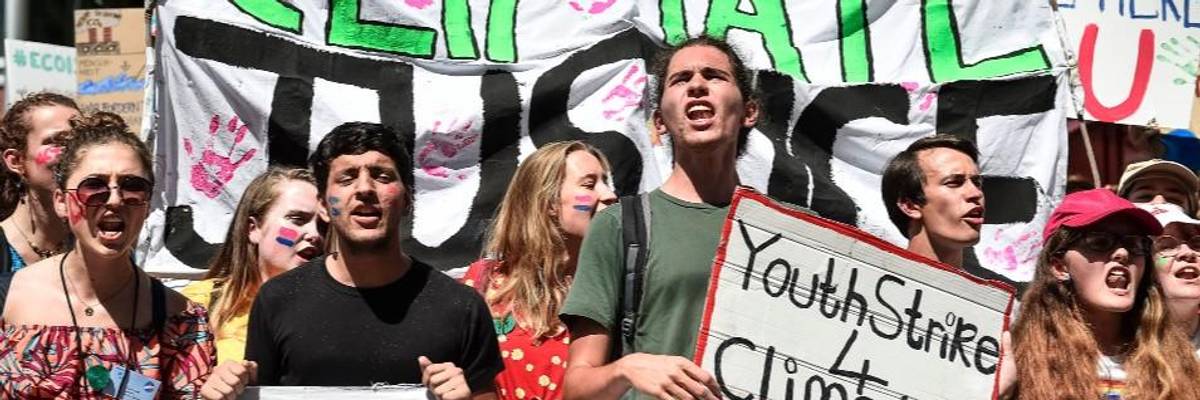
Isn't time for parents and adults to "misbehave," walk out of our offices and join our kids in the streets for the crisis of our times? (Photo: Nicolo Campo/LightRocket via Getty Images)
Parents, Time to Misbehave and Climate Strike With Your Kids
Our kids get it: While schools and parents wring their hands and debate over issuing "excused absences" for missed classes, they have ignored the fact that the surge of carbon emissions last year increasingly renders a bleak future.
The recent announcement by the New York Public Schools to excuse all students taking part in the Global Climate Strike on Friday, September 20th is an admirable and welcome step by educators to address the climate crisis.
Student climate strikers, however, are not clamoring for parental and administration approval. Citing the criteria of the Intergovernmental Panel on Climate Change to drastically cut carbon emissions by 45% by 2030, they're demanding that our schools--and all adults--step up climate action.
Besides, here in the cornfields of Iowa, my teenager sons and their fellow climate strikers are familiar with the US Supreme Court decision, Tinker v. Des Moines, which upheld an Iowan student's right to protest the Vietnam War in 1965. In delivering the Court's opinion in 1969, Justice Abe Fortas reminded the nation--and the school administrators that sought to punish students for their anti-war protests--that "First Amendment rights, applied in light of the special characteristics of the school environment, are available to teachers and students. It can hardly be argued that either students or teachers shed their constitutional rights to freedom of speech or expression at the schoolhouse gate."
But that's not why my kids don't need permission to walk out of school--at least from me, as their parent. The flip-side of their student responsibilities to attend school is their inalienable right to live in and inherit an inhabitable planet; that instead of asking schools and parents to grant permission to walk out of their classes, students are effectively asking adults if they have fully carried out their fiduciary duties to act in the best interests of the children in their care.
In essence: Have we as adults walked out on our children in an age of climate chaos? In the face of mass extinctions and undeniable ramifications unfolding from climate destabilization, are we denying our kids the right to life, liberty and the pursuit of happiness?
Here in the heartland, my kids only have to walk out of their schoolhouse gate to see firsthand devastation from historic flooding and its impact on our agricultural industry. According to a new study, "An Uncertain Future for Iowa: The Outlook for Iowa Communities and Flooding as our Climate Changes," researchers from the University of Wisconsin found that "Iowa and the Upper Midwest have a much clearer trend in annual precipitation than the whole of the contiguous U.S."
And yet, despite its often touted wind industry, Iowa saw a three percent increase in greenhouse gas emissions last year, largely to due to massive factory farms.
Last spring, during their 12-week strike for climate action, students witnessed record floods in both western Iowa and along the Mississippi River in eastern Iowa. As they skipped school on Fridays, our kids' strikes for climate action were bookend by devastating cyclones in Mozambique, heat waves across India and Southeast Asia, and fires in the West. In the first weeks of school this year, our kids learned that July was the hottest month on record, while catastrophic fires raged in the forests from Angola to the Amazon to Indonesia and Siberia.
Like climate strikers across the country, with or without school and parental permission, student actions forced the school district and local community leaders to take some kind of action to reduce carbon emissions. And it worked: Both the school board and local city council in our town passed climate resolutions to fall in line with the IPCC's criteria.
Our kids get it: While schools and parents wring their hands and debate over issuing "excused absences" for missed classes, they have ignored the fact that the surge of carbon emissions last year increasingly renders a bleak future.
"You say you love your children above all else," Swedish teen climate activist Greta Thunberg admonished world leaders gathered at the annual climate summit last year, "and yet you are stealing their future in front of their very eyes."
Perhaps our kids should be granting "unexcused absences" to us as parents, teachers, administrators--and all adults?
Or rather, isn't time for parents and adults to "misbehave," walk out of our offices and join our kids in the streets for the crisis of our times?
"The greater part of what my neighbors call good I believe in my soul to be bad, and if I repent of anything, it is likely to be my good behavior," writer Henry Davis Thoreau questioned his readers in an era of slavery and widespread deforestration, "What demon possessed me, that I behaved so well?"
Living in Concord, Massachusetts, where the first salvos of the American Revolution took place, and active in the abolitionist movement, including his secret efforts to help refugees from John Brown's armed resistance, Thoreau had been inspired by acts of civil disobedience by Pequot writer William Apess and the Mashpee rebellion in 1833. Thoreau sought to "live the American Revolution not as dead history but as a living experience that could overturn, and keep overturning, hidebound convention and comfortable habits."
That sounds like a history lesson our children are teaching us today--and certainly a good reason why I plan to join my kids at the climate strike on September 20th.
We are at a crossroads
This country and this world are at a monumental crossroads. In a few short weeks, US voters will have an opportunity to beat back the forces of fascism and confront the billionaires who are rigging the economy, our media system, and our democracy, making it increasingly impossible for ordinary people to get by. We’re not just talking about the election. We’re talking about what must be done once these fascist elements are vanquished from power. We need a bolder set of solutions than what either major party has so far been willing to offer and a working-class movement ready to fight like hell for it. Trump didn't emerge from nowhere. The conditions that fueled MAGA authoritarianism were created by decades of radical neoliberal economic policies and a corrupt political system dominated by corporate interests. They slashed taxes on the super-rich, promising that the benefits would trickle down. They said giveaways to the corporate titans would make life more affordable for the rest of us. It was all bullshit. And when a bitter, betrayed populace searches for someone to blame, right-wing demagogues have little trouble finding scapegoats. People know when they're being lied to, but you won't hear any of this from the corporate media. Only independent journalism—powered and funded by people who believe in building a better world—can deliver truly trustworthy daily news. Our Fall Campaign is underway, and we need your help. To power our newsroom through the rest of the year, we need to raise $125,000 by midnight on October 31. So if you share our vision, please contribute whatever you can to sustain our work. |
The recent announcement by the New York Public Schools to excuse all students taking part in the Global Climate Strike on Friday, September 20th is an admirable and welcome step by educators to address the climate crisis.
Student climate strikers, however, are not clamoring for parental and administration approval. Citing the criteria of the Intergovernmental Panel on Climate Change to drastically cut carbon emissions by 45% by 2030, they're demanding that our schools--and all adults--step up climate action.
Besides, here in the cornfields of Iowa, my teenager sons and their fellow climate strikers are familiar with the US Supreme Court decision, Tinker v. Des Moines, which upheld an Iowan student's right to protest the Vietnam War in 1965. In delivering the Court's opinion in 1969, Justice Abe Fortas reminded the nation--and the school administrators that sought to punish students for their anti-war protests--that "First Amendment rights, applied in light of the special characteristics of the school environment, are available to teachers and students. It can hardly be argued that either students or teachers shed their constitutional rights to freedom of speech or expression at the schoolhouse gate."
But that's not why my kids don't need permission to walk out of school--at least from me, as their parent. The flip-side of their student responsibilities to attend school is their inalienable right to live in and inherit an inhabitable planet; that instead of asking schools and parents to grant permission to walk out of their classes, students are effectively asking adults if they have fully carried out their fiduciary duties to act in the best interests of the children in their care.
In essence: Have we as adults walked out on our children in an age of climate chaos? In the face of mass extinctions and undeniable ramifications unfolding from climate destabilization, are we denying our kids the right to life, liberty and the pursuit of happiness?
Here in the heartland, my kids only have to walk out of their schoolhouse gate to see firsthand devastation from historic flooding and its impact on our agricultural industry. According to a new study, "An Uncertain Future for Iowa: The Outlook for Iowa Communities and Flooding as our Climate Changes," researchers from the University of Wisconsin found that "Iowa and the Upper Midwest have a much clearer trend in annual precipitation than the whole of the contiguous U.S."
And yet, despite its often touted wind industry, Iowa saw a three percent increase in greenhouse gas emissions last year, largely to due to massive factory farms.
Last spring, during their 12-week strike for climate action, students witnessed record floods in both western Iowa and along the Mississippi River in eastern Iowa. As they skipped school on Fridays, our kids' strikes for climate action were bookend by devastating cyclones in Mozambique, heat waves across India and Southeast Asia, and fires in the West. In the first weeks of school this year, our kids learned that July was the hottest month on record, while catastrophic fires raged in the forests from Angola to the Amazon to Indonesia and Siberia.
Like climate strikers across the country, with or without school and parental permission, student actions forced the school district and local community leaders to take some kind of action to reduce carbon emissions. And it worked: Both the school board and local city council in our town passed climate resolutions to fall in line with the IPCC's criteria.
Our kids get it: While schools and parents wring their hands and debate over issuing "excused absences" for missed classes, they have ignored the fact that the surge of carbon emissions last year increasingly renders a bleak future.
"You say you love your children above all else," Swedish teen climate activist Greta Thunberg admonished world leaders gathered at the annual climate summit last year, "and yet you are stealing their future in front of their very eyes."
Perhaps our kids should be granting "unexcused absences" to us as parents, teachers, administrators--and all adults?
Or rather, isn't time for parents and adults to "misbehave," walk out of our offices and join our kids in the streets for the crisis of our times?
"The greater part of what my neighbors call good I believe in my soul to be bad, and if I repent of anything, it is likely to be my good behavior," writer Henry Davis Thoreau questioned his readers in an era of slavery and widespread deforestration, "What demon possessed me, that I behaved so well?"
Living in Concord, Massachusetts, where the first salvos of the American Revolution took place, and active in the abolitionist movement, including his secret efforts to help refugees from John Brown's armed resistance, Thoreau had been inspired by acts of civil disobedience by Pequot writer William Apess and the Mashpee rebellion in 1833. Thoreau sought to "live the American Revolution not as dead history but as a living experience that could overturn, and keep overturning, hidebound convention and comfortable habits."
That sounds like a history lesson our children are teaching us today--and certainly a good reason why I plan to join my kids at the climate strike on September 20th.
The recent announcement by the New York Public Schools to excuse all students taking part in the Global Climate Strike on Friday, September 20th is an admirable and welcome step by educators to address the climate crisis.
Student climate strikers, however, are not clamoring for parental and administration approval. Citing the criteria of the Intergovernmental Panel on Climate Change to drastically cut carbon emissions by 45% by 2030, they're demanding that our schools--and all adults--step up climate action.
Besides, here in the cornfields of Iowa, my teenager sons and their fellow climate strikers are familiar with the US Supreme Court decision, Tinker v. Des Moines, which upheld an Iowan student's right to protest the Vietnam War in 1965. In delivering the Court's opinion in 1969, Justice Abe Fortas reminded the nation--and the school administrators that sought to punish students for their anti-war protests--that "First Amendment rights, applied in light of the special characteristics of the school environment, are available to teachers and students. It can hardly be argued that either students or teachers shed their constitutional rights to freedom of speech or expression at the schoolhouse gate."
But that's not why my kids don't need permission to walk out of school--at least from me, as their parent. The flip-side of their student responsibilities to attend school is their inalienable right to live in and inherit an inhabitable planet; that instead of asking schools and parents to grant permission to walk out of their classes, students are effectively asking adults if they have fully carried out their fiduciary duties to act in the best interests of the children in their care.
In essence: Have we as adults walked out on our children in an age of climate chaos? In the face of mass extinctions and undeniable ramifications unfolding from climate destabilization, are we denying our kids the right to life, liberty and the pursuit of happiness?
Here in the heartland, my kids only have to walk out of their schoolhouse gate to see firsthand devastation from historic flooding and its impact on our agricultural industry. According to a new study, "An Uncertain Future for Iowa: The Outlook for Iowa Communities and Flooding as our Climate Changes," researchers from the University of Wisconsin found that "Iowa and the Upper Midwest have a much clearer trend in annual precipitation than the whole of the contiguous U.S."
And yet, despite its often touted wind industry, Iowa saw a three percent increase in greenhouse gas emissions last year, largely to due to massive factory farms.
Last spring, during their 12-week strike for climate action, students witnessed record floods in both western Iowa and along the Mississippi River in eastern Iowa. As they skipped school on Fridays, our kids' strikes for climate action were bookend by devastating cyclones in Mozambique, heat waves across India and Southeast Asia, and fires in the West. In the first weeks of school this year, our kids learned that July was the hottest month on record, while catastrophic fires raged in the forests from Angola to the Amazon to Indonesia and Siberia.
Like climate strikers across the country, with or without school and parental permission, student actions forced the school district and local community leaders to take some kind of action to reduce carbon emissions. And it worked: Both the school board and local city council in our town passed climate resolutions to fall in line with the IPCC's criteria.
Our kids get it: While schools and parents wring their hands and debate over issuing "excused absences" for missed classes, they have ignored the fact that the surge of carbon emissions last year increasingly renders a bleak future.
"You say you love your children above all else," Swedish teen climate activist Greta Thunberg admonished world leaders gathered at the annual climate summit last year, "and yet you are stealing their future in front of their very eyes."
Perhaps our kids should be granting "unexcused absences" to us as parents, teachers, administrators--and all adults?
Or rather, isn't time for parents and adults to "misbehave," walk out of our offices and join our kids in the streets for the crisis of our times?
"The greater part of what my neighbors call good I believe in my soul to be bad, and if I repent of anything, it is likely to be my good behavior," writer Henry Davis Thoreau questioned his readers in an era of slavery and widespread deforestration, "What demon possessed me, that I behaved so well?"
Living in Concord, Massachusetts, where the first salvos of the American Revolution took place, and active in the abolitionist movement, including his secret efforts to help refugees from John Brown's armed resistance, Thoreau had been inspired by acts of civil disobedience by Pequot writer William Apess and the Mashpee rebellion in 1833. Thoreau sought to "live the American Revolution not as dead history but as a living experience that could overturn, and keep overturning, hidebound convention and comfortable habits."
That sounds like a history lesson our children are teaching us today--and certainly a good reason why I plan to join my kids at the climate strike on September 20th.