SUBSCRIBE TO OUR FREE NEWSLETTER
Daily news & progressive opinion—funded by the people, not the corporations—delivered straight to your inbox.
5
#000000
#FFFFFF
To donate by check, phone, or other method, see our More Ways to Give page.
Daily news & progressive opinion—funded by the people, not the corporations—delivered straight to your inbox.
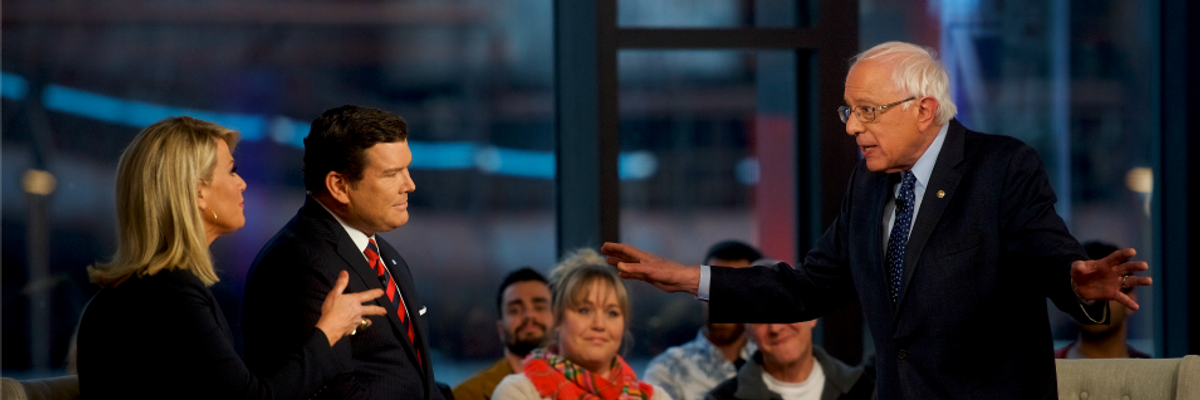
Democratic presidential candidate Sen. Bernie Sanders (I-Vt.) participates in a Fox News town hall on April 15, 2019, in Bethlehem, Pennsylvania. (Photo: Mark Makela/Getty Images)
Many otherwise well-meaning Americans have succumbed to a phenomenon I call "Electoral College Mindset." The reasons are totally understandable--partly because of our terrible system, and partly because of Republican social engineering, the concepts of "red" and "blue" America resonate like never before. There's a perceived cultural divide that seems unbridgeable, and it's manipulated our brains into accepting a prevailing narrative of "two Americas."
When we suffer from Electoral College Mindset, we believe implicitly that voters from Louisiana, to use an example, are worthless, because that state's electoral votes likely won't go to a Democratic candidate in the near future. And while that conclusion is true, it ignores the fact that 38.5% of Louisianans who voted in the last presidential election--almost one million people--chose the Democratic candidate. Not enough to win the state, of course, but enough to show that progressive ideas are far from dead, and enough to make it clear that victories are possible in local and state-wide and even U.S. Senate elections. By ignoring those people, we ignore the future. Electoral College Mindset is why Republicans have dominated state legislatures, governor's mansions, and both chambers of Congress for so long--Democrats cede turf, and they do it constantly.
But Electoral College Mindset doesn't just influence our thoughts on elections--it influences how we feel about messaging. When Bernie Sanders went on Fox News in April for an hour-long town hall, many pundits and voters called him out for "normalizing" the conservative news network, rather than recognizing the opportunity the appearance presented. Fox News doesn't need Bernie Sanders to be normalized, but Bernie Sanders does need Fox News in order to get any progressive ideas broadcast on that network, which is otherwise a cesspool of Trumpian Republican thought.
You tell me: Who really benefited the most?
Can you imagine, in the absence of a Sanders town hall, ever seeing something like this on Fox News:
It would be impossible. But if Sanders had refused to go on the network, he'd have forfeited the opportunity to spread his message to Fox News viewers. If you think he should have refused anyway, then you fundamentally have given up a certain segment of our population for (political) dead. You don't think they're worth your time, and you suffer from Electoral College Mindset. Elizabeth Warren refused a similar offer, and I think it was a big mistake--even if her intentions were good.
A similar narrative arose this week when Bernie Sanders appeared on the Joe Rogan Experience, an audio and video podcast that is among the world's most popular, and yields tens of millions of listens every month. Rogan is not a Fox News conservative, by any means, but he has hosted figures like Alex Jones, Milo Yiannopoulos, Steven Crowder, and Ben Shapiro without condemning them. As Rob Rousseau pointed out on Twitter, Rogan's style is "interested," and pro-free speech to an extreme degree, and he's not one for confrontation:
He also has an enormous, diverse audience that includes the kind of people who may be politically disaffected and even vulnerable to alt-right messaging. Again, if you believe these people are beyond reach, then it's easy to argue that Bernie's appearance with Rogan--an appearance which has netted 4.4 million views already, as of this writing--somehow normalizes alt-right figures who have sat in the same chair. But if you believe that an authentic, directed message can reach many of Rogan's listeners, then Sanders' appearance easily outweighs those considerations, and the decision to join Rogan becomes a no-brainer.
Ultimately, this is about reach. Electoral College Mindset has led us to believe that there are certain demographics who are lost to us totally, but this is ridiculous on its face--consider how many people in our nation voted for both Obama and Trump, and you'll know how changeable we are from one moment to the next. Sanders' core ideas like Medicare for All and cancellation of student debt are bound to appeal to a wide audience, and not necessarily a predictable one. For him to turn down a chance to reach a portion of that audience would be an error. And the fact is, the people responded There's no doubt that Sanders won votes yesterday, and heightened his own profile and the profile of progressive politics in the process.
That's what democracy should be, and exposing Fox News viewers or Joe Rogan listeners to progressive ideas is not just the right choice--it's the critical choice.
Watch the podcast below:
Dear Common Dreams reader, It’s been nearly 30 years since I co-founded Common Dreams with my late wife, Lina Newhouser. We had the radical notion that journalism should serve the public good, not corporate profits. It was clear to us from the outset what it would take to build such a project. No paid advertisements. No corporate sponsors. No millionaire publisher telling us what to think or do. Many people said we wouldn't last a year, but we proved those doubters wrong. Together with a tremendous team of journalists and dedicated staff, we built an independent media outlet free from the constraints of profits and corporate control. Our mission has always been simple: To inform. To inspire. To ignite change for the common good. Building Common Dreams was not easy. Our survival was never guaranteed. When you take on the most powerful forces—Wall Street greed, fossil fuel industry destruction, Big Tech lobbyists, and uber-rich oligarchs who have spent billions upon billions rigging the economy and democracy in their favor—the only bulwark you have is supporters who believe in your work. But here’s the urgent message from me today. It's never been this bad out there. And it's never been this hard to keep us going. At the very moment Common Dreams is most needed, the threats we face are intensifying. We need your support now more than ever. We don't accept corporate advertising and never will. We don't have a paywall because we don't think people should be blocked from critical news based on their ability to pay. Everything we do is funded by the donations of readers like you. When everyone does the little they can afford, we are strong. But if that support retreats or dries up, so do we. Will you donate now to make sure Common Dreams not only survives but thrives? —Craig Brown, Co-founder |
Many otherwise well-meaning Americans have succumbed to a phenomenon I call "Electoral College Mindset." The reasons are totally understandable--partly because of our terrible system, and partly because of Republican social engineering, the concepts of "red" and "blue" America resonate like never before. There's a perceived cultural divide that seems unbridgeable, and it's manipulated our brains into accepting a prevailing narrative of "two Americas."
When we suffer from Electoral College Mindset, we believe implicitly that voters from Louisiana, to use an example, are worthless, because that state's electoral votes likely won't go to a Democratic candidate in the near future. And while that conclusion is true, it ignores the fact that 38.5% of Louisianans who voted in the last presidential election--almost one million people--chose the Democratic candidate. Not enough to win the state, of course, but enough to show that progressive ideas are far from dead, and enough to make it clear that victories are possible in local and state-wide and even U.S. Senate elections. By ignoring those people, we ignore the future. Electoral College Mindset is why Republicans have dominated state legislatures, governor's mansions, and both chambers of Congress for so long--Democrats cede turf, and they do it constantly.
But Electoral College Mindset doesn't just influence our thoughts on elections--it influences how we feel about messaging. When Bernie Sanders went on Fox News in April for an hour-long town hall, many pundits and voters called him out for "normalizing" the conservative news network, rather than recognizing the opportunity the appearance presented. Fox News doesn't need Bernie Sanders to be normalized, but Bernie Sanders does need Fox News in order to get any progressive ideas broadcast on that network, which is otherwise a cesspool of Trumpian Republican thought.
You tell me: Who really benefited the most?
Can you imagine, in the absence of a Sanders town hall, ever seeing something like this on Fox News:
It would be impossible. But if Sanders had refused to go on the network, he'd have forfeited the opportunity to spread his message to Fox News viewers. If you think he should have refused anyway, then you fundamentally have given up a certain segment of our population for (political) dead. You don't think they're worth your time, and you suffer from Electoral College Mindset. Elizabeth Warren refused a similar offer, and I think it was a big mistake--even if her intentions were good.
A similar narrative arose this week when Bernie Sanders appeared on the Joe Rogan Experience, an audio and video podcast that is among the world's most popular, and yields tens of millions of listens every month. Rogan is not a Fox News conservative, by any means, but he has hosted figures like Alex Jones, Milo Yiannopoulos, Steven Crowder, and Ben Shapiro without condemning them. As Rob Rousseau pointed out on Twitter, Rogan's style is "interested," and pro-free speech to an extreme degree, and he's not one for confrontation:
He also has an enormous, diverse audience that includes the kind of people who may be politically disaffected and even vulnerable to alt-right messaging. Again, if you believe these people are beyond reach, then it's easy to argue that Bernie's appearance with Rogan--an appearance which has netted 4.4 million views already, as of this writing--somehow normalizes alt-right figures who have sat in the same chair. But if you believe that an authentic, directed message can reach many of Rogan's listeners, then Sanders' appearance easily outweighs those considerations, and the decision to join Rogan becomes a no-brainer.
Ultimately, this is about reach. Electoral College Mindset has led us to believe that there are certain demographics who are lost to us totally, but this is ridiculous on its face--consider how many people in our nation voted for both Obama and Trump, and you'll know how changeable we are from one moment to the next. Sanders' core ideas like Medicare for All and cancellation of student debt are bound to appeal to a wide audience, and not necessarily a predictable one. For him to turn down a chance to reach a portion of that audience would be an error. And the fact is, the people responded There's no doubt that Sanders won votes yesterday, and heightened his own profile and the profile of progressive politics in the process.
That's what democracy should be, and exposing Fox News viewers or Joe Rogan listeners to progressive ideas is not just the right choice--it's the critical choice.
Watch the podcast below:
Many otherwise well-meaning Americans have succumbed to a phenomenon I call "Electoral College Mindset." The reasons are totally understandable--partly because of our terrible system, and partly because of Republican social engineering, the concepts of "red" and "blue" America resonate like never before. There's a perceived cultural divide that seems unbridgeable, and it's manipulated our brains into accepting a prevailing narrative of "two Americas."
When we suffer from Electoral College Mindset, we believe implicitly that voters from Louisiana, to use an example, are worthless, because that state's electoral votes likely won't go to a Democratic candidate in the near future. And while that conclusion is true, it ignores the fact that 38.5% of Louisianans who voted in the last presidential election--almost one million people--chose the Democratic candidate. Not enough to win the state, of course, but enough to show that progressive ideas are far from dead, and enough to make it clear that victories are possible in local and state-wide and even U.S. Senate elections. By ignoring those people, we ignore the future. Electoral College Mindset is why Republicans have dominated state legislatures, governor's mansions, and both chambers of Congress for so long--Democrats cede turf, and they do it constantly.
But Electoral College Mindset doesn't just influence our thoughts on elections--it influences how we feel about messaging. When Bernie Sanders went on Fox News in April for an hour-long town hall, many pundits and voters called him out for "normalizing" the conservative news network, rather than recognizing the opportunity the appearance presented. Fox News doesn't need Bernie Sanders to be normalized, but Bernie Sanders does need Fox News in order to get any progressive ideas broadcast on that network, which is otherwise a cesspool of Trumpian Republican thought.
You tell me: Who really benefited the most?
Can you imagine, in the absence of a Sanders town hall, ever seeing something like this on Fox News:
It would be impossible. But if Sanders had refused to go on the network, he'd have forfeited the opportunity to spread his message to Fox News viewers. If you think he should have refused anyway, then you fundamentally have given up a certain segment of our population for (political) dead. You don't think they're worth your time, and you suffer from Electoral College Mindset. Elizabeth Warren refused a similar offer, and I think it was a big mistake--even if her intentions were good.
A similar narrative arose this week when Bernie Sanders appeared on the Joe Rogan Experience, an audio and video podcast that is among the world's most popular, and yields tens of millions of listens every month. Rogan is not a Fox News conservative, by any means, but he has hosted figures like Alex Jones, Milo Yiannopoulos, Steven Crowder, and Ben Shapiro without condemning them. As Rob Rousseau pointed out on Twitter, Rogan's style is "interested," and pro-free speech to an extreme degree, and he's not one for confrontation:
He also has an enormous, diverse audience that includes the kind of people who may be politically disaffected and even vulnerable to alt-right messaging. Again, if you believe these people are beyond reach, then it's easy to argue that Bernie's appearance with Rogan--an appearance which has netted 4.4 million views already, as of this writing--somehow normalizes alt-right figures who have sat in the same chair. But if you believe that an authentic, directed message can reach many of Rogan's listeners, then Sanders' appearance easily outweighs those considerations, and the decision to join Rogan becomes a no-brainer.
Ultimately, this is about reach. Electoral College Mindset has led us to believe that there are certain demographics who are lost to us totally, but this is ridiculous on its face--consider how many people in our nation voted for both Obama and Trump, and you'll know how changeable we are from one moment to the next. Sanders' core ideas like Medicare for All and cancellation of student debt are bound to appeal to a wide audience, and not necessarily a predictable one. For him to turn down a chance to reach a portion of that audience would be an error. And the fact is, the people responded There's no doubt that Sanders won votes yesterday, and heightened his own profile and the profile of progressive politics in the process.
That's what democracy should be, and exposing Fox News viewers or Joe Rogan listeners to progressive ideas is not just the right choice--it's the critical choice.
Watch the podcast below: