SUBSCRIBE TO OUR FREE NEWSLETTER
Daily news & progressive opinion—funded by the people, not the corporations—delivered straight to your inbox.
5
#000000
#FFFFFF
To donate by check, phone, or other method, see our More Ways to Give page.
Daily news & progressive opinion—funded by the people, not the corporations—delivered straight to your inbox.
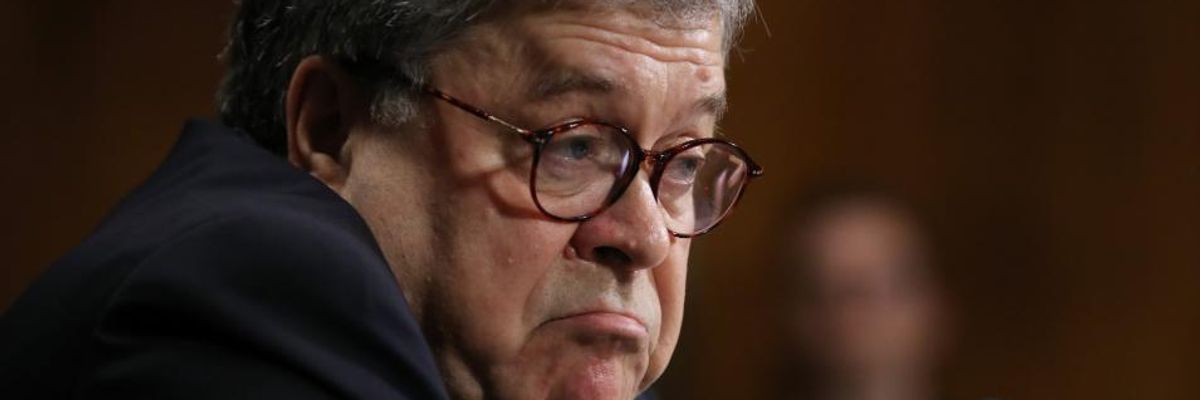
U.S. Attorney General William Barr testifies before the Senate Judiciary Committee May 1, 2019 in Washington, DC. Barr testified on the Justice Department's investigation of Russian interference with the 2016 presidential election. (Photo: Win McNamee/Getty Images)
On Sunday, the chairman of the House Judiciary Committee threatened to subpoena Attorney General William P. Barr if he refuses to testify this week about the Mueller report.
But a subpoena is unlikely to elicit Barr's cooperation. "We're fighting all the subpoenas," says the President of the United States.
In other words, according to Trump, there is to be no congressional oversight of this administration: No questioning the Attorney General about the Mueller Report. No questioning a Trump adviser about immigration policy.
No questioning a former White House security director about issuances of security clearances. No questioning anyone about presidential tax returns.
Such a blanket edict fits a dictator of a banana republic, not the president of a constitutional republic founded on separation of powers.
If Congress cannot question the people who are making policy, or obtain critical documents, Congress cannot function as a coequal branch of government.
If Congress cannot get information about the executive branch, there is no longer any separation of powers, as sanctified in the US constitution.
There is only one power--the power of the president to rule as he wishes. Which is what Donald Trump has sought all along.
The only relevant question is how to stop this dictatorial move.
Presidents before Trump occasionally have argued that complying with a particular subpoena for a particular person or document would infringe upon confidential deliberations within the executive branch.
But no president before Trump has used "executive privilege" as a blanket refusal to cooperate.
"If Mr. Barr does not show up," the chairman of the House Judiciary Committee said Sunday, "we will have to use whatever means we can to enforce the subpoena."
What could the Committee do? Hold Barr in contempt of Congress--under Congress's inherent power to get the information it needs to carry out its constitutional duties. Congress cannot function without this power.
Under this inherent power, the House can order its own sergeant-at-arms to arrest the offender, subject him to a trial before the full House, and, if judged to be in contempt, jail that person until he appears before the House and brings whatever documentation the House has subpoenaed.
When President Richard Nixon tried to stop key aides from testifying in the Senate Watergate hearings, in 1973, Senator Sam Ervin, chairman of the Watergate select committee, threatened to jail anyone who refused to appear.
Congress hasn't actually carried through on the threat since 1935--but it could.
Would America really be subject to the wild spectacle of the sergeant-at-arms of the House arresting an Attorney General and possibly placing him in jail?
Probably not. Before that ever occurred, the Trump administration would take the matter to the Supreme Court on an expedited basis.
Sadly, there seems no other way to get Trump to move. Putting the onus on the Trump administration to get the issue to the court as soon as possible is the only way to force Trump into action, and not simply seek to run out the clock before the next election.
What would the court decide? With two Trump appointees now filling nine of the seats, it's hardly a certainty.
But in a case that grew out of the Teapot Dome scandal in 1927, the court held that the investigative power of Congress is at its peak when lawmakers look into fraud or maladministration in another government department.
Decades later, when Richard Nixon tried to block the release of incriminating recordings of his discussions with aides, the Supreme Court decided that a claim of executive privilege did not protect information relevant to the investigation of potential crimes.
Trump's contempt for the inherent power of Congress cannot stand. It is the most dictatorial move he has initiated since becoming president.
Dear Common Dreams reader, It’s been nearly 30 years since I co-founded Common Dreams with my late wife, Lina Newhouser. We had the radical notion that journalism should serve the public good, not corporate profits. It was clear to us from the outset what it would take to build such a project. No paid advertisements. No corporate sponsors. No millionaire publisher telling us what to think or do. Many people said we wouldn't last a year, but we proved those doubters wrong. Together with a tremendous team of journalists and dedicated staff, we built an independent media outlet free from the constraints of profits and corporate control. Our mission has always been simple: To inform. To inspire. To ignite change for the common good. Building Common Dreams was not easy. Our survival was never guaranteed. When you take on the most powerful forces—Wall Street greed, fossil fuel industry destruction, Big Tech lobbyists, and uber-rich oligarchs who have spent billions upon billions rigging the economy and democracy in their favor—the only bulwark you have is supporters who believe in your work. But here’s the urgent message from me today. It's never been this bad out there. And it's never been this hard to keep us going. At the very moment Common Dreams is most needed, the threats we face are intensifying. We need your support now more than ever. We don't accept corporate advertising and never will. We don't have a paywall because we don't think people should be blocked from critical news based on their ability to pay. Everything we do is funded by the donations of readers like you. When everyone does the little they can afford, we are strong. But if that support retreats or dries up, so do we. Will you donate now to make sure Common Dreams not only survives but thrives? —Craig Brown, Co-founder |
On Sunday, the chairman of the House Judiciary Committee threatened to subpoena Attorney General William P. Barr if he refuses to testify this week about the Mueller report.
But a subpoena is unlikely to elicit Barr's cooperation. "We're fighting all the subpoenas," says the President of the United States.
In other words, according to Trump, there is to be no congressional oversight of this administration: No questioning the Attorney General about the Mueller Report. No questioning a Trump adviser about immigration policy.
No questioning a former White House security director about issuances of security clearances. No questioning anyone about presidential tax returns.
Such a blanket edict fits a dictator of a banana republic, not the president of a constitutional republic founded on separation of powers.
If Congress cannot question the people who are making policy, or obtain critical documents, Congress cannot function as a coequal branch of government.
If Congress cannot get information about the executive branch, there is no longer any separation of powers, as sanctified in the US constitution.
There is only one power--the power of the president to rule as he wishes. Which is what Donald Trump has sought all along.
The only relevant question is how to stop this dictatorial move.
Presidents before Trump occasionally have argued that complying with a particular subpoena for a particular person or document would infringe upon confidential deliberations within the executive branch.
But no president before Trump has used "executive privilege" as a blanket refusal to cooperate.
"If Mr. Barr does not show up," the chairman of the House Judiciary Committee said Sunday, "we will have to use whatever means we can to enforce the subpoena."
What could the Committee do? Hold Barr in contempt of Congress--under Congress's inherent power to get the information it needs to carry out its constitutional duties. Congress cannot function without this power.
Under this inherent power, the House can order its own sergeant-at-arms to arrest the offender, subject him to a trial before the full House, and, if judged to be in contempt, jail that person until he appears before the House and brings whatever documentation the House has subpoenaed.
When President Richard Nixon tried to stop key aides from testifying in the Senate Watergate hearings, in 1973, Senator Sam Ervin, chairman of the Watergate select committee, threatened to jail anyone who refused to appear.
Congress hasn't actually carried through on the threat since 1935--but it could.
Would America really be subject to the wild spectacle of the sergeant-at-arms of the House arresting an Attorney General and possibly placing him in jail?
Probably not. Before that ever occurred, the Trump administration would take the matter to the Supreme Court on an expedited basis.
Sadly, there seems no other way to get Trump to move. Putting the onus on the Trump administration to get the issue to the court as soon as possible is the only way to force Trump into action, and not simply seek to run out the clock before the next election.
What would the court decide? With two Trump appointees now filling nine of the seats, it's hardly a certainty.
But in a case that grew out of the Teapot Dome scandal in 1927, the court held that the investigative power of Congress is at its peak when lawmakers look into fraud or maladministration in another government department.
Decades later, when Richard Nixon tried to block the release of incriminating recordings of his discussions with aides, the Supreme Court decided that a claim of executive privilege did not protect information relevant to the investigation of potential crimes.
Trump's contempt for the inherent power of Congress cannot stand. It is the most dictatorial move he has initiated since becoming president.
On Sunday, the chairman of the House Judiciary Committee threatened to subpoena Attorney General William P. Barr if he refuses to testify this week about the Mueller report.
But a subpoena is unlikely to elicit Barr's cooperation. "We're fighting all the subpoenas," says the President of the United States.
In other words, according to Trump, there is to be no congressional oversight of this administration: No questioning the Attorney General about the Mueller Report. No questioning a Trump adviser about immigration policy.
No questioning a former White House security director about issuances of security clearances. No questioning anyone about presidential tax returns.
Such a blanket edict fits a dictator of a banana republic, not the president of a constitutional republic founded on separation of powers.
If Congress cannot question the people who are making policy, or obtain critical documents, Congress cannot function as a coequal branch of government.
If Congress cannot get information about the executive branch, there is no longer any separation of powers, as sanctified in the US constitution.
There is only one power--the power of the president to rule as he wishes. Which is what Donald Trump has sought all along.
The only relevant question is how to stop this dictatorial move.
Presidents before Trump occasionally have argued that complying with a particular subpoena for a particular person or document would infringe upon confidential deliberations within the executive branch.
But no president before Trump has used "executive privilege" as a blanket refusal to cooperate.
"If Mr. Barr does not show up," the chairman of the House Judiciary Committee said Sunday, "we will have to use whatever means we can to enforce the subpoena."
What could the Committee do? Hold Barr in contempt of Congress--under Congress's inherent power to get the information it needs to carry out its constitutional duties. Congress cannot function without this power.
Under this inherent power, the House can order its own sergeant-at-arms to arrest the offender, subject him to a trial before the full House, and, if judged to be in contempt, jail that person until he appears before the House and brings whatever documentation the House has subpoenaed.
When President Richard Nixon tried to stop key aides from testifying in the Senate Watergate hearings, in 1973, Senator Sam Ervin, chairman of the Watergate select committee, threatened to jail anyone who refused to appear.
Congress hasn't actually carried through on the threat since 1935--but it could.
Would America really be subject to the wild spectacle of the sergeant-at-arms of the House arresting an Attorney General and possibly placing him in jail?
Probably not. Before that ever occurred, the Trump administration would take the matter to the Supreme Court on an expedited basis.
Sadly, there seems no other way to get Trump to move. Putting the onus on the Trump administration to get the issue to the court as soon as possible is the only way to force Trump into action, and not simply seek to run out the clock before the next election.
What would the court decide? With two Trump appointees now filling nine of the seats, it's hardly a certainty.
But in a case that grew out of the Teapot Dome scandal in 1927, the court held that the investigative power of Congress is at its peak when lawmakers look into fraud or maladministration in another government department.
Decades later, when Richard Nixon tried to block the release of incriminating recordings of his discussions with aides, the Supreme Court decided that a claim of executive privilege did not protect information relevant to the investigation of potential crimes.
Trump's contempt for the inherent power of Congress cannot stand. It is the most dictatorial move he has initiated since becoming president.