SUBSCRIBE TO OUR FREE NEWSLETTER
Daily news & progressive opinion—funded by the people, not the corporations—delivered straight to your inbox.
5
#000000
#FFFFFF
To donate by check, phone, or other method, see our More Ways to Give page.
Daily news & progressive opinion—funded by the people, not the corporations—delivered straight to your inbox.
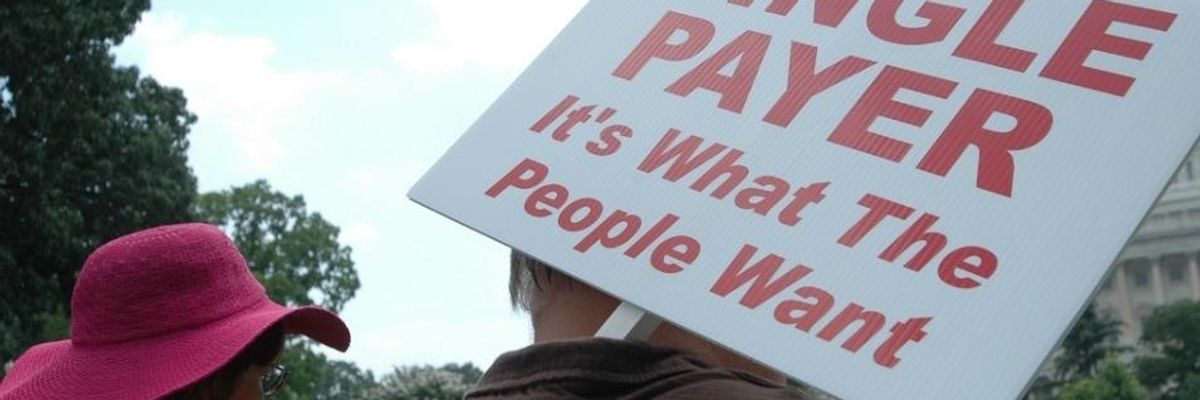
Very quickly, peace of mind will overwhelm that forgotten desire to keep your private insurance.(Photo: Joe Newman via Public Citizen/flickr/cc)
With so much written about the politics and some about the policy of Medicare for All, it seems we're having a real debate about the key issues.
But appearances deceive.
Instead, it's more of a struggle over the semantics of "Medicare" - #M4A - is it for America or is it for All? Proponents of "Medicare for America," the latest talking point elevated to policy - "you can keep your private insurance!" - claim that it provides universal coverage, and thus insures everyone has healthcare.
But is universal coverage guaranteed healthcare?
To address that question means actually debating the role of US based private insurance, it's business model, relationship to the healthcare industry and finance sector. This approach reveals much more about the bi-partisan politics and policy choices of healthcare reform.
If proponents of Medicare for America had to honestly address the primary elements of the health insurers' business model, it would be tough to defend:
So then, do you continue to enrich the insurance companies by promoting the growth of for-profit Medicare Advantage plans (as the Medicare for America proposal calls for), and subsidize their revenue model with unregulated premiums and high out of pocket costs (a $5,000 "limit" as proposed is a lot to the 78% of people living paycheck to paycheck, and the 40% who don't have more than $400 in the bank).
A real debate would be about regulating the insurers vs eliminating their role as profit-making intermediaries. Either defend the commercial health insurance business model, or explain how your M4A changes it.
If the real goal of Medicare for America is to unwind these practices, the incremental approach undermines the prospects for success. As we saw during the four year roll-out of the Affordable Care Act vs the efficient, ten month transition to Medicare, lots of lies can be told, the industry can game the system, and opposition can organize. Rather than contort policy into some hybrid, multi-payer regulatory scheme that generates complexity, fragmentation and waste, as it enshrines profit-making and high out of pocket costs, let's stop the care denials and the insurance company dictates to doctors and patients.
Medicare for All represents the best M4A way: lead and be swift. Don't tell... show. Yes, your premiums are gone, your co-pay to see the doctor is eliminated, you don't have to worry about your deductible or wait for insurance company approval to get that test.
Very quickly, peace of mind will overwhelm that forgotten desire to keep your private insurance.
Ahhh, freedom.
Dear Common Dreams reader, It’s been nearly 30 years since I co-founded Common Dreams with my late wife, Lina Newhouser. We had the radical notion that journalism should serve the public good, not corporate profits. It was clear to us from the outset what it would take to build such a project. No paid advertisements. No corporate sponsors. No millionaire publisher telling us what to think or do. Many people said we wouldn't last a year, but we proved those doubters wrong. Together with a tremendous team of journalists and dedicated staff, we built an independent media outlet free from the constraints of profits and corporate control. Our mission has always been simple: To inform. To inspire. To ignite change for the common good. Building Common Dreams was not easy. Our survival was never guaranteed. When you take on the most powerful forces—Wall Street greed, fossil fuel industry destruction, Big Tech lobbyists, and uber-rich oligarchs who have spent billions upon billions rigging the economy and democracy in their favor—the only bulwark you have is supporters who believe in your work. But here’s the urgent message from me today. It's never been this bad out there. And it's never been this hard to keep us going. At the very moment Common Dreams is most needed, the threats we face are intensifying. We need your support now more than ever. We don't accept corporate advertising and never will. We don't have a paywall because we don't think people should be blocked from critical news based on their ability to pay. Everything we do is funded by the donations of readers like you. When everyone does the little they can afford, we are strong. But if that support retreats or dries up, so do we. Will you donate now to make sure Common Dreams not only survives but thrives? —Craig Brown, Co-founder |
With so much written about the politics and some about the policy of Medicare for All, it seems we're having a real debate about the key issues.
But appearances deceive.
Instead, it's more of a struggle over the semantics of "Medicare" - #M4A - is it for America or is it for All? Proponents of "Medicare for America," the latest talking point elevated to policy - "you can keep your private insurance!" - claim that it provides universal coverage, and thus insures everyone has healthcare.
But is universal coverage guaranteed healthcare?
To address that question means actually debating the role of US based private insurance, it's business model, relationship to the healthcare industry and finance sector. This approach reveals much more about the bi-partisan politics and policy choices of healthcare reform.
If proponents of Medicare for America had to honestly address the primary elements of the health insurers' business model, it would be tough to defend:
So then, do you continue to enrich the insurance companies by promoting the growth of for-profit Medicare Advantage plans (as the Medicare for America proposal calls for), and subsidize their revenue model with unregulated premiums and high out of pocket costs (a $5,000 "limit" as proposed is a lot to the 78% of people living paycheck to paycheck, and the 40% who don't have more than $400 in the bank).
A real debate would be about regulating the insurers vs eliminating their role as profit-making intermediaries. Either defend the commercial health insurance business model, or explain how your M4A changes it.
If the real goal of Medicare for America is to unwind these practices, the incremental approach undermines the prospects for success. As we saw during the four year roll-out of the Affordable Care Act vs the efficient, ten month transition to Medicare, lots of lies can be told, the industry can game the system, and opposition can organize. Rather than contort policy into some hybrid, multi-payer regulatory scheme that generates complexity, fragmentation and waste, as it enshrines profit-making and high out of pocket costs, let's stop the care denials and the insurance company dictates to doctors and patients.
Medicare for All represents the best M4A way: lead and be swift. Don't tell... show. Yes, your premiums are gone, your co-pay to see the doctor is eliminated, you don't have to worry about your deductible or wait for insurance company approval to get that test.
Very quickly, peace of mind will overwhelm that forgotten desire to keep your private insurance.
Ahhh, freedom.
With so much written about the politics and some about the policy of Medicare for All, it seems we're having a real debate about the key issues.
But appearances deceive.
Instead, it's more of a struggle over the semantics of "Medicare" - #M4A - is it for America or is it for All? Proponents of "Medicare for America," the latest talking point elevated to policy - "you can keep your private insurance!" - claim that it provides universal coverage, and thus insures everyone has healthcare.
But is universal coverage guaranteed healthcare?
To address that question means actually debating the role of US based private insurance, it's business model, relationship to the healthcare industry and finance sector. This approach reveals much more about the bi-partisan politics and policy choices of healthcare reform.
If proponents of Medicare for America had to honestly address the primary elements of the health insurers' business model, it would be tough to defend:
So then, do you continue to enrich the insurance companies by promoting the growth of for-profit Medicare Advantage plans (as the Medicare for America proposal calls for), and subsidize their revenue model with unregulated premiums and high out of pocket costs (a $5,000 "limit" as proposed is a lot to the 78% of people living paycheck to paycheck, and the 40% who don't have more than $400 in the bank).
A real debate would be about regulating the insurers vs eliminating their role as profit-making intermediaries. Either defend the commercial health insurance business model, or explain how your M4A changes it.
If the real goal of Medicare for America is to unwind these practices, the incremental approach undermines the prospects for success. As we saw during the four year roll-out of the Affordable Care Act vs the efficient, ten month transition to Medicare, lots of lies can be told, the industry can game the system, and opposition can organize. Rather than contort policy into some hybrid, multi-payer regulatory scheme that generates complexity, fragmentation and waste, as it enshrines profit-making and high out of pocket costs, let's stop the care denials and the insurance company dictates to doctors and patients.
Medicare for All represents the best M4A way: lead and be swift. Don't tell... show. Yes, your premiums are gone, your co-pay to see the doctor is eliminated, you don't have to worry about your deductible or wait for insurance company approval to get that test.
Very quickly, peace of mind will overwhelm that forgotten desire to keep your private insurance.
Ahhh, freedom.