

SUBSCRIBE TO OUR FREE NEWSLETTER
Daily news & progressive opinion—funded by the people, not the corporations—delivered straight to your inbox.
5
#000000
#FFFFFF
To donate by check, phone, or other method, see our More Ways to Give page.
Daily news & progressive opinion—funded by the people, not the corporations—delivered straight to your inbox.

Universal healthcare campaigners in California on Monday unveiled a tool they say shows how most working families would save at least hundreds--and likely thousands--of dollars each year if the state implements a Medicare for All-type system.
"Every second of inaction costs hundreds of dollars, and each year of inaction has an even greater cost--4,000 lives."
The advocacy group Healthy California Now, together with National Union of Healthcare Workers and University of California, San Francisco professor and health finance expert James G. Kahn, launched a calculator that compares what individuals or families currently spend with what their costs would be under the type of Medicare for All system that Democratic Gov. Gavin Newsom campaigned on a promise to enact--but has done nothing to advance.
"It's a new day for healthcare reform in California, and working together, Californians can save our state billions, save each family thousands, and most importantly, guarantee healthcare for all so that everyone has equal access to lifesaving treatment," Healthy California Now president Michael Lighty said in a statement. "Every second of inaction costs hundreds of dollars, and each year of inaction has an even greater cost--4,000 lives."
According to the calculator, a family earning California's median annual household income of $78,600 and paying $500 in monthly health insurance premiums and $4,000 in yearly out-of-pocket costs, whose employer contributes $1,400 per month toward healthcare costs, would save nearly $16,500 every year under a Medicare for All system. An individual making $50,000 per year with a $300 monthly health insurance bill, a $500 employer pay-in, and $1,500 in self-funded healthcare expenditures would save $7,600 annually.
For an uninsured person or family earning under $50,000 with less than $2,500 in out-of-pocket healthcare spending, savings would range from hundreds to around $2,000 per year.
"Taxpayers already foot the bill for over 70% of our state's healthcare," Kahn said in a statement. "The savings we can achieve by cutting the waste in private health insurance will allow us to guarantee improved healthcare services for all Californians while also lowering costs."
"Our estimates of spending under a universal healthcare system account for the added taxes required to cover the single-payer budget, while premiums and out-of-pocket costs disappear," he added. "Overall spending for single-payer will be less than under the current system, and taxes will be higher only for very high-income earners and corporations. Thus, the vast majority of working families will save money."
Although he campaigned on a pledge to deliver single-payer healthcare, Newsom has disappointed activists by backing away from his promise and taking hundreds of thousands of dollars in campaign contributions from the private health insurance industry.
In January, A.B. 1400, a bill that would have implemented a single-payer healthcare system in California, was withdrawn from consideration in the state Assembly in an eleventh-hour move that shocked and outraged progressives who had fought for the measure.
While Newsom has expressed concerns over the cost of universal care, the governor's Healthy California for All Commission reported in April that such a system would save 4,000 lives annually and $500 billion over the next decade. Meanwhile, the commission found that healthcare costs are projected to rise 30% over the next 10 years under the current system.
Writing for Common Dreams, Lighty said in a Sunday opinion piece that the commission report "shows we simply can't afford not to adopt a universal healthcare system."
"The door to quality, universal, and affordable care is open," he wrote. "On the other side is a California where we save lives and save money by cutting out waste and bureaucracy and putting quality healthcare before private insurance company profits."
A 2020 study published in the medical journal Lancet found that Medicare for All on a national scale will save Americans $450 billion and prevent 68,000 unnecessary deaths each and every year. Last month, Common Dreams reported that a universal single-payer healthcare system such as Medicare for All could have prevented 338,000 U.S. Covid-19 deaths.
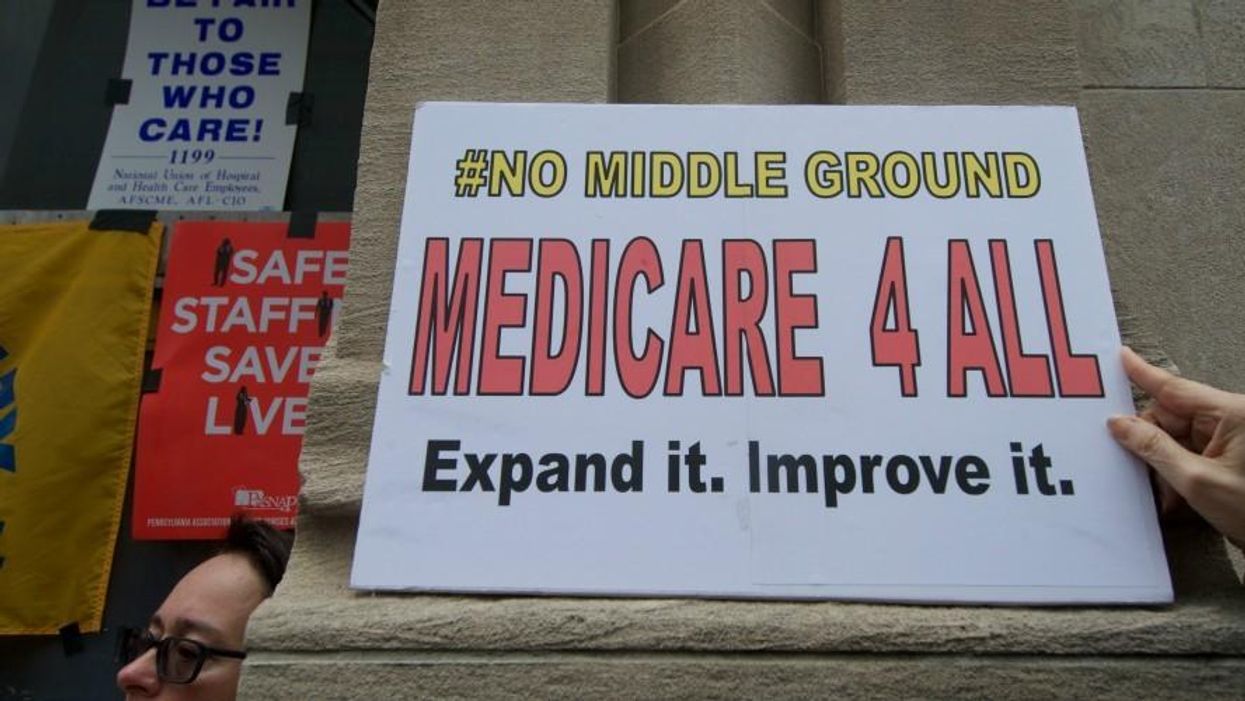
A Democratic National Committee panel on Monday voted down an amendment that would have inserted a plank supporting Medicare for All into the party's 2020 platform, a move progressives decried as out of touch with public opinion and a slap in the face to the millions of people who have lost their health insurance due to the Covid-19 pandemic.
The DNC Platform Committee rejected the Medicare for All amendment introduced by longtime single-payer advocate Michael Lighty by a vote of 36-125 during a virtual meeting Monday. The committee also voted down separate attempts to include support for expanding Medicare to children, dropping the Medicare eligibility age from 65 to 55, and legalizing marijuana.
"Shameful. And during a pandemic," tweeted progressive radio host Kyle Kulinksi in response to the defeat of the Medicare for All amendment. "History will not judge this kindly. It's like opposing the New Deal during the Great Depression. Unforgivable."
Winnie Wong, former senior adviser to Sen. Bernie Sanders' (I-Vt.) presidential campaign, tweeted late Monday that she "can't even imagine what went on in the heads of those 125 DNC Platform Committee members who voted Medicare or All down."
"The fact that our nation is the only advanced industrial country without universal healthcare cannot be blamed on Republican obstruction alone. It was also caused by Democratic leaders who've spent decades catering to corporate interests."
--Jeff Cohen, RootsAction.org
"Today. Now. When the country is in the deathgrip of a global pandemic and people are dying because they can't afford to the upkeep of their sick-care," Wong wrote. "Shameful."
Lighty said ahead of the vote that with more than 100 million people and counting either uninsured or underinsured amid a deadly pandemic, "it is vital that the Democratic Party join the NAACP, the Poor People's Campaign, the Rising Majority, Mijente, community-based organizations all over the country and demand guaranteed healthcare for all through an improved Medicare for All system."
Speaking in support of Lighty's amendment during the platform meeting Monday, Dr. Abdul El-Sayed, former health director for the city of Detroit and 2018 Michigan gubernatorial candidate, said the Covid-19 pandemic has "revealed that our house of healthcare was built of straw."
"We have a for-profit healthcare system that's left 27 million more people without healthcare because we attached healthcare to jobs," said El-Sayed.
As of late Tuesday, more than 600 DNC delegates had signed a petition vowing to vote against the Democratic platform if it doesn't include support for Medicare for All, a policy solution supported by around 80% of Democratic voters and a majority of House Democrats. Most of the petition's signatories are Sanders delegates, according to organizers, but some Biden delegates have also signed on.
Mike Casca, a spokesman for Sanders, said in a statement that the Vermont senator "believes that the Democratic Party platform should advocate strongly for Medicare for All."
"The senator appreciates that, amid a deadly pandemic which is creating a national health emergency, his delegates understand that now more than ever we must guarantee healthcare as a human right," Casca said.
The draft (pdf) version of the Democratic platform includes one mention of Medicare for All but does not endorse the policy that would provide comprehensive healthcare to everyone in the U.S. for free at the point of service.
"Generations of Democrats have been united in the fight for universal healthcare," the draft reads. "We are proud our party welcomes advocates who want to build on and strengthen the Affordable Care Act and those who support a Medicare for All approach; all are critical to ensuring that healthcare is a human right."
Progressives said the brief nod is nowhere near enough. "Democrats who understand the profound need for Medicare for All don't want a pat on the head," Norman Solomon, national director of progressive advocacy group RootsAction.org and a Sanders delegate from California, told Politico on Monday. "We want a genuine political commitment to healthcare as a human right."
In an op-ed for Common Dreams on Tuesday, RootsAction.org co-founder Jeff Cohen wrote that "the fact that our nation is the only advanced industrial country without universal healthcare cannot be blamed on Republican obstruction alone."
"It was also caused by Democratic leaders who've spent decades catering to corporate interests (while collecting their campaign donations)--and refusing to fight for universal coverage," Cohen added. "This history of Democratic obstruction and vacillation is why hundreds of elected delegates to next month's Democratic convention have put their foot down."

With comprehensive Medicare for All legislation now introduced in both chambers of Congress and bolstered by surging grassroots support, health insurance stocks are "crumbling" as investors grow increasingly fearful that single-payer could eventually become a reality.
"Together, the shares of hospitals and insurers lost $28 billion in market value on Tuesday," Bloomberg reported. "The slide in hospital and insurance stocks continued Wednesday, wiping out billions of dollars more in market value from some of the biggest health companies in the U.S."
As Bloomberg's Sahil Kapur put it on Twitter, "Health insurance stocks are in free fall as Democrats introduce 'Medicare for All' legislation in Congress and Bernie Sanders pushes it on Fox News."
University of California, Berkeley professor and economist Robert Reich argued that tumbling insurance stocks are a "[s]ign that Medicare for All is real."
"Current free-fall in health insurance stocks (Anthem, UnitedHealth, Centene, Humana, etc.) marks beginning of end of for-profit health insurance's business model of seeking healthy people and avoiding sick people," Reich tweeted.
National Nurses United, which is organizing and building support for Medicare for All nationwide, echoed Reich, saying the fall of insurance stocks is evidence that grassroots activism is having an impact.
"Insurance industry stocks dropping as the Medicare for All movement heats up--we've got some serious people power on our hands!" the group tweeted Wednesday.
As Common Dreams reported Tuesday, the insurance stock sell-off intensified after UnitedHealth Group CEO David Wichmann lashed out at Medicare for All during a call with investors, saying single-payer would "destabilize the nation's health system."
Medicare for All proponents begged to differ, arguing that the for-profit system--under which 30 million Americans are uninsured and tens of millions more are underinsured--is the actual source of instability and dysfunction.
"As usual, an insurance company CEO has got it backward--Medicare for All stabilizes healthcare for people... and disrupts the failed business model of the insurance industry," Michael Lighty, founding fellow of the Sanders Institute, told Common Dreams.
During a Fox News town hall Monday evening, Sanders--who unveiled Medicare for All legislation in the Senate--challenged the common insurance industry talking point that Medicare for All would "destabilize" healthcare for millions of Americans who are covered by employer-provided insurance plans.
"Millions of people, every single year, lose their health insurance. You know why? They get fired. Or They quit. And they go to another employer," said Sanders, a 2020 presidential contender.
"Every year, millions of workers wake up in the morning and their employer has changed the insurance that they have. So this is not new," the Vermont senator added. "Now what we're talking about actually is stability. That when you have a Medicare for All [program] it is there now and it will be there in the future."

The CEO of America's largest private insurance company faced a flood of pushback from progressives Tuesday after he launched a misleading attack on Medicare for All.
UnitedHealth Group CEO David Wichmann said during a call with investors that Medicare for All would "destabilize the nation's health system"--a common talking point that has been deployed by the right-wing media, Republicans, and establishment Democrats.
"We will end the insurance company denials of care, eliminate premiums, deductibles and co-pays, no longer allow our taxes to subsidize their profits."
--Michael Lighty
"And the inherent cost burden would surely have a severe impact on the economy and jobs--all without fundamentally increasing access to care," Wichmann said.
Under the Medicare for All plans introduced in both the House and Senate, every American would be guaranteed comprehensive health coverage. Two studies released over the past year--including one from a Koch-funded think tank--showed single-payer would result in trillions of dollars in savings compared to the current for-profit system.
"As usual, an insurance company CEO has got it backward--Medicare for All stabilizes healthcare for people, as Senator [Bernie] Sanders said last night on Fox News, and disrupts the failed business model of the insurance industry," Michael Lighty, founding fellow of the Sanders Institute, told Common Dreams.
"So yes, we will end the insurance company denials of care, eliminate premiums, deductibles, and co-pays, no longer allow our taxes to subsidize their profits," Lighty said. "We will 'destabilize' UnitedHealth's ability to enrich themselves at the expense of our healthcare."
Warren Gunnels, Sanders' staff director, added that he is not concerned about the feelings of health insurance executives.
"Whether the UnitedHealth CEO likes it or not, we will no longer tolerate a system allowing him to make $83.2 million while Americans go bankrupt when they get sick," Gunnels tweeted. "The greed of UnitedHealth is killing Americans. Together, we will end it."
Wichmann's comments came as the stocks of UnitedHealth Group and other insurance giants tumbled to 52-week lows.
"Health insurers including Anthem Inc., Humana Inc., and Cigna Corp. were down sharply Tuesday morning, as were hospitals HCA Healthcare Inc. and Community Health Systems Inc.," Bloomberg reported. "Health insurance stocks have been rattled in the first few months of 2019 as Democratic presidential contenders have emerged to back variations of Medicare for All. The sell-off has sent the S&P 500 Managed Care Index to its lowest level in nearly a year."
Politico's Dan Diamond pointed out on Twitter that UnitedHealth Group has lost $30 per share since Sen. Bernie Sanders (I-Vt.) introduced his Medicare for All bill in the Senate last week.
As Common Dreams reported last Friday, a whistleblower from UnitedHealthcare--a subsidiary of UnitedHealth Group--provided a glimpse into the company's behind-the-scenes effort to undermine Medicare for All as it continues to gain support in Congress.
"We are advocating heavily and very involved in the conversation," UnitedHealthcare CEO Steven Nelson said in remarks leaked to the Washington Post. "Part of it is trying to be thoughtful about how we enter in the conversation, because there's a risk of seeming like it's self-serving."
The anonymous whistleblower told the Post's Jeff Stein he leaked Nelson's comments because he "felt Americans needed to know exactly who it is that's fighting against the idea that healthcare is a right, not a privilege."

Arguing that piecemeal reforms to America's for-profit healthcare system will not be sufficient to address the needs of millions who are suffering due to lack of insurance and soaring drug costs, Sen. Bernie Sanders said Tuesday that the U.S. must "get rid of the insurance companies" and move to Medicare for All.
Asked by MSNBC's Chris Hayes why he favors single-payer over the incremental Medicare buy-in plans introduced by congressional Democrats in recent weeks--such as the so-called "Medicare for America" bill--Sanders said, "Because ultimately we have to recognize that the current system is incredibly dysfunctional and wasteful."
"Its goal is to make profits for the insurance companies and the drug companies," said the independent senator from Vermont. "You are not going to be able, in the long run, to have cost-effective, universal healthcare unless you change the system, unless you get rid of the insurance companies, unless you stand up to the greed of the drug companies and lower prescription drug costs."
"That's the only way that you can provide quality care to all people," Sanders continued. "All people people get it, regardless of their income. It is publicly funded. That is the most cost-effective way to provide healthcare to all."
After the Republican National Committee's (RNC) research team posted a clip of Sanders' interview on Twitter, apparently believing it would somehow harm him, the senator didn't back down from his remarks.
"You're damn right," Sanders tweeted.
Sanders' clear call for the elimination of private insurance companies comes as incremental plans are gaining appeal among some congressional Democrats and presidential candidates.
Former Texas Rep. Beto O'Rourke, a 2020 presidential contender, has expressed support for "Medicare for America," which would leave employer-provided private insurance and premiums intact.
Writing for Common Dreams on Monday, Michael Lighty--former director of public policy for the California Nurses Association and a founding fellow at the Sanders Institute, started by Sanders' wife and son--argued that Medicare for America does not adequately address soaring out-of-pocket costs because it fails to confront the private insurance industry's profit-driven business model.
"Rather than contort policy into some hybrid, multi-payer regulatory scheme that generates complexity, fragmentation and waste, as it enshrines profit-making and high out of pocket costs, let's stop the care denials and the insurance company dictates to doctors and patients," Lighty wrote. "Medicare for All represents the best M4A way: lead and be swift."
"Yes, your premiums are gone, your co-pay to see the doctor is eliminated, you don't have to worry about your deductible or wait for insurance company approval to get that test," he concluded. "Very quickly, peace of mind will overwhelm that forgotten desire to keep your private insurance."
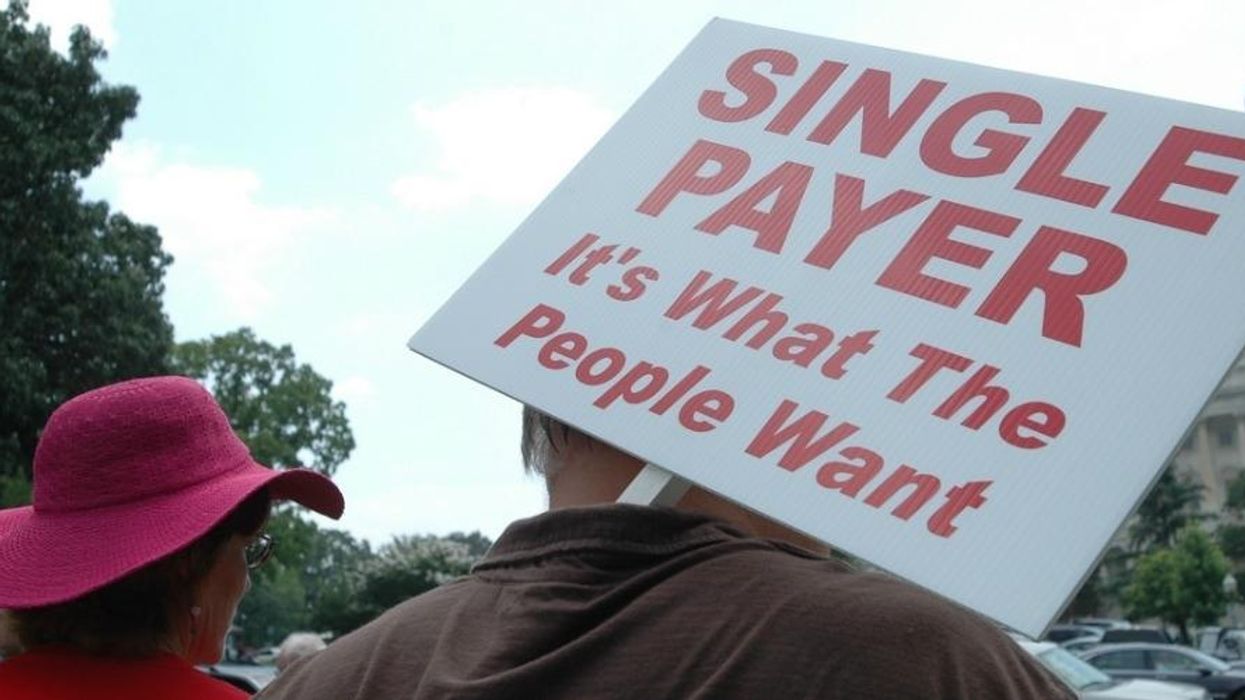
With so much written about the politics and some about the policy of Medicare for All, it seems we're having a real debate about the key issues.
But appearances deceive.
Instead, it's more of a struggle over the semantics of "Medicare" - #M4A - is it for America or is it for All? Proponents of "Medicare for America," the latest talking point elevated to policy - "you can keep your private insurance!" - claim that it provides universal coverage, and thus insures everyone has healthcare.
But is universal coverage guaranteed healthcare?
To address that question means actually debating the role of US based private insurance, it's business model, relationship to the healthcare industry and finance sector. This approach reveals much more about the bi-partisan politics and policy choices of healthcare reform.
If proponents of Medicare for America had to honestly address the primary elements of the health insurers' business model, it would be tough to defend:
So then, do you continue to enrich the insurance companies by promoting the growth of for-profit Medicare Advantage plans (as the Medicare for America proposal calls for), and subsidize their revenue model with unregulated premiums and high out of pocket costs (a $5,000 "limit" as proposed is a lot to the 78% of people living paycheck to paycheck, and the 40% who don't have more than $400 in the bank).
A real debate would be about regulating the insurers vs eliminating their role as profit-making intermediaries. Either defend the commercial health insurance business model, or explain how your M4A changes it.
If the real goal of Medicare for America is to unwind these practices, the incremental approach undermines the prospects for success. As we saw during the four year roll-out of the Affordable Care Act vs the efficient, ten month transition to Medicare, lots of lies can be told, the industry can game the system, and opposition can organize. Rather than contort policy into some hybrid, multi-payer regulatory scheme that generates complexity, fragmentation and waste, as it enshrines profit-making and high out of pocket costs, let's stop the care denials and the insurance company dictates to doctors and patients.
Medicare for All represents the best M4A way: lead and be swift. Don't tell... show. Yes, your premiums are gone, your co-pay to see the doctor is eliminated, you don't have to worry about your deductible or wait for insurance company approval to get that test.
Very quickly, peace of mind will overwhelm that forgotten desire to keep your private insurance.
Ahhh, freedom.

Support for Medicare for All is rapidly gaining momentum in Congress--and insurance investors are starting to get nervous.
Health insurance stocks tanked on Wednesday as Rep. Pramila Jayapal (D-Wash.) introduced comprehensive Medicare for All legislation with the backing of more than 100 House Democrats and major progressive organizations, including America's largest nurses' union and national consumer advocacy groups.
"The S&P 500 Managed Health Care Index plunged as much as 4.9 percent, the most since Dec. 6, led by UnitedHealth Group Inc., Humana Inc., and WellCare Health Plans Inc.," Bloomberg reported after Jayapal unveiled her bill during an event on Capitol Hill. "Insurers UnitedHealth and Cigna Corp, which also own the country's largest pharmacy benefit managers, were both down about four percent."
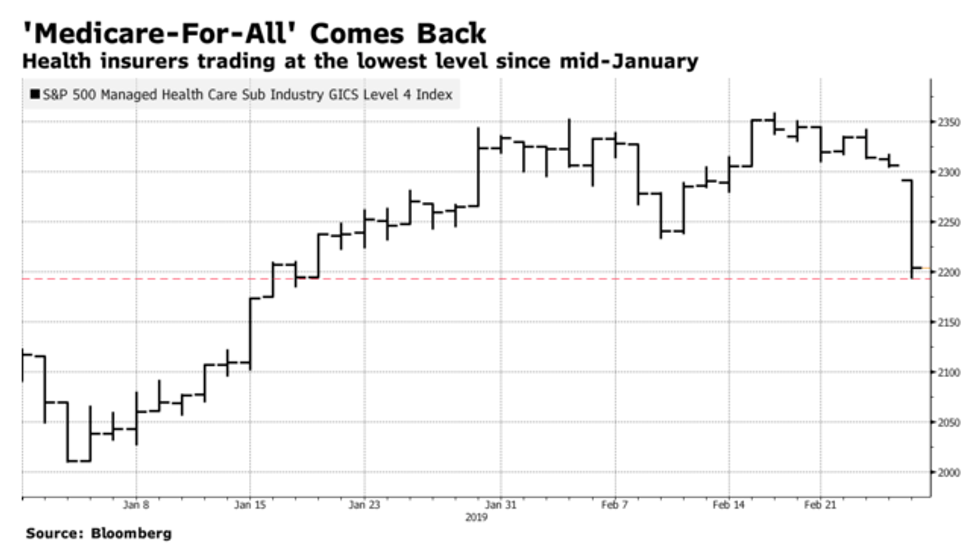
Jayapal quickly made clear that she has no sympathy for the insurance industry, tweeting in response to the news, "Sorry not sorry."
Under Jayapal's plan, the U.S. would transition to a Medicare for All system over a period of two years, and private insurance would be nearly eliminated.
Dr. Adam Gaffney, president of Physicians for a National Health Program (PNHP), said in a statement on Wednesday that the "only way to achieve universal and comprehensive coverage is to eliminate the profits and waste of the private insurance industry, which drains hundreds of billions of dollars from our healthcare system each year."
With their profits under threat, the insurance and pharmaceutical industries are mounting a full-fledged and aggressive campaign to stop Medicare for All in its tracks. The Partnership for America's Health Care Future, a coalition formed by major pharmaceutical and insurance interests, is reportedly planning a "big nationwide effort" to undermine single payer's momentum and preserve the for-profit status quo.
To overcome the opposition of the deep-pocketed insurance industry, National Nurses United (NNU) and other grassroots organizations are planning a nationwide mobilization of their own in the coming weeks in an effort to defeat corporate power with a mass movement of ordinary Americans.
"This is a milestone in the fight for universal healthcare and an equitable society, where working people make the decisions that determine our destiny," Sanders Institute fellow Michael Lighty said of Jayapal's bill. "Now our task is to build a mass organization of working people that will not give up until we win."

With Rep. Pramila Jayapal (D-Wash.) and more than 100 other House Democrats standing behind sweeping new Medicare for All legislation, advocates on Wednesday immediately mobilized to pressure lawmakers to pass the bill.
On Capitol Hill, leaders of National Nurses United unveiled their plan to initiate more than 1,500 local canvassing operations across the country to continue building grassroots momentum--tapping into the growing demand for Medicare for All among the public.
"We will continue building our Medicare for All movement. Neighbor by neighbor. Conversation by conversation, as this bill moves forward," said NNU executive director Bonnie Castillo. "And in honor of those who paid the price in an unfixable, immoral system we will win Medicare for All."
The Medicare for All advocacy blitz will include canvassing and phone banking campaigns, and follow more than 150 barnstorms organized by NNU earlier this month. Organizing efforts are currently scheduled throughout throughout the month of March and into April.
"The launch of today's bill is a monumental achievement in its own right," wrote NNU in an email to supporters. "Just a few years ago, Medicare for All was viewed as little more than a far-away dream. Virtually zero legislators supported it, and even fewer had the courage to add their name to any bills publicly."
"This is a milestone in the fight for universal healthcare and an equitable society, where working people make the decisions that determine our destiny. Now our task is to build a mass organization of working people that will not give up until we win." --Michael Lighty"But that didn't deter us. We've rallied and fought tirelessly--fueled by the belief that healthcare is a right, not a privilege--and now Medicare for All is supported by the majority of voters, the majority of Congressional Democrats, and the majority of 2020 presidential candidates," the group continued. "That's proof that our work is paying off. And this bill is our next big test."
Recent polls have shown that support for Medicare for All has grown rapidly in recent years. Seventy-one percent of Americans approved of the proposal according to a survey by Reuters last year, compared with a 2009 CBS/New York Times poll which found that only 59 percent of the public backed the idea.
Support has climbed as reports on the effects of the for-profit insurance system on American families have become more and more prevalent. NPR reported Tuesday on a recent study that showed 42 percent of Americans who were diagnosed with cancer between 2000 and 2012 drained their life savings within two years, as astronomical bills for tests and treatments piled up.
Leaders of National Nurses United, which has been fighting for Medicare for All since the group's inception more than a decade ago, gathered with the bill's sponsors on Capitol Hill as they announced the proposal.
"Here's the thing, if we can end slavery, if we can give women the right to vote, if we can send a man to the moon then God, we can do universal healthcare for every American!" said Jayapal.
The Democratic Socialists of America (DSA) also offered its endorsement of the proposal on Wednesday and announced its own nationwide mobilization to enure the bill advances through Congress.
On Thursday, DSA will kick off a tour featuring longtime Medicare for All advocate and expert Michael Lighty, who will discuss "the urgency of the moment" with supporters.
"This is a milestone in the fight for universal healthcare and an equitable society, where working people make the decisions that determine our destiny," said Lighty. "Now our task is to build a mass organization of working people that will not give up until we win."
The groups' mobilization comes as the for-profit health insurance industry--and its defenders in Congress--are preparing to launch their own fight to maintain the status quo, instead of transforming the U.S. medical system into one resembling those of other developed countries where healthcare is considered a right.
"Don't forget, when we established Social Security, Medicare, and unemployment insurance, our opponents said it was too hard, they said it was too difficult. today is not going to be any different. You're going to see probably hundreds of millions of dollars flowing in to try to kill this bill, trying to pit us against each other, telling us that it is too expensive or that you're going to give something up," Jayapal said.
"But we are ready. We can do this as long as every single person across America stands with us to organize, to fight, and to demand healthcare as a human right," she added.

On Friday, a ruling by a federal bankruptcy judge in Texas showed why retired coal miners led to believe their health benefits would be with them for life were wrong and at least one advocate for Medicare for All noted that this is just one more reason why a healthcare system that includes everyone and excludes nobody would be a lifeline for workers which capitalism has pulled the rug out from under.
"Another reason for #MedicareForAll - healthcare for retired coal miners." --Michael Lighty, Sanders Institute Fellow
As the Casper Star-Tribune in Wyoming reported over the weekend, retired union members who worked at the local Kemmerer coal mine in Lincoln Country, Wyoming "likely lost their company health benefits" after Judge David R. Jones of the U.S. Bankruptcy Court in Houston ruled that the Westmoreland Coal Co.--now up for auction under bankruptcy proceedings--could eliminate retirement health care and a union contract in order to sell the mine.
According to the Star-Tribune:
In order to sell the Kemmerer mine to new operators, Westmoreland has argued that it must eliminate union agreements that affect the nearly 300 employees of the western Wyoming mine as well as obligations to retired miners and dependents, many of whom still reside in the region.
United Mine Workers of America had argued that responsibilities to employees and former miners of Kemmerer are protected in binding contracts between the miners and owners of the mine. That argument now becomes one for a Virginia billionaire to hear instead of the judge.
That billionaire is Virginia businessman Tom Clarke, who said that while he recognizes the nullification of the coal miners' health package and union contract is "painful," it's necessary for the sale to be worthwhile to an investor like him.
"It's a story," admitted Clarke, "of Wall Street versus the average person that fully expected after putting in a lifetime of work at the mine (that) they were going to have a certain pension and a certain health package."
And even though Clarke recognized that a retired coal miner's body has taken a beating from his career--"When you are 55, you feel like you are 70," he said--the healthcare benefits are simply too expensive to continue. "We can't afford that," Clarke said, "nor could anybody else."
It's nothing new. Coal miners--who Republican lawmakers have used as pawns in their political battles for years--have repeatedly been sold out when their pensions or healthcare become a liability for mine owners or investors. As Common Dreams reported in 2016, Republicans--led by Senate Majority Leader Mitch McConnell--refused to allow a bill to protect miners' pensions receive a vote in the Senate. "We're dying like flies," said Billy Smith, a coal miner for 39 years said at the time, as he put the onus on McConnell and his fellow Republicans.
Allies of the miner workers, like Sara Nelson, president of the Association of Flight Attendants-CWA union, said the kind of joint behavior by bankrupt companies like Westmoreland and predatory investors like Clarke is a betrayal of workers who have risked their very lives while fulfilling their side of the economic agreements:
At the same time, Michael Lighty, a fellow at the progressive Sanders Institute and former public policy director for the National Nurses United (NNU), said that such rulings prove that a single-payer system is very much needed by workers who are told their healthcare needs--despite the promises made to them--are too expensive to be covered:
"Because of the inherent health risks for mine workers, we can easily see the need for a health system that guarantees they get the care they need," Lighty explained to Common Dreams in an email. "Yet, the present U.S. system cannot consistently do that. Anyone of us could suffer health consequences from our job, or be locked into a job we don't want because we need the health benefits. Only Medicare for All solves these problems, and provides the security workers need."
Lighty's tweet was subsequently shared by other leaders in the Medicare for All movement, including the Labor Campaign for Single Payer and Democratic Socialists for Medicare for All.
While Clarke stated that covering retired miners was cost prohibitive, Mike Dalpiaz, vice president of United Mine Workers of America District 22, which represents the miners in Wyoming, told the Star-Tribune that if the miners are not taken care of by somebody, there would be a major revolt among the workers still employed at the mine.
"If we get them people taken care of, Tom Clarke doesn't have to take care of them," he said. "But, somebody is going to take care of them, or that coal is not going to be mined up there. It's about that simple."
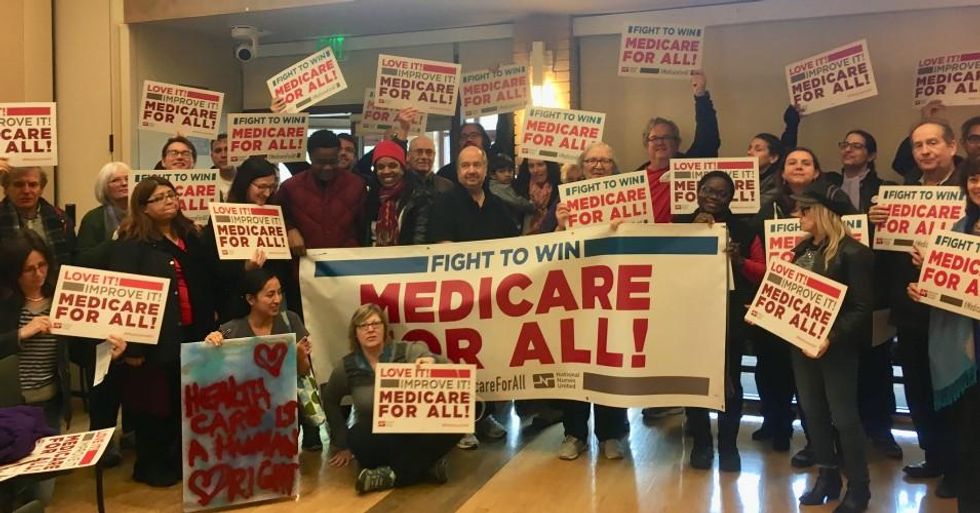
With Rep. Pramila Jayapal (D-Wash.) expected to introduce the Medicare for All Act of 2019 in the coming days, nurses, progressive activists, and ordinary people who have felt firsthand the crushing weight of America's for-profit healthcare system took part in nationwide "barnstorms" this weekend to build grassroots support for transformative change.
"Through recruitment efforts, we can make people understand, they have the power to make this happen. We don't have to resign ourselves to centrist politicians. We can take back our power!"
--Emily HibshmanFrom Texas to Kansas to California--around 150 total locations across the country--Medicare for All supporters gathered to discuss the necessity of a single-payer system that leaves no one behind, at a time when over 30 million Americans are uninsured and two-thirds of personal bankruptcies are caused by medical bills.
"I know of people with diabetes literally dying because they cannot afford their insulin. It's very scary and very real," said 30-year-old Medicare for All organizer Briana Moss, who was diagnosed with type 1 diabetes at the age of 12.
Robyn Gottlieb, who hosted a barnstorm Saturday night in Portland, Oregon, described the U.S. healthcare system as "terrible."
"We are so far behind," she added. "I feel so passionate about this movement and winning Medicare for All. People shouldn't be going bankrupt and dying. We're the generation that's going to get this done."
In addition to answering the "why" question, the Medicare for All week of action--which will continue through Feb. 13--is also aimed at detailing how to win support for single-payer at the local level, as more and more members of Congress sign on to the bold proposal.
"Next steps involve knocking on doors, phone banks--various ways of engaging our communities to get involved," said NNU executive director Bonnie Castillo, RN. "As nurses, we understand the need for guaranteed healthcare for everyone. That's why we are fighting to win Medicare for All and joining thousands at barnstorms across the country over the next few days."
Emily Hibshman, who organized a barnstorm in Allentown, Pennsylvania, argued that the "great thing about Medicare for All is that you don't just have to be progressive to support it, any average person will benefit from this."
According to recent polling, 52 percent of Republican voters--and 70 percent of Americans overall--support Medicare for All.
"That's where the power lies, in building a mass movement of all people," Hibshman said. "Through recruitment efforts, we can make people understand, they have the power to make this happen. We don't have to resign ourselves to centrist politicians. We can take back our power!"
NNU's Medicare for All week of action comes amid historic momentum for Medicare for All at the national level, with several 2020 presidential candidates expressing support for the plan as it is set to have its first-ever congressional hearings in the coming weeks.
But this surge in national attention has come with significant risks.
As Common Dreams reported, single-payer advocates have raised alarm that some politicians are using Medicare for All as a mere slogan--rather than a specific, concrete proposal--while pushing watered down public option alternatives that would leave intact some of the most harmful components of the for-profit system.
"As our momentum grows, we will be facing the concentrated power of the Medical Industrial Complex whose tentacles reach into almost one fifth of the U.S. economy."
--Benjamin Day and Mark Dudzic
"The dilution of improved Medicare for All remains the greatest threat to guaranteeing healthcare for all," Michael Lighty, a founding fellow of the Sanders Institute, told Common Dreams. "Without eliminating all barriers to care--starting with the huge out-of-pocket costs workers must pay--we cannot create a just healthcare system."
Writing for Common Dreams last week, Healthcare-NOW executive director Benjamin Day and Labor Campaign for Single-Payer Healthcare national coordinator Mark Dudzic expressed confidence that the legislation Jayapal is set to release as early as this coming week "will reflect the values of the healthcare justice movement."
"We have been involved in extensive briefings and consultations with Jayapal's staff and we want to... express our confidence that it is shaping up to be a much stronger and more detailed piece of single-payer healthcare legislation than the bills submitted in the last Congress," Day and Dudzic wrote.
"As our momentum grows, we will be facing the concentrated power of the Medical Industrial Complex whose tentacles reach into almost one fifth of the U.S. economy. In addition, we will be confronted with a Democratic establishment intent on diluting and undermining our vision," they concluded. "We will need all hands on deck to fight this two-front war."