SUBSCRIBE TO OUR FREE NEWSLETTER
Daily news & progressive opinion—funded by the people, not the corporations—delivered straight to your inbox.
5
#000000
#FFFFFF
To donate by check, phone, or other method, see our More Ways to Give page.
Daily news & progressive opinion—funded by the people, not the corporations—delivered straight to your inbox.
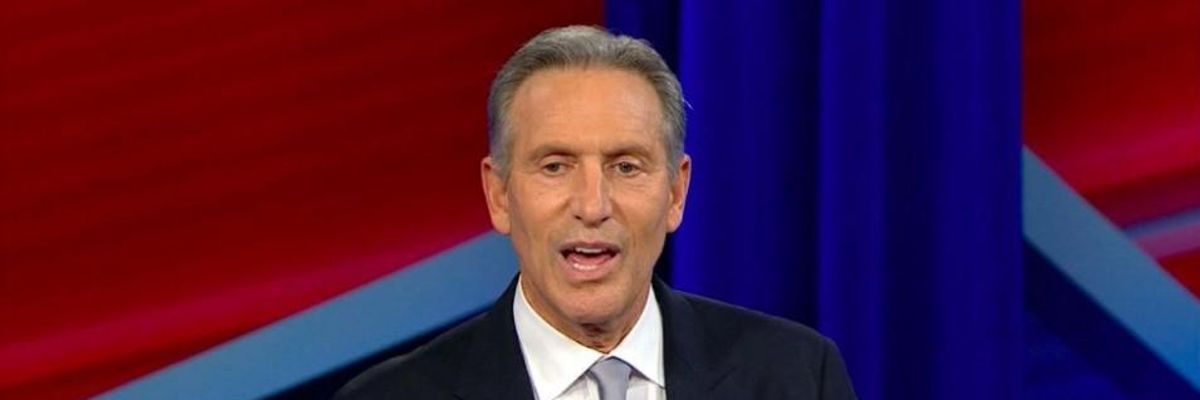
It didn't seem to occur to Schultz that America's growing incivility might be related to the frustrations of people earning coffee grinds while those at the top run off with the Super Venti Flat White. (Photo: CNN)
America is the only place in the world where any citizen over the age of 35 can run for president. No experience in government necessary. No support from a political party necessary. You don't even have to have any ideas or policy proposals.
Take Howard Schultz, the former CEO of Starbucks whose most notable achievement to date has been the Mocha Frappucinno.
Last Tuesday, CNN made Schultz a Serious Presidential Candidate by giving him an hour-long "town hall" in which he fielded questions from an audience.
Why did CNN do this? Because Schultz is worth over $3.6 billion.
It seems, all you need to get the media to anoint you is the money to buy an infinite amount of media.In today's America, someone with this much money can buy so much advertising and self-promotion that he automatically becomes a SPC just by virtue of wanting the job and having the capacity to self-finance a campaign.
Ironically, CNN and other major media are giving Schultz free media now because he can afford an almost infinite amount of paid media later.
Years ago, political parties played the major roles in selecting presidential candidates. Candidates came up through the ranks. They had to convince party leaders across the nation they had what it took to be president. Conventions were the last step in the winnowing process.
Then, over the last several decades, the media took over the job of winnowing the pack. Winners were determined largely by campaign coverage, including presidential primary debates.
Donald Trump became a SPC in 2015 not only because of his billions but also his notoriety as the star of a popular reality TV show and, before that, decades in the tabloids where he learned the art of getting media attention.
Now, it seems, all you need to get the media to anoint you is the money to buy an infinite amount of media.
Part of the reason is the dramatic escalation in presidential campaign spending.
In the 2000 election, neither George W. Bush nor Al Gore spent more than $200 million, in today's dollars. In 2008, according to the Center for Responsive Politics, the total spent by and for Barack Obama was $730 million. In 2016, total spending by Trump and Clinton came to around $1.16 billion.
At the same time, there's more money at the top to spend on politics. Michael Bloomberg, another SPC, with his own media empire, makes Schultz look like a piker by comparison. Bloomberg is worth over $40 billion, of which he's already pledged at least 1% - $400 million - to defeating Trump.
Starbucks paid its baristas an average of $9 an hour (it now pays $11, which, adjusted for inflation, isn't much more). Schultz took home $149.8 million.It's not clear if Bloomberg will run. If he does, he'll run as a Democrat. But Schultz is planning to run as an independent, so he won't even have to go through the gauntlet of primary battles.
Which means Schultz could deliver the 2020 election to Trump by siphoning off votes from the Democratic candidate.
Schultz cannot win, so why is he running? Not because he has any burning issue he wants to raise, or policy he wants to push. His interviews to date have been curiously anodyne.
Back in 2014, before anyone thought of Trump as a plausible candidate, Schultz berated the incivility he saw in American politics and called for business leaders like himself to "take the lead and do what we can to move the country forward".
Is that it? He wants more civility?
It didn't seem to occur to Schultz that America's growing incivility might be related to the frustrations of people earning coffee grinds while those at the top run off with the Super Venti Flat White.
That same year, Starbucks paid its baristas an average of $9 an hour (it now pays $11, which, adjusted for inflation, isn't much more). Schultz took home $149.8 million.
Under Schultz, Starbucks touted its so-called "social responsibility," but it was for show.
Take, for example, the bracelets it sold for $5, whose proceeds were donated to banks and loan funds to support investment in poor communities. At the very same time, Starbucks kept some $1.9 billion offshore to avoid paying US taxes - representing hundreds of millions in lost tax revenues that might otherwise have helped poor communities.
Social responsibility my macchiato. Starbucks spends millions each
year lobbying the federal government, often seeking spending cuts along with the kind of tax breaks that continue to minimize Starbucks's tax bill.
For Schultz, like Trump, it's all about money and media.
Schultz is running because he thinks it will be a hoot - the capstone to his coffee career, the apex of his espresso.
But like many other billionaires of America's New Gilded Age, Schultz doesn't seem to give a damn about what his political escapades do to America.
Dear Common Dreams reader, It’s been nearly 30 years since I co-founded Common Dreams with my late wife, Lina Newhouser. We had the radical notion that journalism should serve the public good, not corporate profits. It was clear to us from the outset what it would take to build such a project. No paid advertisements. No corporate sponsors. No millionaire publisher telling us what to think or do. Many people said we wouldn't last a year, but we proved those doubters wrong. Together with a tremendous team of journalists and dedicated staff, we built an independent media outlet free from the constraints of profits and corporate control. Our mission has always been simple: To inform. To inspire. To ignite change for the common good. Building Common Dreams was not easy. Our survival was never guaranteed. When you take on the most powerful forces—Wall Street greed, fossil fuel industry destruction, Big Tech lobbyists, and uber-rich oligarchs who have spent billions upon billions rigging the economy and democracy in their favor—the only bulwark you have is supporters who believe in your work. But here’s the urgent message from me today. It's never been this bad out there. And it's never been this hard to keep us going. At the very moment Common Dreams is most needed, the threats we face are intensifying. We need your support now more than ever. We don't accept corporate advertising and never will. We don't have a paywall because we don't think people should be blocked from critical news based on their ability to pay. Everything we do is funded by the donations of readers like you. When everyone does the little they can afford, we are strong. But if that support retreats or dries up, so do we. Will you donate now to make sure Common Dreams not only survives but thrives? —Craig Brown, Co-founder |
America is the only place in the world where any citizen over the age of 35 can run for president. No experience in government necessary. No support from a political party necessary. You don't even have to have any ideas or policy proposals.
Take Howard Schultz, the former CEO of Starbucks whose most notable achievement to date has been the Mocha Frappucinno.
Last Tuesday, CNN made Schultz a Serious Presidential Candidate by giving him an hour-long "town hall" in which he fielded questions from an audience.
Why did CNN do this? Because Schultz is worth over $3.6 billion.
It seems, all you need to get the media to anoint you is the money to buy an infinite amount of media.In today's America, someone with this much money can buy so much advertising and self-promotion that he automatically becomes a SPC just by virtue of wanting the job and having the capacity to self-finance a campaign.
Ironically, CNN and other major media are giving Schultz free media now because he can afford an almost infinite amount of paid media later.
Years ago, political parties played the major roles in selecting presidential candidates. Candidates came up through the ranks. They had to convince party leaders across the nation they had what it took to be president. Conventions were the last step in the winnowing process.
Then, over the last several decades, the media took over the job of winnowing the pack. Winners were determined largely by campaign coverage, including presidential primary debates.
Donald Trump became a SPC in 2015 not only because of his billions but also his notoriety as the star of a popular reality TV show and, before that, decades in the tabloids where he learned the art of getting media attention.
Now, it seems, all you need to get the media to anoint you is the money to buy an infinite amount of media.
Part of the reason is the dramatic escalation in presidential campaign spending.
In the 2000 election, neither George W. Bush nor Al Gore spent more than $200 million, in today's dollars. In 2008, according to the Center for Responsive Politics, the total spent by and for Barack Obama was $730 million. In 2016, total spending by Trump and Clinton came to around $1.16 billion.
At the same time, there's more money at the top to spend on politics. Michael Bloomberg, another SPC, with his own media empire, makes Schultz look like a piker by comparison. Bloomberg is worth over $40 billion, of which he's already pledged at least 1% - $400 million - to defeating Trump.
Starbucks paid its baristas an average of $9 an hour (it now pays $11, which, adjusted for inflation, isn't much more). Schultz took home $149.8 million.It's not clear if Bloomberg will run. If he does, he'll run as a Democrat. But Schultz is planning to run as an independent, so he won't even have to go through the gauntlet of primary battles.
Which means Schultz could deliver the 2020 election to Trump by siphoning off votes from the Democratic candidate.
Schultz cannot win, so why is he running? Not because he has any burning issue he wants to raise, or policy he wants to push. His interviews to date have been curiously anodyne.
Back in 2014, before anyone thought of Trump as a plausible candidate, Schultz berated the incivility he saw in American politics and called for business leaders like himself to "take the lead and do what we can to move the country forward".
Is that it? He wants more civility?
It didn't seem to occur to Schultz that America's growing incivility might be related to the frustrations of people earning coffee grinds while those at the top run off with the Super Venti Flat White.
That same year, Starbucks paid its baristas an average of $9 an hour (it now pays $11, which, adjusted for inflation, isn't much more). Schultz took home $149.8 million.
Under Schultz, Starbucks touted its so-called "social responsibility," but it was for show.
Take, for example, the bracelets it sold for $5, whose proceeds were donated to banks and loan funds to support investment in poor communities. At the very same time, Starbucks kept some $1.9 billion offshore to avoid paying US taxes - representing hundreds of millions in lost tax revenues that might otherwise have helped poor communities.
Social responsibility my macchiato. Starbucks spends millions each
year lobbying the federal government, often seeking spending cuts along with the kind of tax breaks that continue to minimize Starbucks's tax bill.
For Schultz, like Trump, it's all about money and media.
Schultz is running because he thinks it will be a hoot - the capstone to his coffee career, the apex of his espresso.
But like many other billionaires of America's New Gilded Age, Schultz doesn't seem to give a damn about what his political escapades do to America.
America is the only place in the world where any citizen over the age of 35 can run for president. No experience in government necessary. No support from a political party necessary. You don't even have to have any ideas or policy proposals.
Take Howard Schultz, the former CEO of Starbucks whose most notable achievement to date has been the Mocha Frappucinno.
Last Tuesday, CNN made Schultz a Serious Presidential Candidate by giving him an hour-long "town hall" in which he fielded questions from an audience.
Why did CNN do this? Because Schultz is worth over $3.6 billion.
It seems, all you need to get the media to anoint you is the money to buy an infinite amount of media.In today's America, someone with this much money can buy so much advertising and self-promotion that he automatically becomes a SPC just by virtue of wanting the job and having the capacity to self-finance a campaign.
Ironically, CNN and other major media are giving Schultz free media now because he can afford an almost infinite amount of paid media later.
Years ago, political parties played the major roles in selecting presidential candidates. Candidates came up through the ranks. They had to convince party leaders across the nation they had what it took to be president. Conventions were the last step in the winnowing process.
Then, over the last several decades, the media took over the job of winnowing the pack. Winners were determined largely by campaign coverage, including presidential primary debates.
Donald Trump became a SPC in 2015 not only because of his billions but also his notoriety as the star of a popular reality TV show and, before that, decades in the tabloids where he learned the art of getting media attention.
Now, it seems, all you need to get the media to anoint you is the money to buy an infinite amount of media.
Part of the reason is the dramatic escalation in presidential campaign spending.
In the 2000 election, neither George W. Bush nor Al Gore spent more than $200 million, in today's dollars. In 2008, according to the Center for Responsive Politics, the total spent by and for Barack Obama was $730 million. In 2016, total spending by Trump and Clinton came to around $1.16 billion.
At the same time, there's more money at the top to spend on politics. Michael Bloomberg, another SPC, with his own media empire, makes Schultz look like a piker by comparison. Bloomberg is worth over $40 billion, of which he's already pledged at least 1% - $400 million - to defeating Trump.
Starbucks paid its baristas an average of $9 an hour (it now pays $11, which, adjusted for inflation, isn't much more). Schultz took home $149.8 million.It's not clear if Bloomberg will run. If he does, he'll run as a Democrat. But Schultz is planning to run as an independent, so he won't even have to go through the gauntlet of primary battles.
Which means Schultz could deliver the 2020 election to Trump by siphoning off votes from the Democratic candidate.
Schultz cannot win, so why is he running? Not because he has any burning issue he wants to raise, or policy he wants to push. His interviews to date have been curiously anodyne.
Back in 2014, before anyone thought of Trump as a plausible candidate, Schultz berated the incivility he saw in American politics and called for business leaders like himself to "take the lead and do what we can to move the country forward".
Is that it? He wants more civility?
It didn't seem to occur to Schultz that America's growing incivility might be related to the frustrations of people earning coffee grinds while those at the top run off with the Super Venti Flat White.
That same year, Starbucks paid its baristas an average of $9 an hour (it now pays $11, which, adjusted for inflation, isn't much more). Schultz took home $149.8 million.
Under Schultz, Starbucks touted its so-called "social responsibility," but it was for show.
Take, for example, the bracelets it sold for $5, whose proceeds were donated to banks and loan funds to support investment in poor communities. At the very same time, Starbucks kept some $1.9 billion offshore to avoid paying US taxes - representing hundreds of millions in lost tax revenues that might otherwise have helped poor communities.
Social responsibility my macchiato. Starbucks spends millions each
year lobbying the federal government, often seeking spending cuts along with the kind of tax breaks that continue to minimize Starbucks's tax bill.
For Schultz, like Trump, it's all about money and media.
Schultz is running because he thinks it will be a hoot - the capstone to his coffee career, the apex of his espresso.
But like many other billionaires of America's New Gilded Age, Schultz doesn't seem to give a damn about what his political escapades do to America.