SUBSCRIBE TO OUR FREE NEWSLETTER
Daily news & progressive opinion—funded by the people, not the corporations—delivered straight to your inbox.
5
#000000
#FFFFFF
To donate by check, phone, or other method, see our More Ways to Give page.
Daily news & progressive opinion—funded by the people, not the corporations—delivered straight to your inbox.
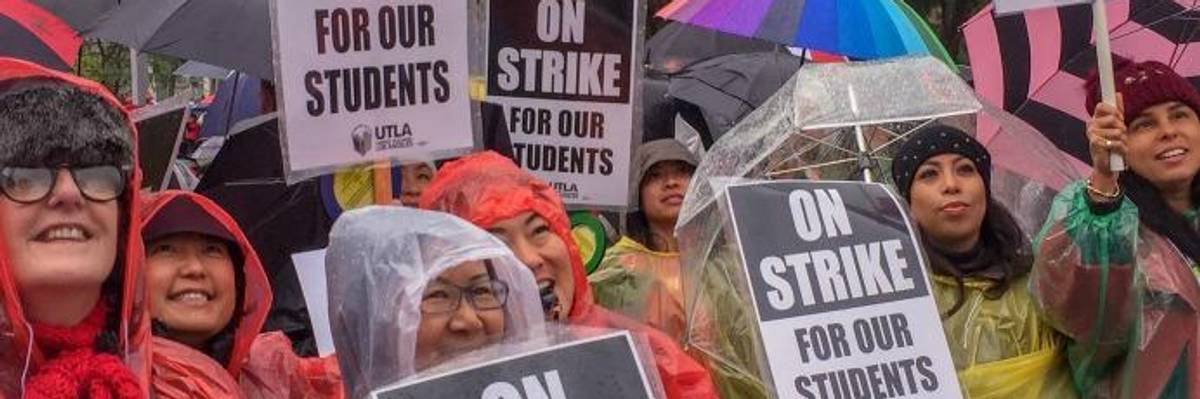
"Billionaires have plenty of reasons to subvert free, universal public education. And the rest of us have plenty of reason to support the striking teachers of Los Angeles," the author writes. (Photo: Wilson Pumpernickel/flickr/cc)
Back during the 1960s and 1970s, in cities, suburbs, and small towns across the United States, teacher strikes made headlines on a fairly regular basis. Teachers in those years had a variety of reasons for walking out. They struck for the right to bargain. They struck for decent pay and benefits. They struck for professional dignity.
Now teachers in Los Angeles, America's second-largest school district, are striking, the latest high-profile walkout in a new surge of teacher strikes that began last year. L.A. teachers are striking for the same dignity and decency teachers sought in the mid-20th century. But the L.A. struggle, many observers believe, amounts to much more than a battle over how school officials treat teachers.
Teachers in L.A. are striking, in a most fundamental way, against how unequal America has become. They're striking against our billionaire class.
In Los Angeles, our billionaires have been up to no good. They've essentially staged an unfriendly takeover of the L.A. board of education, shoveling mega millions into the campaigns of school board candidates pledged to advancing an agenda that funnels public tax dollars to "charter schools" that have next to no accountability to the public.
The newly elected billionaire-friendly board majority then proceeded to hire as superintendent a billionaire investment banker with no background in education. That billionaire proceeded to go about making L.A. a model for privatizing big-city school districts the nation over. Teachers in Los Angles are striking to stop him.
The demands of striking L.A. teachers "for smaller classes, more support staff, safer schools, community schools, and charter school oversight," explains Peter Greene, a long-time union activist with 39 years experience teaching, "are not about making their working conditions a little better, but about keeping public education alive and healthy."
Public education and plutocracy, educator activists in L.A. and nationwide increasingly understand, do not mix. Public schools do not thrive when billionaires prosper.
But why should that be the case? Why should billionaires represent a threat to public education? Why should billionaires even care about public education? The super rich don't, after all, even send their kids to public schools.
True enough, and therein lies a good part of the problem. The ultra wealthy don't send their kids to public schools. They don't use public parks either or ride public buses. They have no need for basic public services, period, and resent having to pay taxes to fund them. Historically, this resentment has ended up having deep-pockets bankroll tax-cut initiatives that hollow out public school budgets and leave teachers feeling perpetually squeezed.
The animus to public education that so many super rich feel has a more ideological driver as well. The right-wing rich -- the billionaire Walton family heirs to the Walmart fortune, for instance -- essentially see public schools as "an island of socialism in a free-market sea." Their free-market fundamentalism recoils at the thought of any sort of public enterprise.
Still other deep pockets see public education as a vast profit opportunity. Why cede all those billions that go into education to the public sector? Why not open up school management to private business?
The charter school movement speaks to all these billionaire preoccupations. Charters can give private, profit-making businesses direct access to public tax dollars. They also reflect basic "free-market" ideology: Instead of having communities democratically decide how their schools operate, let's have charter schools -- operating "free" from government interference -- compete for students!
Charter schools deliver the billionaire class a special political benefit as well. The vast majority of public school teachers belong to teacher unions. Charter schools remain largely unorganized. By shifting tax dollars to nonunion charters, billionaires sap the strength of teacher unions and undermine their capacity to support the causes -- like higher taxes on the rich -- that the rich find so distasteful.
So billionaires have plenty of reasons to subvert free, universal public education. And the rest of us have plenty of reason to support the striking teachers of Los Angeles. We ought to see their struggle, as former teacher Eric Blanc notes, as "a strike for democracy -- against the plans of a tiny clique of billionaires to unilaterally impose their vision for the world."
Dear Common Dreams reader, It’s been nearly 30 years since I co-founded Common Dreams with my late wife, Lina Newhouser. We had the radical notion that journalism should serve the public good, not corporate profits. It was clear to us from the outset what it would take to build such a project. No paid advertisements. No corporate sponsors. No millionaire publisher telling us what to think or do. Many people said we wouldn't last a year, but we proved those doubters wrong. Together with a tremendous team of journalists and dedicated staff, we built an independent media outlet free from the constraints of profits and corporate control. Our mission has always been simple: To inform. To inspire. To ignite change for the common good. Building Common Dreams was not easy. Our survival was never guaranteed. When you take on the most powerful forces—Wall Street greed, fossil fuel industry destruction, Big Tech lobbyists, and uber-rich oligarchs who have spent billions upon billions rigging the economy and democracy in their favor—the only bulwark you have is supporters who believe in your work. But here’s the urgent message from me today. It's never been this bad out there. And it's never been this hard to keep us going. At the very moment Common Dreams is most needed, the threats we face are intensifying. We need your support now more than ever. We don't accept corporate advertising and never will. We don't have a paywall because we don't think people should be blocked from critical news based on their ability to pay. Everything we do is funded by the donations of readers like you. When everyone does the little they can afford, we are strong. But if that support retreats or dries up, so do we. Will you donate now to make sure Common Dreams not only survives but thrives? —Craig Brown, Co-founder |
Back during the 1960s and 1970s, in cities, suburbs, and small towns across the United States, teacher strikes made headlines on a fairly regular basis. Teachers in those years had a variety of reasons for walking out. They struck for the right to bargain. They struck for decent pay and benefits. They struck for professional dignity.
Now teachers in Los Angeles, America's second-largest school district, are striking, the latest high-profile walkout in a new surge of teacher strikes that began last year. L.A. teachers are striking for the same dignity and decency teachers sought in the mid-20th century. But the L.A. struggle, many observers believe, amounts to much more than a battle over how school officials treat teachers.
Teachers in L.A. are striking, in a most fundamental way, against how unequal America has become. They're striking against our billionaire class.
In Los Angeles, our billionaires have been up to no good. They've essentially staged an unfriendly takeover of the L.A. board of education, shoveling mega millions into the campaigns of school board candidates pledged to advancing an agenda that funnels public tax dollars to "charter schools" that have next to no accountability to the public.
The newly elected billionaire-friendly board majority then proceeded to hire as superintendent a billionaire investment banker with no background in education. That billionaire proceeded to go about making L.A. a model for privatizing big-city school districts the nation over. Teachers in Los Angles are striking to stop him.
The demands of striking L.A. teachers "for smaller classes, more support staff, safer schools, community schools, and charter school oversight," explains Peter Greene, a long-time union activist with 39 years experience teaching, "are not about making their working conditions a little better, but about keeping public education alive and healthy."
Public education and plutocracy, educator activists in L.A. and nationwide increasingly understand, do not mix. Public schools do not thrive when billionaires prosper.
But why should that be the case? Why should billionaires represent a threat to public education? Why should billionaires even care about public education? The super rich don't, after all, even send their kids to public schools.
True enough, and therein lies a good part of the problem. The ultra wealthy don't send their kids to public schools. They don't use public parks either or ride public buses. They have no need for basic public services, period, and resent having to pay taxes to fund them. Historically, this resentment has ended up having deep-pockets bankroll tax-cut initiatives that hollow out public school budgets and leave teachers feeling perpetually squeezed.
The animus to public education that so many super rich feel has a more ideological driver as well. The right-wing rich -- the billionaire Walton family heirs to the Walmart fortune, for instance -- essentially see public schools as "an island of socialism in a free-market sea." Their free-market fundamentalism recoils at the thought of any sort of public enterprise.
Still other deep pockets see public education as a vast profit opportunity. Why cede all those billions that go into education to the public sector? Why not open up school management to private business?
The charter school movement speaks to all these billionaire preoccupations. Charters can give private, profit-making businesses direct access to public tax dollars. They also reflect basic "free-market" ideology: Instead of having communities democratically decide how their schools operate, let's have charter schools -- operating "free" from government interference -- compete for students!
Charter schools deliver the billionaire class a special political benefit as well. The vast majority of public school teachers belong to teacher unions. Charter schools remain largely unorganized. By shifting tax dollars to nonunion charters, billionaires sap the strength of teacher unions and undermine their capacity to support the causes -- like higher taxes on the rich -- that the rich find so distasteful.
So billionaires have plenty of reasons to subvert free, universal public education. And the rest of us have plenty of reason to support the striking teachers of Los Angeles. We ought to see their struggle, as former teacher Eric Blanc notes, as "a strike for democracy -- against the plans of a tiny clique of billionaires to unilaterally impose their vision for the world."
Back during the 1960s and 1970s, in cities, suburbs, and small towns across the United States, teacher strikes made headlines on a fairly regular basis. Teachers in those years had a variety of reasons for walking out. They struck for the right to bargain. They struck for decent pay and benefits. They struck for professional dignity.
Now teachers in Los Angeles, America's second-largest school district, are striking, the latest high-profile walkout in a new surge of teacher strikes that began last year. L.A. teachers are striking for the same dignity and decency teachers sought in the mid-20th century. But the L.A. struggle, many observers believe, amounts to much more than a battle over how school officials treat teachers.
Teachers in L.A. are striking, in a most fundamental way, against how unequal America has become. They're striking against our billionaire class.
In Los Angeles, our billionaires have been up to no good. They've essentially staged an unfriendly takeover of the L.A. board of education, shoveling mega millions into the campaigns of school board candidates pledged to advancing an agenda that funnels public tax dollars to "charter schools" that have next to no accountability to the public.
The newly elected billionaire-friendly board majority then proceeded to hire as superintendent a billionaire investment banker with no background in education. That billionaire proceeded to go about making L.A. a model for privatizing big-city school districts the nation over. Teachers in Los Angles are striking to stop him.
The demands of striking L.A. teachers "for smaller classes, more support staff, safer schools, community schools, and charter school oversight," explains Peter Greene, a long-time union activist with 39 years experience teaching, "are not about making their working conditions a little better, but about keeping public education alive and healthy."
Public education and plutocracy, educator activists in L.A. and nationwide increasingly understand, do not mix. Public schools do not thrive when billionaires prosper.
But why should that be the case? Why should billionaires represent a threat to public education? Why should billionaires even care about public education? The super rich don't, after all, even send their kids to public schools.
True enough, and therein lies a good part of the problem. The ultra wealthy don't send their kids to public schools. They don't use public parks either or ride public buses. They have no need for basic public services, period, and resent having to pay taxes to fund them. Historically, this resentment has ended up having deep-pockets bankroll tax-cut initiatives that hollow out public school budgets and leave teachers feeling perpetually squeezed.
The animus to public education that so many super rich feel has a more ideological driver as well. The right-wing rich -- the billionaire Walton family heirs to the Walmart fortune, for instance -- essentially see public schools as "an island of socialism in a free-market sea." Their free-market fundamentalism recoils at the thought of any sort of public enterprise.
Still other deep pockets see public education as a vast profit opportunity. Why cede all those billions that go into education to the public sector? Why not open up school management to private business?
The charter school movement speaks to all these billionaire preoccupations. Charters can give private, profit-making businesses direct access to public tax dollars. They also reflect basic "free-market" ideology: Instead of having communities democratically decide how their schools operate, let's have charter schools -- operating "free" from government interference -- compete for students!
Charter schools deliver the billionaire class a special political benefit as well. The vast majority of public school teachers belong to teacher unions. Charter schools remain largely unorganized. By shifting tax dollars to nonunion charters, billionaires sap the strength of teacher unions and undermine their capacity to support the causes -- like higher taxes on the rich -- that the rich find so distasteful.
So billionaires have plenty of reasons to subvert free, universal public education. And the rest of us have plenty of reason to support the striking teachers of Los Angeles. We ought to see their struggle, as former teacher Eric Blanc notes, as "a strike for democracy -- against the plans of a tiny clique of billionaires to unilaterally impose their vision for the world."