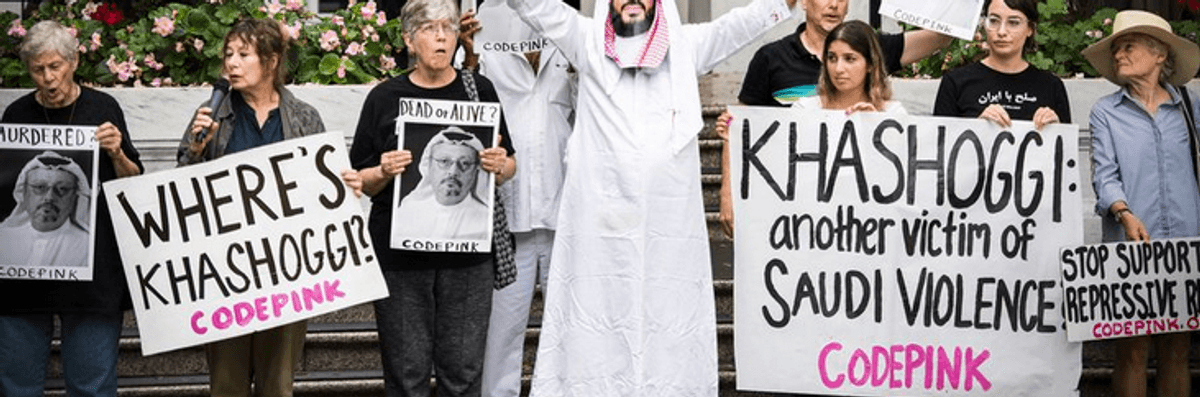
A demonstrator dressed as Saudi Crown Prince Mohammed bin Salman with blood on his hands protests with others outside the Saudi Embassy in Washington, DC, on October 8, 2018, demanding justice for missing Saudi journalist Jamal Khashoggi. (Photo: AFP/Getty Images)
The Khashoggi Affair Won't Stop Trump's Drive for War With Iran
Symbolic punishment will be designed to protect the policy of provocation.
The disappearance and apparent assassination of Jamal Khashoggi have disrupted the Saudi government's charm offensive in the United States. Think tanks are returning Saudi money. Defense contractors are worried about the end of lucrative arms deals. Sen. Marco Rubio says "no more business as usual." The otherwise friendly editorial page of the Washington Post is calling Crown Prince Mohammed bin Salman "a murderer."
But one thing is unlikely to change as a result of a brazen killing of a regime critic: the Trump administration's warmongering policy toward Iran. The emerging damage control story--that Khashoggi died during "an interrogation that went wrong"--is designed to protect the strategic alliance that seeks to confront the Islamic Republic, say Iran experts.
"That's why you're seeing the administration working with Saudi Arabia come up with some kind of plausible explanation that limits the damage to the bilateral relationship," said Kenneth Katzman, senior Iran expert at the Congressional Research Service, in a telephone interview. "At the end of the day, the two countries want to work together against Iran. They don't want Iran to benefit from a rift."
"The Saudis are the driving force behind the policy of confronting Iran, not the United States," Trita Parsi, president of the National Iranian-American Committee, said in an email. "The United States does not need to have this policy of confrontation with Iran, because the nuclear deal was working. So while the United States needs Saudi Arabia to confront Iran, it actually doesn't need to confront Iran at all. It can pursue a much more effective policy of diplomacy."
But that's not going to happen given the Trump administration's belligerence toward Iran. Last year Trump called Iran somewhat awkwardly "the Number One State of Sponsored Terror," Last week, Secretary of State Mike Pompeo released a report calling Iran an "outlaw regime," Before that, national security adviser John Bolton told reporters that if Tehran continues to "cross" the United States, "there will be hell to pay."
This is exactly the aggressive policy that Saudi Arabia has encouraged ever since Jared Kushner took over his father-in-law's Middle East policy and bonded with MBS as "the change agent" in the Middle East. And this is the policy that will be endangered if the flap over Khashoggi's disappearance amounts to anything more than a flap.
"In a rational world, you would look at this incident [Khashoggi's disappearance] and ask, what is good for U.S. policy?" said Paul Pillar, former CIA analyst for the Middle East. "This incident demonstrates that there is not a strong reason to take Saudi Arabia's side in its regional rivalry with Iran."
"But the Trump administration seem so determined, so set on stoking maximum hostility, that I do not see them being fundamentally diverted [by the Khashoggi affair], however inconvenient it may be for them. It may slow things down, making it harder to portray Saudi Arabia as a U.S. partner, but that's about it."
Pillar says Trump's message to MBS, delivered by Pompeo on his emergency visit to Riyadh, will likely be, "Help us help you get over this in a way that doesn't spoil our relationship."
Congress could intervene, but it seems unlikely. Twenty members of the Senate Committee on Foreign Relations sent a letter to Trump last week requesting an investigation under the Global Magnitsky Human Rights Accountability Act. The White House now has 120 days to report back to the committee on whether it will levy sanctions against the country in question. But the law allows the administration to waive sanctions for reasons of "national security."
"Graham and Rubio talk a good game about Khashoggi, but they usually just fold in the end," said one aide to a Senate Democrat.
If Democrats gain control of the House of Representatives in November, they could also complicate Trump's Iran policy by investigating Kushner's business ties with the Saudi regime. But however embarrassing that might be, it would not force any change to Trump's policy.
One coming test of Trump's policy concerns oil. The Trump administration and the Saudis are hoping to implement a full embargo of Iranian oil by early November. To keep gas prices down in the United States, the Saudis need to increase production. If the Saudis do that, Trump's anti-Iran policy will be intact.
The Khashoggi affair, says the Senate aide, "blunts the drive to war. It doesn't end it."
We are at a crossroads
This country and this world are at a monumental crossroads. US voters have an opportunity to beat back the forces of fascism and confront the billionaires who are rigging the economy, our media system, and our democracy, making it increasingly impossible for ordinary people to get by. We’re not just talking about the election. We’re talking about what must be done once these fascist elements are vanquished from power. We need a bolder set of solutions than what either major party has so far been willing to offer and a working-class movement ready to fight like hell for it. Trump didn't emerge from nowhere. The conditions that fueled MAGA authoritarianism were created by decades of radical neoliberal economic policies and a corrupt political system dominated by corporate interests. They slashed taxes on the super-rich, promising that the benefits would trickle down. They said giveaways to the corporate titans would make life more affordable for the rest of us. It was all bullshit. And when a bitter, betrayed populace searches for someone to blame, right-wing demagogues have little trouble finding scapegoats. People know when they're being lied to, but you won't hear any of this from the corporate media. Only independent journalism—powered and funded by people who believe in building a better world—can deliver truly trustworthy daily news. Our Fall Campaign is underway, and we need your help. To power our newsroom through the rest of the year, we need to raise $125,000 by midnight on October 31. So if you share our vision, please contribute whatever you can to sustain our work. |
The disappearance and apparent assassination of Jamal Khashoggi have disrupted the Saudi government's charm offensive in the United States. Think tanks are returning Saudi money. Defense contractors are worried about the end of lucrative arms deals. Sen. Marco Rubio says "no more business as usual." The otherwise friendly editorial page of the Washington Post is calling Crown Prince Mohammed bin Salman "a murderer."
But one thing is unlikely to change as a result of a brazen killing of a regime critic: the Trump administration's warmongering policy toward Iran. The emerging damage control story--that Khashoggi died during "an interrogation that went wrong"--is designed to protect the strategic alliance that seeks to confront the Islamic Republic, say Iran experts.
"That's why you're seeing the administration working with Saudi Arabia come up with some kind of plausible explanation that limits the damage to the bilateral relationship," said Kenneth Katzman, senior Iran expert at the Congressional Research Service, in a telephone interview. "At the end of the day, the two countries want to work together against Iran. They don't want Iran to benefit from a rift."
"The Saudis are the driving force behind the policy of confronting Iran, not the United States," Trita Parsi, president of the National Iranian-American Committee, said in an email. "The United States does not need to have this policy of confrontation with Iran, because the nuclear deal was working. So while the United States needs Saudi Arabia to confront Iran, it actually doesn't need to confront Iran at all. It can pursue a much more effective policy of diplomacy."
But that's not going to happen given the Trump administration's belligerence toward Iran. Last year Trump called Iran somewhat awkwardly "the Number One State of Sponsored Terror," Last week, Secretary of State Mike Pompeo released a report calling Iran an "outlaw regime," Before that, national security adviser John Bolton told reporters that if Tehran continues to "cross" the United States, "there will be hell to pay."
This is exactly the aggressive policy that Saudi Arabia has encouraged ever since Jared Kushner took over his father-in-law's Middle East policy and bonded with MBS as "the change agent" in the Middle East. And this is the policy that will be endangered if the flap over Khashoggi's disappearance amounts to anything more than a flap.
"In a rational world, you would look at this incident [Khashoggi's disappearance] and ask, what is good for U.S. policy?" said Paul Pillar, former CIA analyst for the Middle East. "This incident demonstrates that there is not a strong reason to take Saudi Arabia's side in its regional rivalry with Iran."
"But the Trump administration seem so determined, so set on stoking maximum hostility, that I do not see them being fundamentally diverted [by the Khashoggi affair], however inconvenient it may be for them. It may slow things down, making it harder to portray Saudi Arabia as a U.S. partner, but that's about it."
Pillar says Trump's message to MBS, delivered by Pompeo on his emergency visit to Riyadh, will likely be, "Help us help you get over this in a way that doesn't spoil our relationship."
Congress could intervene, but it seems unlikely. Twenty members of the Senate Committee on Foreign Relations sent a letter to Trump last week requesting an investigation under the Global Magnitsky Human Rights Accountability Act. The White House now has 120 days to report back to the committee on whether it will levy sanctions against the country in question. But the law allows the administration to waive sanctions for reasons of "national security."
"Graham and Rubio talk a good game about Khashoggi, but they usually just fold in the end," said one aide to a Senate Democrat.
If Democrats gain control of the House of Representatives in November, they could also complicate Trump's Iran policy by investigating Kushner's business ties with the Saudi regime. But however embarrassing that might be, it would not force any change to Trump's policy.
One coming test of Trump's policy concerns oil. The Trump administration and the Saudis are hoping to implement a full embargo of Iranian oil by early November. To keep gas prices down in the United States, the Saudis need to increase production. If the Saudis do that, Trump's anti-Iran policy will be intact.
The Khashoggi affair, says the Senate aide, "blunts the drive to war. It doesn't end it."