SUBSCRIBE TO OUR FREE NEWSLETTER
Daily news & progressive opinion—funded by the people, not the corporations—delivered straight to your inbox.
5
#000000
#FFFFFF
To donate by check, phone, or other method, see our More Ways to Give page.
Daily news & progressive opinion—funded by the people, not the corporations—delivered straight to your inbox.
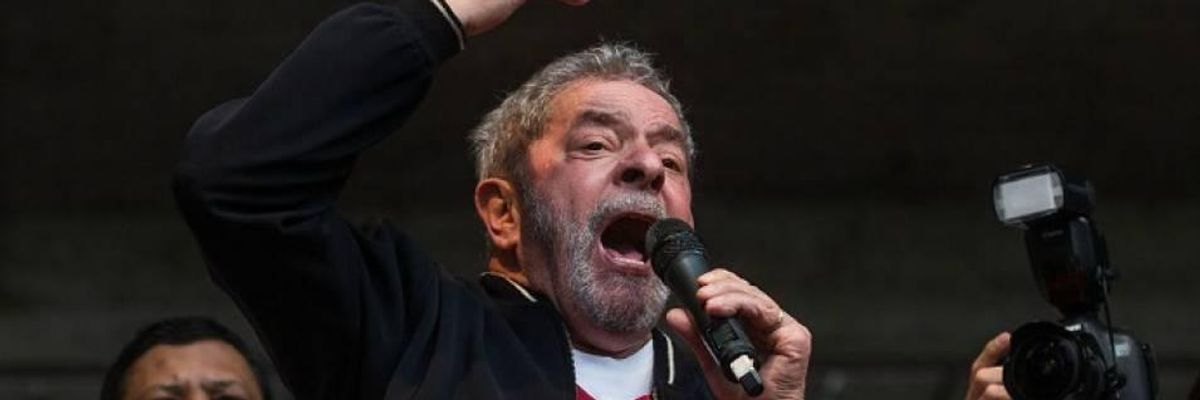
This attack reached a second milestone on 1 September 2018, when former President Luiz Inacio Lula Da Silva (pictured above), a favourite in Brazilian presidential election polling for the elections on 7 and 28 October, was disqualified from running for office.
The following is an open statement warning against the possible election in Brazil of "a fascist, racist, chauvinist and homophobic candidate, one who calls for violence and armed repression." The statement was first published Spanish in El Diario and in English at Open Democracy.
President Dilma Rousseff's removal on 31 August 2016 initiated an attack on Brazilian democracy. This attack reached a second milestone on 1 September 2018, when former President Luiz Inacio Lula Da Silva, a favourite in Brazilian presidential election polling for the elections on 7 and 28 October, was disqualified from running for office. As a result of both actions, Brazilian citizens face the dangerous prospect of a possible victory by a fascist, racist, chauvinist and homophobic candidate, one who calls for violence and armed repression.
We are drawing attention to these two illegitimate attacks. Firstly, a parliamentary attack against President Rousseff. And secondly, Lula's sentencing without proof to 12 years in prison, as well as his disqualification from running for electoral office. These are steps to prevent the Brazilian Worker's Party (PT), to which both Rousseff and Lula belong, from implementing a plan for the redistribution of wealth and the reduction of social, racial and gender inequality. For the past 16 years, this plan has served as a successful example of an alternative to neoliberalism responsible for the global crisis.
"We are warning that the instrumentalization of judicial power, in Brazil and other developing countries, is central to a strategy led by international financial capital and some media companies falling short of their obligation to report the truth."
We are warning that the instrumentalization of judicial power, in Brazil and other developing countries, is central to a strategy led by international financial capital and some media companies falling short of their obligation to report the truth. The strategy operates via allegedly fighting corruption, but is in reality fostering it. It prevents the electoral candidacy, via unjust sentencing, of those who are viewed as a check on the agenda of 'markets.'
This is particularly serious in the case of Brazil, which during the Lula government was a reference point for multilateralism and encouraged significant initiatives like the BRICS. Yet now, Brazil has decided to ignore the United Nations Human Rights Committee's request, "to take all necessary measures to ensure that Lula can enjoy and exercise his political rights while in prison, as a candidate in the 2018 presidential elections."
We are profoundly concerned about the consequences of illegitimately facilitating the Brazilian presidential victory of a fascist candidate. They would reverberate both within the country and across the international stage, where extreme right-wing leaders are on the rise and even govern, via voting marked by frustration with the 2008 crisis and neoliberal austerity.
So that society can peacefully accept the results of the elections on 7 and 28, there should be a guarantee of just competition among all parties, including the PT."
Madrid, September 2018
Signed:
Celso Amorim, former Brazilian Minister of Defense and Foreign Affairs.
Renata Avila, Director of Ciudadania Inteligente Foundation.
William Bourdon, Human rights lawyer and Founding partner of Bourdon & Associes.
Pedro Brieger, Director of NODAL.
Noam Chomsky, Professor Emeritus at the Massachusetts Institute of Technology (MIT).
Gaspard Estrada, Executive Director of OPALC, Sciences Po.
Baltasar Garzon, Jurist and President of FIBGAR.
Rafael Heiber, Executive Director and Co/founder Common Action Forum.
Alexander Main, Director of International Policy, CEPR, Washington, DC.
Pierre Sane, former Secretary General of Amnesty International and President of Imagine Africa Institute.
Dear Common Dreams reader, It’s been nearly 30 years since I co-founded Common Dreams with my late wife, Lina Newhouser. We had the radical notion that journalism should serve the public good, not corporate profits. It was clear to us from the outset what it would take to build such a project. No paid advertisements. No corporate sponsors. No millionaire publisher telling us what to think or do. Many people said we wouldn't last a year, but we proved those doubters wrong. Together with a tremendous team of journalists and dedicated staff, we built an independent media outlet free from the constraints of profits and corporate control. Our mission has always been simple: To inform. To inspire. To ignite change for the common good. Building Common Dreams was not easy. Our survival was never guaranteed. When you take on the most powerful forces—Wall Street greed, fossil fuel industry destruction, Big Tech lobbyists, and uber-rich oligarchs who have spent billions upon billions rigging the economy and democracy in their favor—the only bulwark you have is supporters who believe in your work. But here’s the urgent message from me today. It's never been this bad out there. And it's never been this hard to keep us going. At the very moment Common Dreams is most needed, the threats we face are intensifying. We need your support now more than ever. We don't accept corporate advertising and never will. We don't have a paywall because we don't think people should be blocked from critical news based on their ability to pay. Everything we do is funded by the donations of readers like you. When everyone does the little they can afford, we are strong. But if that support retreats or dries up, so do we. Will you donate now to make sure Common Dreams not only survives but thrives? —Craig Brown, Co-founder |
The following is an open statement warning against the possible election in Brazil of "a fascist, racist, chauvinist and homophobic candidate, one who calls for violence and armed repression." The statement was first published Spanish in El Diario and in English at Open Democracy.
President Dilma Rousseff's removal on 31 August 2016 initiated an attack on Brazilian democracy. This attack reached a second milestone on 1 September 2018, when former President Luiz Inacio Lula Da Silva, a favourite in Brazilian presidential election polling for the elections on 7 and 28 October, was disqualified from running for office. As a result of both actions, Brazilian citizens face the dangerous prospect of a possible victory by a fascist, racist, chauvinist and homophobic candidate, one who calls for violence and armed repression.
We are drawing attention to these two illegitimate attacks. Firstly, a parliamentary attack against President Rousseff. And secondly, Lula's sentencing without proof to 12 years in prison, as well as his disqualification from running for electoral office. These are steps to prevent the Brazilian Worker's Party (PT), to which both Rousseff and Lula belong, from implementing a plan for the redistribution of wealth and the reduction of social, racial and gender inequality. For the past 16 years, this plan has served as a successful example of an alternative to neoliberalism responsible for the global crisis.
"We are warning that the instrumentalization of judicial power, in Brazil and other developing countries, is central to a strategy led by international financial capital and some media companies falling short of their obligation to report the truth."
We are warning that the instrumentalization of judicial power, in Brazil and other developing countries, is central to a strategy led by international financial capital and some media companies falling short of their obligation to report the truth. The strategy operates via allegedly fighting corruption, but is in reality fostering it. It prevents the electoral candidacy, via unjust sentencing, of those who are viewed as a check on the agenda of 'markets.'
This is particularly serious in the case of Brazil, which during the Lula government was a reference point for multilateralism and encouraged significant initiatives like the BRICS. Yet now, Brazil has decided to ignore the United Nations Human Rights Committee's request, "to take all necessary measures to ensure that Lula can enjoy and exercise his political rights while in prison, as a candidate in the 2018 presidential elections."
We are profoundly concerned about the consequences of illegitimately facilitating the Brazilian presidential victory of a fascist candidate. They would reverberate both within the country and across the international stage, where extreme right-wing leaders are on the rise and even govern, via voting marked by frustration with the 2008 crisis and neoliberal austerity.
So that society can peacefully accept the results of the elections on 7 and 28, there should be a guarantee of just competition among all parties, including the PT."
Madrid, September 2018
Signed:
Celso Amorim, former Brazilian Minister of Defense and Foreign Affairs.
Renata Avila, Director of Ciudadania Inteligente Foundation.
William Bourdon, Human rights lawyer and Founding partner of Bourdon & Associes.
Pedro Brieger, Director of NODAL.
Noam Chomsky, Professor Emeritus at the Massachusetts Institute of Technology (MIT).
Gaspard Estrada, Executive Director of OPALC, Sciences Po.
Baltasar Garzon, Jurist and President of FIBGAR.
Rafael Heiber, Executive Director and Co/founder Common Action Forum.
Alexander Main, Director of International Policy, CEPR, Washington, DC.
Pierre Sane, former Secretary General of Amnesty International and President of Imagine Africa Institute.
The following is an open statement warning against the possible election in Brazil of "a fascist, racist, chauvinist and homophobic candidate, one who calls for violence and armed repression." The statement was first published Spanish in El Diario and in English at Open Democracy.
President Dilma Rousseff's removal on 31 August 2016 initiated an attack on Brazilian democracy. This attack reached a second milestone on 1 September 2018, when former President Luiz Inacio Lula Da Silva, a favourite in Brazilian presidential election polling for the elections on 7 and 28 October, was disqualified from running for office. As a result of both actions, Brazilian citizens face the dangerous prospect of a possible victory by a fascist, racist, chauvinist and homophobic candidate, one who calls for violence and armed repression.
We are drawing attention to these two illegitimate attacks. Firstly, a parliamentary attack against President Rousseff. And secondly, Lula's sentencing without proof to 12 years in prison, as well as his disqualification from running for electoral office. These are steps to prevent the Brazilian Worker's Party (PT), to which both Rousseff and Lula belong, from implementing a plan for the redistribution of wealth and the reduction of social, racial and gender inequality. For the past 16 years, this plan has served as a successful example of an alternative to neoliberalism responsible for the global crisis.
"We are warning that the instrumentalization of judicial power, in Brazil and other developing countries, is central to a strategy led by international financial capital and some media companies falling short of their obligation to report the truth."
We are warning that the instrumentalization of judicial power, in Brazil and other developing countries, is central to a strategy led by international financial capital and some media companies falling short of their obligation to report the truth. The strategy operates via allegedly fighting corruption, but is in reality fostering it. It prevents the electoral candidacy, via unjust sentencing, of those who are viewed as a check on the agenda of 'markets.'
This is particularly serious in the case of Brazil, which during the Lula government was a reference point for multilateralism and encouraged significant initiatives like the BRICS. Yet now, Brazil has decided to ignore the United Nations Human Rights Committee's request, "to take all necessary measures to ensure that Lula can enjoy and exercise his political rights while in prison, as a candidate in the 2018 presidential elections."
We are profoundly concerned about the consequences of illegitimately facilitating the Brazilian presidential victory of a fascist candidate. They would reverberate both within the country and across the international stage, where extreme right-wing leaders are on the rise and even govern, via voting marked by frustration with the 2008 crisis and neoliberal austerity.
So that society can peacefully accept the results of the elections on 7 and 28, there should be a guarantee of just competition among all parties, including the PT."
Madrid, September 2018
Signed:
Celso Amorim, former Brazilian Minister of Defense and Foreign Affairs.
Renata Avila, Director of Ciudadania Inteligente Foundation.
William Bourdon, Human rights lawyer and Founding partner of Bourdon & Associes.
Pedro Brieger, Director of NODAL.
Noam Chomsky, Professor Emeritus at the Massachusetts Institute of Technology (MIT).
Gaspard Estrada, Executive Director of OPALC, Sciences Po.
Baltasar Garzon, Jurist and President of FIBGAR.
Rafael Heiber, Executive Director and Co/founder Common Action Forum.
Alexander Main, Director of International Policy, CEPR, Washington, DC.
Pierre Sane, former Secretary General of Amnesty International and President of Imagine Africa Institute.