SUBSCRIBE TO OUR FREE NEWSLETTER
Daily news & progressive opinion—funded by the people, not the corporations—delivered straight to your inbox.
5
#000000
#FFFFFF
To donate by check, phone, or other method, see our More Ways to Give page.
Daily news & progressive opinion—funded by the people, not the corporations—delivered straight to your inbox.
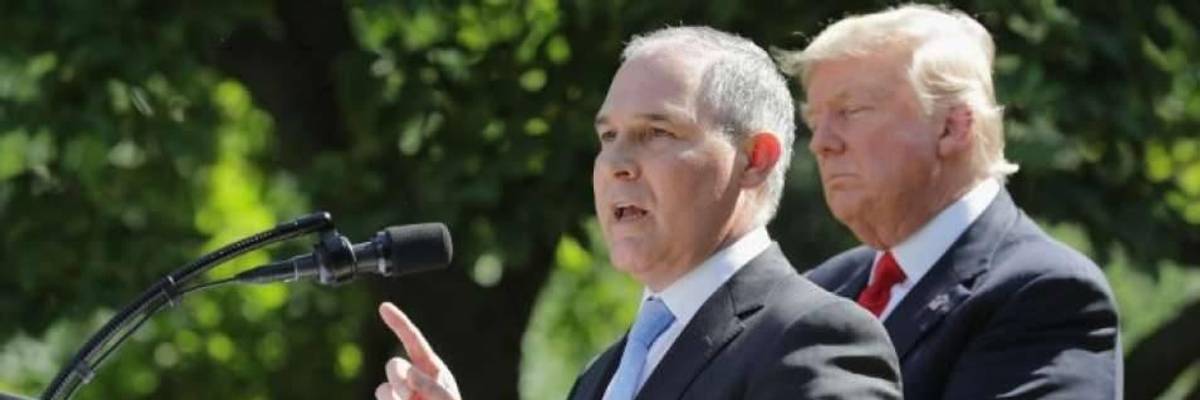
EPA Administrator Scott Pruitt--who resigned eaerlier this month--speaking after U.S. President Donald Trump announced his decision to pull the United States out of the Paris climate agreement in the Rose Garden at the White House June 1, 2017 in Washington, D.C. (Photo: Chip Somodevilla/Getty Images)
"The name of the slough was 'Despond.' Here, therefore, they wallowed for a time, being grievously bedaubed with the dirt. . . ." --John Bunyan, A Pilgrim's Progress
It was such a nicely written letter, beautifully typed, and of impeccable logic. In it Scott Pruitt explained why he resigned, and it had nothing to do with his behavior while serving as Administrator of the EPA. In the second sentence of his letter of resignation he said, in what was probably an unintentional but very straightforward acknowledgement of his conduct, that Mr. Trump's confidence in him "has blessed me personally." He was not, of course, referring to the blessings he received that were the ultimate reason he was forced out. He was forced out, he said: "because of "the unrelenting attacks on me personally, my family" that "have taken a sizable toll on all of us." The letter, of course, made no reference to any of his conduct that gave rise to more than twelve investigations.
A Wall Street Journal editorial that appeared the day after Mr. Pruitt's resignation was announced, was captioned: "Pruitt Drowns in the Swamp." The swamp to which the editorial writers refer was not, as readers might have thought, the swamp that Mr. Pruitt had created. That swamp contained the $48,000 phone booth installed in Mr. Pruitt's office, a phone booth that Clark Kent would have been thrilled to use when changing into his superman outfit. It contained flunkies sent to buy used mattresses and skin cream. It contained first class airplane tickets, 24-hour protection, and elaborate convoys when travelling by car. And that is only a partial list. One would be forgiven for thinking that the swamp to which the WSJ was referring was the one in which Mr. Pruitt swam. A reading of the editorial disabused the reader of that notion.
The first six words of the editorial instructed: "Chalk one up for the swamp." It went on to explain that the swamp to which it was referring was the "permanent progressive state" that "finally ran Scott Pruitt out of the Environmental Protection Agency." The editors of the WSJ did not view Mr. Pruitt as one of the most prominent alligators living in the swamp because of the ingenious ways he found to translate his position into personal profit and self-aggrandizement. Instead, it attributed his downfall to Tom Steyer and Mike Bloomberg who, it says, were out to get him, and to "the EPA bureaucracy that leans left, the green lobby entwined with it, and their collaborators in the press corps."
The WSJ is quite happy to overlook the particulars of the swamp of misconduct in which Mr. Pruitt swam during his tenure. The writers state that allegations that "he misused private air travel, sent staff on personal errands, and bought $1,560 worth of pens, among dozens of other allegations," allegations that Mr. Pruitt described as "false or exaggerated." probably were false and exaggerated.
In further defense of Mr. Pruitt, and placing the blame for his departure on what the WSJ calls the "left," it suggested that to be successful Mr. Pruitt "had to avoid even the hint of an ethical question" and "he should have been walking around Federal Triangle handcuffed to a general counsel."
The WSJ also praised Mr. Pruitt for updating "advisory science boards that have been stacked with members who receive EPA grants." At the time he appointed those representatives Mr. Pruitt held a press conference in which he explained the reasons for rearranging the composition of the boards by making reference to the book of Joshua in the Bible. He referred to the story of Joshua leading the people of Israel into the promised land following the death of Moses, and telling them they would now have to decide whom they would serve. Mr. Pruitt described the rearrangement of the commission as making use of the "Joshua Principle." Scientists would have to decide whether to serve on EPA independent advisory boards, or receive grants from the agency. They could no longer do both. He replaced members who had received grants with "voices from regulated industries, academics and environmental regulators from conservative states and researchers who have a history of critiquing the science and economics underpinning tighter environmental regulations." The WSJ conveniently overlooked those appointments. Included among the appointees were Texas's top toxicologist, Michael Honeycutt, who was appointed to lead the Scientific Advisory Board, and Consultant, Louise Anthony Cox, who chairs the "Clean Air Scientific Advisory Committee." Mr. Honeycutt has said that the EPA overstates the risks that are associated with mercury and has disregarded science that "demonstrates a chemical is not as toxic as it thinks it is." Ms. Cox has said that the methods for calculating the public health benefits are "unreliable, logically unsound, and inappropriate for drawing casual inferences."
The WSJ closes its defense of Scott Pruitt, and its attacks on those it describes as his "defenestrators," by reminding readers of Mr. Pruitt's use of first class air travel that cost tax payers $105,000 in the first year he was in office. It suggests that to avoid receiving the kind of unjust treatment from creatures living in the swamp inhabited by the left, that Mr. Pruitt received, the members of the Trump cabinet should fly coach. Only the editors of the WSJ would think that by itself, that one action would drain the swamp in which Mr. Trump and his cabinet swim. Would that it were so.
Dear Common Dreams reader, It’s been nearly 30 years since I co-founded Common Dreams with my late wife, Lina Newhouser. We had the radical notion that journalism should serve the public good, not corporate profits. It was clear to us from the outset what it would take to build such a project. No paid advertisements. No corporate sponsors. No millionaire publisher telling us what to think or do. Many people said we wouldn't last a year, but we proved those doubters wrong. Together with a tremendous team of journalists and dedicated staff, we built an independent media outlet free from the constraints of profits and corporate control. Our mission has always been simple: To inform. To inspire. To ignite change for the common good. Building Common Dreams was not easy. Our survival was never guaranteed. When you take on the most powerful forces—Wall Street greed, fossil fuel industry destruction, Big Tech lobbyists, and uber-rich oligarchs who have spent billions upon billions rigging the economy and democracy in their favor—the only bulwark you have is supporters who believe in your work. But here’s the urgent message from me today. It's never been this bad out there. And it's never been this hard to keep us going. At the very moment Common Dreams is most needed, the threats we face are intensifying. We need your support now more than ever. We don't accept corporate advertising and never will. We don't have a paywall because we don't think people should be blocked from critical news based on their ability to pay. Everything we do is funded by the donations of readers like you. When everyone does the little they can afford, we are strong. But if that support retreats or dries up, so do we. Will you donate now to make sure Common Dreams not only survives but thrives? —Craig Brown, Co-founder |
"The name of the slough was 'Despond.' Here, therefore, they wallowed for a time, being grievously bedaubed with the dirt. . . ." --John Bunyan, A Pilgrim's Progress
It was such a nicely written letter, beautifully typed, and of impeccable logic. In it Scott Pruitt explained why he resigned, and it had nothing to do with his behavior while serving as Administrator of the EPA. In the second sentence of his letter of resignation he said, in what was probably an unintentional but very straightforward acknowledgement of his conduct, that Mr. Trump's confidence in him "has blessed me personally." He was not, of course, referring to the blessings he received that were the ultimate reason he was forced out. He was forced out, he said: "because of "the unrelenting attacks on me personally, my family" that "have taken a sizable toll on all of us." The letter, of course, made no reference to any of his conduct that gave rise to more than twelve investigations.
A Wall Street Journal editorial that appeared the day after Mr. Pruitt's resignation was announced, was captioned: "Pruitt Drowns in the Swamp." The swamp to which the editorial writers refer was not, as readers might have thought, the swamp that Mr. Pruitt had created. That swamp contained the $48,000 phone booth installed in Mr. Pruitt's office, a phone booth that Clark Kent would have been thrilled to use when changing into his superman outfit. It contained flunkies sent to buy used mattresses and skin cream. It contained first class airplane tickets, 24-hour protection, and elaborate convoys when travelling by car. And that is only a partial list. One would be forgiven for thinking that the swamp to which the WSJ was referring was the one in which Mr. Pruitt swam. A reading of the editorial disabused the reader of that notion.
The first six words of the editorial instructed: "Chalk one up for the swamp." It went on to explain that the swamp to which it was referring was the "permanent progressive state" that "finally ran Scott Pruitt out of the Environmental Protection Agency." The editors of the WSJ did not view Mr. Pruitt as one of the most prominent alligators living in the swamp because of the ingenious ways he found to translate his position into personal profit and self-aggrandizement. Instead, it attributed his downfall to Tom Steyer and Mike Bloomberg who, it says, were out to get him, and to "the EPA bureaucracy that leans left, the green lobby entwined with it, and their collaborators in the press corps."
The WSJ is quite happy to overlook the particulars of the swamp of misconduct in which Mr. Pruitt swam during his tenure. The writers state that allegations that "he misused private air travel, sent staff on personal errands, and bought $1,560 worth of pens, among dozens of other allegations," allegations that Mr. Pruitt described as "false or exaggerated." probably were false and exaggerated.
In further defense of Mr. Pruitt, and placing the blame for his departure on what the WSJ calls the "left," it suggested that to be successful Mr. Pruitt "had to avoid even the hint of an ethical question" and "he should have been walking around Federal Triangle handcuffed to a general counsel."
The WSJ also praised Mr. Pruitt for updating "advisory science boards that have been stacked with members who receive EPA grants." At the time he appointed those representatives Mr. Pruitt held a press conference in which he explained the reasons for rearranging the composition of the boards by making reference to the book of Joshua in the Bible. He referred to the story of Joshua leading the people of Israel into the promised land following the death of Moses, and telling them they would now have to decide whom they would serve. Mr. Pruitt described the rearrangement of the commission as making use of the "Joshua Principle." Scientists would have to decide whether to serve on EPA independent advisory boards, or receive grants from the agency. They could no longer do both. He replaced members who had received grants with "voices from regulated industries, academics and environmental regulators from conservative states and researchers who have a history of critiquing the science and economics underpinning tighter environmental regulations." The WSJ conveniently overlooked those appointments. Included among the appointees were Texas's top toxicologist, Michael Honeycutt, who was appointed to lead the Scientific Advisory Board, and Consultant, Louise Anthony Cox, who chairs the "Clean Air Scientific Advisory Committee." Mr. Honeycutt has said that the EPA overstates the risks that are associated with mercury and has disregarded science that "demonstrates a chemical is not as toxic as it thinks it is." Ms. Cox has said that the methods for calculating the public health benefits are "unreliable, logically unsound, and inappropriate for drawing casual inferences."
The WSJ closes its defense of Scott Pruitt, and its attacks on those it describes as his "defenestrators," by reminding readers of Mr. Pruitt's use of first class air travel that cost tax payers $105,000 in the first year he was in office. It suggests that to avoid receiving the kind of unjust treatment from creatures living in the swamp inhabited by the left, that Mr. Pruitt received, the members of the Trump cabinet should fly coach. Only the editors of the WSJ would think that by itself, that one action would drain the swamp in which Mr. Trump and his cabinet swim. Would that it were so.
"The name of the slough was 'Despond.' Here, therefore, they wallowed for a time, being grievously bedaubed with the dirt. . . ." --John Bunyan, A Pilgrim's Progress
It was such a nicely written letter, beautifully typed, and of impeccable logic. In it Scott Pruitt explained why he resigned, and it had nothing to do with his behavior while serving as Administrator of the EPA. In the second sentence of his letter of resignation he said, in what was probably an unintentional but very straightforward acknowledgement of his conduct, that Mr. Trump's confidence in him "has blessed me personally." He was not, of course, referring to the blessings he received that were the ultimate reason he was forced out. He was forced out, he said: "because of "the unrelenting attacks on me personally, my family" that "have taken a sizable toll on all of us." The letter, of course, made no reference to any of his conduct that gave rise to more than twelve investigations.
A Wall Street Journal editorial that appeared the day after Mr. Pruitt's resignation was announced, was captioned: "Pruitt Drowns in the Swamp." The swamp to which the editorial writers refer was not, as readers might have thought, the swamp that Mr. Pruitt had created. That swamp contained the $48,000 phone booth installed in Mr. Pruitt's office, a phone booth that Clark Kent would have been thrilled to use when changing into his superman outfit. It contained flunkies sent to buy used mattresses and skin cream. It contained first class airplane tickets, 24-hour protection, and elaborate convoys when travelling by car. And that is only a partial list. One would be forgiven for thinking that the swamp to which the WSJ was referring was the one in which Mr. Pruitt swam. A reading of the editorial disabused the reader of that notion.
The first six words of the editorial instructed: "Chalk one up for the swamp." It went on to explain that the swamp to which it was referring was the "permanent progressive state" that "finally ran Scott Pruitt out of the Environmental Protection Agency." The editors of the WSJ did not view Mr. Pruitt as one of the most prominent alligators living in the swamp because of the ingenious ways he found to translate his position into personal profit and self-aggrandizement. Instead, it attributed his downfall to Tom Steyer and Mike Bloomberg who, it says, were out to get him, and to "the EPA bureaucracy that leans left, the green lobby entwined with it, and their collaborators in the press corps."
The WSJ is quite happy to overlook the particulars of the swamp of misconduct in which Mr. Pruitt swam during his tenure. The writers state that allegations that "he misused private air travel, sent staff on personal errands, and bought $1,560 worth of pens, among dozens of other allegations," allegations that Mr. Pruitt described as "false or exaggerated." probably were false and exaggerated.
In further defense of Mr. Pruitt, and placing the blame for his departure on what the WSJ calls the "left," it suggested that to be successful Mr. Pruitt "had to avoid even the hint of an ethical question" and "he should have been walking around Federal Triangle handcuffed to a general counsel."
The WSJ also praised Mr. Pruitt for updating "advisory science boards that have been stacked with members who receive EPA grants." At the time he appointed those representatives Mr. Pruitt held a press conference in which he explained the reasons for rearranging the composition of the boards by making reference to the book of Joshua in the Bible. He referred to the story of Joshua leading the people of Israel into the promised land following the death of Moses, and telling them they would now have to decide whom they would serve. Mr. Pruitt described the rearrangement of the commission as making use of the "Joshua Principle." Scientists would have to decide whether to serve on EPA independent advisory boards, or receive grants from the agency. They could no longer do both. He replaced members who had received grants with "voices from regulated industries, academics and environmental regulators from conservative states and researchers who have a history of critiquing the science and economics underpinning tighter environmental regulations." The WSJ conveniently overlooked those appointments. Included among the appointees were Texas's top toxicologist, Michael Honeycutt, who was appointed to lead the Scientific Advisory Board, and Consultant, Louise Anthony Cox, who chairs the "Clean Air Scientific Advisory Committee." Mr. Honeycutt has said that the EPA overstates the risks that are associated with mercury and has disregarded science that "demonstrates a chemical is not as toxic as it thinks it is." Ms. Cox has said that the methods for calculating the public health benefits are "unreliable, logically unsound, and inappropriate for drawing casual inferences."
The WSJ closes its defense of Scott Pruitt, and its attacks on those it describes as his "defenestrators," by reminding readers of Mr. Pruitt's use of first class air travel that cost tax payers $105,000 in the first year he was in office. It suggests that to avoid receiving the kind of unjust treatment from creatures living in the swamp inhabited by the left, that Mr. Pruitt received, the members of the Trump cabinet should fly coach. Only the editors of the WSJ would think that by itself, that one action would drain the swamp in which Mr. Trump and his cabinet swim. Would that it were so.