SUBSCRIBE TO OUR FREE NEWSLETTER
Daily news & progressive opinion—funded by the people, not the corporations—delivered straight to your inbox.
5
#000000
#FFFFFF
To donate by check, phone, or other method, see our More Ways to Give page.
Daily news & progressive opinion—funded by the people, not the corporations—delivered straight to your inbox.
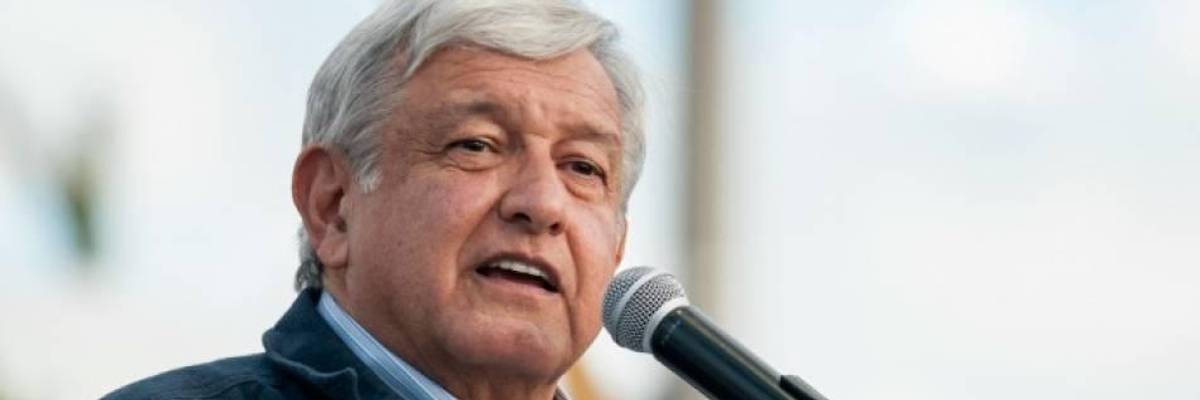
Presidential candidate Andres Manuel Lopez Obrador of the Movimiento Regeneracion Nacional (MORENA) party and Juntos Haremos Historia coalition gives a speech during the public meeting at the Children Heroes Plaza on February 11, 2017 in Guadalajara, Mexico. (Photo: Servando Gomez Camarillo/Getty Images)
Almost all the foreign coverage of today's Mexican election focusses on the drug wars and the murder rate: 30,000 killed last year, and looking to be even higher this year. But there are 127 million Mexicans, so it's not really all that bad by Caribbean standards.
Mexico is not even in the top ten countries in terms of its murder rate, although seven out of those top ten are in the Caribbean: Honduras, Venezuela, Belize, El Salvador, Guatemala, Jamaica and Colombia. In fact, Mexico is ranked at number 20 worldwide, behind apparently safer countries like Brazil, Trinidad, the Dominican Republic and the Bahamas.
The Caribbean is a tough neighbourhood, but Mexico is actually one of its safer places. So why is everybody, including the Mexicans themselves, obsessed with the local murder rate? It's because the killings are so brazen and spectacular - and that is largely due to the fact that so many of them are part of the incessant wars between the rival drug gangs.
'Cartels' is no longer the right word for these gangs: they have splintered into a multitude of rival organisations fighting to maintain or expand their access to the lucrative US market. It's a bloody business, but it's not what the election is about - or at least not openly.
We already know who is going to be the president of Mexico for the next six years. It's 'AMLO', short for Andres Manuel Lopez Obrador. The last opinion poll, with only a week to go, put him at 37% of the vote, and his nearest rival at only 20%. He has little to say about the drug war, apart from vague talk about giving some criminals an amnesty. What he concentrates on is inequality.
Traditionally a far poorer place than the other big economies in Latin America, Brazil and Argentina, Mexico is now level-pegging with Brazil in per capita income, though still trailing Argentina. Indeed, if you calculate it in PPP (purchasing power parity), Mexico is now even with Argentina and well ahead of Brazil. The problem is that the income (in all three countries) is so unevenly shared.
At least a third of Mexico's people live in poverty, and if anything the inequality has become worse as the economy grew. Some of the slums around the big cities are such deprived and violent places that even ambulances will not go there at night. That is Lopez Obrador's priority: he will be Mexico's first left-wing president.
His rivals paint him as a Chavez-style radical who will ruin the economy, but his record as mayor of Mexico City from 2000 to 2005 suggests a much more pragmatic politician: 'Mexico's Bernie Sanders', as some have called him. "No expropriations, no nationalisations", he pledges - but he does promise to address income disparity as no previous Mexican government has done.
It's remarkable that Mexico had to wait so long for the emergence of a successful left-wing politician. The 60-year stranglehold on power of the Institutional Revolutionary Party (PRI) - what it institutionalised was corruption - was broken in the 2000 election, but the winner was the National Action Party (PAN), a center-right, business-friendly organisation.
In 2006 PAN made the fatal mistake, at the behest of the United States, of launching the 'war on drugs'. In the place of PRI's policy of co-existence - you sell the drugs in the US, give us a share of the profits, and we'll leave you alone - it set out to smash the cartels.
It succeeded all too well. That's when the murder rate took off, as the many fragments of the old cartels fought each other for market share. As long as the demand is there in the US, the drug trade will thrive, but now there is also highly visible carnage in Mexico. Indeed, one of the reasons that PRI came back to power in 2012 was the horror Mexicans felt at the violence unleashed in their streets.
PRI did nothing to solve the problem, however, and it will be an also-ran in this election. Lopez Obrador's government will be a very different proposition. It may or may not declare a ceasefire in the local drug war, but it will certainly shake up the Mexican elites.
It will also annoy Washington greatly. Lopez Obrador is promising that all 50 Mexican consulates in the United States will help to defend migrants caught up in the American legal system.
"Trump and his advisers speak of the Mexicans the way Hitler and the Nazis referred to the Jews, just before undertaking the infamous persecution and the abominable extermination," Lopez Obrador wrote just after the Great Distractor's election.
It's quite likely that within a year the US intelligence services will be tasked with the job of finding ways to bring him down.
Dear Common Dreams reader, It’s been nearly 30 years since I co-founded Common Dreams with my late wife, Lina Newhouser. We had the radical notion that journalism should serve the public good, not corporate profits. It was clear to us from the outset what it would take to build such a project. No paid advertisements. No corporate sponsors. No millionaire publisher telling us what to think or do. Many people said we wouldn't last a year, but we proved those doubters wrong. Together with a tremendous team of journalists and dedicated staff, we built an independent media outlet free from the constraints of profits and corporate control. Our mission has always been simple: To inform. To inspire. To ignite change for the common good. Building Common Dreams was not easy. Our survival was never guaranteed. When you take on the most powerful forces—Wall Street greed, fossil fuel industry destruction, Big Tech lobbyists, and uber-rich oligarchs who have spent billions upon billions rigging the economy and democracy in their favor—the only bulwark you have is supporters who believe in your work. But here’s the urgent message from me today. It's never been this bad out there. And it's never been this hard to keep us going. At the very moment Common Dreams is most needed, the threats we face are intensifying. We need your support now more than ever. We don't accept corporate advertising and never will. We don't have a paywall because we don't think people should be blocked from critical news based on their ability to pay. Everything we do is funded by the donations of readers like you. When everyone does the little they can afford, we are strong. But if that support retreats or dries up, so do we. Will you donate now to make sure Common Dreams not only survives but thrives? —Craig Brown, Co-founder |
Almost all the foreign coverage of today's Mexican election focusses on the drug wars and the murder rate: 30,000 killed last year, and looking to be even higher this year. But there are 127 million Mexicans, so it's not really all that bad by Caribbean standards.
Mexico is not even in the top ten countries in terms of its murder rate, although seven out of those top ten are in the Caribbean: Honduras, Venezuela, Belize, El Salvador, Guatemala, Jamaica and Colombia. In fact, Mexico is ranked at number 20 worldwide, behind apparently safer countries like Brazil, Trinidad, the Dominican Republic and the Bahamas.
The Caribbean is a tough neighbourhood, but Mexico is actually one of its safer places. So why is everybody, including the Mexicans themselves, obsessed with the local murder rate? It's because the killings are so brazen and spectacular - and that is largely due to the fact that so many of them are part of the incessant wars between the rival drug gangs.
'Cartels' is no longer the right word for these gangs: they have splintered into a multitude of rival organisations fighting to maintain or expand their access to the lucrative US market. It's a bloody business, but it's not what the election is about - or at least not openly.
We already know who is going to be the president of Mexico for the next six years. It's 'AMLO', short for Andres Manuel Lopez Obrador. The last opinion poll, with only a week to go, put him at 37% of the vote, and his nearest rival at only 20%. He has little to say about the drug war, apart from vague talk about giving some criminals an amnesty. What he concentrates on is inequality.
Traditionally a far poorer place than the other big economies in Latin America, Brazil and Argentina, Mexico is now level-pegging with Brazil in per capita income, though still trailing Argentina. Indeed, if you calculate it in PPP (purchasing power parity), Mexico is now even with Argentina and well ahead of Brazil. The problem is that the income (in all three countries) is so unevenly shared.
At least a third of Mexico's people live in poverty, and if anything the inequality has become worse as the economy grew. Some of the slums around the big cities are such deprived and violent places that even ambulances will not go there at night. That is Lopez Obrador's priority: he will be Mexico's first left-wing president.
His rivals paint him as a Chavez-style radical who will ruin the economy, but his record as mayor of Mexico City from 2000 to 2005 suggests a much more pragmatic politician: 'Mexico's Bernie Sanders', as some have called him. "No expropriations, no nationalisations", he pledges - but he does promise to address income disparity as no previous Mexican government has done.
It's remarkable that Mexico had to wait so long for the emergence of a successful left-wing politician. The 60-year stranglehold on power of the Institutional Revolutionary Party (PRI) - what it institutionalised was corruption - was broken in the 2000 election, but the winner was the National Action Party (PAN), a center-right, business-friendly organisation.
In 2006 PAN made the fatal mistake, at the behest of the United States, of launching the 'war on drugs'. In the place of PRI's policy of co-existence - you sell the drugs in the US, give us a share of the profits, and we'll leave you alone - it set out to smash the cartels.
It succeeded all too well. That's when the murder rate took off, as the many fragments of the old cartels fought each other for market share. As long as the demand is there in the US, the drug trade will thrive, but now there is also highly visible carnage in Mexico. Indeed, one of the reasons that PRI came back to power in 2012 was the horror Mexicans felt at the violence unleashed in their streets.
PRI did nothing to solve the problem, however, and it will be an also-ran in this election. Lopez Obrador's government will be a very different proposition. It may or may not declare a ceasefire in the local drug war, but it will certainly shake up the Mexican elites.
It will also annoy Washington greatly. Lopez Obrador is promising that all 50 Mexican consulates in the United States will help to defend migrants caught up in the American legal system.
"Trump and his advisers speak of the Mexicans the way Hitler and the Nazis referred to the Jews, just before undertaking the infamous persecution and the abominable extermination," Lopez Obrador wrote just after the Great Distractor's election.
It's quite likely that within a year the US intelligence services will be tasked with the job of finding ways to bring him down.
Almost all the foreign coverage of today's Mexican election focusses on the drug wars and the murder rate: 30,000 killed last year, and looking to be even higher this year. But there are 127 million Mexicans, so it's not really all that bad by Caribbean standards.
Mexico is not even in the top ten countries in terms of its murder rate, although seven out of those top ten are in the Caribbean: Honduras, Venezuela, Belize, El Salvador, Guatemala, Jamaica and Colombia. In fact, Mexico is ranked at number 20 worldwide, behind apparently safer countries like Brazil, Trinidad, the Dominican Republic and the Bahamas.
The Caribbean is a tough neighbourhood, but Mexico is actually one of its safer places. So why is everybody, including the Mexicans themselves, obsessed with the local murder rate? It's because the killings are so brazen and spectacular - and that is largely due to the fact that so many of them are part of the incessant wars between the rival drug gangs.
'Cartels' is no longer the right word for these gangs: they have splintered into a multitude of rival organisations fighting to maintain or expand their access to the lucrative US market. It's a bloody business, but it's not what the election is about - or at least not openly.
We already know who is going to be the president of Mexico for the next six years. It's 'AMLO', short for Andres Manuel Lopez Obrador. The last opinion poll, with only a week to go, put him at 37% of the vote, and his nearest rival at only 20%. He has little to say about the drug war, apart from vague talk about giving some criminals an amnesty. What he concentrates on is inequality.
Traditionally a far poorer place than the other big economies in Latin America, Brazil and Argentina, Mexico is now level-pegging with Brazil in per capita income, though still trailing Argentina. Indeed, if you calculate it in PPP (purchasing power parity), Mexico is now even with Argentina and well ahead of Brazil. The problem is that the income (in all three countries) is so unevenly shared.
At least a third of Mexico's people live in poverty, and if anything the inequality has become worse as the economy grew. Some of the slums around the big cities are such deprived and violent places that even ambulances will not go there at night. That is Lopez Obrador's priority: he will be Mexico's first left-wing president.
His rivals paint him as a Chavez-style radical who will ruin the economy, but his record as mayor of Mexico City from 2000 to 2005 suggests a much more pragmatic politician: 'Mexico's Bernie Sanders', as some have called him. "No expropriations, no nationalisations", he pledges - but he does promise to address income disparity as no previous Mexican government has done.
It's remarkable that Mexico had to wait so long for the emergence of a successful left-wing politician. The 60-year stranglehold on power of the Institutional Revolutionary Party (PRI) - what it institutionalised was corruption - was broken in the 2000 election, but the winner was the National Action Party (PAN), a center-right, business-friendly organisation.
In 2006 PAN made the fatal mistake, at the behest of the United States, of launching the 'war on drugs'. In the place of PRI's policy of co-existence - you sell the drugs in the US, give us a share of the profits, and we'll leave you alone - it set out to smash the cartels.
It succeeded all too well. That's when the murder rate took off, as the many fragments of the old cartels fought each other for market share. As long as the demand is there in the US, the drug trade will thrive, but now there is also highly visible carnage in Mexico. Indeed, one of the reasons that PRI came back to power in 2012 was the horror Mexicans felt at the violence unleashed in their streets.
PRI did nothing to solve the problem, however, and it will be an also-ran in this election. Lopez Obrador's government will be a very different proposition. It may or may not declare a ceasefire in the local drug war, but it will certainly shake up the Mexican elites.
It will also annoy Washington greatly. Lopez Obrador is promising that all 50 Mexican consulates in the United States will help to defend migrants caught up in the American legal system.
"Trump and his advisers speak of the Mexicans the way Hitler and the Nazis referred to the Jews, just before undertaking the infamous persecution and the abominable extermination," Lopez Obrador wrote just after the Great Distractor's election.
It's quite likely that within a year the US intelligence services will be tasked with the job of finding ways to bring him down.