SUBSCRIBE TO OUR FREE NEWSLETTER
Daily news & progressive opinion—funded by the people, not the corporations—delivered straight to your inbox.
5
#000000
#FFFFFF
To donate by check, phone, or other method, see our More Ways to Give page.
Daily news & progressive opinion—funded by the people, not the corporations—delivered straight to your inbox.
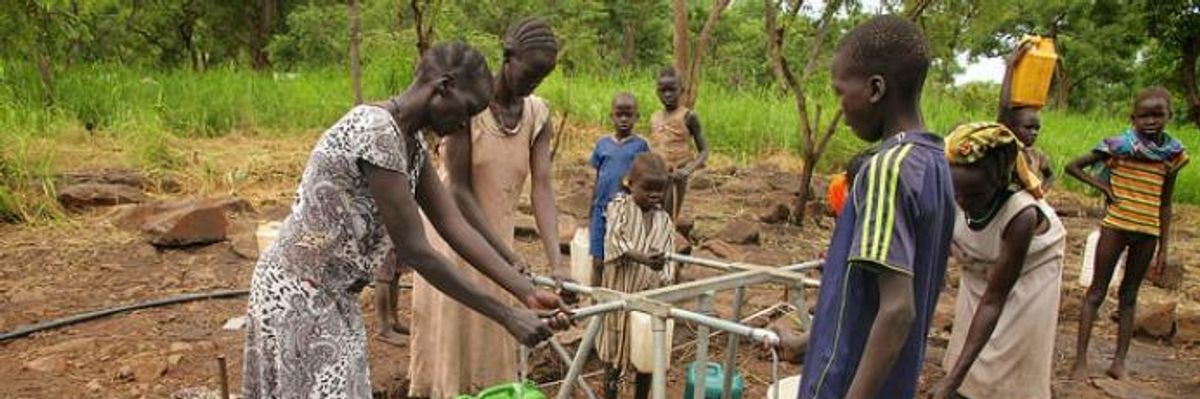
The capitalists of the world are heralding the idea that millions have been lifted out of poverty due to unfettered markers and free enterprise, but when the facts are checked, they show how the chains of poverty are being wrapped around more and more human beings. (Photo: Oxfam)
"Take a bow, capitalism." That's from The Economist, a business-happy publication that has every reason to perpetuate the myth that a world run by free enterprise is improving people's lives. Its story continues with an astounding claim: "The world now knows how to reduce poverty." Perhaps by presenting questionable data that seems to support what the business community wants us to believe.
Other super-capitalists are similarly exuding hyperbole in defense of their shaky beliefs. Said a spokesman for the American Enterprise Institute: "It was the American free-enterprise system that started to spread around the world. They looked at you and said, 'I want to have their life, their freedom, and their stuff, and they threw off their chains of poverty and tyranny.'" But it's clear, when the facts are checked, that the chains of poverty are being wrapped around more and more human beings.
Extreme Poverty Has INCREASED, in Terms of Wealth
According to the Credit Suisse Global Wealth Databook 2016, the median wealth of the world's adults is $2,222, down from $3,248 at the end of 2007. While the rich people of the world have taken more than their share of the $35 trillion wealth gain since the recession, the world median has dropped by over $1,000!
There are other recent indications of rising poverty. Based again on Credit Suisse wealth data, in just seven years the world's Gini Coefficient, the most widely accepted measure of inequality, has surged from 88.1 to 92.7. Wealth inequality BETWEEN countries has grown dramatically. It's a stunning rise, further evidence of a world splitting into two.
A widely held misconception is that global inequality between countries is declining because of growth in China and other developing countries. But that claim is generally made with respect to income inequality, and it is only partially true. Global income inequality is down only in relative terms, in the sense that an income boost from $1 to $2 a day is greater in percentage than an income boost from $1,000 to $1,500 a day.
The Poverty Threshold is Absurdly Low
The world poverty threshold was recently increased by the World Bank from $1.25 to $1.90 per day. Numerous sources have recognized the absurdity of this dollar amount for day-to-day survival. The United Nations Conference on Trade and Development argues for a $5 minimum; ActionAid says $10; even the World Bank admits that the $1.90 poverty line is "too miserly for middle-income countries," and that"more than 50 percent of the population in IDA [the world's poorest] countries live on less than US $6 a day and are considered at high or moderate risk of relapsing into poverty."
In addition, the poverty threshold has not kept up with inflation. The World Bank set the first poverty threshold to $1.01/day using 1985 purchasing power parity. It eventually raised the threshold to $1.90/dayat 2011 purchasing power parity. But with inflation, $1.01 in 1985 is equivalent to $2.10 in 2011. The World Bank's most recent threshold adjustment falls far short of realistic human needs.
Taking Credit for China, and Further Fudging the Numbers
Most of the so-called "escape from poverty" has occurred in China, where starting in the 1980s millions of residents of farming communities moved en masse to the cities for jobs in the factories of technology and in service-related positions.
The UN's Millennium Development Goals (MDGs) took advantage of this in the year 2000, calling for a halving of poverty, but backtracking to the year 1990 to include the income gains across China. The UN also revised statistical and caloric standards to ensure that its poverty reduction goals were reached.
An Extra $1 a Day, But Is It Worth It When You're Living in These Conditions?
China may have pulled millions "out of poverty," but in reality they've gained a few dollars a day while the country has become increasingly unequal in terms of wealth. The new Chinese "middle class" has in many ways gone backwards. According to China Labor Watch, weekly working hours in Apple's factories surpass 60 hours, much of it without compensation. Toy builders labor in the factories 11 hours a day, 6 or 7 days a week, earning minimum wage, while at night ten workers share a small dormitory room that may not even have hot showers. In the factories making products for Walmart and Home Depot, there are hundreds of underpaid student workers who labor in workshops that are hot and dusty, with volatile chemicals in the air, but with few health safeguards.
Numerous surveys and studies have made it clear that the Chinese people, despite their nation's unparalleled economic growth, are no happier than they were 20 years ago, and have generally experienced a loss of well-being in their daily lives.
It goes well beyond China. BBC journalist Paul Mason writes that the developing world middle class is characterized by life in a "chaotic mega-city, cheek-by-jowl with abject poverty and crime, crowding on to makeshift public transport systems and seeing your income leach away into the pockets of all kinds of corrupt officials.." In a review of Mike Davis's "Planet of Slums," urban areas are described as "horizontal spreads of unplanned squats and shantytowns, unsightly dumps of humans and waste, where child labour is the norm, child prostitution is commonplace, gangs and paramilitaries rule and there is no access to clean water or sanitation, let alone to education or democratic institutions." And, ironically, this is caused in great part by the policies of neoliberal institutions such as the World Bank, which would have us believe that conditions are steadily getting better.
Conditions getting better? Only in the minds of capitalists who don't want their comfortable lives disrupted by a rebellion among their billions of victims.
Dear Common Dreams reader, It’s been nearly 30 years since I co-founded Common Dreams with my late wife, Lina Newhouser. We had the radical notion that journalism should serve the public good, not corporate profits. It was clear to us from the outset what it would take to build such a project. No paid advertisements. No corporate sponsors. No millionaire publisher telling us what to think or do. Many people said we wouldn't last a year, but we proved those doubters wrong. Together with a tremendous team of journalists and dedicated staff, we built an independent media outlet free from the constraints of profits and corporate control. Our mission has always been simple: To inform. To inspire. To ignite change for the common good. Building Common Dreams was not easy. Our survival was never guaranteed. When you take on the most powerful forces—Wall Street greed, fossil fuel industry destruction, Big Tech lobbyists, and uber-rich oligarchs who have spent billions upon billions rigging the economy and democracy in their favor—the only bulwark you have is supporters who believe in your work. But here’s the urgent message from me today. It's never been this bad out there. And it's never been this hard to keep us going. At the very moment Common Dreams is most needed, the threats we face are intensifying. We need your support now more than ever. We don't accept corporate advertising and never will. We don't have a paywall because we don't think people should be blocked from critical news based on their ability to pay. Everything we do is funded by the donations of readers like you. When everyone does the little they can afford, we are strong. But if that support retreats or dries up, so do we. Will you donate now to make sure Common Dreams not only survives but thrives? —Craig Brown, Co-founder |
"Take a bow, capitalism." That's from The Economist, a business-happy publication that has every reason to perpetuate the myth that a world run by free enterprise is improving people's lives. Its story continues with an astounding claim: "The world now knows how to reduce poverty." Perhaps by presenting questionable data that seems to support what the business community wants us to believe.
Other super-capitalists are similarly exuding hyperbole in defense of their shaky beliefs. Said a spokesman for the American Enterprise Institute: "It was the American free-enterprise system that started to spread around the world. They looked at you and said, 'I want to have their life, their freedom, and their stuff, and they threw off their chains of poverty and tyranny.'" But it's clear, when the facts are checked, that the chains of poverty are being wrapped around more and more human beings.
Extreme Poverty Has INCREASED, in Terms of Wealth
According to the Credit Suisse Global Wealth Databook 2016, the median wealth of the world's adults is $2,222, down from $3,248 at the end of 2007. While the rich people of the world have taken more than their share of the $35 trillion wealth gain since the recession, the world median has dropped by over $1,000!
There are other recent indications of rising poverty. Based again on Credit Suisse wealth data, in just seven years the world's Gini Coefficient, the most widely accepted measure of inequality, has surged from 88.1 to 92.7. Wealth inequality BETWEEN countries has grown dramatically. It's a stunning rise, further evidence of a world splitting into two.
A widely held misconception is that global inequality between countries is declining because of growth in China and other developing countries. But that claim is generally made with respect to income inequality, and it is only partially true. Global income inequality is down only in relative terms, in the sense that an income boost from $1 to $2 a day is greater in percentage than an income boost from $1,000 to $1,500 a day.
The Poverty Threshold is Absurdly Low
The world poverty threshold was recently increased by the World Bank from $1.25 to $1.90 per day. Numerous sources have recognized the absurdity of this dollar amount for day-to-day survival. The United Nations Conference on Trade and Development argues for a $5 minimum; ActionAid says $10; even the World Bank admits that the $1.90 poverty line is "too miserly for middle-income countries," and that"more than 50 percent of the population in IDA [the world's poorest] countries live on less than US $6 a day and are considered at high or moderate risk of relapsing into poverty."
In addition, the poverty threshold has not kept up with inflation. The World Bank set the first poverty threshold to $1.01/day using 1985 purchasing power parity. It eventually raised the threshold to $1.90/dayat 2011 purchasing power parity. But with inflation, $1.01 in 1985 is equivalent to $2.10 in 2011. The World Bank's most recent threshold adjustment falls far short of realistic human needs.
Taking Credit for China, and Further Fudging the Numbers
Most of the so-called "escape from poverty" has occurred in China, where starting in the 1980s millions of residents of farming communities moved en masse to the cities for jobs in the factories of technology and in service-related positions.
The UN's Millennium Development Goals (MDGs) took advantage of this in the year 2000, calling for a halving of poverty, but backtracking to the year 1990 to include the income gains across China. The UN also revised statistical and caloric standards to ensure that its poverty reduction goals were reached.
An Extra $1 a Day, But Is It Worth It When You're Living in These Conditions?
China may have pulled millions "out of poverty," but in reality they've gained a few dollars a day while the country has become increasingly unequal in terms of wealth. The new Chinese "middle class" has in many ways gone backwards. According to China Labor Watch, weekly working hours in Apple's factories surpass 60 hours, much of it without compensation. Toy builders labor in the factories 11 hours a day, 6 or 7 days a week, earning minimum wage, while at night ten workers share a small dormitory room that may not even have hot showers. In the factories making products for Walmart and Home Depot, there are hundreds of underpaid student workers who labor in workshops that are hot and dusty, with volatile chemicals in the air, but with few health safeguards.
Numerous surveys and studies have made it clear that the Chinese people, despite their nation's unparalleled economic growth, are no happier than they were 20 years ago, and have generally experienced a loss of well-being in their daily lives.
It goes well beyond China. BBC journalist Paul Mason writes that the developing world middle class is characterized by life in a "chaotic mega-city, cheek-by-jowl with abject poverty and crime, crowding on to makeshift public transport systems and seeing your income leach away into the pockets of all kinds of corrupt officials.." In a review of Mike Davis's "Planet of Slums," urban areas are described as "horizontal spreads of unplanned squats and shantytowns, unsightly dumps of humans and waste, where child labour is the norm, child prostitution is commonplace, gangs and paramilitaries rule and there is no access to clean water or sanitation, let alone to education or democratic institutions." And, ironically, this is caused in great part by the policies of neoliberal institutions such as the World Bank, which would have us believe that conditions are steadily getting better.
Conditions getting better? Only in the minds of capitalists who don't want their comfortable lives disrupted by a rebellion among their billions of victims.
"Take a bow, capitalism." That's from The Economist, a business-happy publication that has every reason to perpetuate the myth that a world run by free enterprise is improving people's lives. Its story continues with an astounding claim: "The world now knows how to reduce poverty." Perhaps by presenting questionable data that seems to support what the business community wants us to believe.
Other super-capitalists are similarly exuding hyperbole in defense of their shaky beliefs. Said a spokesman for the American Enterprise Institute: "It was the American free-enterprise system that started to spread around the world. They looked at you and said, 'I want to have their life, their freedom, and their stuff, and they threw off their chains of poverty and tyranny.'" But it's clear, when the facts are checked, that the chains of poverty are being wrapped around more and more human beings.
Extreme Poverty Has INCREASED, in Terms of Wealth
According to the Credit Suisse Global Wealth Databook 2016, the median wealth of the world's adults is $2,222, down from $3,248 at the end of 2007. While the rich people of the world have taken more than their share of the $35 trillion wealth gain since the recession, the world median has dropped by over $1,000!
There are other recent indications of rising poverty. Based again on Credit Suisse wealth data, in just seven years the world's Gini Coefficient, the most widely accepted measure of inequality, has surged from 88.1 to 92.7. Wealth inequality BETWEEN countries has grown dramatically. It's a stunning rise, further evidence of a world splitting into two.
A widely held misconception is that global inequality between countries is declining because of growth in China and other developing countries. But that claim is generally made with respect to income inequality, and it is only partially true. Global income inequality is down only in relative terms, in the sense that an income boost from $1 to $2 a day is greater in percentage than an income boost from $1,000 to $1,500 a day.
The Poverty Threshold is Absurdly Low
The world poverty threshold was recently increased by the World Bank from $1.25 to $1.90 per day. Numerous sources have recognized the absurdity of this dollar amount for day-to-day survival. The United Nations Conference on Trade and Development argues for a $5 minimum; ActionAid says $10; even the World Bank admits that the $1.90 poverty line is "too miserly for middle-income countries," and that"more than 50 percent of the population in IDA [the world's poorest] countries live on less than US $6 a day and are considered at high or moderate risk of relapsing into poverty."
In addition, the poverty threshold has not kept up with inflation. The World Bank set the first poverty threshold to $1.01/day using 1985 purchasing power parity. It eventually raised the threshold to $1.90/dayat 2011 purchasing power parity. But with inflation, $1.01 in 1985 is equivalent to $2.10 in 2011. The World Bank's most recent threshold adjustment falls far short of realistic human needs.
Taking Credit for China, and Further Fudging the Numbers
Most of the so-called "escape from poverty" has occurred in China, where starting in the 1980s millions of residents of farming communities moved en masse to the cities for jobs in the factories of technology and in service-related positions.
The UN's Millennium Development Goals (MDGs) took advantage of this in the year 2000, calling for a halving of poverty, but backtracking to the year 1990 to include the income gains across China. The UN also revised statistical and caloric standards to ensure that its poverty reduction goals were reached.
An Extra $1 a Day, But Is It Worth It When You're Living in These Conditions?
China may have pulled millions "out of poverty," but in reality they've gained a few dollars a day while the country has become increasingly unequal in terms of wealth. The new Chinese "middle class" has in many ways gone backwards. According to China Labor Watch, weekly working hours in Apple's factories surpass 60 hours, much of it without compensation. Toy builders labor in the factories 11 hours a day, 6 or 7 days a week, earning minimum wage, while at night ten workers share a small dormitory room that may not even have hot showers. In the factories making products for Walmart and Home Depot, there are hundreds of underpaid student workers who labor in workshops that are hot and dusty, with volatile chemicals in the air, but with few health safeguards.
Numerous surveys and studies have made it clear that the Chinese people, despite their nation's unparalleled economic growth, are no happier than they were 20 years ago, and have generally experienced a loss of well-being in their daily lives.
It goes well beyond China. BBC journalist Paul Mason writes that the developing world middle class is characterized by life in a "chaotic mega-city, cheek-by-jowl with abject poverty and crime, crowding on to makeshift public transport systems and seeing your income leach away into the pockets of all kinds of corrupt officials.." In a review of Mike Davis's "Planet of Slums," urban areas are described as "horizontal spreads of unplanned squats and shantytowns, unsightly dumps of humans and waste, where child labour is the norm, child prostitution is commonplace, gangs and paramilitaries rule and there is no access to clean water or sanitation, let alone to education or democratic institutions." And, ironically, this is caused in great part by the policies of neoliberal institutions such as the World Bank, which would have us believe that conditions are steadily getting better.
Conditions getting better? Only in the minds of capitalists who don't want their comfortable lives disrupted by a rebellion among their billions of victims.