SUBSCRIBE TO OUR FREE NEWSLETTER
Daily news & progressive opinion—funded by the people, not the corporations—delivered straight to your inbox.
5
#000000
#FFFFFF
To donate by check, phone, or other method, see our More Ways to Give page.
Daily news & progressive opinion—funded by the people, not the corporations—delivered straight to your inbox.
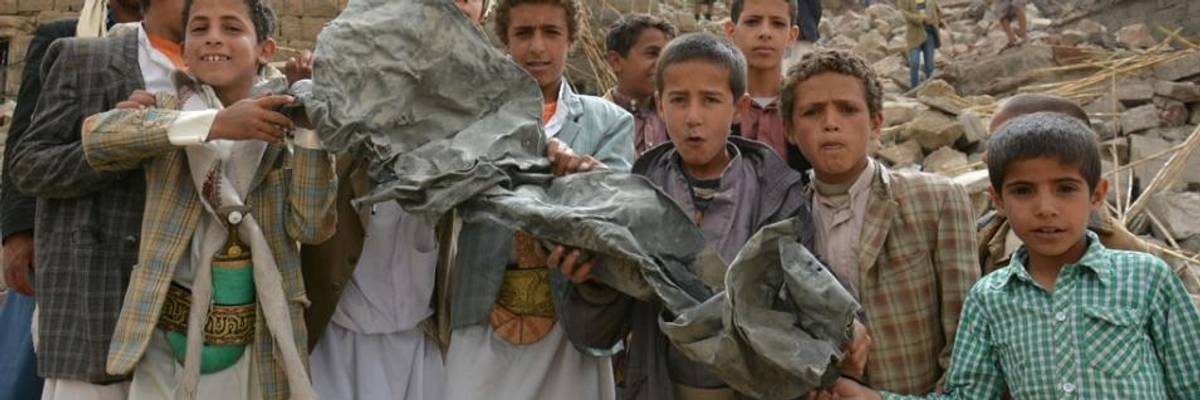
Boys hold a large piece of twisted metal near homes that were destroyed in an air strike, in Okash Village, near Sana'a, the capital of Yemen. (Photo: UNICEF/Mohammed Hamoud)
The Saudi Arabia-led war in Yemen is a tragedy of epic proportions in which the United States is deeply and directly involved. The war has caused mass starvation and a cholera epidemic that is worse than any the world has witnessed in the past 50 years, with the latest estimate of Yemeni victims at well over half a million.
This horrific situation is the result of Saudi/UAE bombing of roads, hospitals, bridges, water and sewage facilities, and the main port of Hodeida combined with a Saudi/UAE naval and air blockade that prevents large-scale humanitarian assistance from reaching the Yemeni war victims.
The Saudi/UAE coalition could not execute the war without U.S. direct involvement -- specifically the refueling of their planes carrying out the bombing -- and the further assistance of providing bombs and targeting intelligence.
Even apart from the need to halt this growing humanitarian disaster, Congress has a Constitutional obligation to deal with U.S. participation in this war. Flatly stated, U.S. participation is illegal.
When President Barack Obama ordered U.S. involvement, the Saudi-led war was not covered by the Authorization for the Use of Military Force (AUMF) issued by Congress in the wake of 9/11. The Houthis and the forces of former Yemeni president Saleh against whom the Saudi coalition is engaged are not affiliated with al Qaeda or any other entity associated with the 9/11 terror attacks.
That is why a bipartisan group of House members -- Mark Pocan (D-Wis.), Thomas Massie (R-Ky.), Ro Khanna (D-Calif.) and Walter Jones (R-N.C.)--have introduced H. Con. Res. 81, giving Congress an opportunity to end U.S. support. The resolution instructs the president to withdraw U.S. military personnel from the war -- except the U.S. military elements that are strictly aimed at al-Qaeda elements in Yemen.
Even if House members are indifferent to the fact that Congress did not authorize U.S. support for the war, they should take account of the fact that such support has increased the security threat to all Americans. The Saudi-led war in Yemen, enabled by U.S. support, has strengthened America's most dangerous enemies in the Middle East -- al Qaeda in the Arabian Peninsula (AQAP).
U.S. intelligence and counter-terrorism officials have regarded AQAP as even more of a foreign terrorist threat to the United States than ISIS. It mounted efforts to bring down U.S. airlines three times between 2009 and 2012, and nearly succeeded twice. But the Saudi/UAE war in Yemen has made them the most powerful indigenous armed group in southern Yemen, with more money, arms and territorial control than ever before. The Saudi-led coalition and the forces of the Saudi backed former regime have allied openly with AQAP and even fought alongside them. As a result of the war AQAP is now poised for the first time to compete for national power In Yemen.
The war is also increasing anti-American sentiment in Yemen. As Senator Chris Murphy (D-Conn.) has pointed out, Yemenis believe the war is being waged by the U.S., not by the Saudi/UAE coalition, which they view as a U.S. proxy. "(W)e are helping to radicalize the Yemeni population against the United States," Murphy warns.
Some Members of Congress refuse to support H. Con. Res. 81 because they accept the official rationale for U.S. involvement in the war created by the Obama administration. They argue that the United States has no choice but to support the Saudi-led war because it is necessary to oppose an expansionist Iran. But it is widely recognized that the Houthis are not Iranian proxies; they pursue their own interests and strategy.
Before the war began, in fact, U.S. intelligence learned that Iran had advised the Houthis against seizing power by force in Sanaa in 2014 but the Houthis ignored the advice and had instead responded to encouragement from their erstwhile foe, former president Ali Abdullah Saleh.
The Obama administration promoted the idea that Iran had been supplying arms to the Houthis by sea for years before the war started. But that argument was based on old recycled claims by the Yemeni government that were contradicted by the publicly available evidence. After seizing power in 2014, the Houthis did obtain a bonanza of arms, but it wasn't from Iran; it was from U.S.-supplied arms held by the Yemeni Army units still loyal to Saleh.
Although some Iranian arms have certainly reached Yemen, a careful assessment by a UN panel of experts on Yemen in January 2017 was unable to confirm "any direct large-scale supply of arms" from Iran to the Houthis. And whatever Iranian arms that were supplied were not the cause of the Saudi/UAE attack on Yemen; they were a response to the beginning of the Saudi air assault.
U.S. fealty to Saudi Arabia has worsened the chaos and suffering sweeping across the Middle East. It's time to break with such destabilizing policies that threaten fundamental U.S. security interests. By passing H. Con. Res. 81 the House of Representatives can reduce threats to U.S. security, assert the power of Congress to authorize U.S. participation in wars of choice and end the infliction of massive starvation and cholera on the Yemeni population.
Dear Common Dreams reader, It’s been nearly 30 years since I co-founded Common Dreams with my late wife, Lina Newhouser. We had the radical notion that journalism should serve the public good, not corporate profits. It was clear to us from the outset what it would take to build such a project. No paid advertisements. No corporate sponsors. No millionaire publisher telling us what to think or do. Many people said we wouldn't last a year, but we proved those doubters wrong. Together with a tremendous team of journalists and dedicated staff, we built an independent media outlet free from the constraints of profits and corporate control. Our mission has always been simple: To inform. To inspire. To ignite change for the common good. Building Common Dreams was not easy. Our survival was never guaranteed. When you take on the most powerful forces—Wall Street greed, fossil fuel industry destruction, Big Tech lobbyists, and uber-rich oligarchs who have spent billions upon billions rigging the economy and democracy in their favor—the only bulwark you have is supporters who believe in your work. But here’s the urgent message from me today. It's never been this bad out there. And it's never been this hard to keep us going. At the very moment Common Dreams is most needed, the threats we face are intensifying. We need your support now more than ever. We don't accept corporate advertising and never will. We don't have a paywall because we don't think people should be blocked from critical news based on their ability to pay. Everything we do is funded by the donations of readers like you. When everyone does the little they can afford, we are strong. But if that support retreats or dries up, so do we. Will you donate now to make sure Common Dreams not only survives but thrives? —Craig Brown, Co-founder |
The Saudi Arabia-led war in Yemen is a tragedy of epic proportions in which the United States is deeply and directly involved. The war has caused mass starvation and a cholera epidemic that is worse than any the world has witnessed in the past 50 years, with the latest estimate of Yemeni victims at well over half a million.
This horrific situation is the result of Saudi/UAE bombing of roads, hospitals, bridges, water and sewage facilities, and the main port of Hodeida combined with a Saudi/UAE naval and air blockade that prevents large-scale humanitarian assistance from reaching the Yemeni war victims.
The Saudi/UAE coalition could not execute the war without U.S. direct involvement -- specifically the refueling of their planes carrying out the bombing -- and the further assistance of providing bombs and targeting intelligence.
Even apart from the need to halt this growing humanitarian disaster, Congress has a Constitutional obligation to deal with U.S. participation in this war. Flatly stated, U.S. participation is illegal.
When President Barack Obama ordered U.S. involvement, the Saudi-led war was not covered by the Authorization for the Use of Military Force (AUMF) issued by Congress in the wake of 9/11. The Houthis and the forces of former Yemeni president Saleh against whom the Saudi coalition is engaged are not affiliated with al Qaeda or any other entity associated with the 9/11 terror attacks.
That is why a bipartisan group of House members -- Mark Pocan (D-Wis.), Thomas Massie (R-Ky.), Ro Khanna (D-Calif.) and Walter Jones (R-N.C.)--have introduced H. Con. Res. 81, giving Congress an opportunity to end U.S. support. The resolution instructs the president to withdraw U.S. military personnel from the war -- except the U.S. military elements that are strictly aimed at al-Qaeda elements in Yemen.
Even if House members are indifferent to the fact that Congress did not authorize U.S. support for the war, they should take account of the fact that such support has increased the security threat to all Americans. The Saudi-led war in Yemen, enabled by U.S. support, has strengthened America's most dangerous enemies in the Middle East -- al Qaeda in the Arabian Peninsula (AQAP).
U.S. intelligence and counter-terrorism officials have regarded AQAP as even more of a foreign terrorist threat to the United States than ISIS. It mounted efforts to bring down U.S. airlines three times between 2009 and 2012, and nearly succeeded twice. But the Saudi/UAE war in Yemen has made them the most powerful indigenous armed group in southern Yemen, with more money, arms and territorial control than ever before. The Saudi-led coalition and the forces of the Saudi backed former regime have allied openly with AQAP and even fought alongside them. As a result of the war AQAP is now poised for the first time to compete for national power In Yemen.
The war is also increasing anti-American sentiment in Yemen. As Senator Chris Murphy (D-Conn.) has pointed out, Yemenis believe the war is being waged by the U.S., not by the Saudi/UAE coalition, which they view as a U.S. proxy. "(W)e are helping to radicalize the Yemeni population against the United States," Murphy warns.
Some Members of Congress refuse to support H. Con. Res. 81 because they accept the official rationale for U.S. involvement in the war created by the Obama administration. They argue that the United States has no choice but to support the Saudi-led war because it is necessary to oppose an expansionist Iran. But it is widely recognized that the Houthis are not Iranian proxies; they pursue their own interests and strategy.
Before the war began, in fact, U.S. intelligence learned that Iran had advised the Houthis against seizing power by force in Sanaa in 2014 but the Houthis ignored the advice and had instead responded to encouragement from their erstwhile foe, former president Ali Abdullah Saleh.
The Obama administration promoted the idea that Iran had been supplying arms to the Houthis by sea for years before the war started. But that argument was based on old recycled claims by the Yemeni government that were contradicted by the publicly available evidence. After seizing power in 2014, the Houthis did obtain a bonanza of arms, but it wasn't from Iran; it was from U.S.-supplied arms held by the Yemeni Army units still loyal to Saleh.
Although some Iranian arms have certainly reached Yemen, a careful assessment by a UN panel of experts on Yemen in January 2017 was unable to confirm "any direct large-scale supply of arms" from Iran to the Houthis. And whatever Iranian arms that were supplied were not the cause of the Saudi/UAE attack on Yemen; they were a response to the beginning of the Saudi air assault.
U.S. fealty to Saudi Arabia has worsened the chaos and suffering sweeping across the Middle East. It's time to break with such destabilizing policies that threaten fundamental U.S. security interests. By passing H. Con. Res. 81 the House of Representatives can reduce threats to U.S. security, assert the power of Congress to authorize U.S. participation in wars of choice and end the infliction of massive starvation and cholera on the Yemeni population.
The Saudi Arabia-led war in Yemen is a tragedy of epic proportions in which the United States is deeply and directly involved. The war has caused mass starvation and a cholera epidemic that is worse than any the world has witnessed in the past 50 years, with the latest estimate of Yemeni victims at well over half a million.
This horrific situation is the result of Saudi/UAE bombing of roads, hospitals, bridges, water and sewage facilities, and the main port of Hodeida combined with a Saudi/UAE naval and air blockade that prevents large-scale humanitarian assistance from reaching the Yemeni war victims.
The Saudi/UAE coalition could not execute the war without U.S. direct involvement -- specifically the refueling of their planes carrying out the bombing -- and the further assistance of providing bombs and targeting intelligence.
Even apart from the need to halt this growing humanitarian disaster, Congress has a Constitutional obligation to deal with U.S. participation in this war. Flatly stated, U.S. participation is illegal.
When President Barack Obama ordered U.S. involvement, the Saudi-led war was not covered by the Authorization for the Use of Military Force (AUMF) issued by Congress in the wake of 9/11. The Houthis and the forces of former Yemeni president Saleh against whom the Saudi coalition is engaged are not affiliated with al Qaeda or any other entity associated with the 9/11 terror attacks.
That is why a bipartisan group of House members -- Mark Pocan (D-Wis.), Thomas Massie (R-Ky.), Ro Khanna (D-Calif.) and Walter Jones (R-N.C.)--have introduced H. Con. Res. 81, giving Congress an opportunity to end U.S. support. The resolution instructs the president to withdraw U.S. military personnel from the war -- except the U.S. military elements that are strictly aimed at al-Qaeda elements in Yemen.
Even if House members are indifferent to the fact that Congress did not authorize U.S. support for the war, they should take account of the fact that such support has increased the security threat to all Americans. The Saudi-led war in Yemen, enabled by U.S. support, has strengthened America's most dangerous enemies in the Middle East -- al Qaeda in the Arabian Peninsula (AQAP).
U.S. intelligence and counter-terrorism officials have regarded AQAP as even more of a foreign terrorist threat to the United States than ISIS. It mounted efforts to bring down U.S. airlines three times between 2009 and 2012, and nearly succeeded twice. But the Saudi/UAE war in Yemen has made them the most powerful indigenous armed group in southern Yemen, with more money, arms and territorial control than ever before. The Saudi-led coalition and the forces of the Saudi backed former regime have allied openly with AQAP and even fought alongside them. As a result of the war AQAP is now poised for the first time to compete for national power In Yemen.
The war is also increasing anti-American sentiment in Yemen. As Senator Chris Murphy (D-Conn.) has pointed out, Yemenis believe the war is being waged by the U.S., not by the Saudi/UAE coalition, which they view as a U.S. proxy. "(W)e are helping to radicalize the Yemeni population against the United States," Murphy warns.
Some Members of Congress refuse to support H. Con. Res. 81 because they accept the official rationale for U.S. involvement in the war created by the Obama administration. They argue that the United States has no choice but to support the Saudi-led war because it is necessary to oppose an expansionist Iran. But it is widely recognized that the Houthis are not Iranian proxies; they pursue their own interests and strategy.
Before the war began, in fact, U.S. intelligence learned that Iran had advised the Houthis against seizing power by force in Sanaa in 2014 but the Houthis ignored the advice and had instead responded to encouragement from their erstwhile foe, former president Ali Abdullah Saleh.
The Obama administration promoted the idea that Iran had been supplying arms to the Houthis by sea for years before the war started. But that argument was based on old recycled claims by the Yemeni government that were contradicted by the publicly available evidence. After seizing power in 2014, the Houthis did obtain a bonanza of arms, but it wasn't from Iran; it was from U.S.-supplied arms held by the Yemeni Army units still loyal to Saleh.
Although some Iranian arms have certainly reached Yemen, a careful assessment by a UN panel of experts on Yemen in January 2017 was unable to confirm "any direct large-scale supply of arms" from Iran to the Houthis. And whatever Iranian arms that were supplied were not the cause of the Saudi/UAE attack on Yemen; they were a response to the beginning of the Saudi air assault.
U.S. fealty to Saudi Arabia has worsened the chaos and suffering sweeping across the Middle East. It's time to break with such destabilizing policies that threaten fundamental U.S. security interests. By passing H. Con. Res. 81 the House of Representatives can reduce threats to U.S. security, assert the power of Congress to authorize U.S. participation in wars of choice and end the infliction of massive starvation and cholera on the Yemeni population.