SUBSCRIBE TO OUR FREE NEWSLETTER
Daily news & progressive opinion—funded by the people, not the corporations—delivered straight to your inbox.
5
#000000
#FFFFFF
To donate by check, phone, or other method, see our More Ways to Give page.
Daily news & progressive opinion—funded by the people, not the corporations—delivered straight to your inbox.
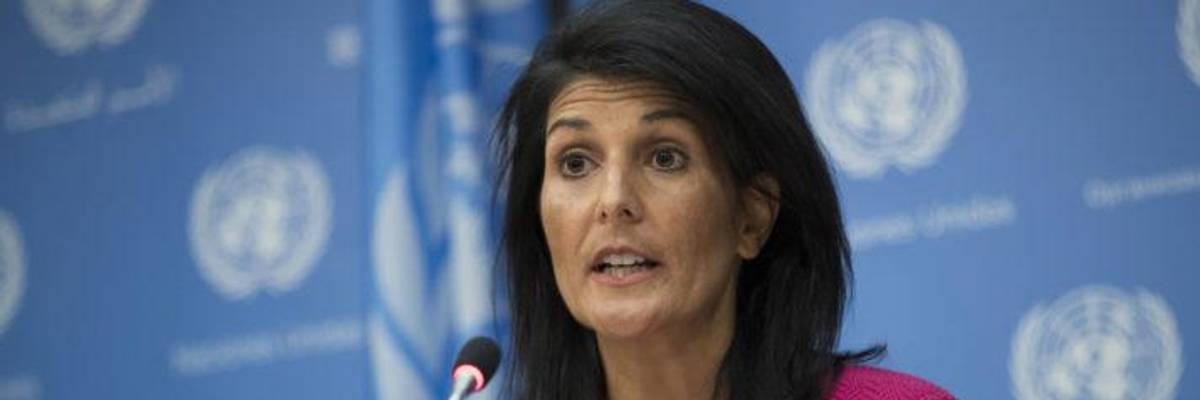
United States Ambassador to the United Nations Nikki Haley is scheduled to visit Africa, but as Okoye writes, "the US may say it cares about Africa, but words are cheap." (Photo: Getty)
Donald Trump, an orator that never knowingly exits a room without leaving all eyebrows raised, surpassed himself on September 20th in a speech to African Leaders at the UN. He not only managed to happily endorse neo-colonialism by telling the assembled dignitaries that Americans love going to Africa to "get rich," he also managed to invent a whole new African country of "Nambia," having become confused between Namibia and Zambia.
Aside from these trademark zingers, he said all the right things, but, crucially, nothing that relates too closely to reality. He spoke, for example, of the US commitment to fostering peace and development in Africa, even as his administration remains hell-bent on slashing funding for the continent.
Meanwhile, countries like the Democratic Republic of Congo and South Sudan continue to disintegrate. And cosmetic moves, like sending UN Ambassador Nikki Haley and Health to Africa will do nothing to change this. Words, press releases and token tours should not distract us from reality: the Trump administration does not have a problem with allowing African countries to become failed states
Trump's speech at the UN wasn't just an insult to Africa, it glossed over the very real injuries that the US is inflicting as it decimates its aid budget. While the US deludes itself that it, and it alone, is the most generous aid benefactor on the world stage, nothing could be further from the truth. Sure, it may donate the most in crude terms of financial output, but when the money it donates is considered relative to its population, a very different type of picture emerges. As one writer in the Guardian put it, when it comes to the global aid leaderboard, it is not so much "America First" as "America Twenty Second."
"While the US deludes itself that it, and it alone, is the most generous aid benefactor on the world stage, nothing could be further from the truth."
And Trump aims to slip further down the rankings. His budget will see aid to Africa cut from $8 billion down to $5.2 billion. Perhaps even more crucially, the goal of this aid will change, shifting away from development organizations like the African Development Foundation and towards security and the military. There is arguably never a good time to unilaterally reduce aid to some of the poorest countries in the world, but this is without a doubt one of the worst times the US could have picked. Conflict and drought have led to widespread levels of displacement across Africa, with all the attendant problems this brings. According to the UN, millions of people are on the brink of starvation in South Sudan, Somalia and Nigeria.
Where there's hunger, there's anger and conflict. And Trump's aim of "reducing costs at any cost" leaves Africa's myriad hotspots even more vulnerable than they already are and means the organizations on the ground will be even less able to keep civilians safe. One official from the UN Peacekeeping Mission in the DRC, MONUSCO, commented that they are effectively being asked to "do less with less" as they try to prevent the conflict in the beleaguered country spinning completely out of control.
For when Haley visits the DRC, she will be visiting a country that is unraveling at the seams. Its current leader, PresidentJoseph Kabila, whose mandate for power expired in December 2016, is refusing to step down. He's also refusing to allow the most viable opposition candidate Moise Katumbi to step-up by ensuring he stays exiled in Europe on the most spurious of charges.
In the meantime, the country is being run by Kabila for the benefit of him and his cronies--or, as Katumbi himself put it, like a "pilotless plane and a family boutique"--and it is the people who are suffering. In the province of Kasai alone, for example, more than one million people have been uprooted from their homes in the wake of anti-government revolts. Katumbi has also threatened to call for street protests unless Kabila leaves the presidential palace by the end of the year. The DRC is a pressure cooker and Trump's measures are eroding the integrity of its already weakened gasket.
The situation in another of Haley's destinations, South Sudan, is not much better. The country may have recently marked the sixth anniversary of its independence but there was very little to celebrate. It is, according to the UN, facing its "highest ever level of food insecurity." Around two thirds of the population, 7.5 million people, are in need of humanitarian assistance and in some places, half the population is malnourished. This is in part due to what Oxfam calls the "hostage situation," that sees the wider population at the mercy of the havoc wreaked by the government of the newest nation on earth and rebel forces.
And, as Trump's administration slashes funding for Africa, this havoc is unlikely to end any time soon. For the US may say it cares about Africa, but words are cheap (and in Trump's case, often not even accurate). It's actions that matter and the actions of the current administration show they do not really care; they are happy to sit back while countries like the DRC burn. We can no doubt look forward to more mealy-mouthed sentiment when the consequences of this begin to reverberate around the continent.
Dear Common Dreams reader, It’s been nearly 30 years since I co-founded Common Dreams with my late wife, Lina Newhouser. We had the radical notion that journalism should serve the public good, not corporate profits. It was clear to us from the outset what it would take to build such a project. No paid advertisements. No corporate sponsors. No millionaire publisher telling us what to think or do. Many people said we wouldn't last a year, but we proved those doubters wrong. Together with a tremendous team of journalists and dedicated staff, we built an independent media outlet free from the constraints of profits and corporate control. Our mission has always been simple: To inform. To inspire. To ignite change for the common good. Building Common Dreams was not easy. Our survival was never guaranteed. When you take on the most powerful forces—Wall Street greed, fossil fuel industry destruction, Big Tech lobbyists, and uber-rich oligarchs who have spent billions upon billions rigging the economy and democracy in their favor—the only bulwark you have is supporters who believe in your work. But here’s the urgent message from me today. It's never been this bad out there. And it's never been this hard to keep us going. At the very moment Common Dreams is most needed, the threats we face are intensifying. We need your support now more than ever. We don't accept corporate advertising and never will. We don't have a paywall because we don't think people should be blocked from critical news based on their ability to pay. Everything we do is funded by the donations of readers like you. When everyone does the little they can afford, we are strong. But if that support retreats or dries up, so do we. Will you donate now to make sure Common Dreams not only survives but thrives? —Craig Brown, Co-founder |
Donald Trump, an orator that never knowingly exits a room without leaving all eyebrows raised, surpassed himself on September 20th in a speech to African Leaders at the UN. He not only managed to happily endorse neo-colonialism by telling the assembled dignitaries that Americans love going to Africa to "get rich," he also managed to invent a whole new African country of "Nambia," having become confused between Namibia and Zambia.
Aside from these trademark zingers, he said all the right things, but, crucially, nothing that relates too closely to reality. He spoke, for example, of the US commitment to fostering peace and development in Africa, even as his administration remains hell-bent on slashing funding for the continent.
Meanwhile, countries like the Democratic Republic of Congo and South Sudan continue to disintegrate. And cosmetic moves, like sending UN Ambassador Nikki Haley and Health to Africa will do nothing to change this. Words, press releases and token tours should not distract us from reality: the Trump administration does not have a problem with allowing African countries to become failed states
Trump's speech at the UN wasn't just an insult to Africa, it glossed over the very real injuries that the US is inflicting as it decimates its aid budget. While the US deludes itself that it, and it alone, is the most generous aid benefactor on the world stage, nothing could be further from the truth. Sure, it may donate the most in crude terms of financial output, but when the money it donates is considered relative to its population, a very different type of picture emerges. As one writer in the Guardian put it, when it comes to the global aid leaderboard, it is not so much "America First" as "America Twenty Second."
"While the US deludes itself that it, and it alone, is the most generous aid benefactor on the world stage, nothing could be further from the truth."
And Trump aims to slip further down the rankings. His budget will see aid to Africa cut from $8 billion down to $5.2 billion. Perhaps even more crucially, the goal of this aid will change, shifting away from development organizations like the African Development Foundation and towards security and the military. There is arguably never a good time to unilaterally reduce aid to some of the poorest countries in the world, but this is without a doubt one of the worst times the US could have picked. Conflict and drought have led to widespread levels of displacement across Africa, with all the attendant problems this brings. According to the UN, millions of people are on the brink of starvation in South Sudan, Somalia and Nigeria.
Where there's hunger, there's anger and conflict. And Trump's aim of "reducing costs at any cost" leaves Africa's myriad hotspots even more vulnerable than they already are and means the organizations on the ground will be even less able to keep civilians safe. One official from the UN Peacekeeping Mission in the DRC, MONUSCO, commented that they are effectively being asked to "do less with less" as they try to prevent the conflict in the beleaguered country spinning completely out of control.
For when Haley visits the DRC, she will be visiting a country that is unraveling at the seams. Its current leader, PresidentJoseph Kabila, whose mandate for power expired in December 2016, is refusing to step down. He's also refusing to allow the most viable opposition candidate Moise Katumbi to step-up by ensuring he stays exiled in Europe on the most spurious of charges.
In the meantime, the country is being run by Kabila for the benefit of him and his cronies--or, as Katumbi himself put it, like a "pilotless plane and a family boutique"--and it is the people who are suffering. In the province of Kasai alone, for example, more than one million people have been uprooted from their homes in the wake of anti-government revolts. Katumbi has also threatened to call for street protests unless Kabila leaves the presidential palace by the end of the year. The DRC is a pressure cooker and Trump's measures are eroding the integrity of its already weakened gasket.
The situation in another of Haley's destinations, South Sudan, is not much better. The country may have recently marked the sixth anniversary of its independence but there was very little to celebrate. It is, according to the UN, facing its "highest ever level of food insecurity." Around two thirds of the population, 7.5 million people, are in need of humanitarian assistance and in some places, half the population is malnourished. This is in part due to what Oxfam calls the "hostage situation," that sees the wider population at the mercy of the havoc wreaked by the government of the newest nation on earth and rebel forces.
And, as Trump's administration slashes funding for Africa, this havoc is unlikely to end any time soon. For the US may say it cares about Africa, but words are cheap (and in Trump's case, often not even accurate). It's actions that matter and the actions of the current administration show they do not really care; they are happy to sit back while countries like the DRC burn. We can no doubt look forward to more mealy-mouthed sentiment when the consequences of this begin to reverberate around the continent.
Donald Trump, an orator that never knowingly exits a room without leaving all eyebrows raised, surpassed himself on September 20th in a speech to African Leaders at the UN. He not only managed to happily endorse neo-colonialism by telling the assembled dignitaries that Americans love going to Africa to "get rich," he also managed to invent a whole new African country of "Nambia," having become confused between Namibia and Zambia.
Aside from these trademark zingers, he said all the right things, but, crucially, nothing that relates too closely to reality. He spoke, for example, of the US commitment to fostering peace and development in Africa, even as his administration remains hell-bent on slashing funding for the continent.
Meanwhile, countries like the Democratic Republic of Congo and South Sudan continue to disintegrate. And cosmetic moves, like sending UN Ambassador Nikki Haley and Health to Africa will do nothing to change this. Words, press releases and token tours should not distract us from reality: the Trump administration does not have a problem with allowing African countries to become failed states
Trump's speech at the UN wasn't just an insult to Africa, it glossed over the very real injuries that the US is inflicting as it decimates its aid budget. While the US deludes itself that it, and it alone, is the most generous aid benefactor on the world stage, nothing could be further from the truth. Sure, it may donate the most in crude terms of financial output, but when the money it donates is considered relative to its population, a very different type of picture emerges. As one writer in the Guardian put it, when it comes to the global aid leaderboard, it is not so much "America First" as "America Twenty Second."
"While the US deludes itself that it, and it alone, is the most generous aid benefactor on the world stage, nothing could be further from the truth."
And Trump aims to slip further down the rankings. His budget will see aid to Africa cut from $8 billion down to $5.2 billion. Perhaps even more crucially, the goal of this aid will change, shifting away from development organizations like the African Development Foundation and towards security and the military. There is arguably never a good time to unilaterally reduce aid to some of the poorest countries in the world, but this is without a doubt one of the worst times the US could have picked. Conflict and drought have led to widespread levels of displacement across Africa, with all the attendant problems this brings. According to the UN, millions of people are on the brink of starvation in South Sudan, Somalia and Nigeria.
Where there's hunger, there's anger and conflict. And Trump's aim of "reducing costs at any cost" leaves Africa's myriad hotspots even more vulnerable than they already are and means the organizations on the ground will be even less able to keep civilians safe. One official from the UN Peacekeeping Mission in the DRC, MONUSCO, commented that they are effectively being asked to "do less with less" as they try to prevent the conflict in the beleaguered country spinning completely out of control.
For when Haley visits the DRC, she will be visiting a country that is unraveling at the seams. Its current leader, PresidentJoseph Kabila, whose mandate for power expired in December 2016, is refusing to step down. He's also refusing to allow the most viable opposition candidate Moise Katumbi to step-up by ensuring he stays exiled in Europe on the most spurious of charges.
In the meantime, the country is being run by Kabila for the benefit of him and his cronies--or, as Katumbi himself put it, like a "pilotless plane and a family boutique"--and it is the people who are suffering. In the province of Kasai alone, for example, more than one million people have been uprooted from their homes in the wake of anti-government revolts. Katumbi has also threatened to call for street protests unless Kabila leaves the presidential palace by the end of the year. The DRC is a pressure cooker and Trump's measures are eroding the integrity of its already weakened gasket.
The situation in another of Haley's destinations, South Sudan, is not much better. The country may have recently marked the sixth anniversary of its independence but there was very little to celebrate. It is, according to the UN, facing its "highest ever level of food insecurity." Around two thirds of the population, 7.5 million people, are in need of humanitarian assistance and in some places, half the population is malnourished. This is in part due to what Oxfam calls the "hostage situation," that sees the wider population at the mercy of the havoc wreaked by the government of the newest nation on earth and rebel forces.
And, as Trump's administration slashes funding for Africa, this havoc is unlikely to end any time soon. For the US may say it cares about Africa, but words are cheap (and in Trump's case, often not even accurate). It's actions that matter and the actions of the current administration show they do not really care; they are happy to sit back while countries like the DRC burn. We can no doubt look forward to more mealy-mouthed sentiment when the consequences of this begin to reverberate around the continent.