SUBSCRIBE TO OUR FREE NEWSLETTER
Daily news & progressive opinion—funded by the people, not the corporations—delivered straight to your inbox.
5
#000000
#FFFFFF
To donate by check, phone, or other method, see our More Ways to Give page.
Daily news & progressive opinion—funded by the people, not the corporations—delivered straight to your inbox.
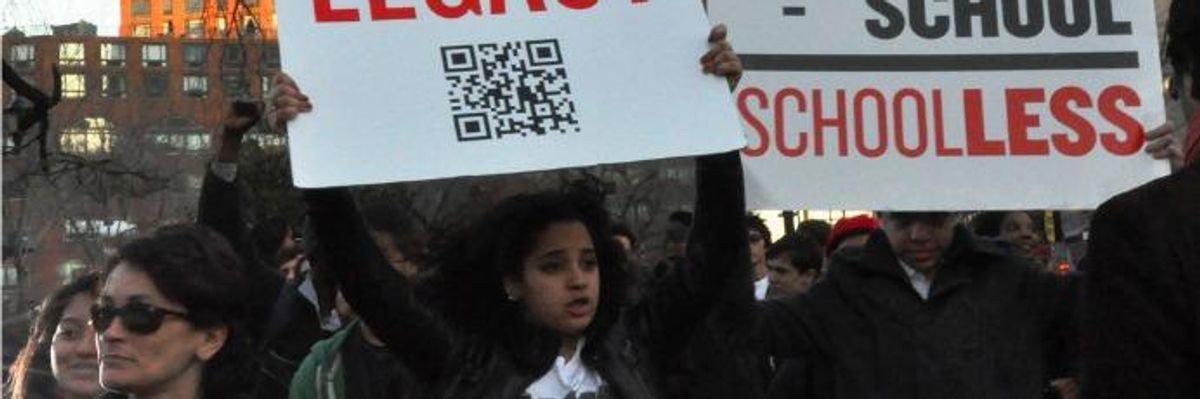
"School closures and charter school proliferation are bad no matter who proposes it--Republicans or Democrats," writes Steven Singer. (Photo: Michael Fleshman/Flickr/cc)
You might be tempted to file this under 'No Shit, Sherlock.'
But a new study found that closing schools where students achieve low test scores doesn't end up helping them learn. Moreover, such closures disproportionately affect students of color.
What's surprising, however, is who conducted the study--corporate education reform cheerleaders, the Center for Research on EDucation Outcomes (CREDO).
Like their 2013 study that found little evidence charter schools outperform traditional public schools, this year's research found little evidence for another key plank in the school privatization platform.
These are the same folks who have suggested for at least a decade that the solution to low test scores was to simply close struggling public schools, replace them with charter schools and voila.
But now their own research says "no voila." Not to the charter part. Not to the school closing part. Not to any single part of their own backward agenda.
Stanford-based CREDO is funded by the Hoover Institution, the Walton Foundation and testing giant Pearson, among others. They have close ties to the KIPP charter school network and privatization propaganda organizations like the Center for Education Reform.
If they can't find evidence to support these policies, no one can!
After funding one of the largest studies of school closures ever conducted, looking at data from 26 states from 2003 to 2013, they could find zero support that closing struggling schools increases student test scores.
The best they could do was find no evidence that it hurt.
But this is because they defined student achievement solely by raw standardized scores. No other measure--not student grades, not graduation rates, attendance, support networks, community involvement, not even improvement on those same assessments--nothing else was even considered.
Perhaps this is due to the plethora of studies showing that school closures negatively impact students in these ways. Closing schools crushes the entire community economically and socially. It affects students well beyond academic achievement.
The CREDO study did, however, find that where displaced students enrolled after their original school was closed made a difference.
If Sally moves to School B after School A is closed, her success is significantly affected by the quality of her new educational institution. Students who moved to schools that suffered from the same structural deficiencies and chronic underfunding as did their original alma mater, did not improve. But students who moved to schools that were overflowing with resources, smaller class sizes, etc. did better. However, the latter rarely happened. Displaced students almost always ended up at schools that were just about as neglected as their original institution.
Even in the fleeting instances where students traded up, researchers noted that the difference between School A and B had to be massive for students to experience positive results.
Does that mean school closures can be a constructive reform strategy?
No. It only supports the obvious fact that increasing resources and providing equitable funding can help improve student achievement. It doesn't justify killing struggling schools. It justifies saving them.
Another finding of the CREDO study was the racial component of school closings.
Schools with higher populations of blacks and Hispanics were more likely to be shuttered than institutions serving mostly white students. In addition, schools with higher poverty populations were also more likely to be closed than those serving middle class or rich children.
Yet you really don't need an academic study to know that. All you have to do is read the news. Read about the closings in Chicago, New Orleans, Detroit--really any major metropolitan area. The fact that CREDO admits it, only adds credence to arguments by critics like myself.
It is no accident that poor black schools get closed more than rich white ones. Poor students of color are targeted for this exact treatment. Corporate education reform is not just bad policy; it is racist and classist as well.
Greg Richmond, President of the National Association of Charter School Authorizers, was shocked by these findings.
"We are especially troubled by the report's observation of different school closure patterns based on race, ethnicity, and poverty," he said in a statement. "These differences were present among both charter schools and traditional public schools and serve as a wake-up call to examine our practices to ensure all schools and students are being treated equitably."
But his industry benefits from these practices. Just as CREDO's backers do.
Never has our country been less prepared to deal with the real problems besieging it. But if the time ever comes when sanity returns, we cannot simply go back to familiar habits. School closures and charter school proliferation are bad no matter who proposes it--Republicans or Democrats. Regardless of who sits in the Oval Office, regardless of who represents us in federal, state and local government, we have to make sure they do the right things for our children.
That means learning from our mistakes. Beyond partisanship. Beyond economics. It's the only way to build a better world. CREDO's study just adds fuel to the fire surrounding the regressive education policies of the last decade.
If we're ever in the position to hold a match, will we have the courage to strike it?
Dear Common Dreams reader, It’s been nearly 30 years since I co-founded Common Dreams with my late wife, Lina Newhouser. We had the radical notion that journalism should serve the public good, not corporate profits. It was clear to us from the outset what it would take to build such a project. No paid advertisements. No corporate sponsors. No millionaire publisher telling us what to think or do. Many people said we wouldn't last a year, but we proved those doubters wrong. Together with a tremendous team of journalists and dedicated staff, we built an independent media outlet free from the constraints of profits and corporate control. Our mission has always been simple: To inform. To inspire. To ignite change for the common good. Building Common Dreams was not easy. Our survival was never guaranteed. When you take on the most powerful forces—Wall Street greed, fossil fuel industry destruction, Big Tech lobbyists, and uber-rich oligarchs who have spent billions upon billions rigging the economy and democracy in their favor—the only bulwark you have is supporters who believe in your work. But here’s the urgent message from me today. It's never been this bad out there. And it's never been this hard to keep us going. At the very moment Common Dreams is most needed, the threats we face are intensifying. We need your support now more than ever. We don't accept corporate advertising and never will. We don't have a paywall because we don't think people should be blocked from critical news based on their ability to pay. Everything we do is funded by the donations of readers like you. When everyone does the little they can afford, we are strong. But if that support retreats or dries up, so do we. Will you donate now to make sure Common Dreams not only survives but thrives? —Craig Brown, Co-founder |
You might be tempted to file this under 'No Shit, Sherlock.'
But a new study found that closing schools where students achieve low test scores doesn't end up helping them learn. Moreover, such closures disproportionately affect students of color.
What's surprising, however, is who conducted the study--corporate education reform cheerleaders, the Center for Research on EDucation Outcomes (CREDO).
Like their 2013 study that found little evidence charter schools outperform traditional public schools, this year's research found little evidence for another key plank in the school privatization platform.
These are the same folks who have suggested for at least a decade that the solution to low test scores was to simply close struggling public schools, replace them with charter schools and voila.
But now their own research says "no voila." Not to the charter part. Not to the school closing part. Not to any single part of their own backward agenda.
Stanford-based CREDO is funded by the Hoover Institution, the Walton Foundation and testing giant Pearson, among others. They have close ties to the KIPP charter school network and privatization propaganda organizations like the Center for Education Reform.
If they can't find evidence to support these policies, no one can!
After funding one of the largest studies of school closures ever conducted, looking at data from 26 states from 2003 to 2013, they could find zero support that closing struggling schools increases student test scores.
The best they could do was find no evidence that it hurt.
But this is because they defined student achievement solely by raw standardized scores. No other measure--not student grades, not graduation rates, attendance, support networks, community involvement, not even improvement on those same assessments--nothing else was even considered.
Perhaps this is due to the plethora of studies showing that school closures negatively impact students in these ways. Closing schools crushes the entire community economically and socially. It affects students well beyond academic achievement.
The CREDO study did, however, find that where displaced students enrolled after their original school was closed made a difference.
If Sally moves to School B after School A is closed, her success is significantly affected by the quality of her new educational institution. Students who moved to schools that suffered from the same structural deficiencies and chronic underfunding as did their original alma mater, did not improve. But students who moved to schools that were overflowing with resources, smaller class sizes, etc. did better. However, the latter rarely happened. Displaced students almost always ended up at schools that were just about as neglected as their original institution.
Even in the fleeting instances where students traded up, researchers noted that the difference between School A and B had to be massive for students to experience positive results.
Does that mean school closures can be a constructive reform strategy?
No. It only supports the obvious fact that increasing resources and providing equitable funding can help improve student achievement. It doesn't justify killing struggling schools. It justifies saving them.
Another finding of the CREDO study was the racial component of school closings.
Schools with higher populations of blacks and Hispanics were more likely to be shuttered than institutions serving mostly white students. In addition, schools with higher poverty populations were also more likely to be closed than those serving middle class or rich children.
Yet you really don't need an academic study to know that. All you have to do is read the news. Read about the closings in Chicago, New Orleans, Detroit--really any major metropolitan area. The fact that CREDO admits it, only adds credence to arguments by critics like myself.
It is no accident that poor black schools get closed more than rich white ones. Poor students of color are targeted for this exact treatment. Corporate education reform is not just bad policy; it is racist and classist as well.
Greg Richmond, President of the National Association of Charter School Authorizers, was shocked by these findings.
"We are especially troubled by the report's observation of different school closure patterns based on race, ethnicity, and poverty," he said in a statement. "These differences were present among both charter schools and traditional public schools and serve as a wake-up call to examine our practices to ensure all schools and students are being treated equitably."
But his industry benefits from these practices. Just as CREDO's backers do.
Never has our country been less prepared to deal with the real problems besieging it. But if the time ever comes when sanity returns, we cannot simply go back to familiar habits. School closures and charter school proliferation are bad no matter who proposes it--Republicans or Democrats. Regardless of who sits in the Oval Office, regardless of who represents us in federal, state and local government, we have to make sure they do the right things for our children.
That means learning from our mistakes. Beyond partisanship. Beyond economics. It's the only way to build a better world. CREDO's study just adds fuel to the fire surrounding the regressive education policies of the last decade.
If we're ever in the position to hold a match, will we have the courage to strike it?
You might be tempted to file this under 'No Shit, Sherlock.'
But a new study found that closing schools where students achieve low test scores doesn't end up helping them learn. Moreover, such closures disproportionately affect students of color.
What's surprising, however, is who conducted the study--corporate education reform cheerleaders, the Center for Research on EDucation Outcomes (CREDO).
Like their 2013 study that found little evidence charter schools outperform traditional public schools, this year's research found little evidence for another key plank in the school privatization platform.
These are the same folks who have suggested for at least a decade that the solution to low test scores was to simply close struggling public schools, replace them with charter schools and voila.
But now their own research says "no voila." Not to the charter part. Not to the school closing part. Not to any single part of their own backward agenda.
Stanford-based CREDO is funded by the Hoover Institution, the Walton Foundation and testing giant Pearson, among others. They have close ties to the KIPP charter school network and privatization propaganda organizations like the Center for Education Reform.
If they can't find evidence to support these policies, no one can!
After funding one of the largest studies of school closures ever conducted, looking at data from 26 states from 2003 to 2013, they could find zero support that closing struggling schools increases student test scores.
The best they could do was find no evidence that it hurt.
But this is because they defined student achievement solely by raw standardized scores. No other measure--not student grades, not graduation rates, attendance, support networks, community involvement, not even improvement on those same assessments--nothing else was even considered.
Perhaps this is due to the plethora of studies showing that school closures negatively impact students in these ways. Closing schools crushes the entire community economically and socially. It affects students well beyond academic achievement.
The CREDO study did, however, find that where displaced students enrolled after their original school was closed made a difference.
If Sally moves to School B after School A is closed, her success is significantly affected by the quality of her new educational institution. Students who moved to schools that suffered from the same structural deficiencies and chronic underfunding as did their original alma mater, did not improve. But students who moved to schools that were overflowing with resources, smaller class sizes, etc. did better. However, the latter rarely happened. Displaced students almost always ended up at schools that were just about as neglected as their original institution.
Even in the fleeting instances where students traded up, researchers noted that the difference between School A and B had to be massive for students to experience positive results.
Does that mean school closures can be a constructive reform strategy?
No. It only supports the obvious fact that increasing resources and providing equitable funding can help improve student achievement. It doesn't justify killing struggling schools. It justifies saving them.
Another finding of the CREDO study was the racial component of school closings.
Schools with higher populations of blacks and Hispanics were more likely to be shuttered than institutions serving mostly white students. In addition, schools with higher poverty populations were also more likely to be closed than those serving middle class or rich children.
Yet you really don't need an academic study to know that. All you have to do is read the news. Read about the closings in Chicago, New Orleans, Detroit--really any major metropolitan area. The fact that CREDO admits it, only adds credence to arguments by critics like myself.
It is no accident that poor black schools get closed more than rich white ones. Poor students of color are targeted for this exact treatment. Corporate education reform is not just bad policy; it is racist and classist as well.
Greg Richmond, President of the National Association of Charter School Authorizers, was shocked by these findings.
"We are especially troubled by the report's observation of different school closure patterns based on race, ethnicity, and poverty," he said in a statement. "These differences were present among both charter schools and traditional public schools and serve as a wake-up call to examine our practices to ensure all schools and students are being treated equitably."
But his industry benefits from these practices. Just as CREDO's backers do.
Never has our country been less prepared to deal with the real problems besieging it. But if the time ever comes when sanity returns, we cannot simply go back to familiar habits. School closures and charter school proliferation are bad no matter who proposes it--Republicans or Democrats. Regardless of who sits in the Oval Office, regardless of who represents us in federal, state and local government, we have to make sure they do the right things for our children.
That means learning from our mistakes. Beyond partisanship. Beyond economics. It's the only way to build a better world. CREDO's study just adds fuel to the fire surrounding the regressive education policies of the last decade.
If we're ever in the position to hold a match, will we have the courage to strike it?